A loan committee meeting is where a bank's senior lenders and credit officers vote on the loans too large or too risky for any one officer, and review the loans approved below them. It runs on a fixed order: the agenda closes, the package goes out, the chair confirms a quorum and asks for conflicts, each deal is presented and questioned, members vote with their reasons, conditions are set, and the secretary turns all of it into minutes the committee approves at its next meeting. Those minutes are the bank's proof that each loan was approved by people with the authority to approve it after a real discussion, and they are among the first things an examiner requests: the OCC's 2026 request letter asks every credit committee for "meeting minutes for the last 12 months" and the report package distributed for each meeting. Botminds' Loan Approval Workflow keeps that record while the meeting runs and drafts the minutes from it for the secretary to check and the chair to sign.
What supervisors expect a loan committee's records to show
12months
of credit committee minutes, plus each meeting’s report package, on the OCC’s request list
examiners may change the range
Nextmeeting
when minutes should be presented for approval, with attendance, votes and abstentions recorded
OCC Director’s Book
$500K
insider credit above this needs prior approval by a majority of the entire board, the insider abstaining
12 CFR 215.4(b)
What happens at a loan committee meeting?
Two kinds of business, in that order: decisions on new requests, renewals and exceptions above individual authority, then oversight of what was approved below it and how the book is performing. The Federal Reserve's examination manual describes a loan committee as a body that may be set up "to monitor underwriting standards and loan quality, and to ensure that lending policies and procedures are adequate", and notes that most such committees review every new loan either before or after funding. The decisions take most of the time; the oversight reports are where a committee notices a drift in its own standards.
The running order of a typical loan committee meeting
| Step | What happens | What the secretary records |
|---|---|---|
| 1. Opening | The chair calls the meeting to order and the committee confirms it can act. | Time, members present and absent, others attending, quorum. |
| 2. Previous minutes | Members correct and approve the last meeting’s minutes. | Approval, and any change made. |
| 3. Conflicts | Members disclose interests in any item on the agenda. | Each disclosure, and who steps out of which item. |
| 4. Each credit request | The analyst or relationship manager presents; members question; exceptions are weighed. | Exposure and authority, questions and answers, exceptions and mitigants. |
| 5. The vote | Each voting member votes, with conditions if any. | Each vote with its reason, the count, the conditions. |
| 6. Reports | Loans approved under delegated authority, past-due and criticised loans, exceptions, insider credit. | What was reviewed and any follow-up asked for. |
| 7. Close | Follow-up items are assigned and the meeting ends. | Owners, dates, and the time of adjournment. |
The order matters more than it looks. Conflicts are declared before any deal is discussed, because a member with an interest should not hear the debate, let alone vote. Previous minutes come early so that corrections are made while members still remember the meeting. And the reports come last, which is why they are the first thing cut when a meeting overruns; a committee that never reaches them is approving loans without seeing what its earlier approvals became.
Who sits on a loan committee?
Senior officers who lend and senior officers who do not, chaired by the chief credit officer or a senior executive, with a secretary who does not vote. Banks commonly run two tiers. A senior or officers' loan committee of executives meets weekly and decides relationships up to a house limit. A directors' loan committee of board members meets less often, decides the largest relationships, and reviews the exceptions and reports the officers' committee sends up; the Federal Reserve's manual expects the directors' committee, or a similar body, to review and approve the exceptions granted below it at regular intervals (Commercial Bank Examination Manual).
The OCC's guide for directors gives a board's credit committee a wider brief than approvals alone: setting the lending strategy and risk limits, approving lending policies, approving loans that are large relative to the bank's capital, monitoring performance and exceptions, and receiving loan review's reports (Director's Book). At the fictional bank in this guide, Brennwood Bank & Trust, the Senior Loan Committee has seven voting members: the chief credit officer as chair, the chief executive, the chief lending officer, the chief financial officer, a regional credit officer, the head of special assets and a senior commercial banker. Lena Whitford, a credit administrator, is the secretary.
The people around the committee table, and what each depends on the secretary for
Today
Builds the agenda by hand, takes two days over the minutes, and still chases members for why they voted no.
With agents
Records each vote with its reason as it is cast; the minutes are drafted from that record by 10:25 and go to the chair the same morning.
Still theirs: Checking the draft against what happened, and sending it.
Today
Cannot see which deal waits on whom, and answers to examiners for exceptions whose reasons sit in other people’s email.
With agents
Opens the meeting with quorum, authority and open questions already checked.
Still theirs: Ruling on recusals and signing the minutes.
Today
Answers the same leverage question four times in a month, one member’s inbox at a time.
With agents
Members’ questions are answered from her file before the meeting, with citations.
Still theirs: What the file does not hold.
Today
Reads every package the night before and asks for the downside case by email.
With agents
Gets answers from the file, cited, and a decline is minuted with the reason given.
Still theirs: The vote, and its reason.
How often does a loan committee meet?
As often as the lending policy says, and the choice sets the bank's speed more than any other. The Federal Reserve expects the policy to describe how loans are approved and reported to the board, "as well as the frequency of any loan committee meetings". Weekly is common for an officers' committee at a bank with a steady commercial pipeline; monthly is common for a directors' committee. Every deal above the officers' limits waits for the next date, so a weekly committee adds up to five business days to a decision and a monthly one up to a month.
Brennwood's Senior Loan Committee meets every Tuesday at 10:00; its Directors' Loan Committee meets on the fourth Thursday of each month and takes relationships above the $40 million house limit and insider credit under Regulation O. The agenda for Tuesday closes at 17:00 the Friday before; a memo finished afterwards goes to the following week. A fixed cut-off protects members' reading time and stops the package changing under them, and it is the secretary who holds the line on it.
What does the secretary of a loan committee do?
The secretary runs the committee's paper: what goes in front of members, who was in the room, what they decided and why. The job may sit in credit administration or with the corporate secretary, and it is distinct from voting. In practice it has three phases: the week before, the meeting itself, and the hours after.
Before the meeting, the secretary decides what members will read and makes sure they all read the same thing. The package is part of the record: the OCC's guidance says the record of board meetings "should include all materials distributed to the board for informational, oversight, or monitoring purposes", and examiners ask for the standard package distributed for each credit committee meeting. When a number changes after distribution, the corrected page, the old version and the date each went out all belong to the file. In an email-driven process this is where versions multiply: a revised spread on Saturday, a new appraisal figure on Monday, a member who read the first version. The week before is also when members' questions arrive, usually by email to the analyst, and when the secretary checks who must step out of which item.
The secretary's duties, meeting by meeting
- Close the agenda on time
Only finished memos, each with its exposure, authority and exceptions.
- Send one package, and keep its versions
What each member received, and when, including any corrected page.
- Collect conflicts before the meeting
Check owners, guarantors and related companies against members’ disclosures and the insider list.
- Confirm quorum, item by item
A recusal can leave the committee able to meet but unable to approve one item.
- Record each vote with its reason
As the member gives it, not reconstructed from memory two days later.
- Write conditions a closer can test
“Corvane’s written consent before closing”, not “subject to customer consent”.
- Draft, check, send for signature
The chair signs; the committee approves the minutes at its next meeting.
- Report to the board
Minutes or a summary of the committee’s decisions go to the board on its regular cycle.
What is a quorum for a loan committee?
The number of voting members the charter requires before the committee can act, commonly a majority of its members; Brennwood's is four of seven. Quorum has to hold for each item, not only at the opening. On the Merrow Precision Components deal, the originating officer, Ben Castellano, presented and did not vote under the bank's credit policy, which left six voting members and made four approvals a majority. Had two other members been absent that morning, the committee could have met but would have needed four of the remaining four to approve.
Two rules are easy to confuse here. A committee's quorum and majority come from its charter. Prior approval of insider credit under Regulation O comes from statute and asks for something stricter: "a majority of the entire board of directors", counted against every seat rather than those present. A loan committee cannot satisfy that rule on the board's behalf, which is why insider credit above the threshold goes to the full board.
How is a recusal handled at a loan committee meeting?
The member discloses the interest, leaves the discussion as well as the vote, and the minutes say so. The Federal Reserve tells its examiners that a director with a potential conflict "should fully disclose the nature of the conflict and abstain from voting on the matter. The abstention should be recorded in the minutes." Its Regulation O procedures describe what good minutes look like: they "typically reflect that the affected insiders excused themselves during the discussions and abstained from voting". Regulation O itself treats taking part in the discussion, or any attempt to influence the vote, as indirect participation in the voting.
Recusals for other reasons follow the bank's own policy. Brennwood's credit policy keeps an originating officer out of the vote on his own deal, though he may present it; other banks let the relationship manager vote, or keep lenders off the committee altogether. Whatever the rule, the minutes should name who stepped out of which item and why, because an examiner reading them cannot otherwise tell a recusal from an absence.
Votes with reasons, attendance and the recusal on one page
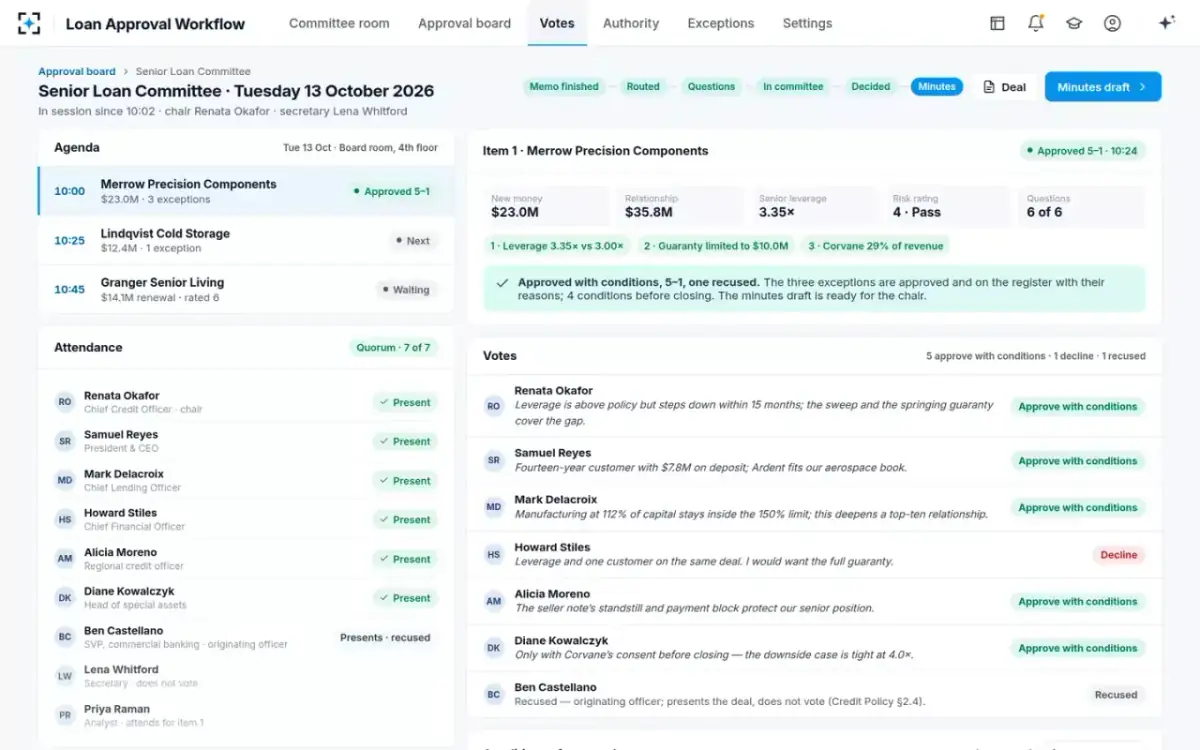
The vote itself is where most minutes go thin. "Approved" is easy to write. "Approved with conditions, five to one, one recused, the dissent based on leverage and customer concentration together" takes attention the secretary does not have while also tracking who is speaking. The solution's committee room lets the secretary enter each vote and its reason as the member gives it; a reason is required for a decline and for approval with conditions. How that played out on one split vote is told in how to record dissent in the minutes, and what an examiner then looks for in the minutes is set out in loan committee meeting minutes.
The secretary's morning, with the record kept as it happens
When the record is kept during the meeting, the secretary's work afterwards becomes checking rather than reconstructing. On the sample morning the committee went into session at 10:02 and decided the Merrow deal at 10:24. The minutes drafter, one of the solution's agents, drafted the item's minutes at 10:25 from the recorded attendance, questions, exceptions, votes, reasons and conditions. Lena checked the draft against the record and sent it to the chair at 10:41. Renata Okafor signed it at 10:53 as a true record.
Loan Approval Workflow on the sample morning: from session to signed minutes in 51 minutes
- In session: presentation, questions, vote22 min
- Draft1 min
- Secretary checks against the record16 min
- Chair reads and signs12 min
Two limits keep this honest. The minutes drafter never records a vote or a reason nobody gave: every line traces to a recorded event, and a section with nothing recorded says it is waiting. And the agent does not approve or sign anything; the secretary checks and the chair signs. Where the agents stop and people decide is set out in AI loan approval: where the agents stop.
Minutes drawn from the record, checked and signed
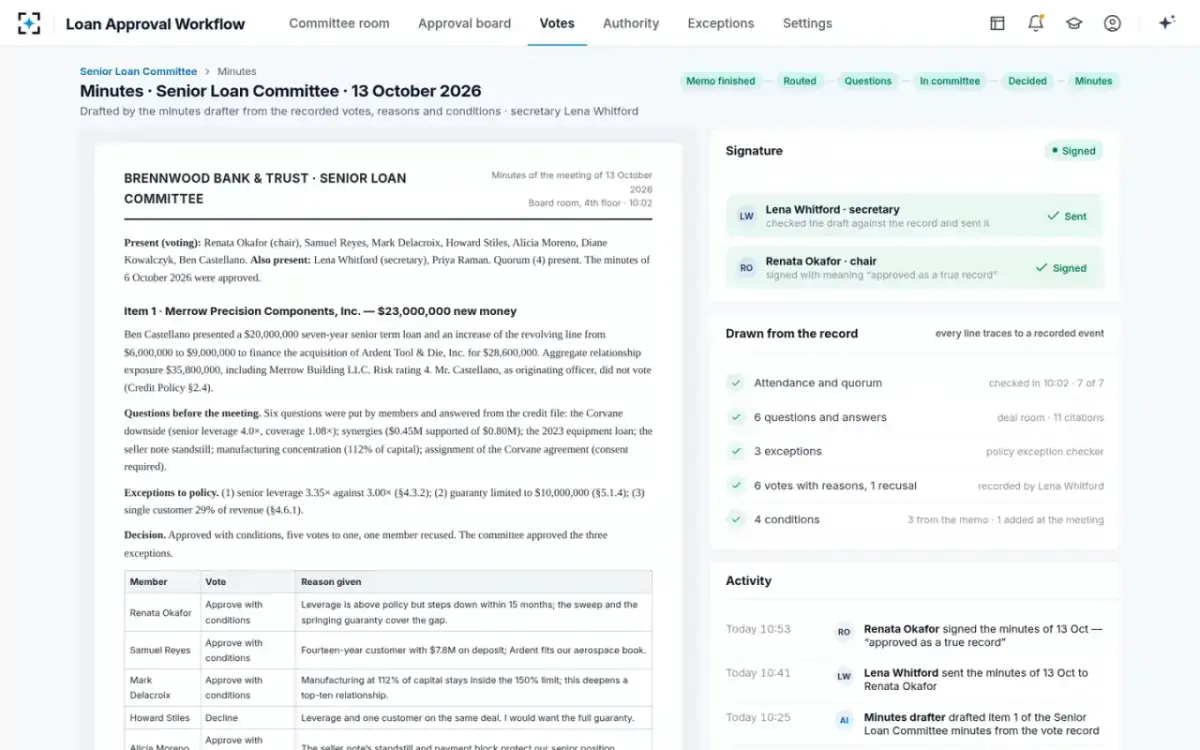
What changes for the secretary is where the effort goes. The agenda fills itself from finished memos, the package is one current version, members' questions are answered from the file before the meeting, and the minutes are a draft to verify the same morning rather than two days of notes and follow-up emails. The work that remains is the work that needs judgement: confirming that what was recorded is what happened, and that the committee acted within its charter.
Questions people ask
Does the loan committee secretary vote?
Usually not. The secretary is often a credit administrator or a member of the corporate secretary's office who records the meeting rather than taking part in it. If a voting member also keeps the minutes, the charter should say so, and the minutes should still show that member's vote like anyone else's.
Who signs loan committee minutes?
Commonly the chair, sometimes with the secretary, after the secretary has checked them. The OCC's guidance for boards says each director should have the chance to review and, where needed, correct the minutes before they are approved, and that minutes should come up for approval at the next meeting (Director's Book).
Does the loan committee report to the board?
Yes. The OCC expects a board to receive regular reports or minutes from its committees, and the Federal Reserve expects the lending policy to say how approved loans are ultimately reported to the board. In practice the board sees a monthly list of loans approved, the exceptions granted and the committee's minutes.
What is the difference between a directors' loan committee and a senior loan committee?
Membership and reach. A directors' loan committee is a committee of the board, usually meeting monthly, that decides the largest relationships and reviews exceptions and reports. A senior or officers' loan committee is made of executives, usually meets weekly, and decides within a limit the board has delegated to it.
Can a loan committee approve a loan with conditions?
Yes, and many approvals carry them: a covenant, a guaranty, a third party's consent before closing. The condition should be written so a closer can test it, and the loan should not fund until it is met; the OCC's examination procedures check whether conditions of closing were satisfied.