A loan committee decides the loans that are too large or too far outside policy for any one officer to approve, and it does more shaping than refusing: it sets conditions, changes structure and accepts or rejects specific exceptions. In a credit package it looks for four things: whether it has the authority to decide, whether the borrower can repay from the cash flow described, what falls outside policy and why the analyst thinks that is acceptable, and the answers to its own questions. It has very little time to find them. Economists who study lending describe the committee as a decision-maker that "has limited time and attention to devote to each decision" and needs information "boiled down to what is important". Botminds' Loan Approval Workflow takes a finished credit memo to a recorded decision; part of that is building the page a member reads before the vote, with every figure tied to the document it came from.
Inside one bank's credit committees: time per file
4.7min
average time a committee spent evaluating an application
15
applications a committee saw on an average day
about 70 minutes of evaluation a day
92%
of approvals changed the amount the borrower requested
What does a credit committee do?
It approves credit above the limits delegated to individuals, and it oversees how the bank's lending is going. The OCC's guide for directors lists a board credit committee's duties: set the lending strategy, risk appetite and limits; approve lending policies and underwriting standards; approve loans "for credits involving large dollar amounts relative to the bank's size and capital levels"; monitor the portfolio, its exceptions and the allowance; and receive loan review's reports (Director's Book). A management committee of senior officers usually does the same work one level down, within a limit the board sets.
A credit committee's duties, and what each asks of the package
| Duty | What the committee decides or reviews | What it needs to see |
|---|---|---|
| Approve credit | Requests, renewals and changes in terms above individual limits | Exposure, repayment, structure, exceptions, the vote |
| Grant exceptions | Departures from policy the analyst justifies | Each exception, its policy section, its mitigant |
| Set conditions | What must happen before closing or funding | The gap the condition closes |
| Watch exceptions | Their volume and pattern across the book | Exceptions by type, officer and age |
| Oversee the portfolio | Past-due, criticised and insider credit, loan review findings | Regular reports, not anecdotes |
The first three duties are about one deal and happen in every meeting. The last two are about the whole book and are easy to neglect when the agenda is full. They are also where a committee learns whether its approvals were right: an exception granted ten times in a year is a policy question, not ten deal questions. How that pattern is tracked is the subject of loan exception tracking.
What do loan committees look for?
Repayment first, then the support behind it, then the exceptions. The interagency safety-and-soundness guidelines require banks to consider, before committing, "the borrower's overall financial condition and resources, the financial responsibility of any guarantor, the nature and value of any underlying collateral, and the borrower's character and willingness to repay as agreed". Small banks especially weigh the numbers: in the FDIC's survey, 74 to 82 percent of small banks called the business's financial position the most important part of an application, whatever the loan size.
The OCC's 2026 examination procedures describe what a good approval package gives the decision-makers, and they double as a member's checklist (OCC, 2026):
What examiners say an approval package should give the committee
- A thorough analysis of repayment
From the borrower’s and the guarantors’ sources, not the borrower’s alone.
- Previous and related transactions
How earlier loans to this relationship were approved and how they performed.
- The key risks, with their mitigants
A comprehensive analysis, not a list of strengths followed by a recommendation.
- Support for the decision
For the approval itself, the risk rating, and the accrual treatment.
- Exceptions identified
Named in the approval documentation, with the mitigants that justify approving anyway.
Most large banks have long added one more element. A Federal Reserve survey of the fifty largest bank holding companies found that most "require some sort of written justification of the grade as part of the loan approval package". A committee that approves a loan approves its risk rating too, and the rating decides how the loan is reserved for and reviewed from then on.
How long does a committee spend on each loan?
Minutes, not hours. One of the few measured answers comes from a randomized trial at a Colombian small-business lender, an illustration rather than a US benchmark: its committees spent an average of 4.7 minutes per application and saw about 15 a day. A US commercial committee spends longer on a $20 million acquisition loan, but its members read the package on their own time the night before, alongside their day jobs, and the meeting itself gives each item a short slot: at the fictional bank used in these guides, a $23 million deal was presented, questioned and voted in 22 minutes.
Committee time is therefore the bank's most expensive and least elastic resource. Liberti and Petersen put the trade-off precisely: "The larger the organization and the higher one goes in the organization, the more the information needs to be concentrated or decision-making authority delegated." A community bank that sends its large loans to executives and directors, as most do, has chosen concentration over delegation, and has to make concentration work. Why small banks feel this most is set out in how long a bank takes to approve a business loan.
How do you present a loan to a credit committee?
Lead with what the committee must decide, in a fixed order, on one page, and leave everything else one click away. Authority comes first, because a committee that discovers halfway through that the relationship is larger than the memo said has wasted its reading. Exceptions come next, because they are what the committee is being asked to accept. Then the questions members have already asked, the gaps the file cannot fill, and who may vote.
The page a member reads first, in Loan Approval Workflow's reading order
Who decides, and why
Aggregate relationship exposure with related interests, the authority it requires, and the share of the legal lending limit.
Settles authority before anyone reads further.
What is outside policy
Each exception with its policy section, its size against the limit, and the mitigant the memo proposes.
The part the committee is actually being asked to accept.
What members already asked
Each question, the answer, and the document and page it comes from.
Nobody reads the same answer in four inboxes.
What the file does not hold
Questions the file cannot answer, and who has been asked.
The gap, said out loud, can become a condition.
Who may vote
Quorum, the originating officer’s recusal, and any insider or conflict.
So the vote that follows can stand.
What is missing from that page is deliberate. The business description, the management section, the industry overview and the five-year history all matter, but a member who wants them knows where they are. What a member cannot easily find is the one sentence in a 40-page subordination agreement that answers his question, or the related company's loan the memo left out. Those are what the first page is for.
Two packages for the same deal
The package as usually sent: The memo’s figure for the borrower, which may leave out a related company.
The five-minute view: The relationship total, facility by facility, with any difference from the memo flagged.
The package as usually sent: Mentioned in the narrative, sometimes in a closing paragraph.
The five-minute view: Listed one by one with policy section, size against the limit, and the proposed mitigant.
The package as usually sent: Asked by email; answers reach whoever asked.
The five-minute view: Pinned to the deal, answered from the file with citations, visible to every member.
The package as usually sent: Discovered in the meeting, or after.
The five-minute view: Stated: “not in the file”, with the person asked to supply it.
The package as usually sent: Re-sent each time a number changes.
The five-minute view: One current page; earlier versions kept with their dates.
What questions does a credit committee ask?
Questions about what the memo implies, rarely about what it says. On the sample deal used across these guides, a fictional bank's Senior Loan Committee considered a $23.0 million loan to Merrow Precision Components to buy a competitor. Six questions came in before the meeting. None asked the analyst to restate the memo. Each asked how one fact would behave under pressure, or what another document said.
Six questions before one meeting, and where each answer came from
| Member | Question | Answered from | Answer, in short |
|---|---|---|---|
| Chief lending officer | Where does this leave our manufacturing concentration? | Concentration report, September 2026 | 112% of capital, up from 107%, against a 150% board limit. |
| Chief financial officer | Can the largest customer’s supply agreement pass to the combined company? | Supply agreement §14.2 | Only with that customer’s written consent, which is not in the file. Suggested as a condition. |
| Regional credit officer | What does the seller note’s standstill say? | Subordination agreement | $3.0M, five years at 6%; no enforcement for 180 days after a senior default; no cash payment while senior leverage is above 3.50×. |
| Chief executive | What did we approve on the 2023 equipment loan? | Decision history, 2023 approval | The 2023 terms and guaranties, as approved, from the decision record. |
| Chief financial officer | What does the downside case look like? | Memo and spreads | Senior leverage about 4.0× and coverage 1.08×. |
| Head of special assets | How much of the synergy case is supported? | Quality-of-earnings report | $0.45M of the $0.80M is supported. |
Two patterns are worth noticing. The questions cluster on the exceptions: concentration, the largest customer, leverage. And the most consequential answer was a gap. The supply agreement could only be assigned with the customer's consent, and the consent was not in the file. That became the fourth condition of approval, and one member said she would vote yes only with it. How that question shaped a split vote is told in how a dissent was recorded in the minutes.
Exceptions and members' questions, answered from the file
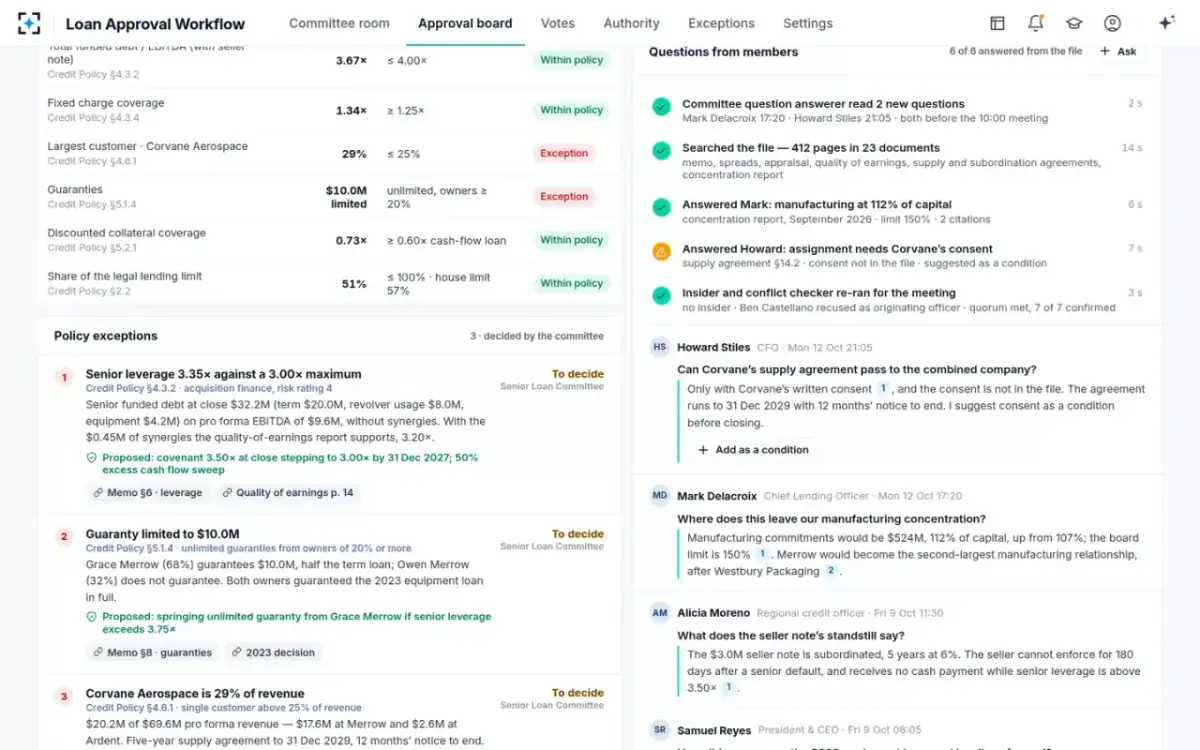
Answer from the file, or say it is not there
An answer a member cannot trace is worse than no answer, because it ends the question without settling it. The committee question answerer in the solution answers only from the credit file: the memo, spreads, appraisal, quality-of-earnings report, agreements and past decisions, citing the document and page behind every figure. When the file does not hold the answer, it says "not in the file" and sends the question to the relationship manager. It can suggest a condition; a person adds it. That rule exists because generative models can produce what the Treasury's 2024 report calls "confidently stated but incorrect output", and in a committee a confident wrong answer about a consent clause is an approval on a false premise.
Can a loan committee change the terms of a loan?
Yes, and reshaping is most of what committees do. In the Colombian trial, committees that reached a decision rejected only 0.3 percent of applications and changed the approved amount on 92 percent. In US commercial lending the levers are usually covenants, guaranties, amortization and conditions precedent rather than the amount alone. A first page that pairs each exception with the mitigant proposed for it, a covenant that steps down, a springing guaranty, a consent before closing, lets members argue about the right thing.
It also changes where the meeting's minutes go. When the authority, exceptions and routine questions are settled on paper, the meeting time goes to the one or two questions that divide the room. That is where the record of reasons matters most, and where an examiner reading the file will judge whether the committee had enough analysis in front of it to make an informed decision.
A question in plain words, answered on the deal
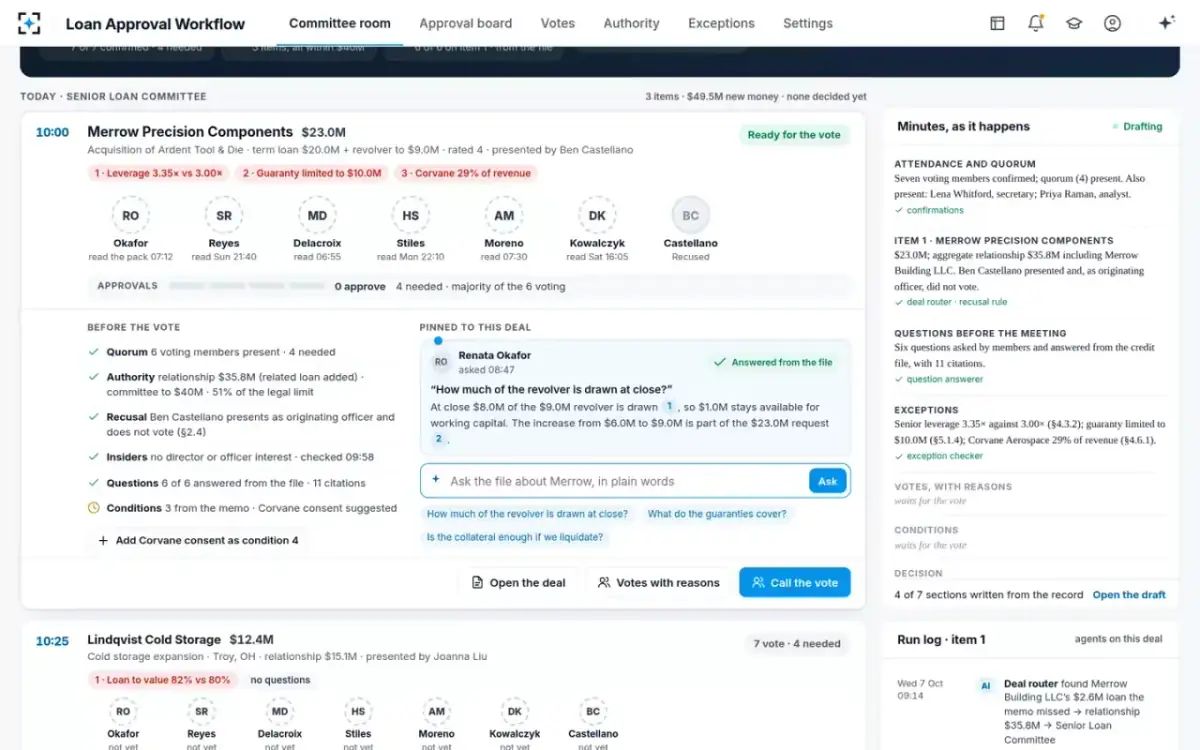
How Loan Approval Workflow builds the five-minute view
The committee room is the first page, built for the chair and members on the morning of the meeting. For each item it shows quorum and authority already checked, the exceptions as labels, each member's seat with when they read the papers, the questions pinned to the deal with their answers, and the conditions on the table. The deal router has added up the relationship; the policy exception checker has listed each exception with its section; the insider and conflict checker has re-run against the bank's insider list.
The committee room on the morning of the meeting
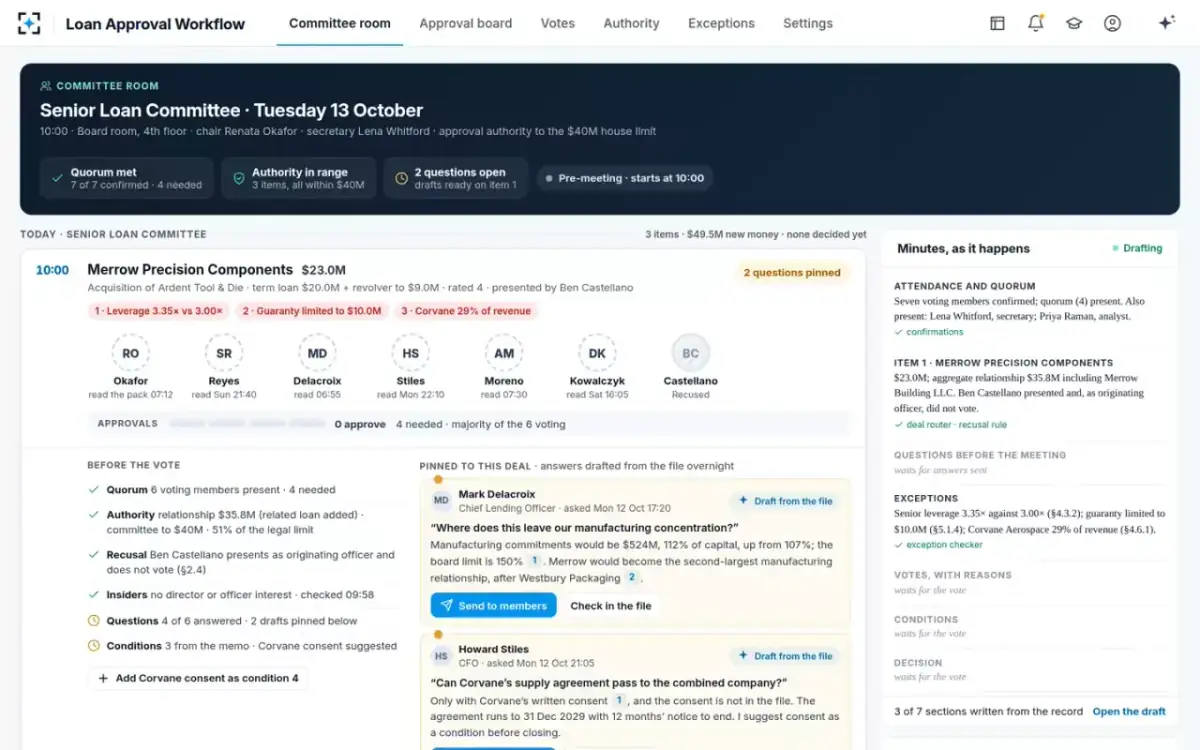
None of this decides anything. Members still read, ask, argue and vote, and the chair still rules who may vote. What changes is that their five minutes go to judgement instead of search. Where exactly the agents stop is the subject of AI loan approval: where the agents stop.
Questions people ask
What goes in a credit committee memo?
The borrower and its history, the request and its purpose, the sources of repayment with the financial analysis behind them, guarantors and collateral, risks and mitigants, exceptions, and a recommended rating and structure. The SBA's rules for 7(a) lenders are the one federal text that spells it out, requiring the memo to address repayment "from the cash flow of the business and past performance", based on three years of history plus an interim statement for an existing business (SOP 50 10 8.1).
How long should a credit committee presentation be?
As long as the deal needs, but the first page should stand alone. If a member reads only that page, they should know the authority, the exceptions and mitigants, the answers to open questions and anything the file does not hold.
Can a loan committee defer a decision?
Yes, and committees do: in the Colombian trial they reached a decision on 89 percent of applications, and sent the rest back for more information or to a manager. A deferral should say what is missing, so the deal returns with that answer rather than in the same form.
Should questions be answered before the meeting?
Factual ones, yes, and to every member at once, with sources. Meeting time is better spent on questions of judgement than on looking up a covenant definition, and an answer everyone saw is one nobody asks again in the room.
Does the committee approve the risk rating too?
In effect, yes. The rating proposed in the package is approved with the loan, and it sets the reserve, the review schedule and, at many banks, the approval route for the next renewal. That is why examiners look for written support for the rating in the approval package.