A loan approval matrix, also called a credit approval matrix or lending authority matrix, is the board-approved table that says who may approve which loans: each officer's personal limit, the limits of joint and committee authorities, what counts toward those limits, which features move a deal to a higher authority, and how insider loans and policy exceptions are handled. The OCC describes lending authorities as setting out "who is authorized to approve loans, make changes in terms, and grant exceptions to policy", with limits set "as a dollar threshold or as a percentage of capital". It does not prescribe a design. That leaves the chief credit officer six decisions to make, in order, and take to the board. Botminds' Loan Approval Workflow applies the finished matrix to every credit memo: it adds up the relationship, finds the authority, starts that authority's clock and records the version of the matrix it applied.
Six decisions before the board approves a matrix
- 1. Who holds authority
Individuals, joint or laddered signatures, committees, or a mix, and whether credit approval is independent of the line.
- 2. The limits, and what counts toward them
Dollar or capital-based limits per person and committee, a house limit under the legal one, and the aggregation rule.
- 3. What moves a deal up
Policy exceptions, risk rating, loan type and any other trigger, and how far each one moves it.
- 4. How insiders are handled
Regulation O routing to the board, the insider list, and abstentions recorded.
- 5. Who may approve which exceptions
Within one’s own limit, one level up, or committee only, and how exceptions reach the board.
- 6. How decisions are made and recorded
Quorum, meeting cadence, clocks, reasons with votes, and the minutes the board receives.
What is a credit approval matrix?
It is the written form of the board's delegation of credit authority, so the board approves it and examiners test every approval against it. The Federal Reserve's manual says the lending policy "should establish limits for all lending officers and ensure controls are in place to monitor compliance with the bank's legal lending limit", and should say how loans are approved and reported to the board. The OCC's examiners, for their part, check each approval against the limits in force when it was made. A matrix that is ambiguous, out of date or applied inconsistently fails that test on every loan it touches.
The OCC does not recommend one approach over another.
OCC, Lending and Loan Portfolio Risk Management, 2026
Decision one: should loans be approved by individuals or a committee?
Each structure trades speed and accountability against shared judgement, and the OCC sets out the trade without choosing. Individual authority "is typically faster and establishes clear accountability but can create undue credit risk if a lender's ethics, knowledge, or experience are inadequate for his or her authority". Committees "allow for shared knowledge and reinforce the credit culture but can diminish accountability and can slow a bank's responsiveness". An independent approver such as a senior credit officer, whose primary goal is credit quality, "can introduce more objectivity". Laddered or joint authorities sit between them.
Three ways to hold approval authority
Individual authority: Faster: one person, one clock.
Committee authority: Slower: waits for a meeting and a quorum.
Individual authority: Clear: one name on the approval.
Committee authority: Can be diluted: many names, one outcome.
Individual authority: Only as good as the officer’s experience and ethics.
Committee authority: Shared knowledge; reinforces the credit culture.
Individual authority: Too much authority in one person.
Committee authority: Nobody owns the decision; deals queue for the meeting.
Individual authority: Escalating individual limits by size, exceptions, history and rating: a middle path the OCC describes.
Committee authority: Two signatures or a credit officer’s co-approval can add objectivity without a meeting.
The failure on the individual side is concentration. The FDIC's Inspector General traced First NBC Bank's failure in part to a chief executive whose personal lending authority had grown to a level it called excessive by 2009; the board cut it to $5 million in 2011 and raised it to $7.5 million in 2013 despite supervisory concerns (material loss review). Whatever the structure, the matrix should name who can change an individual's limit, and the minutes should show when they did.
Decision two: how are individual lending limits set?
Limits are only as good as the number they are measured against, so the aggregation rule matters as much as the dollar figures. The Federal Reserve says an officer's limit "is usually based on his or her experience, tenure, and past adherence to the bank's loan policy", and that group limits allow "a combination of officers or a committee to approve larger loans than the members would be permitted to approve individually". Above everything sits the legal lending limit, for a national bank 15 percent of capital and surplus to one borrower plus 10 percent if fully secured by readily marketable collateral.
Three choices follow. First, whether limits are fixed dollar amounts or a share of capital, which rise and fall with the bank. Second, the house limit: the largest relationship the bank's own committees may approve before the board decides, set below the legal limit. Third, what counts. The Federal Reserve notes that committee thresholds are set on "the amount of either the loan or the aggregate debt to the borrower"; measuring aggregate relationship exposure, with related entities, guarantors and unfunded commitments, stops a relationship growing past a limit in small steps. Write the aggregation rule down in words a system can apply, such as "all entities with any common owner of 20 percent or more", rather than "related parties".
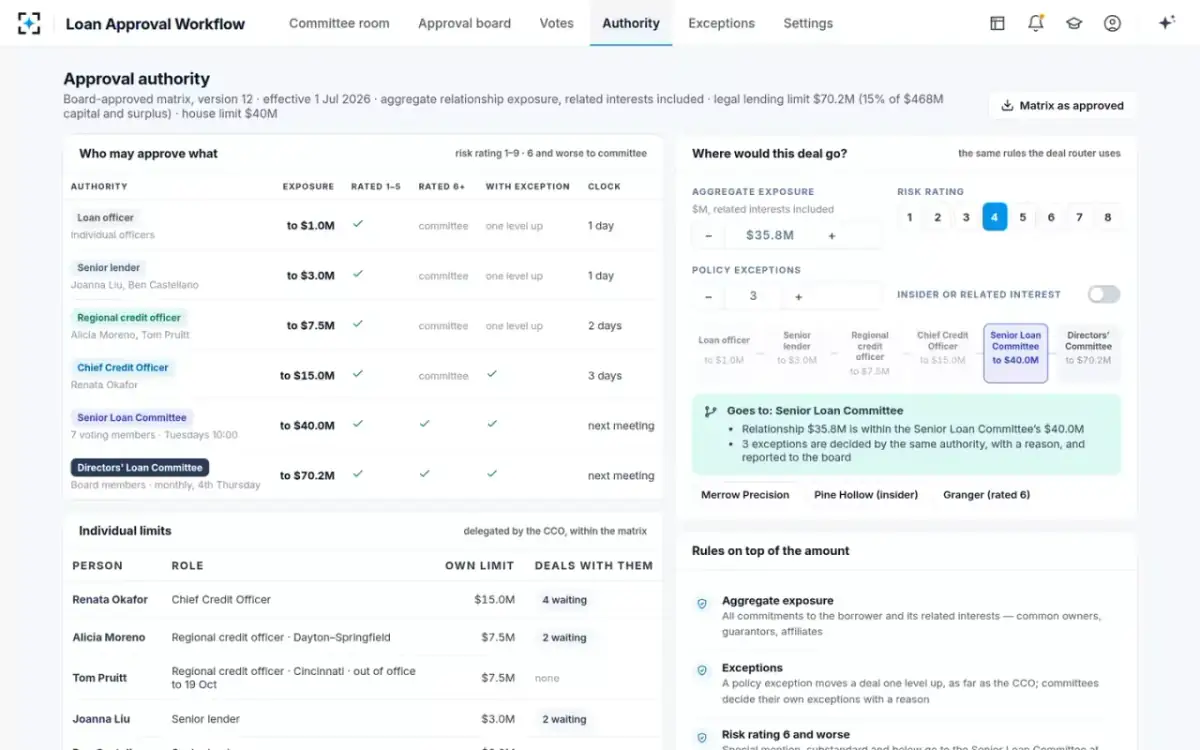
Take a fictional bank's matrix as it runs in the solution. Brennwood Bank & Trust's matrix, version 12, effective 1 July 2026, gives a loan officer $1.0 million, a senior lender $3.0 million, a regional credit officer $7.5 million, the chief credit officer $15.0 million and the Senior Loan Committee $40.0 million, its house limit. The Directors' Loan Committee decides above that, up to the $70.2 million legal limit, which is 15 percent of $468 million in capital and surplus.
The board-approved matrix in Loan Approval Workflow, with individual limits and a calculator
What goes in a loan approval matrix template?
One row per authority and one column per rule that can change the answer: the limit and what it is measured on, what happens to a weak rating, an exception or an insider, the clock, and who may change the row. A matrix written that way can be applied by anyone, or by software, with the same result every time; a matrix that says "larger or riskier credits go to committee" cannot.
Columns of a loan approval matrix, defined, with one sample row
| Column | What it must say | Sample row: regional credit officer |
|---|---|---|
| Authority | A named role or committee, never a person’s name alone | Regional credit officer |
| Limit | Dollars or a share of capital, and whether joint signatures raise it | $7.5M |
| Measured on | Aggregate relationship, with the aggregation rule in words | All facilities to the borrower, guarantors and entities with common owners |
| Weak ratings | The rating at which the row no longer applies | Rated 6 or worse: Senior Loan Committee |
| With a policy exception | Approve within limit, move up, or committee only | One level up, to the chief credit officer |
| Insiders | Where Regulation O credit goes regardless of size | Directors’ Loan Committee; full board where required |
| Clock | How long the authority has, and what happens after | 2 business days, then remind and escalate |
| Who may change it | The board, or the CCO within limits the board set | CCO, within the board’s matrix; reported to the board |
Two columns are the ones most often missing from real matrices. "Measured on" is left to habit, so two officers add up the same relationship differently. "Who may change it" is left unstated, so a limit raised for one deal stays raised. Both are the kind of gap an examiner finds when comparing a sample of approvals with the matrix the board approved.
Decision three: what moves a deal up
Size alone is rarely enough, so the matrix should list every feature that sends a deal higher and how far. The OCC describes laddered arrangements in which approval levels escalate "based on the size of the loan, exceptions to policy, borrower history, risk rating, and other factors". Banks agree in practice: asked what adds a level of approval, 80 percent of banks named loan size or total exposure and 67 percent named insufficient debt service coverage.
The choices to make are which triggers apply (exceptions, a criticised rating, loan types such as construction or leveraged loans, new industries) and how far each moves the deal: one level, straight to committee, or to the board. Brennwood's matrix moves a deal with a policy exception one level up, as far as the chief credit officer, and sends anything rated 6 or worse to the Senior Loan Committee at any size. Two triggers is a short list; a long one is harder to apply the same way every time.
Decision four: how insiders are handled
Insider loans follow Regulation O, which overrides the size ladder. Credit to an executive officer, director or principal shareholder, or a company they control, that exceeds the higher of $25,000 or 5 percent of capital, and in every case above $500,000, needs prior approval by a majority of the whole board, counted against every seat, with the interested party abstaining (12 CFR 215.4). Banks must identify their insiders "through an annual survey" and keep records of every extension of credit to them.
The matrix should say where those loans go (at Brennwood, to the Directors' Loan Committee for decision and the full board where Regulation O requires), how the insider list is kept current between annual surveys, and how abstentions are recorded. The OCC's insider guidance is plain: "Directors must abstain from voting and deliberating on any matter involving their own interests. Abstentions should be documented in the board minutes." Add the committee-level rule as well: whether an originating officer who sits on the committee may vote on their own deal. Brennwood's credit policy says no.
Decision five: who can approve an exception to loan policy?
Exception authority is a separate grant from loan authority, and the matrix should make it explicit. The OCC's definition of lending authorities includes who may "grant exceptions to policy", and the Federal Reserve wants the reason for each exception "submitted for approval to a designated authority" and reviewed by the directors' loan committee "at reasonable intervals". The common designs are to let each authority approve exceptions within its own limit, to move an excepted deal one level up, or to reserve certain exceptions, such as supervisory loan-to-value exceptions counted against capital under the interagency real estate guidelines, for a committee.
Whatever the choice, every approved exception should land on a register the board sees, with the decision that approved it. That is covered in loan exception tracking.
Decision six: how decisions are made and recorded
The last decision turns the matrix from a table into a process: how committees meet and vote, how long each authority has, and what the record must hold. The Federal Reserve expects the policy to state the frequency of loan committee meetings. The OCC's guidance to directors expects minutes that record attendance and each member's vote or abstention, and that the board "should receive regular reports or minutes from the various committee meetings".
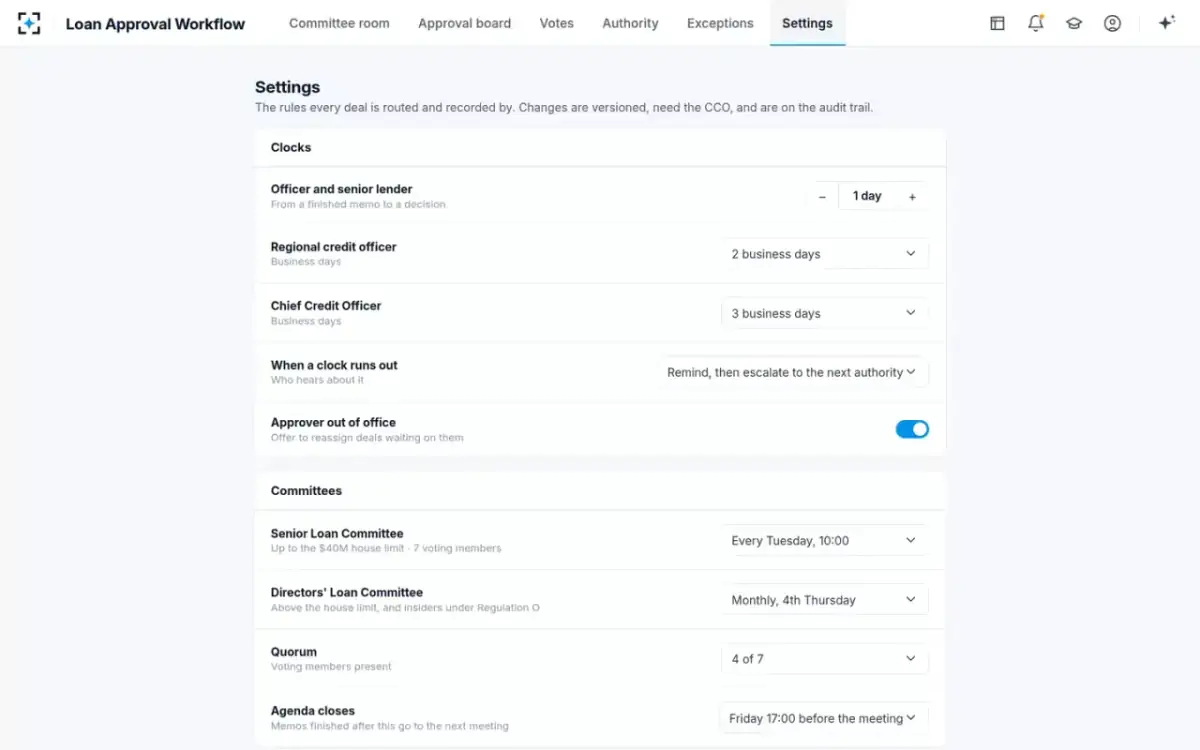
The sixth decision, written as settings
| Setting | Brennwood’s choice | Other options offered |
|---|---|---|
| Clock for an officer or senior lender | 1 day | Any number of days |
| Clock for a regional credit officer | 2 business days | 1 or 3 business days |
| Clock for the chief credit officer | 3 business days | 2 or 5 business days |
| When a clock runs out | Remind, then escalate to the next authority | Remind only; escalate straight away |
| Senior Loan Committee meets | Every Tuesday, 10:00 | Tuesday and Thursday; every other Tuesday |
| Quorum | 4 of 7 | 5 of 7; a majority of members |
| Agenda closes | Friday 17:00 before the meeting | Monday 12:00 before the meeting |
| A reason with every vote | Required for declines and conditions | Required for every vote |
Clocks deserve particular thought because they are where small banks lose most time. A deal sitting with an approver who is away is invisible in most processes, and senior approvers are the ones most often away. Set a clock for each authority, decide what happens when it runs out, and name who holds the same authority as a fallback. Why this matters more at small banks, where executives and directors carry the largest approvals, is set out in how long a bank takes to approve a business loan.
The rules every deal is routed and recorded by
Putting the matrix to work
A matrix earns its keep only if it is applied the same way to every deal, and that is where manual processes slip. Someone adds up the relationship from memory, forgets an affiliate, or applies last year's limits. In the solution, the deal router reads each finished memo, sums the relationship with its related interests line by line, applies the current matrix, books the agenda and starts the right clock. It never routes a deal below the matrix, and when its sum differs from the memo's it says so on the deal. Each route records the matrix version it used, so an approval can be judged later against the limits in force that day.
Bring the matrix to the board with the record of how it has been applied: how many deals went to each authority, how many exceptions each approved, which clocks ran out and why. That turns the annual approval into a review. How the routing questions play out on a single deal is walked through in who approves loans at a bank.
Questions people ask
What is the difference between a house limit and the legal lending limit?
The legal lending limit is the statutory maximum a bank may lend to one borrower. A house limit is the bank's own, lower ceiling, often the largest relationship its committees may approve before the board must decide. Both should appear in the matrix.
Should limits be set in dollars or as a share of capital?
Either works; the OCC notes that approval limits can be set as a dollar threshold or as a percentage of capital. Dollar limits are easier to read and apply; capital-based limits grow and shrink with the bank, which keeps them in proportion after a capital raise or a loss without a new board vote.
Can the chief credit officer change an officer's lending limit?
If the board-approved matrix delegates that power, yes, within the matrix. At the sample bank, individual limits are delegated by the CCO within the matrix the board approved. Changes should be recorded and reported, because examiners ask for each officer's current authority.
Should relationship managers have approval authority?
Many banks give them small limits and send larger loans to an independent credit officer. The reason is incentive: a Federal Reserve study of large banks found that "all institutions evaluate the performance of RMs—and thus set their compensation—on the basis of the profitability of the relationships in question", which is why the OCC describes an approver whose primary goal is credit quality as adding objectivity.
How often should the approval matrix be reviewed?
With the lending policy, which boards commonly approve annually; the OCC reminds directors that real estate lending policies must be reviewed and approved by the board at least annually (Director's Book). Review it sooner after a merger, a change in capital or a new lending line.