Loan exception tracking means recording every loan approved, or later found, outside the bank's credit policy, with the policy section it breaks, the mitigant that justified it, the authority that approved it and how long it has been open, then reporting the totals to senior management and the board. Supervisors expect it: the Federal Reserve's manual says the reason for each exception "should be detailed in writing and submitted for approval to a designated authority", and the OCC's 2026 handbook calls "identifying, approving, and tracking exceptions" part of sound risk management. Botminds' Loan Approval Workflow lists each exception on a deal with its section before the vote and enters it on the register, with the decision that approved it, as soon as the vote closes.
The exception types examiners distinguish
| Type | When it arises | Commercial examples |
|---|---|---|
| Underwriting | When the loan is underwritten and approved outside policy. | DSCR, LTV, supervisory LTV, fixed charge coverage, term or amortization outside policy; no guarantor or covenants where policy requires them. |
| Financial | During the life of the loan. | Covenant breaches, even if waived; DSCR below policy or LTV above policy at annual review. |
| Credit administration | At any time. | Stale financial statements, tax returns or borrowing base certificates; missing lien recordation; lapsed insurance. |
| Unidentified | Found later by credit review, audit or examiners. | Any of the above that staff missed at the point it arose. |
What is the difference between a policy exception and a documentation exception?
A policy exception is a decision to lend outside the credit policy; a documentation exception is something missing from the file after the decision. Examiners sort exceptions by when they arise, because each kind says something different about the bank. Underwriting exceptions are decisions: the bank chose to lend outside policy. Financial exceptions are news about the borrower: a covenant breached, coverage below policy at review. Credit administration exceptions are housekeeping that can hide bad news, a missing tax return being the classic case. The OCC notes that "some lending policies include heightened reporting requirements to senior management and the board for financial exceptions", because they bear directly on repayment.
The fourth kind is the one that damages a bank's standing with examiners. An unidentified exception is one nobody named when it arose. The OCC says isolated cases are not necessarily a concern, but "a large volume of unidentified exceptions, however, could be indicative of less than satisfactory exception processes", and names the usual causes: "errors, miscalculations, breakdowns in the pre- or post-closing review process, or system failures."
How do banks track loan policy exceptions?
In five steps: name the exception in the approval, approve it with a reason, enter it on one register, age it until it is cured, and report the totals against limits the board has set. The OCC's 2026 booklet gives examiners the test for the whole chain: they "should determine whether the bank tracks and analyzes exceptions in a thorough and timely manner and whether corrective action follows when necessary". Most banks keep the register in credit administration, separate from the lenders whose deals fill it.
The five steps of exception tracking, and where each one breaks
| Step | Who does it | What it produces | How it usually fails |
|---|---|---|---|
| Identify | Analyst, before the deal goes to an approver | Each exception named with its policy section and size | Missed under deadline: becomes an unidentified exception |
| Approve | An authority allowed to grant that exception | A decision with its reason and mitigant | Approved by someone whose limit does not cover exceptions |
| Record | Credit administration | One line per exception, linked to the approval | Kept in a spreadsheet nobody reconciles to the approvals |
| Age and cure | Credit administration and the relationship manager | Status: open, cured or overdue | Mitigants never tested; old lines never closed |
| Report | Chief credit officer to the board or its committee | Totals by type, approver and age, against limits | A count with no cuts, so no pattern is visible |
The register is only as good as the first step. An exception that never reaches the approval cannot be approved, only discovered later, and the approval workflow is where most underwriting exceptions are born. The interagency credit risk review guidance tells loan review to sample "credits approved as exceptions to policy"; a loan review that finds an exception the approval never mentioned has found two problems, not one.
What each line of the register needs
A useful register line answers the examiner's question without anyone opening the credit file: what was broken, by how much, why it was accepted, and who decided. Take a fictional bank's register, Brennwood Bank & Trust's, as it runs through the solution. On Tuesday 13 October its Senior Loan Committee approved a $23.0 million acquisition loan to Merrow Precision Components with three exceptions. Here is the first of them as a register line.
One line of the exception register in Loan Approval Workflow, field by field
- Borrower and loan
- Merrow Precision Components · $20.0M senior term loanWhich credit, and how much rides on it.
- Type
- Underwriting · leverageLets the register be counted by kind.
- Exception
- Senior funded debt 3.35× EBITDA against a 3.00× maximumThe size of the breach, not just its existence.
- Policy section
- Credit Policy §4.3.2So a reader can check the limit that was broken.
- Mitigant
- Covenant 3.50× at close stepping to 3.00× by 31 Dec 2027; 50% excess cash flow sweepWhy it was acceptable, in terms that can be tested later.
- Approved by
- Senior Loan Committee, 5–1, Tuesday 13 October 2026The authority and the vote, linked to the minutes.
- Age and status
- Open · aged from approvalWhat the board sees grow or clear.
The two other Merrow lines read the same way: a personal guaranty limited to $10.0 million where policy asks for unlimited guaranties from owners of 20 percent or more (§5.1.4), mitigated by a springing unlimited guaranty if senior leverage passes 3.75 times; and one customer at 29 percent of revenue against a 25 percent limit (§4.6.1), mitigated by a supply agreement running to 2029 and a condition that the customer consent to its assignment before closing.
What every line of an exception register should carry
- The loan and the borrower
Including the relationship it belongs to, so exceptions can be counted per relationship.
- The type
Underwriting, financial or administrative, and the measure (leverage, coverage, guaranty, LTV, concentration, documentation).
- The size of the breach
The actual figure against the policy limit, not a yes or no.
- The policy section
So the limit can be checked and the line counted against the right standard.
- The mitigant
In terms that can be tested later: a covenant level, a date, a guaranty trigger.
- Who approved it, and when
An authority with the power to approve that exception, linked to the minutes or approval.
- Age and status
Open, cured or overdue, aged from approval, with the oldest reported separately.
- Supervisory LTV flag
For real estate loans above the supervisory LTV limits, which are tracked against capital.
What are loan policy exception tracking best practices?
Track the pattern, not only the lines: set exception limits, cut the register by type and approver, and read a rising count as a question about the policy as much as about the lenders.
Exceptions are part of sound lending, and supervisors say so. The OCC writes that banks "sometimes approve loans outside of policy standards to service creditworthy borrowers" and that properly justified exceptions "often present acceptable credit risk".
Examiners should not criticize a loan solely because it has an exception.
OCC, Lending and Loan Portfolio Risk Management, 2026
What examiners do criticise is the aggregate. The same booklet says "a loan portfolio with a high level of underwriting exceptions, however, is generally an indication that the bank's practices deviate from the bank's risk appetite", and that "when aggregated, even well mitigated exceptions" can add up to more risk than the board intended. It also warns in the other direction: "the absence of policy exceptions could indicate the policy is overly broad". The Federal Reserve puts both readings in one sentence: the frequency of exceptions "may indicate a lessening of underwriting standards on the one hand, or a need to adjust the policy to allow flexibility within safe and sound parameters on the other".
That is why the register is a management tool, not a filing obligation. The OCC notes that exception limits "are commonly established as a percentage of the loan portfolio and capital", set in aggregate, by portfolio and by type. A register that can be cut those ways tells the board whether the policy and the practice still match. The policy's own drafting matters too: the OCC warns that if policies are "too prescriptive and granular, exceptions to policies could become the norm", which buries the exceptions that matter among the ones that do not. Exceptions also cost time: in the FDIC's survey, 70 percent of banks said an exception to credit policy lengthens the review of an application.
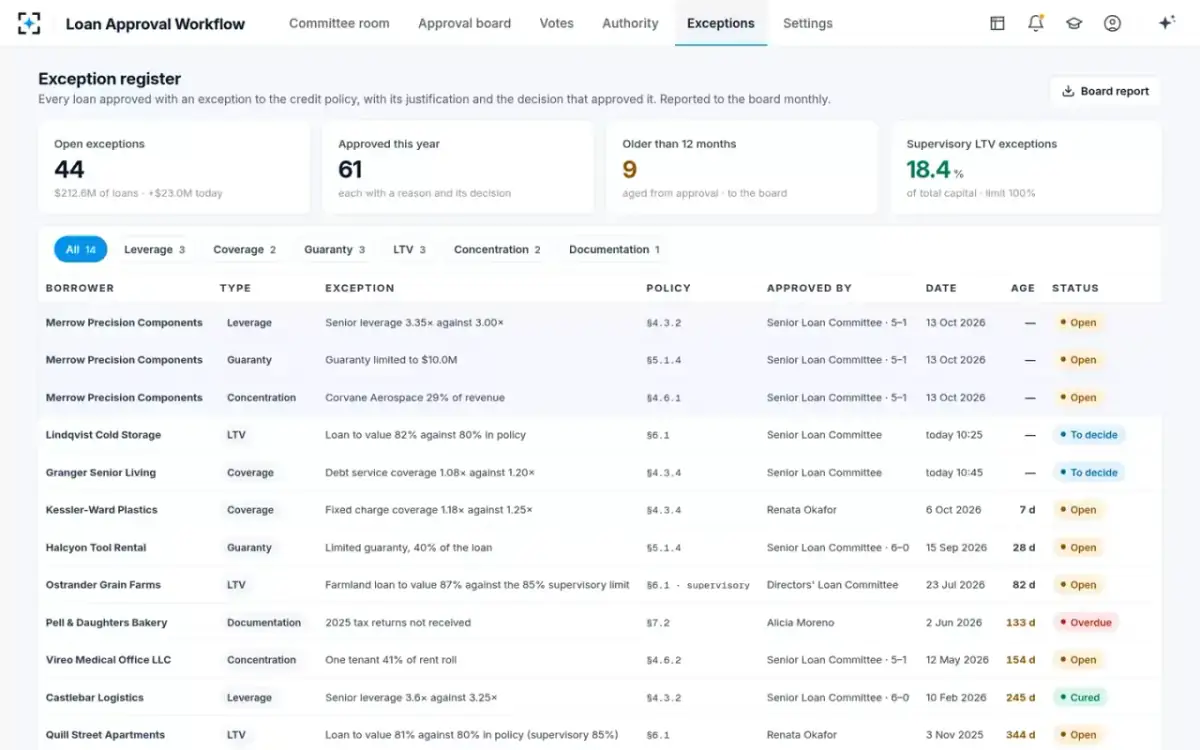
One fictional bank's register on the morning of a committee meeting
44
open exceptions, on $212.6 million of loans
$23.0 million added that morning
61
approved so far this year, each with its reason and decision
9
older than 12 months, reported to the board by age
18.4%
of total capital in supervisory LTV exceptions, against a 100% limit
What are supervisory LTV exceptions?
Real estate loans made above the loan-to-value limits set in the interagency real estate lending guidelines, and they are the one class of exception with a ceiling set against capital. Under the interagency real estate lending guidelines, loans above the supervisory loan-to-value limits "should be identified in the institution's records, and their aggregate amount reported at least quarterly to the institution's board of directors". Their total should not exceed 100 percent of total capital, and within that, loans on commercial, agricultural, multifamily and other non-1-to-4 family property should not exceed 30 percent. An institution approaching those levels comes under increased scrutiny.
That makes the supervisory LTV flag one of the most important fields on the register. A bank's own policy limit and the supervisory limit can differ: on Brennwood's register, Quill Street Apartments is at 81 percent against an 80 percent policy limit, an exception to policy but still inside the 85 percent supervisory limit, while Ostrander Grain Farms' farmland loan at 87 percent breaks the supervisory limit and counts against capital. The register needs both numbers to report correctly.
The exception register: every approved exception, its section and its approver
Unidentified exceptions point at the process
An exception missed at approval is usually a symptom of how the approval was assembled. The causes the OCC lists, errors, miscalculations, breakdowns in review and system failures, are what happens when a busy analyst compares a structure against a long policy by hand under deadline. A covenant level not checked against the policy, a guaranty requirement forgotten, a concentration test run on the wrong revenue figure.
The fix is to test the structure against the policy every time, section by section, before the deal reaches an approver. In the solution, the policy exception checker does that on every finished memo: it tests each ratio and term against the credit policy and lists every exception with its section, its size and the mitigant the memo proposes. It never waives or softens an exception; it can only list it. The approver or committee then decides each one, with a reason, and Brennwood's policy moves an excepted deal one level up as far as the chief credit officer, while committees decide their own. How that routing works is set out in who approves loans at a bank.
What should a loan exception report include?
Totals against the board's limits, new exceptions with their mitigants, the oldest open ones, cures, and supervisory LTV exceptions against capital. The board, or its directors' loan committee, should see the register often enough to act on it. The Federal Reserve's manual says the directors' loan committee or a similar body "should review and approve all exceptions at reasonable intervals"; supervisory LTV exceptions must be reported at least quarterly. Brennwood reports monthly. What makes the report useful is less its frequency than its cuts.
A board report that helps directors provide challenge shows totals against the limits the board set, by type and by approver; new exceptions since the last report with their mitigants; the oldest open exceptions and whether their mitigants are working; cures; and supervisory LTV exceptions against capital. Every line should lead back to the decision that approved it. When an examiner asks why a loan was approved with three exceptions, the answer should be one click from the register to the minutes, as described in what examiners check in loan committee minutes. Who may approve which exceptions is itself a board decision, covered in the loan approval matrix.
What should loan exception tracking software do?
Capture each exception where it is decided, not after, and make the board's cuts a query rather than a project. Many banks still keep the register in a spreadsheet fed from approval memos, and many document-tracking systems were built to chase missing statements and insurance certificates rather than to record why a committee accepted a leverage exception. Both can work. The test is whether the register can answer an examiner's questions without anyone rebuilding it.
Two ways banks keep the exception register
Spreadsheet or document tracker: After closing, when someone copies it from the memo or a checklist.
Register written at approval: When the approver or committee decides the exception, with the vote.
Spreadsheet or document tracker: A reference typed by hand, if any.
Register written at approval: The approval and the minutes that accepted it, one click away.
Spreadsheet or document tracker: Found by loan review or examiners.
Register written at approval: Fewer, because every structure is tested against the policy before approval.
Spreadsheet or document tracker: Built each month by hand: by type, approver, age.
Register written at approval: A filter on the same register, with supervisory LTV totals against capital.
Spreadsheet or document tracker: Chasing documents after closing.
Register written at approval: Showing why each exception was accepted, and by whom.
What to ask of loan exception tracking software
- Does it test the structure against your policy before approval?
Section by section, so exceptions are named before anyone votes.
- Does each line carry the size of the breach and the policy section?
Not a yes or no, and not a free-text note.
- Is every line linked to the decision that approved it?
The approver, the vote, the reason, the minutes.
- Can it flag supervisory LTV exceptions and total them against capital?
Separately for non-1-to-4 family property, against the 30 percent sub-limit.
- Can the board report be cut by type, approver, officer and age?
Without a separate spreadsheet built each month.
- Does it keep cured lines?
So a cure can be shown, and a pattern of exceptions that always cure can be seen.
Where Botminds' solution fits: it is an approval workflow first, so its register is strongest on underwriting exceptions, which it names before the vote and enters with the decision that approved them. It also holds administrative exceptions, such as a borrower's missing tax returns, and ages them until cleared. A bank whose main pain is collecting documents from borrowers after closing needs a document tracking tool for that job, and can run the two side by side.
Questions people ask
What is a policy exception in lending?
A loan, or a feature of a loan, that does not meet the bank's written credit policy: leverage above the limit, a guaranty weaker than required, a missing financial statement. It is permitted when an authorised approver accepts it in writing with a reason. A breach of a law, such as the legal lending limit, is not an exception; it is a violation.
Is a waived covenant breach still an exception?
Yes. The OCC lists covenant breaches "even if waived" among financial exceptions. Waiving the breach is a credit decision about the borrower; it does not remove the exception from the bank's reporting.
How often should loan exceptions be reported to the board?
Supervisory LTV exceptions at least quarterly, under the interagency guidelines. For the rest, the Federal Reserve asks for review at reasonable intervals; a monthly report, as at the sample bank, lets the board see trends before an examiner does.
Should exceptions be tracked by loan officer?
Many banks do, and the OCC notes that some track them by officer, broker or dealer. A count by approver and by originating officer shows whether one lender's deals carry most of the exceptions, which is a question about that lender's judgement or about a policy that does not fit their market.
Is an exception tracked again when the loan renews?
Yes. A renewal is a new approval, so an exception that is still there, such as leverage above the policy limit, has to be named and approved again rather than carried over silently. Between renewals, the OCC counts debt service coverage below policy or loan-to-value above policy at the annual review as financial exceptions, so the register picks them up even when nothing is being approved.