To record dissent in minutes, write the member's name, the vote and the reason in the member's own words, next to the questions that shaped it and any condition it produced, and state the count so nobody can read the decision as unanimous. That is what makes a split vote useful rather than awkward: it shows the committee saw the risk, argued it, and decided anyway, with terms. The OCC's guidance for directors asks for minutes that record each member's vote or abstention and show that members challenged a proposal where it needed challenging (Director's Book). This page follows one split vote through Botminds' Loan Approval Workflow, which records each vote with its reason as it is cast and drafts the minutes from that record. The bank, borrower and people are fictional sample data.
Brennwood Bank & Trust's Senior Loan Committee met at 10:00 on Tuesday 13 October 2026. Item 1 was a $23.0 million request from Merrow Precision Components to finance its purchase of Ardent Tool & Die: a $20.0 million seven-year term loan and an increase in its revolving line from $6.0 million to $9.0 million. The relationship, with a related company's loan included, was $35.8 million. The vote was five to one, with one member recused.
Seven seats on item 1, and how they were filled
Senior Loan Committee, Tuesday 13 October
- Approve with conditions (5 members) · 71%
- Decline (1) · 14%
- Recused: originating officer (1) · 14%
How to record a no vote in meeting minutes
Name the member, record the vote as a decline, give the reason as the member stated it, and make the count add up. A no vote recorded that way takes one line and answers every later question about it. Supervisors ask committees to show that members challenged the deals in front of them, and a dissent with its reason is the clearest evidence of that challenge a committee will ever produce.
Five lines that make a recorded dissent complete
| Line | What to write | From the sample minutes |
|---|---|---|
| Who | The member’s name and role | Howard Stiles, chief financial officer |
| Vote | Decline, distinct from abstain and recused | Declines |
| Reason | In the member’s words, taken as spoken | “Leverage and one customer on the same deal. I would want the full guaranty.” |
| Link to the debate | The question, exception or mitigant the reason concerns | Guaranty limited to $10.0M against policy §5.1.4; springing guaranty proposed |
| Count | Approvals, declines, abstentions and recusals against the number needed | Approved with conditions 5–1, one recused; four approvals needed of six voting |
Three habits spoil this. Writing "one member expressed concern" hides who and what. Writing the reason after the meeting from memory turns the member's words into the secretary's. And recording only the outcome leaves the count to be inferred, which is how a split vote becomes "approved" and then, in a summary to the board, "approved unanimously". The rest of this page follows one dissent from the question that prompted it to the signed minutes.
What is the difference between a dissent and an abstention?
A dissent is a vote against; an abstention is a decision not to vote; a recusal is stepping out of the item altogether because of a conflict. The three are easy to blur in the minutes and they mean different things to an examiner. A dissent shows challenge. An abstention without a reason raises the question of why a member present for the debate would not decide. A recusal shows that a conflict was handled, and where an insider is involved, Regulation O treats taking part in the discussion as indirect participation in the vote, so the member should leave the discussion as well.
Dissent, abstention and recusal in the minutes
Dissent or abstention: Hears the debate; votes no, or declines to vote.
Recusal: Discloses the interest and leaves the discussion and the vote.
Dissent or abstention: To show challenge, and to protect the member from being counted as assenting.
Recusal: To show the conflict was disclosed and kept out of the decision.
Dissent or abstention: Name, vote, the reason given.
Recusal: Name, the item, the interest or policy section, that the member left.
Dissent or abstention: A dissent counts as a vote cast against; an abstention is set by the charter.
Recusal: Not entitled to vote on the item; the majority is counted among the rest.
The deal, the exceptions and the question that split the room
The deal broke the credit policy in three places, and the dissent sat on all three. Senior leverage at close would be 3.35 times EBITDA against a 3.00 times maximum (§4.3.2). The majority owner's personal guaranty was limited to $10.0 million where policy asks for unlimited guaranties from owners of 20 percent or more (§5.1.4). And one customer, Corvane Aerospace, would supply 29 percent of the combined company's revenue against a 25 percent limit (§4.6.1). The memo proposed mitigants for each: a leverage covenant stepping from 3.50 times to 3.00 times by the end of 2027 with a 50 percent excess cash flow sweep, a guaranty that becomes unlimited if senior leverage passes 3.75 times, and a five-year supply agreement with Corvane.
Exceptions like these are ordinary, and supervisors do not treat an approved exception as a fault in itself. What made this one contested was the combination. Taken one at a time, each had a mitigant the memo could point to. Together they meant a more leveraged borrower, dependent on one customer, with less personal support behind it.
From finished memo to signed minutes, as Loan Approval Workflow recorded it
- Wed: memo finished 09:12, routed 09:14Wed
- Thu–Fri: four questions asked and answeredThu–Fri
- Mon evening: two more questionsMon
- Tue: answers sent, vote 10:24, minutes signed 10:53Tue
Monday night: two questions, answered from the file
The question that later became a condition was asked at 21:05 the night before the meeting. Six questions came in during the week. The last two arrived on Monday evening. At 17:20 the chief lending officer, Mark Delacroix, asked where the deal left the bank's manufacturing concentration. At 21:05 the chief financial officer, Howard Stiles, asked: "Can Corvane's supply agreement pass to the combined company?" Earlier in the week he had asked about the downside case if Corvane's volumes fell.
Both were answered from the credit file overnight, after the solution's committee question answerer searched 412 pages in 23 documents. Manufacturing would reach 112 percent of capital, up from 107 percent, against a 150 percent board limit, with Merrow becoming the second-largest manufacturing relationship. The supply agreement, at §14.2, could pass to the combined company only with Corvane's written consent, and the consent was not in the file. The answer said so, and suggested the consent as a condition. It did not add it.
At 08:47 the chair, chief credit officer Renata Okafor, sent both drafted answers to the six voting members with their citations. Everyone walked into the room with the same facts, including the one that was missing. Why that pre-reading matters on a committee's tight attention budget is covered in what a loan committee does with five minutes a file.
The vote, seat by seat
The vote turned on whether the mitigants were enough for the combined risk, and each member said why. The originating officer, Ben Castellano, presented and stepped back from the vote under the bank's credit policy (§2.4). Corvane's consent went on the table as condition 4, and the chair called the vote. Samuel Reyes, Renata Okafor and Alicia Moreno approved with conditions. Howard Stiles declined. That made three approvals of the four needed.
Mid-vote: three approvals, one decline, two still to speak
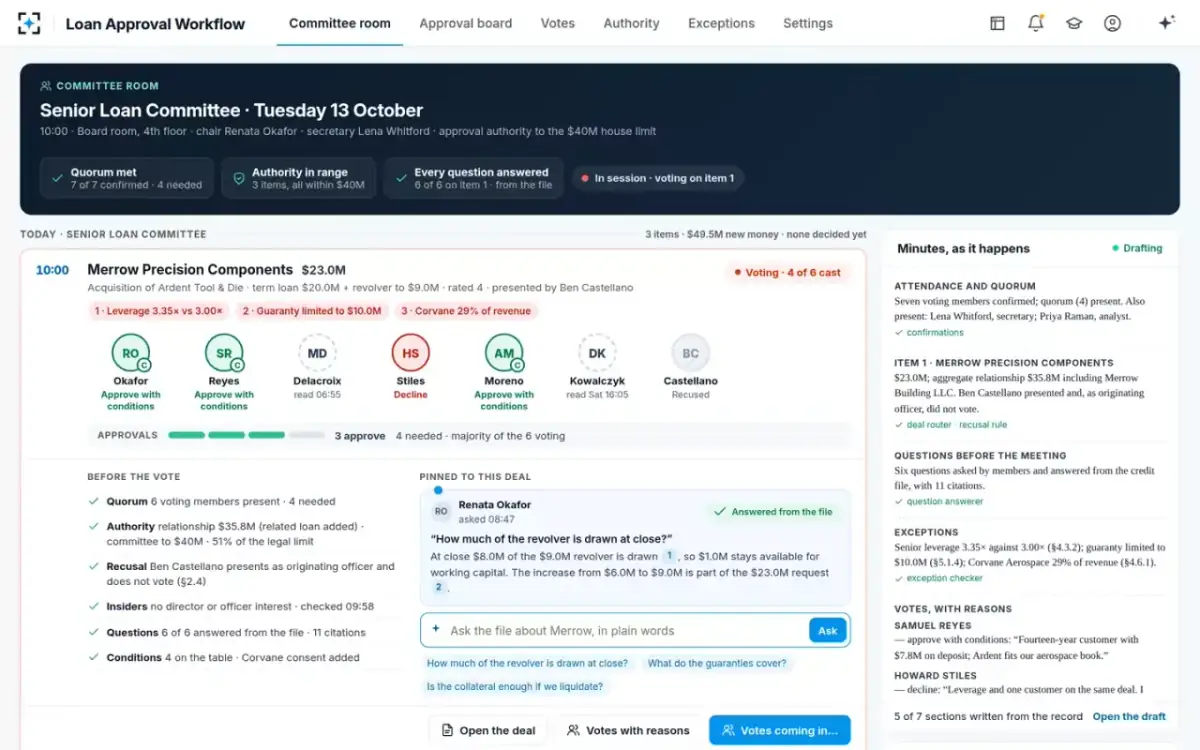
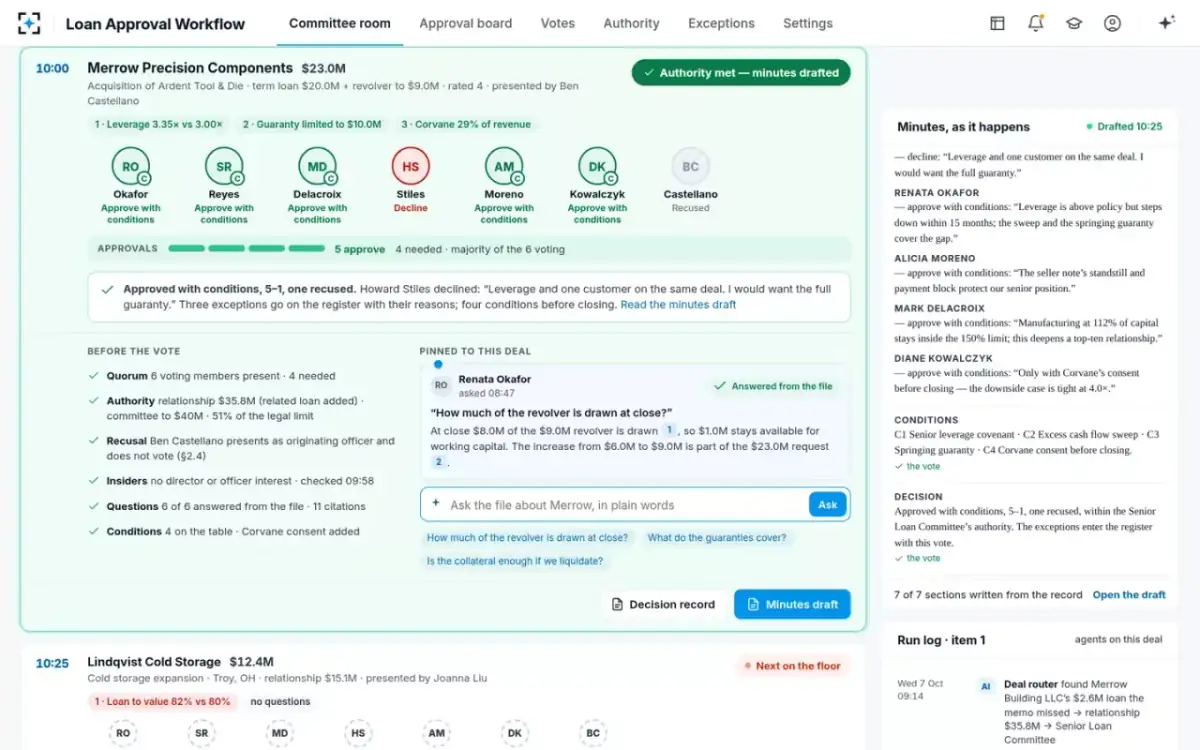
Mark Delacroix approved with conditions at 10:24, the fourth approval, and the committee's authority was met. Diane Kowalczyk, head of special assets, followed, but only with Corvane's consent before closing. The vote closed five to one, one recused. Every vote except the recusal carries a reason in the member's own words.
Item 1: each vote and the reason given
| Member | Vote | Reason, as minuted |
|---|---|---|
| Renata Okafor, chief credit officer, chair | Approve with conditions | Leverage is above policy but steps down within 15 months; the sweep and the springing guaranty cover the gap. |
| Samuel Reyes, president and chief executive | Approve with conditions | Fourteen-year customer with $7.8M on deposit; Ardent fits our aerospace book. |
| Mark Delacroix, chief lending officer | Approve with conditions | Manufacturing at 112% of capital stays inside the 150% limit; this deepens a top-ten relationship. |
| Howard Stiles, chief financial officer | Decline | Leverage and one customer on the same deal. I would want the full guaranty. |
| Alicia Moreno, regional credit officer | Approve with conditions | The seller note’s standstill and payment block protect our senior position. |
| Diane Kowalczyk, head of special assets | Approve with conditions | Only with Corvane’s consent before closing — the downside case is tight at 4.0×. |
| Ben Castellano, SVP commercial banking | Recused | Originating officer; presents the deal, does not vote (Credit Policy §2.4). |
What the dissent changed
The dissent did not block the loan, but it shaped what the bank will watch and what a future reader can learn. Read the reasons side by side and the committee's real debate is visible. Three approvals rested on specific mitigants: the leverage step-down with the sweep and the springing guaranty, the seller note's subordination, and the concentration headroom. One rested on the relationship itself: fourteen years and $7.8 million on deposit. The dissent rejected one of those mitigants by name: Howard wanted the full guaranty, not a springing one. The sixth vote, Diane's, was conditional on the gap his question had exposed.
That gives the bank three things a unanimous minute would not. A monitoring trigger: if leverage drifts toward 3.75 times, the guaranty question comes back, and the person who raised it is on record. A test for the condition: closing cannot fund without Corvane's written consent, because a member's vote depended on it. And a fair record for loan review: if the loan later weakens, the file shows the committee identified the risk and chose mitigants, rather than missing it.
Should minutes say a vote was unanimous?
Only when every member entitled to vote voted yes, and even then the minutes should say who was entitled. "Approved by all six voting members, one recused" is accurate; "approved unanimously" for a 5–1 vote is not, and neither is it for a 6–0 vote with an unexplained abstention.
Minutes that compress a split vote into "approved after discussion" lose exactly what an examiner or loan reviewer wants to see: which exceptions were accepted, on what mitigants, and who disagreed. A minute that names three exceptions and five reasons for accepting them answers that. A minute that says the committee discussed the exceptions does not.
The same meeting, minuted two ways
“Approved after discussion”: Approved.
Minutes drawn from the vote record: Approved with conditions, 5–1, one recused, within the committee’s authority.
“Approved after discussion”: “Exceptions were discussed.”
Minutes drawn from the vote record: Each of the three, with its policy section, approved by the same vote.
“Approved after discussion”: Not recorded.
Minutes drawn from the vote record: Six questions answered from the file before the meeting, eleven citations, including the missing consent.
“Approved after discussion”: Absent, or “one member expressed concern”.
Minutes drawn from the vote record: Howard Stiles declined: leverage and one customer on the same deal; wanted the full guaranty.
“Approved after discussion”: In the commitment letter.
Minutes drawn from the vote record: C1 leverage covenant; C2 cash flow sweep; C3 springing guaranty; C4 Corvane’s consent before closing.
“Approved after discussion”: Not mentioned.
Minutes drawn from the vote record: Originating officer presented and did not vote, under §2.4.
Is a director who stays silent assumed to agree?
For some institutions, by rule. The OCC notes that for a stock federal savings association, a director present at a meeting is considered to have assented to an action "unless his or her abstention or dissent is entered in the meeting minutes". Such a director may also file a written dissent with the secretary before the meeting adjourns, or send one by registered mail within five days after receiving the minutes. National banks and state banks have no identical rule, but the logic travels: the minutes are the evidence of what each member did, and silence in them reads as agreement.
That makes accurate dissent a protection for the member as much as a record for the bank. A member who voted no and appears in minutes as part of a unanimous approval has been recorded as saying something he did not say, in a document that can later be read in litigation. The dissenter is the person with most reason to want the minutes right, and the secretary should send the draft to every member while the meeting is still fresh.
Authority met: 5–1, one recused, and the minutes drafted
What to keep when a committee vote splits
A split vote is the moment a committee's record matters most, and the moment it is most often thinned out. The checklist below works with or without software.
Minuting a split loan committee vote
- Each member’s vote by name
Approve, approve with conditions, decline, abstain or recused, and the count against the number needed.
- A reason for every decline and every condition
In the member’s words, as close to verbatim as the secretary can take them.
- The questions that shaped the vote
With the answers and where they came from, including anything the file did not hold.
- Which mitigant each side relied on or rejected
So a reviewer can see the actual disagreement.
- Conditions added in the meeting
Worded so a closer can test them before funding.
- Recusals and abstentions with their basis
The policy section or the conflict disclosed.
- The minutes checked against the record and signed
Before memories fade, and approved at the next meeting.
In the solution, the secretary enters each vote and reason as it is cast; a reason is required for a decline and for an approval with conditions. The minutes drafter writes the minutes only from what was recorded and never records a vote or a reason nobody gave. On this deal the draft was ready at 10:25, the secretary checked it against the record and sent it at 10:41, and the chair signed at 10:53. The secretary's side of that morning is in how a loan committee meeting runs; what else an examiner checks in the file is in loan committee meeting minutes, as examiners read them.
Questions people ask
Should a dissenting committee member explain their vote?
Yes. A reason makes the dissent useful: it names the risk the member saw and the mitigant they did not trust, which is exactly what monitoring and loan review need. At the sample bank a reason is required for every decline and every approval with conditions.
Does a dissent make a loan harder to defend to examiners?
Not if it is minuted well. It shows the committee identified and debated the risk, which is the challenge supervisors ask directors to provide. What weakens a file is an exception that was never discussed.
What if a dissent is missing from the minutes?
The member should ask for it to be added before the minutes are approved at the next meeting, and the correction should appear in that meeting's minutes. The OCC's guidance gives each director the chance to review and, where needed, correct the minutes before they are ratified, so a missing dissent is a correction, not a dispute.
Can a member change a vote after the meeting?
Not by editing the minutes. The vote is what was cast in the room, and the minutes record it. A member who has changed their mind can say so at the next meeting, where it is minuted in turn, or ask for the item to be reconsidered under the charter.
Does a split vote need more approvals than a unanimous one?
No. The charter sets the number, usually a majority of the members entitled to vote. On the sample deal, six could vote, so four approvals carried it whether the other two approved, declined or abstained.