Loan approval workflow software manages the stretch between a finished credit memo and a recorded credit decision: it works out who must approve a deal under the bank's authority matrix, puts the deal in front of that person or committee with a clock, assembles the committee package, records votes, reasons and conditions, and keeps the evidence examiners test. Buyers should judge it less on screens than on one question: can a credit committee check every figure it shows in seconds, and does it say so plainly when the file is silent? Members are accountable for their votes, so they trust citations, visible working and stated gaps, not summaries or scores. Botminds' Loan Approval Workflow is built on that principle and introduced as a ladder: side by side on deals already decided, then answers from the file, then routing and clocks, then minutes drafted for the secretary, with people deciding at every rung.
What is loan approval workflow software?
It is the system of record for credit approval, sitting between the place a loan is underwritten and the place it is booked. Many banks already have pieces of it scattered across email, shared drives, a loan origination system's approval step and a spreadsheet of exceptions. The OCC's 2026 handbook describes what a bank's procedures should cover, and the list reads like a specification: "approval authorities, necessary steps for approvals, approval documentation requirements". Workflow software turns those written procedures into rules that run the same way on every deal.
Where loan approval workflow software sits among the systems a commercial bank buys
| System | What it does | What it leaves to email and paper |
|---|---|---|
| Loan origination system (LOS) | Takes the application, holds documents, books the loan; often has a basic approval step | Aggregating the relationship, committee packages, members’ questions, votes with reasons, minutes |
| Spreading and memo tools | Spread statements and draft the credit memo | Everything after the memo is finished |
| Credit decisioning engine | Scores and auto-decides small, high-volume loans | Any loan that goes to a person or committee |
| Document or exception tracker | Chases missing statements, insurance and other post-closing items | Why an underwriting exception was accepted, and by whom |
| Loan approval workflow software | Routes by the matrix, runs clocks, prepares the committee, records votes and minutes, keeps the exception register | The analysis and the decision, which stay with people |
The gap the last row fills is mostly time and evidence. In our estimate for a fictional bank's committee deals, most of the 16 business days from finished memo to decision went to waiting: deals with an approver nobody could see, papers re-sent, questions answered one inbox at a time. The breakdown, and the design target of four days, is set out in how long a bank takes to approve a business loan.
What should you look for in loan approval software?
Rules you can read, sums you can check, decisions that always have a named person, and an export an examiner can test without the vendor in the room. Every item below maps to something an examiner already checks on paper.
A buyer's checklist for loan approval workflow software
- The authority matrix as rules, with versions
Each limit, trigger and exception rule written so a credit officer can read it, and every route stamped with the matrix version in force that day.
- Relationship aggregation you can audit
The total shown facility by facility, with related interests and guarantors, and a flag when it differs from the memo.
- Regulation O and conflicts before the vote
Owners, guarantors and related companies checked against the insider list and members’ disclosures, with abstentions recorded.
- Exceptions named with their policy section
Before an approver sees the deal, and entered on the register with the decision that approved each one.
- Clocks and out-of-office handling
A clock per authority, visible to everyone waiting, with reassignment offered to someone with the same authority.
- Votes with reasons, and minutes from the record
Each vote entered as cast, a reason required for declines and conditions, minutes drafted from what was recorded.
- An examiner export
The decision file for any deal, with route, exceptions, questions, votes and minutes, in one piece.
- Changes under control
Who changed a clock, quorum or limit, when, and with whose approval.
Ask too what the vendor gives your third-party risk review. The 2023 interagency guidance on third parties is explicit that using a vendor leaves the bank fully responsible for doing the activity safely and lawfully, and it walks banks through planning, due diligence, contract terms, ongoing monitoring and exit (88 FR 37920). A vendor that can show where data goes, how models are sourced and changed, and what evidence your examiners will see shortens that review considerably.
Where this solution fits, honestly: it is built for banks whose commercial loans above individual limits go to a credit officer or a committee, and whose problem is the waiting, the side questions and the record between memo and decision. It does not book loans, spread statements, score credit or decide anything. A bank that mainly wants faster automated decisions on small loans needs a decisioning engine instead; one that mainly needs to chase post-closing documents needs a tracker. The line between preparing and deciding is set out in AI loan approval: where the agents stop.
Is automated loan approval right for commercial loans?
Automate the workflow, not the decision. Automated approval is rare and concentrated in small loans: fewer than one in thirty banks use a scoring system to auto-approve loans, fewer than one in a hundred will auto-approve a $250,000 loan, and outside credit cards the FDIC found automated lending confined almost entirely to smaller loans (FDIC, 2024). Commercial credit above an officer's limit is approved by people the board names, and the time it takes is mostly time spent waiting for them. Software that removes the waiting, and leaves the decision where it is, fits how commercial approval actually works.
What is credit committee software?
The part of the workflow the committee itself sees: the agenda, the package, members' questions, quorum and recusals, the vote and the minutes. It is also the part that most often fails at adoption, because committee members are senior, short of time and personally accountable for their votes. A package they cannot verify asks them to share that accountability with something that holds none. Economists who study lending note how little attention a committee has for each decision (Liberti and Petersen), so verification has to take seconds or it will not happen.
What a member is asked to trust
A summary: “Leverage is acceptable given the mitigants.”
A cited answer: “Senior leverage 3.35× against a 3.00× maximum (Credit Policy §4.3.2); covenant 3.50× at close stepping to 3.00× by 31 Dec 2027 (memo §6).”
A summary: Re-read the memo and spreads.
A cited answer: Open the two cited pages.
A summary: The summary fills the gap.
A cited answer: “Not in the file”, and the question goes to the relationship manager.
A summary: Unclear: the writer, the tool, the reader.
A cited answer: The member, on facts they can see.
How do you get a credit committee to trust new software?
Show it working on deals the committee has already decided, then widen its job one rung at a time, each rung earned with evidence from the bank's own files. Supervisors describe the same posture for AI in banking generally: the OCC's spring 2026 risk perspective found adoption limited to specific uses with guardrails and human-in-the-loop accountability (OCC, 2026). A ladder that keeps people deciding at every rung fits that, and gives the chief credit officer something to show the board.
Loan Approval Workflow's adoption ladder: four rungs, each with its own evidence
- Rung 1Side by side, on decided deals
Members see
The solution’s package for recent deals the committee has already decided, beside the package it actually read.
Measure
Relationship totals that differ from the memo; exceptions listed that the memo missed; questions the file could have answered.
Chair and CCO agree to go live.
- Rung 2Questions answered from the file
Members see
Members’ questions answered before the meeting, every sentence cited, gaps marked “not in the file”.
Measure
Answers whose citations the analyst checked and found right; answers sent without edits; gaps that became conditions.
Members keep asking; the analyst checks citations.
- Rung 3Routing and clocks
Members see
Every finished memo routed by the matrix, with the sum shown line by line, and a clock on every approver.
Measure
Routes that match credit administration’s own; routes changed upward by a person; clocks that ran out, and why.
The CCO decides reassignments.
- Rung 4Minutes drafted for the secretary
Members see
Votes and reasons recorded as cast; minutes drafted from the record the same morning.
Measure
Sections the secretary changed; lines that could not be traced to a recorded event; time from vote to signature.
The secretary checks; the chair signs.
Rung one: the package beside the one they already read
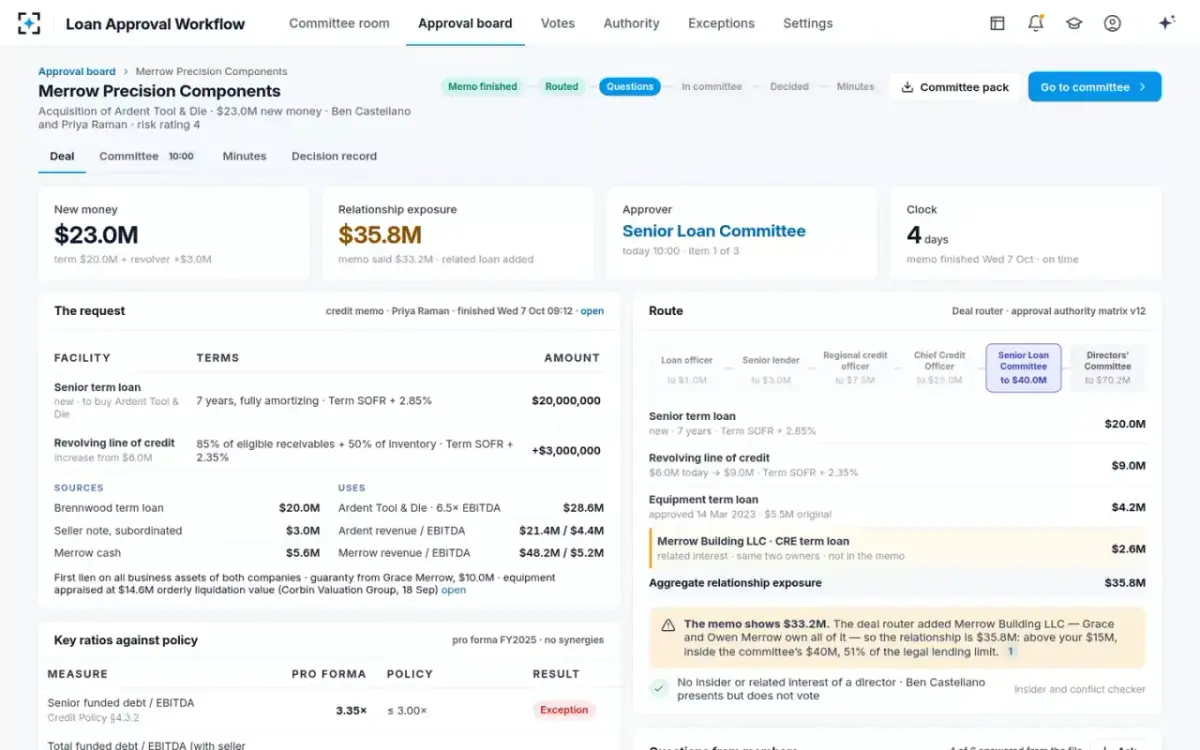
Start on deals the committee has already decided, so nothing rides on the comparison. Take a handful of recent approvals and run them through the solution: the relationship total and route, the exceptions with their sections, the answers the file could have given to the questions members actually asked. Put each beside the package the committee read at the time. Members look for two things: anything the new package got wrong, and anything it found that theirs missed. The second is what moves them. On the fictional sample deal used in these guides, the deal router found a $2.6 million loan to a company owned by the same two people, which the memo had left out; the relationship was $35.8 million, not $33.2 million.
A difference from the memo, shown with its working
Rung two: questions answered from the file
Answering members' questions is the first live use, and the one members feel most. Before each meeting, questions are answered from the credit file, every sentence cited to the document and page, and sent to all voting members at once. Anything the file does not hold is marked "not in the file" and sent to the relationship manager, and the analyst checks the citations before the chair sends the answers. The citation is the guard against the failure generative models are known for, a fluent answer that is simply wrong, which the Treasury's 2024 report on AI in financial services describes (Treasury, 2024). On the sample deal, one answer of six was a gap: a supply agreement that could be assigned only with the customer's consent, which was not in the file. That gap became a condition of approval. A system that says so when the file is silent gives members a reason to rely on it when the file is not.
Rung three: routing and clocks
Once members trust the facts, the bank can let the solution route deals and run clocks, which is where much of the waiting goes. The deal router applies the board-approved matrix to every finished memo, shows its sum line by line and never routes a deal below the matrix. The approval clock keeper watches each authority's clock, reminds the approver and offers reassignment when a clock runs out or the approver is away; it never reassigns a deal itself. The measure here is agreement with credit administration: for a period, administrators route deals as they always have, and the two are compared. Either the solution has found an affiliate or trigger the manual route missed, or the matrix's wording is ambiguous and needs fixing before an examiner finds it.
Rung four: minutes drafted for the secretary
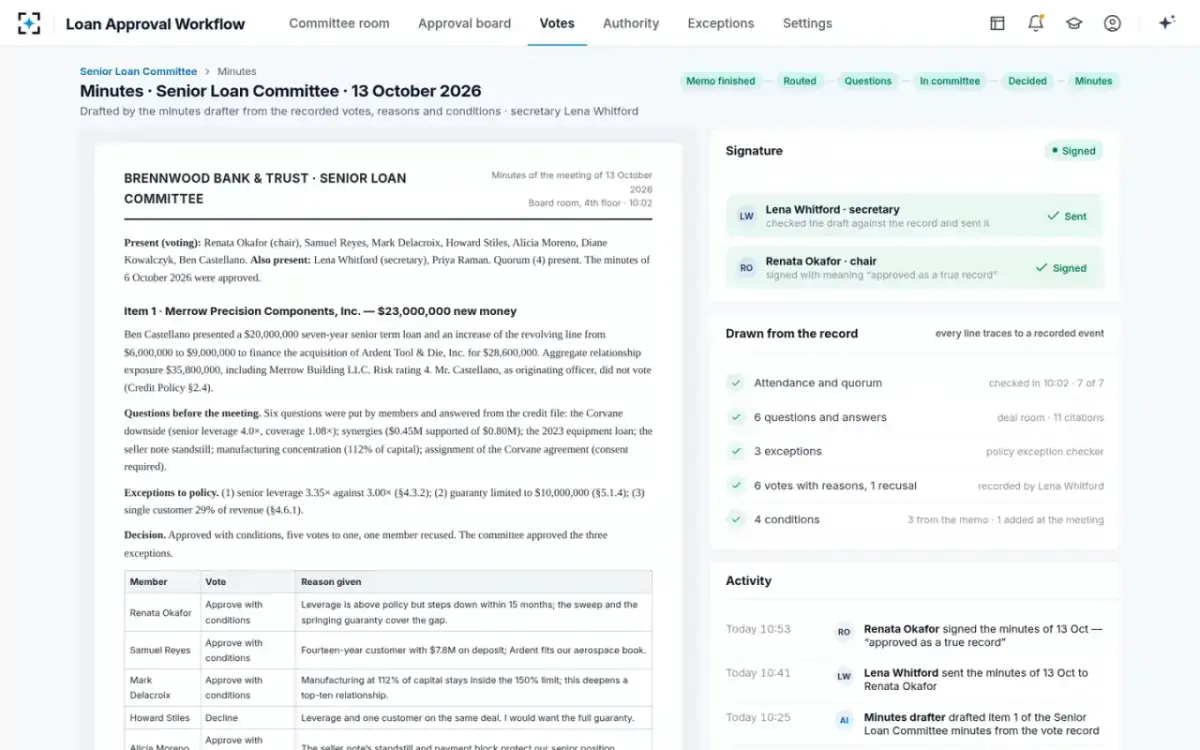
The last rung changes the secretary's job most, and needs the most care because minutes are the bank's formal record. Votes and reasons are entered as members give them, and the minutes drafter writes the minutes only from what was recorded: attendance, questions, exceptions, votes, reasons and conditions. It never records a vote or a reason nobody gave. The secretary checks the draft against the record; the chair signs. On the sample morning the draft was ready one minute after the vote and signed 29 minutes after it, one meeting at a fictional bank rather than a benchmark. What the secretary's week looks like at this rung is described in how a loan committee meeting runs.
Minutes drafted from the record, checked by the secretary, signed by the chair
What should a loan approval software pilot measure?
Accuracy you can count on your own deals, not a vendor's demonstration: sums, exceptions, citations, routes and minutes, each checked by the person who would otherwise have done the work. The NIST AI Risk Management Framework, a voluntary federal framework, asks that "processes for human oversight are defined, assessed, and documented". The checklist below is that documentation, in a credit committee's terms, and each line is a criterion that can fail.
Evidence to collect before moving up a rung
- Relationship totals checked
Every difference from the memo traced to a facility, and confirmed or corrected by the analyst.
- Exceptions reconciled
Exceptions the solution listed that the memo did not, and any it missed, against the policy section.
- Citations sampled
A sample of answers with every citation opened and checked; zero uncited statements of fact.
- “Not in the file” respected
Every gap marked as a gap, and where it went.
- Routes compared
Agreement with credit administration’s own routing, and the cause of each difference.
- Clocks reviewed
Clocks that ran out, why, and what the CCO decided.
- Minutes traced
Sections the secretary changed, and any line without a recorded source.
- Rule changes logged
Every change to a clock, quorum or limit approved by the CCO and on the audit trail.
One more measure is worth tracking from the start: what members do with the time. If questions are answered before the meeting and authority is settled on paper, discussion should move to the one or two issues that divide the room, and minutes with reasons will show whether it has. Why that matters is set out in what a loan committee does with five minutes a file.
What stays the same at every rung
The committee's authority and its members' accountability do not move. At every rung, the approving officer decides within their limit, the committee votes above it, the chair rules on recusals, the secretary checks the minutes and the chair signs them. The agents never vote, never lower an authority and never waive an exception. Rule changes are versioned, need the chief credit officer and are on the audit trail.
What each role checks while the committee adopts the solution
Today
Takes the package on trust from the analyst and the route from credit administration.
With agents
Compares routes and exceptions on decided deals, then decides when to move up a rung.
Still theirs: Reassignments, rule changes and the decision to go live.
Today
Reads every package and asks side questions by email.
With agents
Opens the cited page behind any answer that matters to the vote.
Still theirs: The vote and its reason.
Today
Answers the same question in several inboxes.
With agents
Checks citations on drafted answers before they are sent.
Still theirs: Whatever the file does not hold.
Today
Reconstructs minutes from notes over two days.
With agents
Checks each section of the draft against what was recorded.
Still theirs: Sending the minutes to the chair.
Questions people ask
How long does it take to implement loan approval software?
It depends on how quickly evidence builds up on the bank's own deals rather than on installation. The first rung needs only recent decided deals and the bank's credit policy, authority matrix and committee charter; later rungs need a few meeting cycles each, so the chief credit officer can see results across different kinds of deal.
Does it replace the loan origination system?
No. The origination system still takes the application and books the loan; approval workflow software works from the finished memo and the bank's records of the relationship, and hands the decision and its conditions back for closing. Banks often run the two side by side.
Do committee members need training?
Mostly in what to check: how to open a citation, what "not in the file" means, and where the route's working is shown. The vote, the discussion and the approval of the minutes are unchanged.
What if a member does not trust an answer?
They open the cited page, or ask the analyst. An answer that cannot be traced should not be relied on, and the solution is built so that every answer can be traced to a document and page.
Who should own the software inside the bank?
The chief credit officer, with credit administration running it day to day. The rules it applies are the board's matrix and the credit policy, which the CCO already answers for, so changes to clocks, quorum or limits should need the CCO's approval and leave a trail.