How long does it take for a bank to approve a business loan? In the FDIC's survey of about 1,300 US banks, three in four approve their typical small-business loan within ten business days, more than three quarters can approve a small and simple loan within a week, and a very large or complex loan can take four to six weeks. The gap between small and large banks is not in the typical case but at the edges: large banks are faster on the smallest loans, and small banks send large loans much higher up, to executives and directors who have other jobs. Botminds' Loan Approval Workflow works on the stretch between a finished credit memo and a recorded decision, where most of that time is spent waiting. It routes the deal by the bank's own matrix, keeps a clock on every approver and answers committee questions from the file, so a small bank can keep senior people on its large loans without the deals queuing for them.
How long US banks take to approve a business loan
77%
of banks approve their typical small-business loan within 10 business days
two weeks or less
4–6weeks
approval can take for a very large or complex loan
51% vs 29%
of large vs small banks can approve a small, simple loan in one business day
1 in 8
small banks let a first-level lender sign a loan of $1 million or more
nearly a third of large banks do
How long does a commercial loan take to get approved?
For a typical small-business loan, most banks take between three and ten business days; for the largest and most complex, four banks in ten say it can take more than 20 business days. The FDIC asked each bank three separate questions: the fewest business days it needs to approve a small and simple loan, the days a typical loan takes, and the most a large and complex loan takes. The answers form three quite different curves.
Business days from application to approval, share of banks
| Business days | Fastest case: small, simple loan | Typical loan | Slowest case: large, complex loan |
|---|---|---|---|
| 1 or less | 30% | 14% (2 days or less) | — |
| 2–5 | 46% | 34% (3–5 days) | 15% (5 days or less) |
| 6–10 | 14% | 29% | 21% |
| 11–15 | 5% | 10% | 15% |
| 16–20 | 5% (16 or more) | 13% (16 or more) | 8% |
| 21–30 | — | — | 27% |
| 31 or more | — | — | 13% |
Read down the right-hand column and the four-to-six-week figure becomes concrete: 40 percent of banks say a large, complex loan can take more than 20 business days, and 13 percent say more than 30. Those are the loans that reach committees and boards. The survey measures the bank's whole approval process, from application to decision, so it includes the analyst's spreading and the credit memo as well as the approvals themselves. No public source splits that time into underwriting and waiting, which is why the estimate further down this page is labelled as ours.
Speed matters to borrowers more than lenders sometimes assume. Banks in the same survey ranked lending speed second only to customer service in importance to small-business customers, and the Federal Reserve Banks' 2016 Small Business Credit Survey found a long wait for approval among the most frequent problems firms reported (FDIC, 2024).
Why do small banks take longer to approve large loans?
Because a large loan climbs higher at a small bank: signature authority thins out with loan size, and it thins out faster where the bank is small. Almost every bank lets its first-level lenders sign a $25,000 loan, 89 percent of small banks and 85 percent of large banks. At $250,000 the shares fall to 43 and 58 percent. At $1 million they part: about one in eight small banks, nearly a third of large ones. At $3 million only 5 percent of small banks leave it with the first level, against 29 percent of large banks.
Who can sign a business loan, by loan size and bank size
| Loan size | First level can sign: small banks | First level can sign: large banks | Needs a third level or higher: small banks | Needs a third level or higher: large banks |
|---|---|---|---|---|
| $25,000 | 89% | 85% | 2% | 1% |
| $250,000 | 43% | 58% | 13% | 1% |
| $1 million | 12% | 32% | 47% | 12% |
| $3 million | 5% | 29% | 70% | 32% |
The FDIC's explanation is proportion: "a $1 million loan is a larger share of assets to a small bank than to a large bank and thus may merit a larger degree of scrutiny." That is sound. It also means the same loan carries a different approval cost depending on who makes it, and it overturns a common assumption. Small banks are often described as flat, yet the survey's authors conclude that "small banks still may have more levels of approval for larger loans."
Who signs a $1 million business loan at a community bank?
Usually an executive, a senior committee or the board. Three in four small banks involve an executive in small-business loan decisions, and six in ten involve a board member or the whole board when a loan is large and complex enough. At large banks those shares are 42 and 9 percent.
At small banks, executives and directors sign the larger loans
That is not a flaw. At a $500 million bank, the size of loan that could hurt the bank's capital if it went bad is much smaller than at a $50 billion one, and senior involvement brings knowledge: 95 percent of banks under $500 million in assets have a decision-maker meet the applicant, against fewer than a quarter of banks over $50 billion. Research on bank hierarchies finds that the further the approver sits from the loan officer, the more the decision rests on hard numbers rather than judgement about the borrower (Liberti and Mian).
The price is time, paid by people with other jobs. A director who meets monthly, a chief executive who is also the senior lender, a chief credit officer who chairs the committee and reviews every exception: each is a queue. The OCC's handbook names the trade-off directly: committees spread knowledge and reinforce the credit culture, but they can blur accountability and slow the bank down (OCC, 2026).
How many levels of approval does a business loan need?
At most banks, three or more for the largest loans. The FDIC asked each bank the most levels its main small-business product could require for a large, complex loan with policy exceptions: 41 percent said three, 20 percent four, 6 percent five and 6 percent six or more, which sums to 73 percent at three or more. Only 5 percent had a single level or an automated decision even for that loan.
Most banks can send a large, complex loan through three or more levels
The survey also shows what adds a level. Loan size or total exposure was named by 80 percent of banks, insufficient debt service coverage by 67 percent, a borrower outside the primary lending area by 57 percent and an industry the bank has not lent to by 53 percent. Being an existing customer rarely takes a level away: only 21 percent of banks would lower the levels for a previous deposit relationship, and 26 percent for a previous lending relationship. How those triggers are written into a policy is covered in who approves loans at a bank.
What slows down business loan approval?
Complexity slows approval more than size does. Asked what lengthens the review of an application, 91 percent of banks named a complex loan or borrower and 89 percent unusual financial characteristics, while a larger loan was named by 66 percent. A policy exception lengthens review at 70 percent of banks, the same share as a start-up borrower.
What lengthens a bank's review of a business loan
One finding cuts the other way. A good past loan relationship shortens the review at 73 percent of banks, yet lowers the number of approval levels at only 26 percent. Existing customers move faster because the file is familiar, not because fewer people sign. The exception figure matters for the approval route as well: an exception has to be named, justified and approved by someone with the authority to grant it, which is the subject of loan exception tracking.
Where the days go between a finished memo and a decision
Most of the time between a finished memo and a decision is waiting, not deliberating. The FDIC data cover the whole process and do not split it, so we have estimated the split for one fictional bank, Brennwood Bank & Trust, whose median from finished memo to decision in 2025 was 16 business days for deals that went to committee.
Loan Approval Workflow and the 16 days: where a committee deal waits
- Adding up exposure, finding the authority1.5 d
- With an approver, unseen5 d
- Re-sending papers, side questions4 d
- Waiting for the meeting4 d
- Chasing reasons for the vote1.5 d
- Exposure and authority0.1 d
- With an approver, on a clock1 d
- Questions answered from the file0.5 d
- Waiting for the meeting2 d
- Reasons recorded with the vote0.4 d
Two of the five stretches are pure queue: a deal sitting with an approver nobody can see, and papers re-sent each time a number changes while members ask side questions by email. Neither improves the decision. Together they are nine of the sixteen days in our estimate, and they are longest exactly where approval sits highest, because senior people travel, chair other meetings and take leave. The wait for the meeting itself is a design choice: a committee that meets weekly costs up to a week, and one that meets monthly costs up to a month.
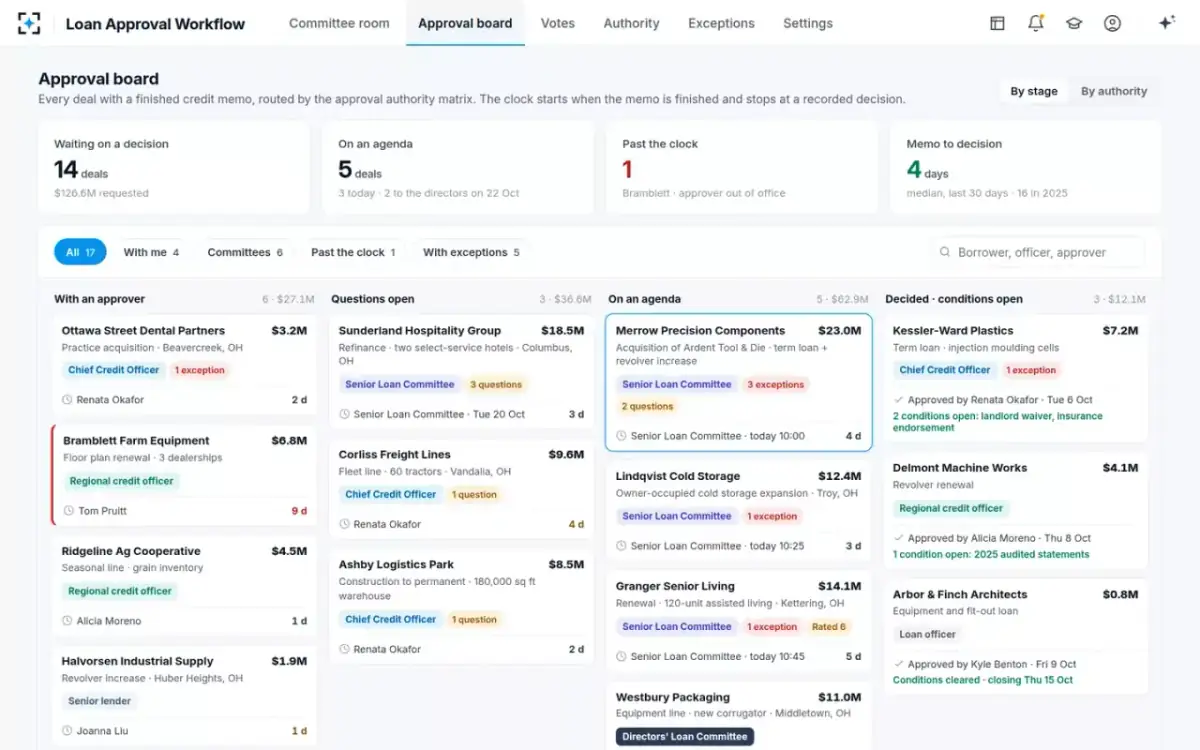
The approval board shows Brennwood's morning. Fourteen deals are waiting on a decision, $126.6 million requested, each with its authority and its clock. One is past it: a $6.8 million floor-plan renewal for Bramblett Farm Equipment, nine business days with a regional credit officer who is out of office, against a two-day target. The floor plan matures at the end of the month.
Every deal waiting on a decision, and on whom
Can a loan officer approve a loan on their own?
Yes, up to the personal limit the board's lending policy gives them, and raising those limits is the usual advice for a slow bank. It moves risk to people with less experience. The OCC's handbook is blunt about the trade: individual authority is faster and leaves no doubt who decided, but it creates undue risk when a lender's ethics, knowledge or experience fall short of the limit (OCC, 2026). Concentrated authority has failed before: the FDIC's Inspector General found that First NBC Bank's chief executive had built up a personal lending authority it called excessive, with limited board oversight, before the bank failed in 2017 (material loss review).
The other route keeps the senior approvers and removes what they wait on. Most of it is administrative and can be fixed without touching the matrix.
Cutting approval time while keeping senior approvers
- Put a clock on every authority
A day for an officer, two or three business days for a credit officer or the CCO, visible to everyone who is waiting.
- Plan for the approver who is away
Name who holds the same authority, and offer the move to the person who may make it, rather than letting the deal sit.
- Close the agenda on a fixed day
Members read on a known schedule; memos finished after the cut-off go to the next meeting, not into the package by email.
- Answer members’ questions before the meeting
From the credit file, with the page cited, and send only what the file does not hold back to the deal team.
- Send one package, kept current
A number that changes changes in one place, so nobody reads an old version.
- Record the reason with the vote
So nobody chases a member for it afterwards, and the minutes can be drafted the same morning.
- Match meeting frequency to the queue
A committee that meets twice a week costs less waiting than one that meets every other Tuesday.
In the solution these are settings: clocks by authority, what happens when one runs out (remind, then escalate), whether an absent approver's deals are offered for reassignment, committee dates, quorum and when the agenda closes. Changes need the chief credit officer and are kept on the audit trail. The clock keeper never reassigns a deal itself; it offers, and the chair decides. What members read once the waiting is gone, and how little time they have for it, is the subject of what a loan committee does with five minutes a file.
Is a flatter approval structure riskier?
Not by itself. Fewer levels with clear accountability can be safer than many levels where each assumes the next will catch a problem. The OCC's handbook declines to prefer individual, joint or committee authority; what it asks is whether controls confirm acceptable credit quality at origination and make someone accountable for the decision. What matters at any size is that each approver had the authority, saw the analysis and left a record of why. Directors in particular should be able to point to minutes showing they had the facts and questioned what needed questioning, which is the standard the OCC sets for board records (Director's Book).
Adding levels has a cost of its own that rarely appears in a policy review. Each level is a hand-off, and each hand-off is a place where a deal waits, a number is re-keyed or a question is asked twice. A bank that finds most of its approval time in queues, not in analysis, has a workflow problem rather than a delegation problem, and fixing it does not require anyone to approve more than they do today. How to set the limits themselves is in the six decisions behind a loan approval matrix.
Questions people ask
Can a bank approve a business loan in one day?
For a small, simple loan, often yes: 30 percent of banks say their fastest approvals take one business day or less, and slightly more than half of large banks can do it, against 29 percent of small banks. Automated approval is still rare. Fewer than one in thirty banks use a credit-scoring system to auto-approve loans, and fewer than one in a hundred will auto-approve a $250,000 loan (FDIC executive summary).
Does being an existing customer speed up approval?
It speeds up the review but rarely the sign-off. A good prior loan relationship shortens review at 73 percent of banks, yet only 26 percent would lower the number of approval levels for it, and 21 percent for a deposit relationship. The familiar file saves the analyst's time, not the approvers'.
Why do small banks meet borrowers more often?
Because their decision-makers are closer to the loan. Nearly 90 percent of small banks have a decision-maker meet the applicant at some level of approval, against fewer than 40 percent of large banks. The FDIC flags the trend as a concern: as banks consolidate, fewer small businesses get to make their case directly to the person who decides.
Does a policy exception delay a business loan?
At most banks, yes: 70 percent say an exception to credit policy lengthens review. The delay comes from the extra approval the exception needs and the questions it draws, so a file that names each exception with its mitigant up front moves faster than one where the approver has to find it.
How long does the board take to approve a loan?
As long as the gap to its next meeting, unless it meets specially. A board or directors' loan committee that sits monthly adds up to a month to any loan above the committee's limit, and to insider loans that need prior board approval under Regulation O. Banks that cannot wait schedule special meetings or set the house limit high enough that few loans need the board.