Deposit concentration risk is the risk that a small number of depositors, or a group of depositors who behave as one because they share an industry, an investor or a news feed, withdraw enough at the same time to strain a bank's liquidity. Banks measure it with the share of deposits held by the largest depositors, the uninsured share, and the share held by each sector or channel, and they limit it in their liquidity policy. Those measures show how exposed the bank is. They do not answer the question a treasurer faces when an indicator trips: which accounts moved, through which channels, why, and whether the others in the same network will follow before noon. Botminds' Liquidity Risk Monitoring is an agentic solution built to answer that question from the bank's own payment records, with client names shown only to roles permitted to see them. In its sample bank the answer is on the analyst's screen by 7:10 a.m. and confirmed by 7:52, ahead of an 8:15 deadline.
The bank and clients in the examples are the solution's fictional sample, Corvane National Bank, a US regional bank of about $92 billion in assets, on October 22, 2026. Rules and the 2023 failure facts are the agencies', linked where they appear.
From a tripped indicator to the accounts behind it: one outflow, decomposed
Indicator
Uninsured commercial deposits, three days−$1,060M
Past the 3.0% limit: −4.1%
Cohort
Technology clients−$940M
−9.6%; every other sector moved less than 1%
Accounts
Eleven named clients−$763M
72% of the drop, from 2,614 payments; $1.55B still on deposit
Channels
Sweeps to money market funds$324M
Three clients
Wires to other banks$300M
Five clients; no receiving bank under stress
Treasury bills through custody$115M
Two clients
Payroll and taxes$24M
One client
Thread
7 of the 11 share a lead investor0.82
It asked its companies on October 19 to hold no more than two months of cash at any one bank
What is deposit concentration risk?
Deposit concentration risk is a funding concentration: a dependence on a source of deposits large enough, or correlated enough, that its loss would strain the bank. The 2010 Interagency Policy Statement treats it as one of the core measures a bank should limit, naming "exposures to single providers of funds, exposures to funds providers by market segments, and different types of brokered deposits or wholesale funding," and concludes plainly: "In general, funding concentrations should be avoided" (Interagency Policy Statement).
The FDIC's examiners have a working threshold for the single-depositor version. "For examination purposes, a large depositor is a customer or entity that owns or controls two percent or more of the institution's total deposits," and such deposits "are considered potentially less stable liabilities" (FDIC RMS Manual, Section 6.1). The manual's next point is the one 2023 proved: relationships help less than banks think in a stress. "While the duration, number of accounts, or use of multiple services in the deposit relationship may result in more stable deposit balances in a business-as-usual scenario, such extended relationships may only have a modest effect in tempering flight risk during a stress event."
How do banks measure deposit concentration?
Banks measure deposit concentration with a handful of shares, each of which catches one shape of the risk and misses another. The table sets them side by side with the sample bank's readings.
Deposit concentration measures, what each catches, and what each misses
| Measure | Sample bank reading | What it catches | What it misses |
|---|---|---|---|
| Largest depositors' share | Top 50: $10.6 billion, 14.8% of deposits | Dependence on a few names | Hundreds of mid-sized depositors who move together |
| Large depositors (2% or more each) | The FDIC's examination threshold | Any single name big enough to matter alone | A network of names each under 2% |
| Uninsured share | $27.5 billion, 38.4% of deposits | Money with a reason to run | Which uninsured money; one rate for all |
| Sector or cohort share | Technology: 36% of uninsured commercial deposits | Depositors exposed to one shock | Links across sectors, such as a shared investor |
| Channel share | Brokered and listing-service: $3.29 billion | Rate-sensitive, third-party money | Operating accounts that leave by sweep or wire |
| Network share | Not on any standard report | Depositors who share an investor or adviser | Needs onboarding data most liquidity views never read |
The network row is the one that ran in 2023, and the one with no standard metric. At SVB, a 2021 supervisory finding was that "The approach to assessing risk in deposits for ILST does not appropriately consider key risk attributes (e.g., product and customer type), which limits the ability to differentiate deposit risks in stress" (Federal Reserve, April 2023). In the sample bank, the Concentration agent reads only the investor field of onboarding records to build that view, and nothing else in them.
What is a deposit concentration limit?
A deposit concentration limit is a ceiling in the bank's liquidity policy on how much funding may come from one depositor, one segment or one channel, with a warning level below it and a named approver for any change. For the largest holding companies the requirement is explicit: Regulation YY requires Category I, II and III firms to set limits on "Concentrations in sources of funding by instrument type, single counterparty, counterparty type, secured and unsecured funding" (12 CFR 252.34(g)). Smaller banks set them under the policy statement's general expectation.
A limit is only as strong as the process for changing it. Signature Bank shows both failure modes. On uninsured deposits it set none, because management judged a limit incompatible with a strategy built on large commercial deposits (the uninsured deposits ratio quotes the FDIC). On digital-asset deposits it had one and raised it when breached, from 10% to 35% of total assets (FDIC, April 2023).
In the sample bank, concentration is limited through indicators with warning levels and limits: the top 50 depositors' share, uninsured commercial deposits' three-day change, sweeps to money market funds over five days. A new cohort indicator, uninsured technology deposits, was suggested by the agents after the morning's trip and waits for the liquidity risk officer's approval and ALCO's ratification like any other change.
What did SVB's and Signature Bank's deposit concentration look like?
Both banks were concentrated by sector and by size, and both believed their client relationships made the money stable. The figures below come from the regulators' reviews.
Deposit concentration at the two banks that failed in March 2023
>50%
of SVB's deposits from venture-backed companies at year-end 2022
~60
Signature Bank clients with balances above $250 million, holding about 40% of deposits
14%
of Signature's total assets held by four depositors, each above 2% of assets
20%
of Signature's total deposits requested in withdrawals on March 10, 2023
Signature's management had an answer for the concentration, and the FDIC recorded it: "SBNY management did not heed the FDIC's concerns and responded that the close relationship that SBNY cultivated with these large depositor clients made them less likely to leave SBNY." Large depositors "typically also maintained their operating account and/or lending relationship with the bank and it was therefore assumed their deposits were “sticky”." The bank "never fully developed liquidity stress testing deposit assumptions or a deposit runoff framework to substantiate this assumption." The relationship argument is the one the FDIC's manual now answers: such relationships "may only have a modest effect in tempering flight risk during a stress event."
What is a depositor cohort, and why does the network matter?
A depositor cohort is a group of depositors expected to behave alike under stress: uninsured commercial deposits in one sector, public funds, brokered placements, the largest fifty names, or companies that share a lead investor. Cohorts matter because runs in 2023 were collective decisions. The Federal Reserve's account of SVB's last day is of a network acting at once, the run "appears to have been fueled by social media and SVB's concentrated network of venture capital investors and technology firms that withdrew their deposits in a coordinated manner with unprecedented speed" (Federal Reserve).
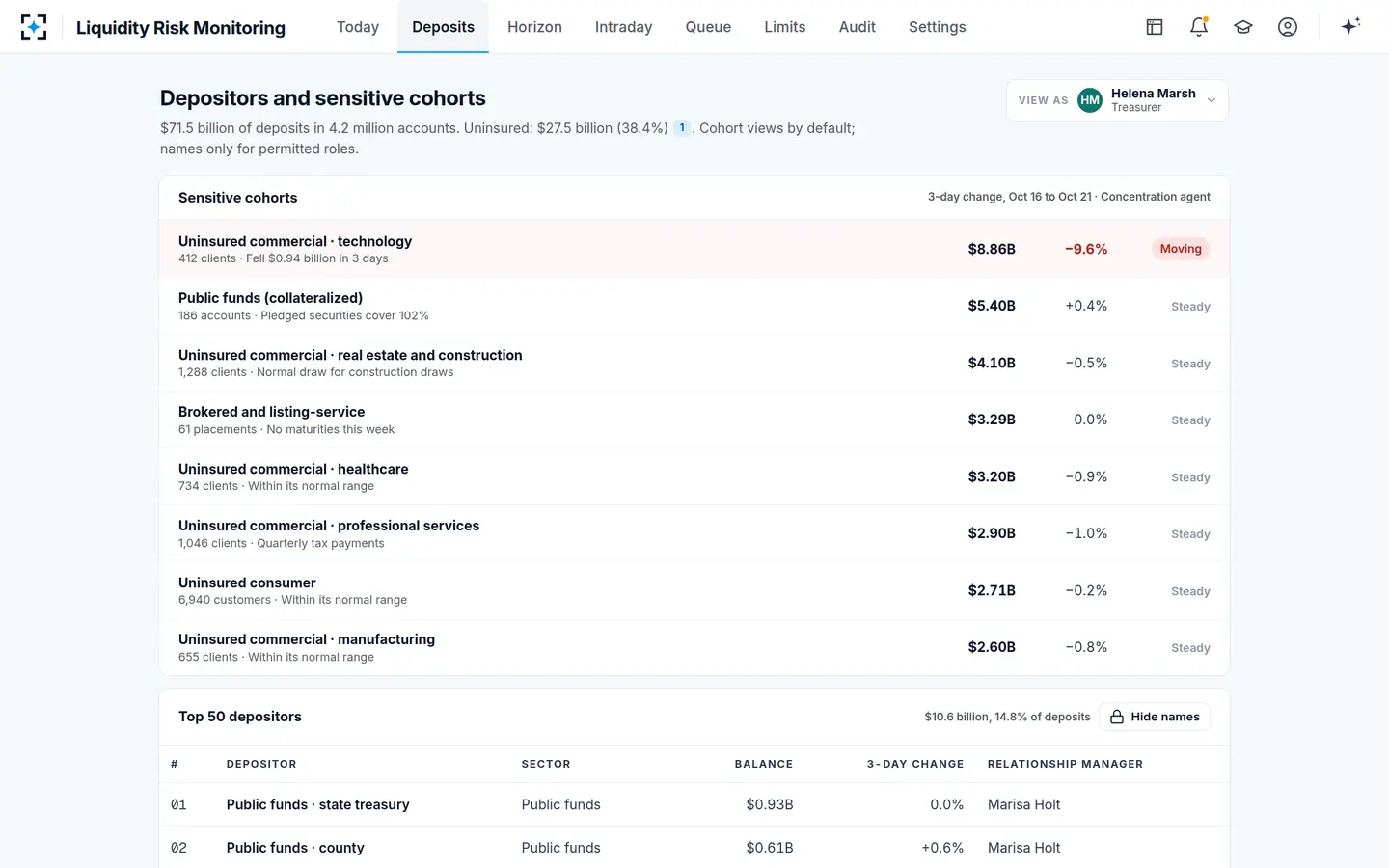
A cohort view also answers the question a concentration ratio cannot: is the move contained? On the sample morning, the uninsured technology cohort, 412 clients with $8.86 billion, was down 9.6% in three days, while every other uninsured commercial sector was within its normal range. Seven of the eleven clients who moved most shared a lead investor. That is the shape a treasurer needs to see: one cohort, one network, one cause, and a known amount still on deposit.
Deposit concentration risk by cohort in Liquidity Risk Monitoring: one cohort moving
How do you find which clients moved deposits?
You find which clients moved deposits by starting from the cohort that moved, tracing its outbound payments in the payments hub and the sweep log to the accounts behind them, ranking those accounts by amount, and then looking for what they have in common. By hand it means tracing payments one client at a time. The FDIC tells its examiners why aggregates are not enough: too much aggregation can hide substantial liquidity risk, which is why the liquidity dashboard guide argues for account-level data (FDIC RMS Manual).
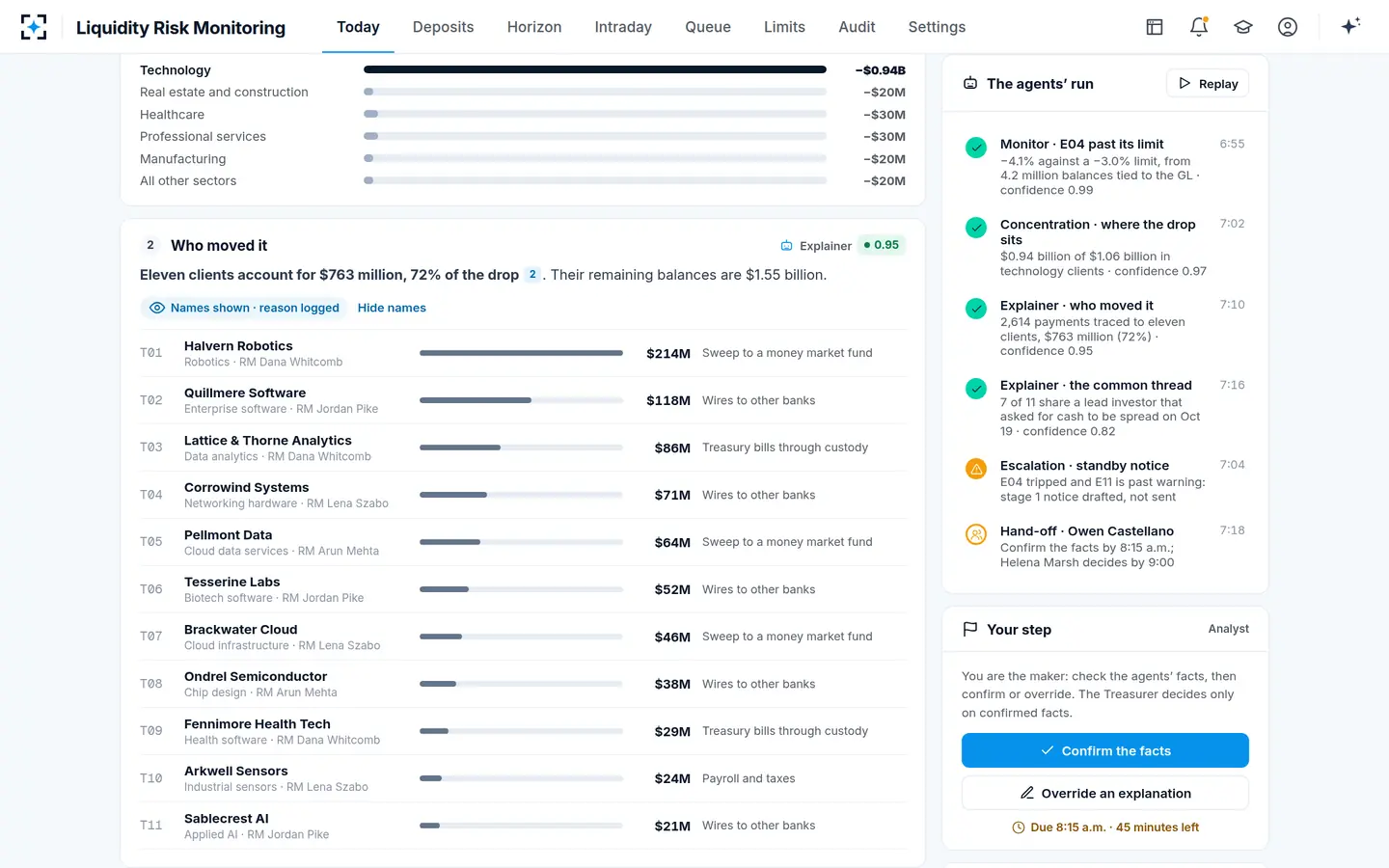
Naming who moved the money in Liquidity Risk Monitoring, with a person confirming
Agent
MonitorFinds uninsured commercial deposits down 4.1% in three days, past the 3.0% limit, from balances tied to the general ledger.
Never: changes the limit it is measuring against.
Agent
ConcentrationFinds where the drop sits: $0.94 billion of $1.06 billion in technology clients; every other sector under 1%.
Never: reads BSA/AML case data, or any onboarding field other than the investor.
Agent
ExplainerTraces 2,614 payments to eleven clients and $763 million, cites each settlement record, and finds the shared lead investor.
Never: states a cause below 70% confidence as fact, or names other clients in a relationship manager's note.
A person decides
AnalystShows names with a logged reason, opens the records, and confirms the facts at 7:52 a.m., ahead of the 8:15 deadline.
A person decides
TreasurerDecides to watch, with calls to all eleven by noon; the relationship managers see only their own clients.
Eleven clients, 72% of the outflow, named only after a logged reason
How fast can concentrated deposits leave?
Concentrated deposits can leave in hours once the group decides, which is why the useful time to act is while the cohort is still drifting. SVB lost more than $40 billion in a day. At Signature Bank, withdrawal requests on March 10, 2023 came to a fifth of total deposits, and the bank was closed two days later (FDIC). The FDIC's manual explains who goes first: "non-retail uninsured deposits are likely to be more sensitive and reactive to signs of serious financial distress than uninsured retail accounts."
The sample bank's cohort moved more slowly, 9.6% over three days, and that is the window the method is for. The eleven clients still held $1.55 billion. If they moved it all that week, the survival horizon would fall from 61 days to 54, under the 55-day warning level; if technology uninsured deposits ran off 60% in ten days, to 48. How the survival horizon is calculated explains those numbers. The decision that morning was to call all eleven by noon, and by 12:05 p.m. eight had been reached: five described operating moves or diversification under their investor's guidance, two were moving cash for yield, and one planned to move a further $40 million.
Who should see client-level liquidity data?
Only the people who need it to act, each time with a reason on record. Client-level views of deposit outflows are sensitive commercially, because they reveal who is leaving and why, and legally, because they sit next to data the bank must keep apart. The sample bank's rules are a reasonable template: cohort views are the default, client names appear only to permitted roles with a logged reason, account numbers are masked to the last four digits on every screen and export, and relationship managers see only their own clients' call notes.
Two boundaries are absolute in the sample design. No BSA/AML case data is read or shown, and nothing in the solution is customer-facing, so the existence of a suspicious activity report cannot surface through a liquidity screen or a relationship call. The CFO and ALCO see cohorts rather than client names. Cited payment records are kept for five or seven years, as the bank sets.
Concentration metrics and attribution are different capabilities
Measuring concentration and attributing an outflow are different jobs, done at different times, from different data, and a bank needs both. Most liquidity tools do the first well. The comparison shows what the second adds.
Deposit concentration metric vs outflow attribution
Concentration metric: How exposed are we to a few depositors or one segment?
Outflow attribution: Which depositors moved this money, and will the rest of their group follow?
Concentration metric: Monthly or quarterly, and in the policy review
Outflow attribution: The morning an indicator trips, within the hour
Concentration metric: Balances by depositor and segment
Outflow attribution: Payments, sweeps and instruction changes, linked to onboarding attributes such as the lead investor
Concentration metric: A share against a limit
Outflow attribution: Named accounts, amounts, channels and a common thread, each cited
Concentration metric: ALCO and the board, on limits and funding mix
Outflow attribution: The treasurer, on watch, escalate or act; relationship managers, on calls
Attribution does not replace the limits; it tells the treasurer whether a breach is one network acting on one piece of advice, which can be watched and called, or the start of something wider, which cannot. Which indicators should carry a concentration line is tested in early warning indicators replayed on 2023, and the share of uninsured money behind it in the uninsured deposits ratio. The method runs every morning in Liquidity Risk Monitoring.
Questions people ask
How does the FDIC define a large depositor?
For examination purposes, the FDIC's RMS Manual defines a large depositor as a customer or entity that owns or controls 2% or more of the institution's total deposits. Such deposits are treated as potentially less stable, and examiners look at the whole relationship, including whether the depositor has other services or ownership in the bank.
Are public funds a deposit concentration risk?
They can be, though collateralized public deposits behave differently from uninsured commercial money. The FDIC's 2026 Risk Review found public deposits represented almost half of community bank wholesale funding in 2025, up from slightly less than 39% a decade earlier (FDIC, 2026 Risk Review). In the sample bank, collateralized public funds are their own cohort, with pledged securities covering 102%.
Are brokered deposits a concentration?
The policy statement lists different types of brokered deposits among the funding concentrations a bank should limit, and the FDIC's manual expects policies to set amounts and concentration limits for brokered and rate-sensitive funding. Brokered money is usually a channel concentration: it leaves when it matures or when the bank's capital category changes, rather than by sweep or wire.
What is a good top 20 depositor ratio?
There is no regulatory figure; the right limit depends on how stable those depositors are and how quickly the bank could replace them. A more useful test than the ratio is whether the bank's survival horizon stays above its minimum if its largest cohort leaves, which turns a share into a number of days.
How often should deposit concentration be reviewed?
Measured daily where deposits are concentrated or uninsured, reported to senior management at least monthly and to the board at least quarterly under the policy statement, and with limits reviewed at least annually with the liquidity policy. Large holding companies must review compliance with their liquidity limits at least quarterly under Regulation YY.