Intraday liquidity monitoring is the bank's watch, during the business day, on whether it can meet its payment and settlement obligations on time: measuring expected and actual gross inflows and outflows through the Federal Reserve account and the payments systems, tracking the collateral available for intraday credit, and alerting the people who can act when outflows run ahead of plan. On a normal day it is a quiet control. On a stress day it is the place a bank discovers whether it can fund the wires its depositors have sent, and the decisions it forces arrive in hours. Botminds' Liquidity Risk Monitoring is an agentic solution whose Intraday Watch agent reads the payments hub hourly, or every 15 minutes on a stress day, and alerts the treasurer and the analyst at the warning level and the limit; it never holds, stops or delays a payment. This guide uses the FDIC's account of Signature Bank's last Friday to show why the watch matters, and who decides what when it fires.
Signature Bank facts come from the FDIC's review of April 28, 2023; the Federal Reserve's rules and measures are linked where they appear. Product examples come from the solution's fictional sample bank, Corvane National Bank.
Signature Bank's last 72 hours, to scale: one day of run, then a weekend of queued wires
- Over $40 billion outThu, Mar 9
- ClosedFri a.m.
- Before the runThu
- Concerns rejected at noonFri a.m.
- Run; wires exceed the Fed accountFri p.m.
- Withdrawal requests queueSat–Sun
- ClosedSun
What is intraday liquidity monitoring, and who needs it?
Intraday liquidity monitoring is the measurement and management of a bank's liquidity within the business day, so that time-critical payments settle when due. The 2010 Interagency Policy Statement calls it "an important component of the liquidity risk management process for institutions engaged in significant payment, settlement, and clearing activities," and expects such institutions to "actively manage their intraday liquidity positions and risks to meet payment and settlement obligations on a timely basis under both normal and stressed conditions" (Interagency Policy Statement).
The statement lists what an intraday liquidity strategy should let a bank do. The list is short and practical: "Monitor and measure expected daily gross liquidity inflows and outflows," "Manage and mobilize collateral when necessary to obtain intraday credit," "Identify and prioritize time-specific and other critical obligations in order to meet them when expected," "Settle other less critical obligations as soon as possible," and "Control credit to customers when necessary." For smaller banks the OCC narrows it: processes "typically focus on the adequacy of funds and credit within the bank's Federal Reserve or correspondent settlement and clearing account" (OCC, Liquidity booklet).
What is intraday liquidity risk?
Intraday liquidity risk is the risk that a bank cannot make a payment when it is due during the day, even if it would have the money by the close. It arises from timing: outgoing payments must be funded when they are sent, while incoming payments arrive when counterparties choose to send them. The FDIC's manual describes the stress version precisely. A bank that sends wholesale payments "could encounter situations that result in intraday cash deficits, such as if expected payments receipts are throttled/slowed by senders concerned about the institution's financial condition (and the risk of having a large intraday loan to the institution) but the institution is unable to throttle outgoing payments in a similar manner" (FDIC RMS Manual, Section 6.1).
That asymmetry is the heart of the risk. Counterparties can slow what they send a troubled bank; the troubled bank's own depositors cannot be slowed in the same way, because their instructions are theirs. The OCC notes the cost when it goes wrong: "Operational risk can occur in wholesale payments when a bank is unable to meet its daylight overdrafts with the Federal Reserve Banks." For a community bank the most common intraday exposure is smaller and more ordinary, such as a derivatives margin call due by a set time on a day when the bank expects a net inflow later.
Signature Bank's last Friday, hour by hour
Signature Bank's last business day shows intraday liquidity risk at full scale. Silicon Valley Bank was closed on the morning of Friday, March 10, 2023. At Signature, the FDIC records that the bank's president "rejected examiner concerns about the stability of uninsured deposits as late as noon EST on March 10, 2023," and that management "failed to acknowledge the severity of the problem until a run started on SBNY in the afternoon" (FDIC, April 2023).
The afternoon was an intraday liquidity problem. Withdrawal requests "equaled 20 percent of total deposits," and "Outgoing wire requests significantly exceeded funds available in SBNY's Federal Reserve account." Management "had a difficult time initially ascertaining how much borrowing it needed to fund pending wires, had approached the Federal Home Loan Bank of New York (FHLB) too late in the day to draw against its line, and did not have sufficient collateral pledged at the Federal Reserve's Discount Window to cover pending wire requests." The gap was closed only by arrangement: the FHLB subordinated its interest in collateral to the New York Reserve Bank, and the bank gained discount window access "just before the Federal Reserve's wire room closed."
Signature Bank's stress day in four numbers
20%
of total deposits requested in withdrawals on Friday, March 10, 2023
$7.9B
maximum outgoing wires queued for Monday, as of Sunday afternoon
$3B
liquidity available on the FDIC's best-case view: 4% of total deposits
53hours
from SVB's failure to Signature's closure
Every failure in that sequence is something an intraday watch is built to surface earlier: the size of the queue against the Fed account balance, the collateral available to borrow against, and the cut-off by which a line must be drawn. None of them is a forecasting problem. They are facts the bank had, in systems that did not put them in front of the decision-makers in time.
What is a daylight overdraft, and how does the Fed measure it?
A daylight overdraft is a negative balance in a bank's Federal Reserve account at any point during the business day. The Federal Reserve's guide to its payment system risk policy defines it simply: "A daylight overdraft occurs when an institution's Federal Reserve account is in a negative position at any point during the business day," as distinct from "a negative balance in a Federal Reserve account at the close of the business day" (Federal Reserve, PSR guide).
The Federal Reserve measures it by the minute. "An institution's account balance is measured at the end of each minute based on the institution's opening balance and all payment transactions posted to the institution's account up until that time." That is the clock a bank's own intraday monitoring is ultimately judged against, even if the bank itself checks hourly.
How the Federal Reserve measures, caps and prices intraday credit
| Element | What the policy says | What it means for monitoring |
|---|---|---|
| Measurement | The account balance is measured at the end of each minute | A bank's own watch should know its expected balance through the day, not just at the close |
| Net debit cap | "net debit cap = cap multiple x capital measure": the maximum uncollateralized daylight overdraft | Cap headroom is an intraday indicator in its own right |
| Collateral | Collateralized daylight overdrafts are charged a zero fee | Collateral pledged at the Reserve Bank is intraday capacity as well as overnight capacity |
| Fee | Uncollateralized daylight overdrafts are charged 50 basis points (annual rate), with a fee waiver of up to $150 per reserve maintenance period, generally ten business days | Uncollateralized overdrafts cost money and use cap; both should be visible |
How often should intraday liquidity be checked?
Intraday liquidity should be checked at least hourly on a normal day by any bank with material payment flows, and far more often, every 15 minutes or continuously, once a stress begins. The rules do not set an interval; they set an expectation of active management under both normal and stressed conditions, and the FDIC's manual notes that banks with large payment and settlement activity may need to measure within the day, and that every bank gains from being able to monitor and report more often once a stress begins (the liquidity dashboard guide quotes both passages).
Intraday liquidity monitoring in Liquidity Risk Monitoring, normal day and stress day
Normal day: The Intraday Watch agent reads the payments hub hourly.
Stress day: Every 15 minutes, set by the treasurer's decision.
Normal day: Gross inflows and outflows against the day's expected pattern; the peak net outflow so far.
Stress day: The same, plus the named clients and channels behind any large outflow.
Normal day: The treasurer and the analyst, at the warning level and the limit.
Stress day: The same, with each alert tied to the morning's decision and its re-check time.
Normal day: An explanation, confirmed by the analyst.
Stress day: A decision by the treasurer to watch, escalate or act, with a reason.
Normal day: Hold, stop or delay a payment.
Stress day: Hold, stop or delay a payment.
For internationally active banks there is a Basel standard behind the cadence. The Basel Committee's 2013 "Monitoring tools for intraday liquidity management" set out "seven quantitative monitoring tools," introduced "for monitoring purposes only," with reporting "on a monthly basis from 1 January 2015" (Basel Committee, BCBS 248). National supervisors decide how far they apply to other banks.
What triggers an intraday liquidity alert?
An intraday liquidity alert is triggered when a measure the bank watches during the day crosses a warning level or a limit set in its policy: the peak net outflow so far against its expected pattern, the Federal Reserve account balance against the payments still queued, the headroom under the net debit cap, or a single large outflow from a sensitive cohort. Each should be paired with the collateral available to cover it.
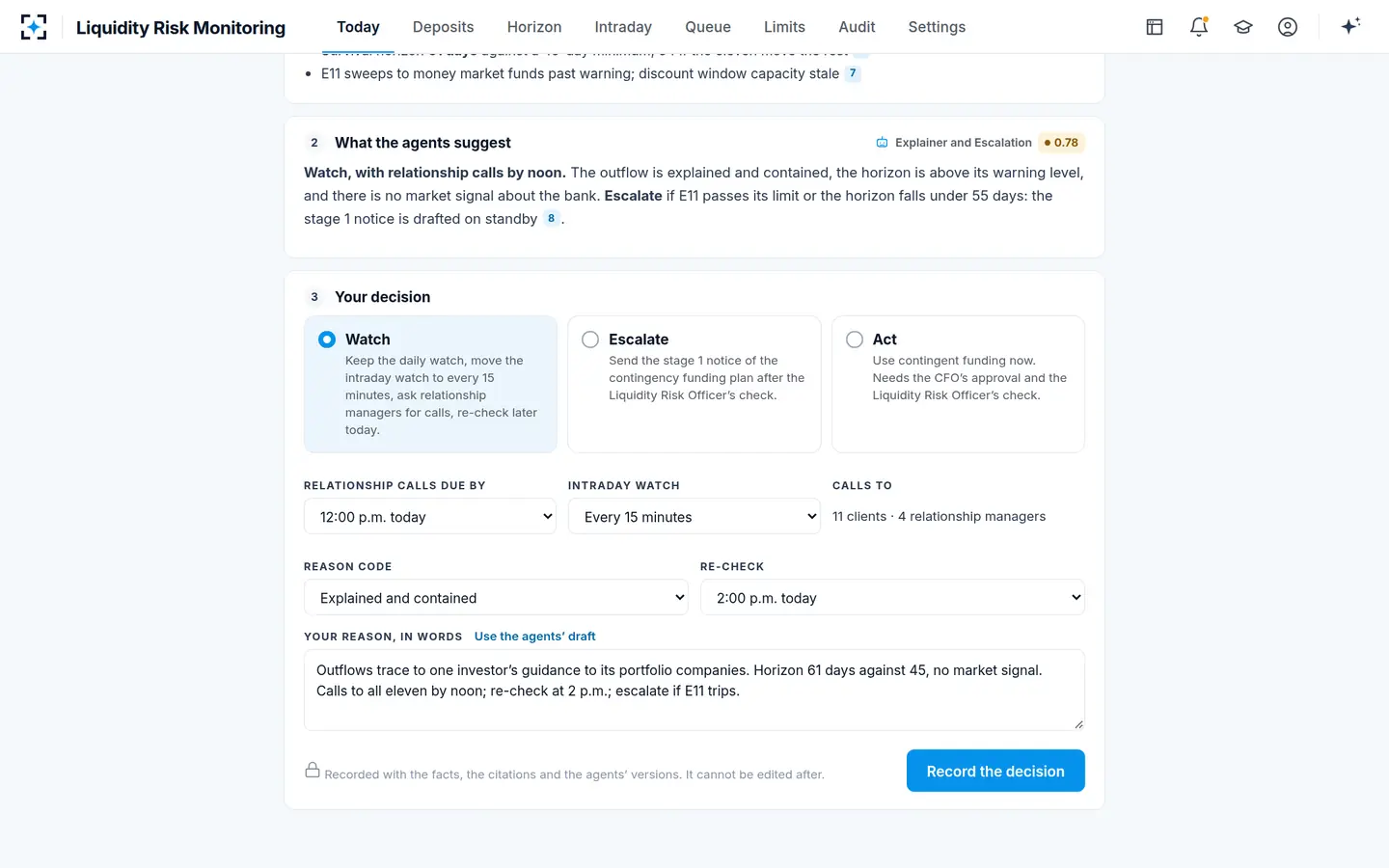
In the sample bank, one of the 18 morning indicators is the peak intraday net outflow of the previous day. On October 21 it was $1.12 billion at 2:10 p.m., $0.08 billion under its warning level, close enough that the analyst confirms its explanation each morning. On October 22, after uninsured commercial deposits tripped, the treasurer's decision moved the intraday watch to every 15 minutes for the day, with a re-check at 2:00 p.m. and escalation if sweeps to money market funds passed their limit.
The treasurer's decision sets the intraday watch to every 15 minutes
Can treasury stop a payment in a liquidity stress?
Treasury can sequence and prioritize the bank's own payments and manage the credit it extends to customers, but a depositor's instruction to move their own money is not the treasurer's to cancel, and the rules frame intraday management as meeting obligations, not avoiding them. The policy statement's verbs are to "prioritize time-specific and other critical obligations," "settle other less critical obligations as soon as possible," and "control credit to customers when necessary." Regulation YY uses the same language for the largest holding companies: "Manage the issuance of credit to customers where necessary" (12 CFR 252.34(h)(3)).
The useful levers in a stress are on the funding side: pledging and moving collateral early enough to obtain intraday and overnight credit, drawing tested lines before the cut-off, and knowing the queue well enough to borrow the right amount. Signature's afternoon shows what happens when those levers are pulled late. In the sample design, no agent holds, stops or delays a payment; the Intraday Watch agent measures and alerts, and every funding action is a decision by named people.
Who decides on an intraday funding action?
The treasurer decides, within authority the contingency funding plan sets, and any action that moves money needs a second signature. The FDIC's manual expects plans to "establish clear lines of authority and reporting by defining responsibilities and decision-making authority," and a stress day is when they are tested. In the sample bank the chain is fixed in advance.
From an intraday alert to a funding action, and who signs at each step
Agent
Intraday WatchReads the payments hub every 15 minutes on a stress day and alerts the treasurer and the analyst at the warning level and the limit.
Never: holds, stops or delays a payment.
Agent
ExplainerNames the clients and channels behind the outflow, with each payment record cited.
Never: names other clients or any BSA/AML matter in a relationship manager's note.
A person decides
AnalystConfirms the facts of the alert, or overrides an explanation with a reason.
A person decides
TreasurerDecides to watch, escalate or act. Escalating sends the contingency funding plan's stage 1 notice after the liquidity risk officer's check.
A person decides
CFOApproves any action that uses contingent funding now, with the liquidity risk officer's check.
Agent
Record KeeperRecords the decision with its facts, citations and reason.
Never: edits a recorded decision.
What does the interagency policy statement say about intraday liquidity?
The policy statement says intraday liquidity monitoring is important for institutions with significant payment, settlement and clearing activity, that those with material activity should actively manage intraday positions under normal and stressed conditions, and that a strategy should cover gross flows, collateral, prioritized obligations and customer credit. It also states the stakes: "An institution's failure to manage intraday liquidity effectively, under normal and stressed conditions, could leave it unable to meet payment and settlement obligations in a timely manner, adversely affecting its own liquidity position and that of its counterparties."
Two other passages make intraday part of the wider program rather than a payments-desk concern. Collateral systems "should be capable of monitoring shifts between intraday and overnight or term collateral usage," and the statement asks liquidity planners to "understand the amounts of collateral and liquidity needed to perform payment-system obligations when assessing the organization's overall liquidity needs." For holding companies of $100 billion or more, Regulation YY requires procedures for monitoring intraday exposures, and for Category I to III firms spells out the same elements.
Intraday liquidity risk management after SVB: the assumptions count too
Intraday liquidity is not only watched on the day; it is an assumption in every stress test, and SVB showed it can be eased like any other. When its internal stress test was failing in 2022, management changed its methodologies for unfunded commitments and intraday liquidity in October, reducing the modelled 30-day requirement by about $8 billion and $5 billion respectively, according to the Federal Reserve's review; supervisors later flagged "the recent changes to make lending commitments and intraday assumptions less conservative" (Federal Reserve, April 2023).
The practical step is to treat the intraday assumption in the stress test and the intraday measure on the day as the same number seen twice: if the stress test assumes the bank needs a certain buffer to get through a day of payments, the intraday watch should show whether actual peaks are inside it. The sample bank's daily peak intraday net outflow indicator does that comparison every morning. How intraday needs feed the survival horizon is in how to calculate a survival horizon, and the morning that set this day's watch is traced in a liquidity dashboard morning, step by step.
Liquidity Risk Monitoring's decision on record: the intraday watch runs every 15 minutes
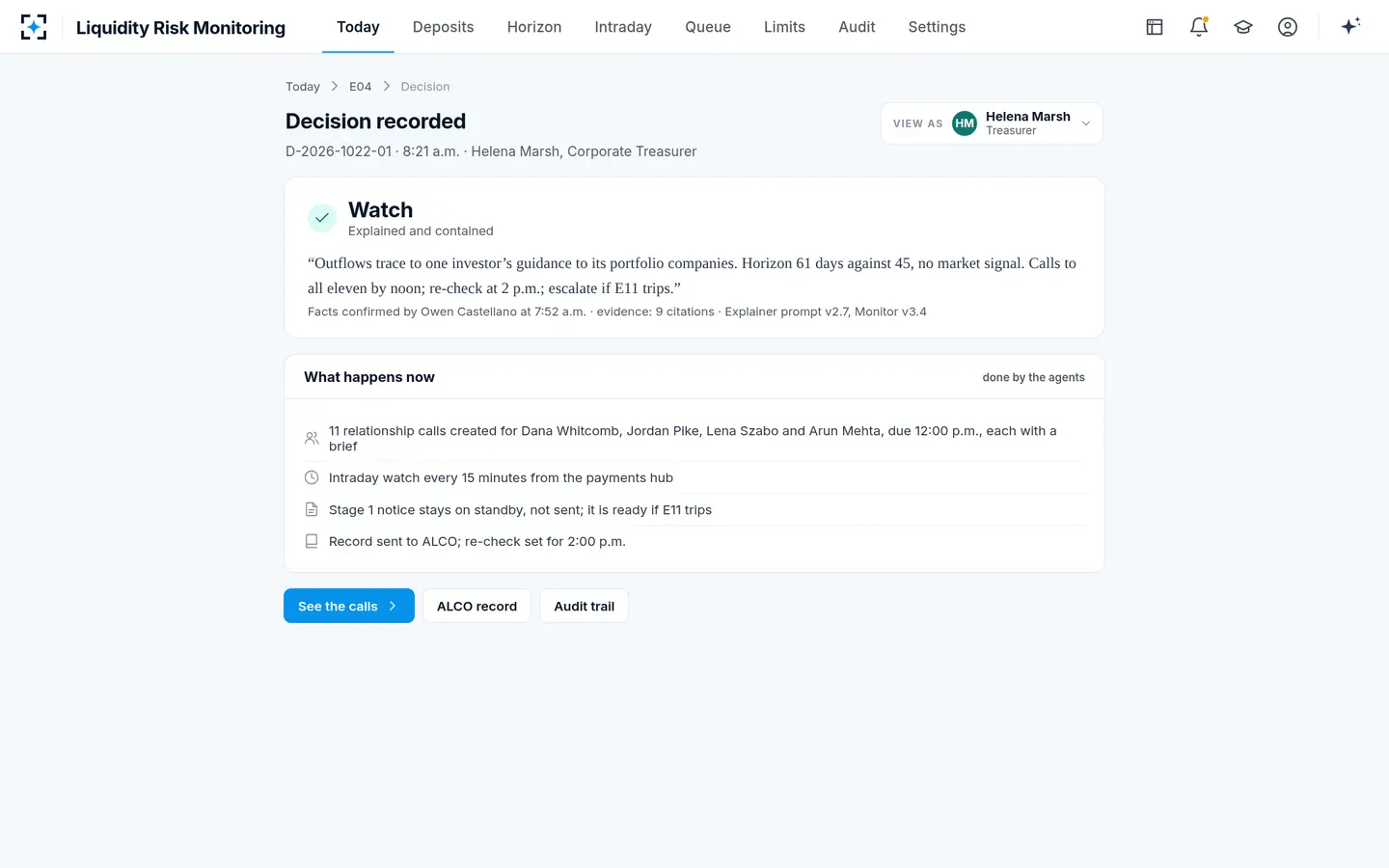
The whole morning-to-afternoon cycle, with the agents and the people at each step, is on the Liquidity Risk Monitoring page.
Questions people ask
What is a net debit cap?
A net debit cap is the maximum amount of uncollateralized daylight overdraft a bank may incur in its Federal Reserve account. Under the Federal Reserve's payment system risk policy it equals the bank's cap multiple times its capital measure, and the cap category, from zero to high, normally does not change within a year.
Does a community bank need intraday liquidity monitoring?
Most need a simple version. The OCC says small, non-complex banks' intraday processes typically focus on the funds and credit in their Federal Reserve or correspondent account, with active monitoring of significant settlement activity and enough cash and daylight overdraft capacity. A bank with large wire volumes, derivatives margin or concentrated commercial depositors needs more.
What are the Basel intraday liquidity monitoring tools?
They are seven quantitative monitoring tools the Basel Committee published in April 2013 to help supervisors monitor banks' management of intraday liquidity risk. They are for monitoring only, apply to internationally active banks, and have been reported monthly since January 1, 2015; national supervisors decide whether they apply to other banks.
What is a late-day liquidity test?
A test of contingent funding run late in the business day, when markets are thin and cut-offs are close. The OCC's examiner booklet notes that late-day simulations "can point out specific problems, such as difficulties in selling assets or borrowing new funds when the markets are winding down or staff may become inefficient," which is the situation Signature Bank met when it approached its FHLB too late in the day.
How is intraday monitoring different from daily liquidity monitoring?
Daily monitoring asks whether the bank's position at the close, and over the coming days and weeks, is within its limits; intraday monitoring asks whether each payment can be funded when it is sent. A bank can be comfortably liquid at the close and still breach its net debit cap at 11 a.m. if large outflows arrive before expected inflows.