Liquidity monitoring tools are the systems a bank uses to watch its liquidity between regulatory reports: they gather balances, payments, stress results and collateral, compute the bank's early warning indicators and ratios against its limits, and tell treasury and the second line what has changed. Almost every tool on a shortlist will calculate a ratio correctly. The differences that matter on the day appear elsewhere: whether the tool admits that a feed is late, whether it can explain an outflow down to the depositors behind it, whether its assumptions are visible and governed, and whether the decision taken on a tripped indicator is recorded with its reason. Botminds' Liquidity Risk Monitoring is an agentic solution for that work, in which seven agents recompute, trace and draft while the analyst confirms, the treasurer decides and the liquidity risk officer checks. The fifteen questions below are the ones we would ask of any tool, ours included, with the answer to look for, the red flag, and a test to run on your own files.
Product examples come from the solution's fictional sample bank, Corvane National Bank. Rules and failure facts are the agencies', linked where they appear; the questions and the scoring are ours.
Fifteen questions for any liquidity monitoring tool, grouped by what goes wrong
- Data 1. What happens to every number when a feed is late?
Good: each dependent value is marked stale with the time of its last good value. Red flag: yesterday's value in today's colour.
- Data 2. Does it tie deposits to the general ledger every day, and refuse to publish when they do not tie?
Good: a tie-out with a tolerance and a visible break. Red flag: "we load what you send us".
- Data 3. Can it show collateral positions daily, by what lenders will actually accept?
Good: pledged and unencumbered collateral with eligibility and haircuts. Red flag: one capacity figure with no source.
- Explanation 4. Can it say which depositors moved the money?
Good: cohort, accounts and channels from payment records, each cited. Red flag: a sector chart and a promise.
- Explanation 5. Does every number open the record it came from?
Good: one click to the core extract or the settlement record. Red flag: a definition page instead of the data.
- Explanation 6. How does it show a cause it is unsure of?
Good: below a set confidence, as a question for a person. Red flag: every explanation stated with the same certainty.
- Assumptions 7. Where do the stress outflow assumptions live, and who can change them?
Good: in the bank's ALM model, read and never changed by the tool. Red flag: the tool re-estimates run-off rates on its own.
- Assumptions 8. When a stress result improves, does it say whether an assumption changed?
Good: old and new assumptions side by side. Red flag: a better number with no history.
- Assumptions 9. Can it re-run the survival horizon on the depositors who just moved?
Good: a what-if in minutes, on named cohorts. Red flag: a request to the ALM team for next week.
- Control 10. Can the person who proposes a limit change approve it?
Good: no; a second person approves and the committee ratifies. Red flag: an administrator can edit limits.
- Control 11. Is the decision on a tripped indicator recorded with a reason, and can it be edited later?
Good: recorded, reason required, not editable. Red flag: decisions live in email.
- Control 12. Can it draft the contingency funding plan's first notice without sending it?
Good: drafted on standby, sent only after a decision and a check. Red flag: automatic sending, or nothing at all.
- People 13. Who can see client names, and is each look logged?
Good: cohorts by default, names for permitted roles with a logged reason. Red flag: everyone with access sees everything.
- People 14. What does it never do on its own?
Good: a written list, such as never holds a payment, never sends a notice, never changes a limit. Red flag: "it's configurable".
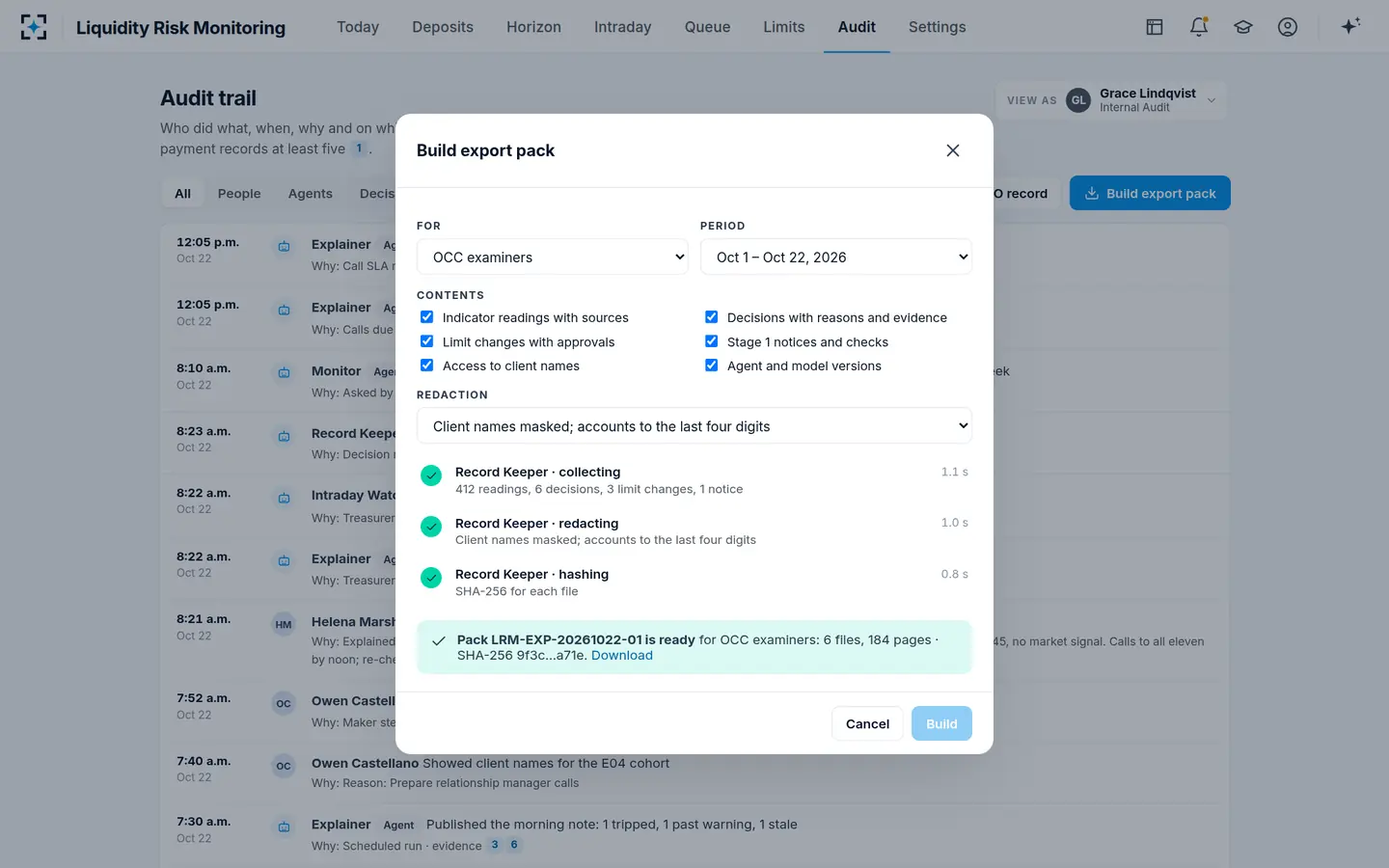
- People 15. What can it hand an examiner, and how long does that take?
Good: readings, decisions, limit changes and approvals, masked and fixed, in one step. Red flag: a services engagement.
What are liquidity monitoring tools?
The phrase has three meanings, and a buyer should know which one a seller means. First, the bank's own monitoring systems: the indicators, limits, stress results and reports that treasury and risk use every day, which is what this guide is about. Second, regulatory reporting systems such as those that produce the FR 2052a and the LCR for larger banks; those are covered in liquidity reporting in US banks. Third, the Basel Committee's "liquidity monitoring tools," a defined set of metrics supervisors use, which share the name but are a standard rather than a product.
The agencies' guidance describes what the first kind has to do. The 2010 policy statement expects reports that show the bank's liquidity risk and whether it is inside its limits, and lists the items they may carry, from early warning indicators to the state of contingent funding sources and collateral (Interagency Policy Statement; the list is quoted in the liquidity risk analyst's desk). Any tool that cannot do those things is not a liquidity monitoring tool, whatever else it does.
What are the Basel liquidity monitoring tools?
The Basel liquidity monitoring tools are metrics the Basel Committee set for supervisors alongside the liquidity coverage ratio, now in chapter SRP50 of the Basel Framework. The Framework's own summary says "The tools cover contractual maturity mismatch, funding concentration, available unencumbered assets, LCR by currency, market-related monitoring tools and intraday metrics" (Basel Framework, SRP50). They sit beside the ratio in the January 2013 standard, Basel III: The Liquidity Coverage Ratio and liquidity risk monitoring tools (BCBS 238), and the intraday part is a separate set of "seven quantitative monitoring tools," introduced "for monitoring purposes only," for internationally active banks, with monthly reporting from January 1, 2015 (BCBS 248).
For a US buyer they are a useful checklist of measures, not a specification. A bank's own tool should be able to show its funding concentration, unencumbered assets and maturity mismatch, because those are the measures examiners and the Basel standard both use; how it should show them, every morning and with the depositors named, is the bank's own requirement.
How do liquidity tools handle late data?
A good liquidity tool handles late data by saying so: every number that depends on a late feed is marked stale with the time of its last good value, nothing is filled in silently, and the indicators re-run when the file lands. It matters because the inputs most often late, collateral and borrowing capacity, are the ones that decide the worst day. Signature Bank's examiners found its liquidity reports still overstating unpledged securities up to the weekend it failed (FDIC, April 2023; the ALM report, traced to one balance quotes the finding).
The test takes an hour. Hold back the collateral file on a test day and look at every screen. In the sample bank, the collateral management system's 5:00 a.m. file was late on October 22; discount window capacity kept its October 21, 6:12 p.m. value of $6.2 billion, marked Stale everywhere, and the survival horizon panel shows what the horizon would be without it: 36 days against a 45-day minimum.
Can liquidity tools explain deposit outflows?
Some can, and it is the question that separates tools most clearly. Explaining an outflow means going below the aggregate to the cohort, the accounts and the channels, with the payment records cited. The FDIC tells its examiners that too much aggregation in liquidity analysis can hide a large risk (FDIC RMS Manual, Section 6.1). A tool that shows a sector bar chart has measured concentration; it has not explained a move.
What an explained outflow looks like in Liquidity Risk Monitoring
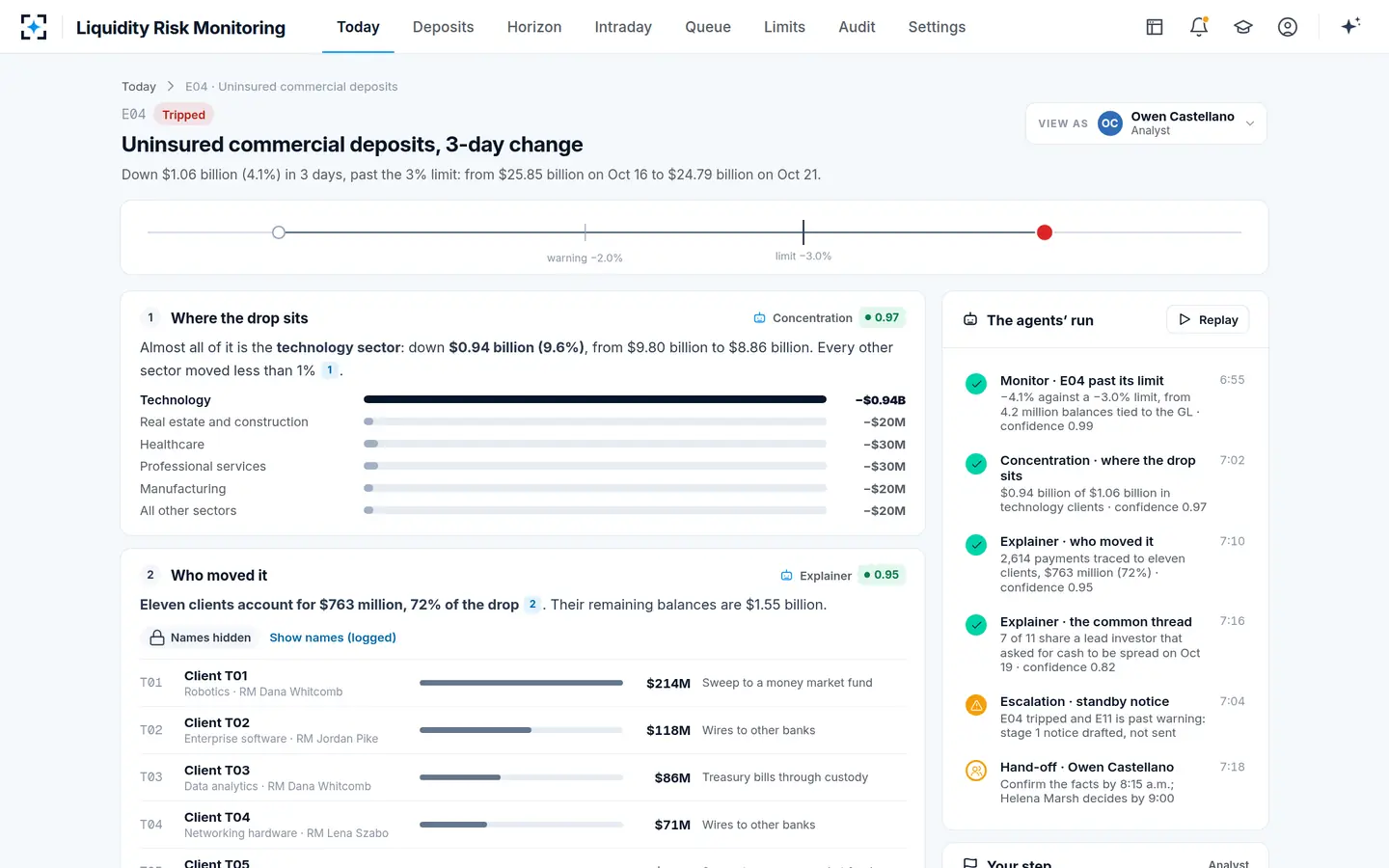
Ask for the explanation on your own data, not the vendor's. Pick the week of your largest recent outflow, give the tool the files as they were that week, and compare its answer with what your team found by hand at the time. Time it. Then ask what it does when the cause is unclear: in the sample bank, the Explainer agent shows a cause below 70% confidence as a question for a person rather than a fact, a threshold the liquidity risk officer must approve to change. How the method works on one morning is set out in naming who moved the money.
Do liquidity monitoring tools need model validation?
It depends what the tool does. Under the 2026 interagency model risk guidance, SR 26-2, which replaced SR 11-7 in April 2026, simple arithmetic and deterministic rule-based processes are outside the definition of a model, and generative and agentic AI models are outside the guidance's scope altogether; how SR 26-2 treats a risk model sets out the text. Indicator arithmetic against thresholds is usually not a model; the ALM model whose stress cash flows drive the survival horizon usually is, and stays under the bank's model risk program whatever monitoring tool reads it.
Agentic tools sit in the gap, and the agencies have said so. The OCC's spring 2026 risk perspective finds banks adopting generative and agentic AI cautiously, mostly in narrow use cases with guardrails and a person accountable for the outcome (OCC, Spring 2026). The Financial Stability Board's October 2026 sound practices name the risk directly.
AI agents pose a distinct challenge for human oversight, given the impracticality of real-time human monitoring of agent decisions as their use scales.
Financial Stability Board, Sound Practices for Responsible Adoption of Artificial Intelligence, final report, October 15, 2026
The buyer's answer is to ask questions 6, 11, 12 and 14 hard. A tool whose agents compute, trace and draft, and never decide, send, change a limit or hold a payment, keeps every consequential action with a named person, which is the governance the regulators describe. A tool whose agents act on their own needs a governance case the bank should be ready to defend.
What should liquidity monitoring tools include?
A liquidity monitoring tool should include the bank's own indicators and limits under maker-checker control, daily data with tie-outs and stale marking, account-level explanation of moves, a survival horizon with what-ifs, decision recording, contingency funding plan integration, role-based access to client data, and an examiner export. The rubric below weights them by what failed in 2023; adjust the weights for your bank.
A scoring rubric for liquidity monitoring tools
| Group | Weight | What a top score needs | Where 2023 tested it |
|---|---|---|---|
| Data and timeliness | 25% | Daily tie-out, stale marking, collateral by eligibility | Signature's pledged securities misstated until the day it failed |
| Explanation | 25% | Cohort, accounts and channels, cited; uncertain causes shown as questions | SVB's correlated run by one network of depositors |
| Assumptions and stress | 20% | ALM assumptions read, never changed; assumption changes shown; what-ifs on named cohorts | SVB's stress assumptions eased in October 2022 |
| Control and decisions | 20% | Maker-checker on limits; decisions recorded with reasons and not editable; plan notices drafted, never sent alone | Signature's limit raised from 10% to 35% after a breach |
| People and evidence | 10% | Names by role with logged reasons; a written list of what agents never do; one-step examiner export | Signature's weak issue tracking; SVB's contingent funding gaps only partly resolved when it failed |
Evasive answers and good answers, side by side
Vendor answers to these questions fall into recognisable patterns. An evasive answer describes a capability; a good answer describes what happens on a specific morning with specific data, and offers to show it. The comparison below pairs the two for five of the questions.
How to tell an evasive answer from a good one
Evasive answer: "Our data quality layer handles that."
Good answer: "Every dependent number is marked stale with its last good time; hold a file back in the trial and look."
Evasive answer: "You can drill down by segment."
Good answer: "Give us your largest outflow week; we will name the depositors and channels, cite each payment, and you compare it with your own trace."
Evasive answer: "Our models are best in class."
Good answer: "We read your ALM model's stress cash flows and never change an assumption; changes stay with ALCO."
Evasive answer: "Limits are fully configurable."
Good answer: "A proposer cannot approve their own change; try it in the trial."
Evasive answer: "The agents can take action automatically."
Good answer: "Here is the list of what the agents never do: hold a payment, send a notice, change a limit, decide."
What does a good demo of liquidity software show?
A good demo of liquidity software shows your bank's own bad morning, not a clean sample month. Ask for four things in a trial: a month of your own balances and payments, your own indicator list and limits, one held-back file, and your largest recent outflow week. Then watch for five moments: the stale mark when the file is missing, the named depositors behind the outflow, the survival horizon re-run on them, a limit change stopped at its proposer, and a recorded decision you cannot edit the next day.
Botminds offers to run Liquidity Risk Monitoring on a bank's own early warning indicators and a month of its balances and payments, and to show the accounts behind each move. A trial on that basis answers most of the fifteen questions with the bank's own evidence. What the first weeks after a purchase look like is laid out in a six-week go-live plan.
Question 15 in Liquidity Risk Monitoring: an examiner export built in one step
Where Liquidity Risk Monitoring fits, and where it does not
Liquidity Risk Monitoring fits a bank whose liquidity risk sits in who holds its deposits: concentrated or uninsured commercial money, sector exposure, sweeps and wires that can move quickly, and a contingency funding plan whose first stage depends on a morning call. It answers questions 1 to 15 with the agents doing the arithmetic, the tracing and the drafting, and named people confirming, deciding and checking. Its morning is traced in a liquidity dashboard morning, step by step.
It does not fit every need, and a buyer should not be told otherwise. It is not an ALM model and does not produce interest rate risk measures; the bank's interest rate risk process owns those, as interest rate risk management software sets out. It does not file the FR 2052a or compute a regulatory LCR. It does not author or test the contingency funding plan. It never moves money. And a small bank with a granular, insured deposit base and little payment activity may not need daily explanation at all; for such a bank, a reliable monthly report and the agencies' minimum reporting cadence may be the right answer. The solution itself is described on the Liquidity Risk Monitoring page.
Questions people ask
How do you evaluate liquidity monitoring software?
Score it on your own data against what failed in 2023: late or wrong inputs, unexplained outflows, eased assumptions, moved limits and unrecorded decisions. Run a trial with a held-back file, your largest recent outflow week and your own limits, and weigh what you see above what you are told.
What is the difference between ALM software and liquidity monitoring tools?
ALM software models the balance sheet's cash flows and rate sensitivity under scenarios, usually monthly or quarterly; liquidity monitoring tools watch the actual position daily or intraday against indicators and limits, and explain what moved. A monitoring tool should read the ALM model's stress cash flows rather than replace them.
Do liquidity monitoring tools need to cover intraday liquidity?
If the bank has material payment, settlement or clearing activity, yes; the 2010 policy statement expects such banks to manage intraday liquidity actively under normal and stressed conditions. Smaller banks typically need a watch on their Federal Reserve or correspondent account rather than a full intraday framework.
Can AI agents be trusted with liquidity monitoring?
With the arithmetic, the tracing and the drafting, if every statement is cited and every consequential action stays with a named person. The FSB's 2026 sound practices warn that real-time human monitoring of agent decisions becomes impractical as their use scales, which argues for agents that never decide, send or change anything on their own.
How much does liquidity monitoring software cost?
There is no public benchmark for liquidity monitoring software prices, and quotes vary with scope and data. A more useful comparison is the hours it saves: Botminds estimates that a morning with one tripped indicator takes about eleven hours of people's time by hand and a little over one with the agents, an estimate to test against your own desk.