Liquidity reporting in US banks is the work of describing, position by position, how much cash a banking organization can raise and how much it could be asked to pay, and at every U.S. banking organization with $100 billion or more in assets its regulatory anchor is the Federal Reserve's FR 2052a, the Complex Institution Liquidity Monitoring Report. A Category IV monthly filer has ten calendar days after the as-of date; daily filers and Category III monthly filers have two business days; all submit by 3:00 p.m. Eastern. The hard part is not the liquidity coverage ratio at the end. It is proving that every inflow and outflow in 13 tables came from a complete feed, carries the right product, counterparty and maturity bucket, and ties to the general ledger. Botminds' FR 2052a Liquidity Reporting gives that proof to agents, with analysts and managers deciding every change.
The calendar on this page is real. It follows a September 30, 2026 report at a Category IV firm, the monthly filer the instructions give the longest clock. T+10 falls on Saturday, October 10. Monday, October 12 is Columbus Day, a Federal Reserve holiday (Federal Reserve, holidays observed 2026). So the report is due by 3 p.m. on Tuesday, October 13. The plan inside those thirteen calendar days is an illustration of how many desks divide the work; the screens come from the solution's fictional sample bank.
Four numbers set the rhythm of the FR 2052a desk
T+10
calendar days for a monthly Category IV filer
moved to the next business day if it lands on a weekend or holiday
T+2
business days for daily filers and Category III monthly filers
3:00pm ET
the submission time the instructions set
121hours
per monthly response, by the Federal Reserve’s own estimate
Thirteen calendar days for a ten-day report, and two business days for a daily one
- Count feedsOct 1–2
- WeekendOct 3–4
- ClassifyOct 5–6
- Tie outOct 7–8
- ExplainOct 9
- Weekend, holidayOct 10–12
- SubmitOct 13
- BuildOct 1
- SubmitOct 2
What is liquidity reporting in banks? One data set, three readers
Liquidity reporting in banks serves three readers from the same positions. Treasury and the asset-liability committee use it to manage funding day to day. The board uses it to check that the firm stays inside the liquidity risk tolerance it approved. The supervisor uses it to watch the firm, and the system, for funding stress. At a large U.S. banking organization the first two are internal reports; the third is the FR 2052a.
The internal side has its own legal floor. Regulation YY requires a bank holding company with $100 billion or more to produce cash-flow projections and to "update short-term cash-flow projections daily and must update longer-term cash-flow projections at least monthly" (12 CFR 252.34(e)). The FR 2052a is the supervisor's view of the same balance sheet, cut by contractual maturity rather than by the firm's own behavioural assumptions. The instructions say what the Federal Reserve wants from it: data that "provide timely information on firm-specific liquidity risks during periods of stress" (FR 2052a instructions, Purpose).
Who files is set by the tailoring categories. Top-tier U.S. bank holding companies and covered savings and loan holding companies with $100 billion or more in total consolidated assets, on a four-quarter average, report, as do foreign banking organizations with $100 billion or more in combined U.S. assets. Category I to III firms report the consolidated entity, the parent company alone and each material entity, and every bank subsidiary with $10 billion or more counts as material. Category IV firms report the consolidated entity and the parent, and ask their supervisory team whether any material entity should be added. The full set of rules, measured table by table, is in the guide to the FR 2052a reporting requirements.
What time is the FR 2052a due? T+2, T+10 and 3 p.m. Eastern
The FR 2052a is due by 3:00 p.m. Eastern on T+2 business days for daily filers and Category III monthly filers, and on T+10 calendar days for Category IV monthly filers. Day T is the as-of date. The instructions add one rule that decides real deadlines: "If the submission date falls on a weekend or Federal Reserve bank holiday based on a calendar day reporting cycle, the submission is due the following business day" (FR 2052a instructions, When to Submit the Report). Weekends and U.S. bank holidays are not as-of dates: no report is submitted for them.
Who reports how often, and how fast
| Reporter | Frequency | Timing |
|---|---|---|
| Global systemically important bank holding companies; Category II firms; Category III firms with $75 billion or more in average weighted short-term wholesale funding (and the matching foreign banking organizations) | Each business day | T+2 business days |
| Category III firms with less than $75 billion in average weighted short-term wholesale funding (U.S. and foreign) | Monthly | T+2 business days |
| Category IV firms (U.S. and foreign) | Monthly | T+10 calendar days |
| Supplemental-Balance Sheet table and the NSFR supplemental products, for the firms the instructions name | Month-end (quarter-end for the balance sheet table at Category IV firms under $50 billion of that funding) | T+15 calendar days |
The difference between the first and last rows is the difference between two jobs. A Category IV desk has a month to think and ten days to prove. A daily desk files about 250 reports a year, the frequency the Board itself assumes when it estimates the burden (FR 2052a supporting statement, February 2025), and is always finishing one as-of date while the next two are already loading.
Days one and two: is every feed in, and is it whole?
The first two days answer one question: did every source deliver everything it should have? The solution's sample run draws on 43 feeds: the deposit system, the loan subledger, securities and collateral, derivatives, treasury funding, the legal entity master. A feed that arrives with half its rows does not fail loudly. It produces a table that looks small, and someone notices on day seven.
The instructions make completeness the analyst's problem. Report "all executed transactions, including transactions that have traded but have not settled", and leave out anything anticipated but not executed. Because the FR 2052a is a flat file with an open number of rows, there is no fixed template whose empty cells would expose a gap; the only test is to count each feed against what it normally sends and when.
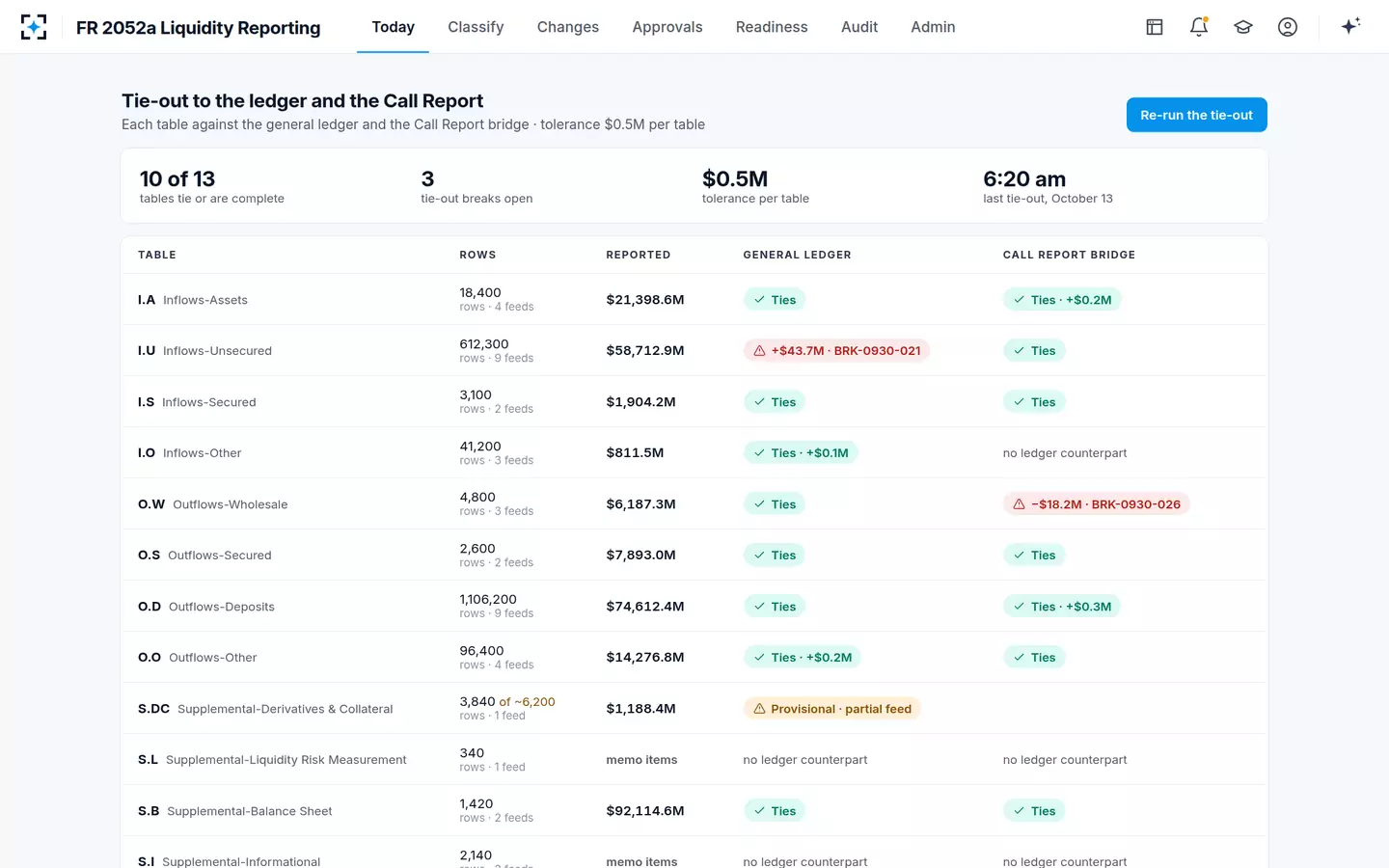
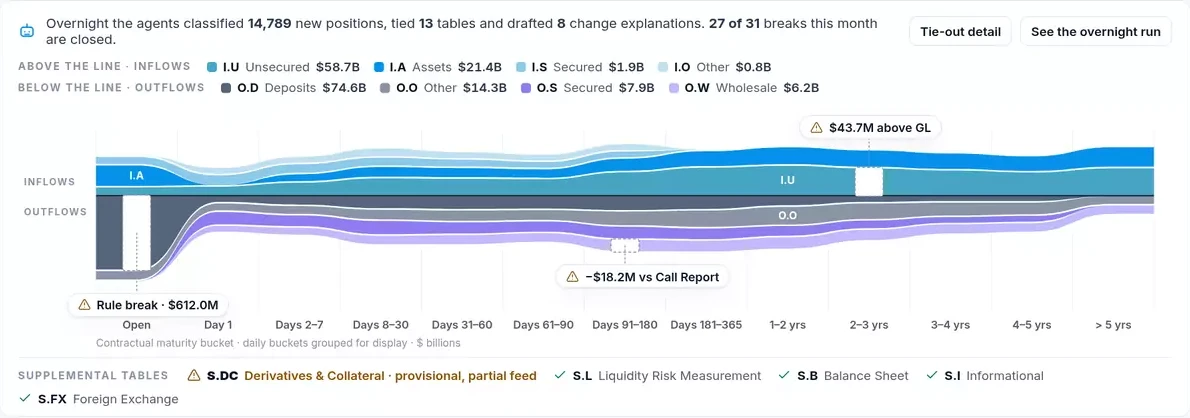
In the solution's sample run, 42 of 43 feeds were complete by 6:10 a.m. on the first working morning. One, from the securities and collateral system, delivered 3,840 of about 6,200 rows. The Derivatives and Collateral table was marked provisional and the other twelve ran on, so the analyst started with a list of what was missing instead of a report that was quietly short.
Days five and six: classifying what is new this month
Classification is where a month's judgement goes. Every position needs a product, a counterparty type, a collateral class where there is collateral, a maturity bucket and, for deposits, an insured flag. Positions that existed last month mostly keep their codes. The work is in what changed: a new deposit program, a new facility type, a counterparty whose legal form is unclear, a balance whose maturity moved.
The definitions are precise and they cut against habit. Counterparty type follows "the legal counterparty to a given exposure and not the counterparty's ultimate parent". A retail deposit counts as a relationship account only where the firm "has demonstrated to the satisfaction of the supervisory team" that the depositor's other ties make withdrawal highly unlikely, and brokered, sweep and reciprocal deposits are excluded from it outright. Maturity buckets are calendar days after T, from Open and Day 1 through Day 60, then wider bands out to more than five years and Perpetual, and they follow contractual maturity, never the firm's behavioural assumptions. Every one of those fields comes from a different system, which is why the FR 2052a data dictionary has to be mapped field by field to its owner.
One wrong product moves the numbers that matter. In the sample run, $612.0 million of balances from a treasury sweep program had been mapped as retail relationship deposits, which carry the 3% stable retail outflow rate in the liquidity coverage ratio. The program sweeps brokerage cash from an affiliate into the bank at each day's close, so under the current instructions the balances belong in the affiliated sweep products (O.D.9 or O.D.10), where fully insured balances run off at 10% and the rest at 40%. Corrected, the derived 30-day outflows rose by $58.4 million.
Days seven and eight: tying 13 tables to the general ledger
Tie-out answers whether the report describes the same balance sheet the firm reports everywhere else. Each table is compared with the general ledger and, through a bridge, with the Call Report. A difference above the desk's tolerance is a break: a named discrepancy with an owner, an amount and a due date. If it cannot be fixed in the source system before the deadline, the desk books a top-side adjustment, a manual change to the report's output that leaves the source as it was, and that adjustment has to be retired once the source is fixed.
The tie is not a simple sum. The instructions require some exposures to appear twice, collateral swaps in both the secured inflow and outflow tables and loans in both the inflow tables and the asset table among them, and they provide a Supplemental-Balance Sheet table with counterparty netting and carrying value adjustments precisely so that the Federal Reserve can rebuild an accounting balance sheet from the file. An analyst who sums the tables and compares them with total assets will find differences that are correct.
Each table against the general ledger and the Call Report bridge, with the breaks named
Day nine and the last morning: explaining the month, then signing
The last working days go to explanation. Supervisors read the FR 2052a as a series, so a table that moved by hundreds of millions needs a reason in plain words: municipal tax receipts, a certificate of deposit promotion, a reclassification that moved balances between products without changing the total. The comments table carries some of this formally: products reported as "Other", and several catch-all categories, need a description "on at least a monthly basis and in the event of a material change in reported values".
Then the run is signed off and sent. The Board's supporting statement describes the mechanics: respondents "submit XML files via a secure file transfer protocol to the Federal Reserve Bank of New York" (supporting statement, 2025). For the September 30 report in the timeline, that file is due by 3 p.m. on October 13. A desk that is still closing breaks on the final morning is choosing between filing a top-side adjustment it cannot fully explain and filing late.
What does a liquidity reporting analyst do at a daily filer?
At a daily filer, a liquidity reporting analyst runs the same checks every business day with two days to finish each one. The September 30 report in the timeline would be due Friday, October 2 at 3 p.m. Holidays stretch the window unevenly: a Friday, October 9 report counts Tuesday the 13th as its first business day and is due Wednesday the 14th.
The daily job is less about the month's story and more about exceptions. Classification rules must be settled in advance, because there is no week in which to debate a new product. Feeds must arrive by fixed times. Breaks are triaged the same day: fix it in tomorrow's run, adjust today's, or escalate. The Board estimates 221 hours of work per daily response against 121 for a monthly one, and with 250 responses a year the daily filers carry almost all of the report's million hours.
How long does the FR 2052a take, and where do the hours go?
The Federal Reserve estimates 121 hours per monthly response and 221 per daily response, and 1,027,896 hours a year across all filers (Federal Register, February 7, 2025). The Board does not say how those hours divide. Our own estimate for a monthly response, below, puts most of them in mapping, tie-out and chasing data owners; the ratio itself is not a line, because once the data are right it is arithmetic.
Where the 121 hours of a monthly response go, by Botminds' estimate
What skills does liquidity reporting need?
Liquidity reporting needs three skills that rarely sit in one person: reading regulatory definitions literally, tracing a number back through systems, and explaining a change to someone senior in two sentences. The first is harder than it sounds. The FR 2052a counterparty types are defined by reference to statutes, from the Employee Retirement Income Security Act for pension funds to the Investment Company Act and the Dodd-Frank Act; collateral values follow fair value under GAAP; and many products only make sense next to the LCR rule they feed.
The second skill is data work: knowing which system owns a field, reading an extract, finding why two totals differ. The third is judgement under a clock: deciding which break can wait for next month's source fix and which must be adjusted now. The desk is a team of seats, and each one changes when agents do the first pass.
Four seats on the FR 2052a run, before and with agents
Today
Reviews mapping exceptions in spreadsheets, ties tables to the general ledger with bridge files and emails data owners when something does not tie.
With agents
Opens each break with the proposal, the instruction passage and the liquidity effect already there, and accepts or rejects with a reason code.
Still theirs: the decision on every classification below the confidence threshold
Today
Asks why each table moved while analysts rebuild the answer from queries and email.
With agents
Approves every reclassification, adjustment and break closure as checker, with the evidence in front of them.
Still theirs: sign-off on the run
Today
Reads the derived ratio at sign-off, after the classifications behind it are made.
With agents
Sees each change above the materiality threshold priced before the run is signed.
Still theirs: the challenge
Today
Hears about a break by email days before the deadline, often as a screenshot.
With agents
Receives a drafted source fix with the product code, the accounts, the rule and the evidence.
Still theirs: the fix in the source system
Where FR 2052a Liquidity Reporting changes the ten days
The solution moves the first pass of each stage into the night before, and leaves every decision with a person. A Feed monitor counts each feed against its expected rows and time and marks a partial table provisional. A Classifier proposes product, counterparty, collateral class, maturity bucket and insured flag for each new or changed position, and a separate Rule agent re-checks each proposal against the instructions and either agrees or opens a rule break. A Tie-out agent compares every table with the general ledger and the Call Report bridge. A Change agent drafts each table's month-over-month explanation and shows any residual it cannot explain.
In the sample run that meant 14,812 new or changed positions classified overnight, 14,789 agreed by the Rule agent, and 23 sent to a person, before the analyst logged in. The analyst's days five to eight become a queue of named breaks rather than a search for them. The design target is that all 13 tables tie to the general ledger and the Call Report bridge before the run is signed. How the agents and people divide authority, including what an agent may never do, is set out in the guide to FR 2052a liquidity reporting with agents.
FR 2052a Liquidity Reporting: the whole report on one strip, with the gaps that do not tie
Questions people ask
How long does the FR 2052a take to prepare?
The Federal Reserve estimates 121 hours for each monthly response and 221 hours for each daily one. Across 18 daily and 23 monthly filers that comes to 1,027,896 hours a year, the figure the Board published when it extended the report without revision in February 2025.
What is T+2 and T+10 in FR 2052a reporting?
T is the as-of date of the data. Daily filers and Category III monthly filers submit within two business days of it; Category IV monthly filers submit within ten calendar days. Both deadlines run to 3:00 p.m. Eastern.
What happens if the FR 2052a due date falls on a weekend or holiday?
The submission moves to the following business day. For a September 30, 2026 report at a Category IV firm, T+10 is Saturday, October 10, and Monday, October 12 is Columbus Day, so the report is due on Tuesday, October 13.
Do monthly FR 2052a filers ever report more often?
Yes, in two ways. The Federal Reserve may temporarily require data more often from monthly filers during periods of stress, and a firm whose category or short-term wholesale funding changes moves to daily reporting after a transition period that the instructions set.
Which entities does a Category IV firm report on the FR 2052a?
A U.S. Category IV firm reports the global consolidated entity and the parent company only, ignoring consolidated subsidiaries. Its supervisory team decides whether the parent should also report any material entity separately.
Can a firm report all FR 2052a values in U.S. dollars?
Category IV firms, and Category III firms with less than $75 billion in average weighted short-term wholesale funding, may report everything in U.S. dollar millions. All other filers report each value in its own currency for the dollar, euro, sterling, Swiss franc, yen, Australian and Canadian dollar, and convert the rest to dollars.