Liquidity regulatory reporting, for a U.S. banking organization crossing $100 billion in assets, means the Federal Reserve's FR 2052a every month, the liquidity risk-management and stress-testing rules of Regulation YY, and, once its weighted short-term wholesale funding reaches $50 billion, a liquidity coverage ratio and a net stable funding ratio that it must calculate and disclose. Most moves up a category bring a transition window, and the window is the time to run the report in parallel: rebuild your last three month-ends as if you were filing them, tie every table to the general ledger and the Call Report as filed, and compare the result table by table with what you believed your liquidity position to be. Botminds' FR 2052a Liquidity Reporting is designed to run that parallel test and to show a go-live committee the evidence.
The transition rules are dense, and the Federal Reserve has said so itself. Its review of Silicon Valley Bank found that the firm and its supervisors "spent considerable effort seeking to understand the rules and when they apply, including the implications of different evaluation criteria, historical and prospective transition periods, cliff effects, and complicated definitions" (Federal Reserve, April 2023). This guide sets out the dates, then the test.
Three windows a firm crossing the thresholds should plan around
5thquarter
Regulation YY liquidity risk management and stress testing apply no later than the first day of the fifth quarter after crossing $100 billion
5thquarter
a monthly T+10 filer moving to T+2 may stay at T+10 until the first day of the fifth calendar quarter after its category changes
2ndquarter
a monthly filer that must start daily reporting may stay monthly until the first day of the second calendar quarter after the trigger
A parallel run on past months tests what a first live filing cannot undo
Parallel run on three past months: Month-ends already closed, with the general ledger and the Call Report as filed
First live filing: This month, with feeds still arriving
Parallel run on three past months: Your own; a missed day costs a meeting
First live filing: T+10 calendar days or T+2 business days, 3:00 p.m. Eastern
Parallel run on three past months: Every product mapping tested against the agreements behind it
First live filing: Errors filed and repeated until found
Parallel run on three past months: Cut-offs and collateral classes compared with what treasury knew that month
First live filing: Breaks found under time pressure
Parallel run on three past months: Each table to a general ledger and Call Report that will not move
First live filing: Each table to a general ledger that may still be adjusted
Parallel run on three past months: Break counts, run length and adjustments, measured and trending
First live filing: Whether the first file is right, after it is filed
What is liquidity regulatory reporting? Four obligations at $100 billion
Liquidity regulatory reporting at a U.S. banking organization of $100 billion or more is four obligations, not one. The FR 2052a reports positions to the Federal Reserve. Regulation YY requires liquidity risk-management processes, internal liquidity stress tests and a liquidity buffer. The FR Y-15 reports the risk-based indicators, including weighted short-term wholesale funding, that set the firm's category and therefore everything else. And a firm subject to the LCR and NSFR must calculate them and publish quarterly disclosures (12 CFR 249.90).
What applies to a U.S. holding company at each line
| Line crossed | FR 2052a | LCR and NSFR | Regulation YY liquidity standards |
|---|---|---|---|
| $100 billion (Category IV) | Monthly, T+10 calendar days; consolidated and parent only | None below $50 billion of weighted short-term wholesale funding | Risk management, internal stress tests and buffer |
| Category IV with $50 billion or more of weighted short-term wholesale funding | Monthly, T+10; finer maturity buckets | Reduced: 70% outflow and stable funding adjustment; LCR at month-end | As above |
| Category III (e.g. $250 billion, or $75 billion of one indicator) | Monthly at T+2, or daily if weighted short-term wholesale funding is $75 billion or more; material entities too | 85% or 100% adjustment; LCR each business day | As above, with more limits and intraday monitoring |
| Category II or a global systemically important bank holding company | Daily, T+2 | Full calibration | As above |
When does a bank start filing the FR 2052a?
A U.S. holding company starts filing the FR 2052a once its total consolidated assets reach $100 billion on a four-quarter average; the instructions set no separate lead time for a first-time filer, so the start date is a conversation with the Reserve Bank, and it should start early. Regulation YY gives a longer runway for the liquidity risk-management and stress-testing requirements: a bank holding company must comply "no later than the first day of the fifth quarter following the date on which its average total consolidated assets equal or exceed $100 billion" (12 CFR 252.31).
Silicon Valley Bank's holding company is the public example. It crossed the $100 billion average in June 2021, began submitting the FR 2052a in January 2022, and became subject to the internal liquidity stress testing requirements in July 2022, the start of the fifth quarter. Its first FR 2052a came within seven months of crossing the line. A firm that sees the line coming has those months, or more if it starts before crossing, and the parallel run belongs in them.
What changes at $100 billion for liquidity reporting?
At $100 billion the change is less the ratio than the granularity. A firm used to managing liquidity from internal reports and the Call Report must now report every inflow and outflow by product, counterparty type, collateral class and contractual maturity bucket, with definitions it may never have applied before: operational deposits, affiliated sweeps, relationship accounts the supervisor must be satisfied are stable, encumbrance types for every pledged asset.
The LCR may not apply yet. A Category IV firm with less than $50 billion of average weighted short-term wholesale funding is outside the LCR and NSFR, and one above it applies a 70% adjustment and calculates the LCR on the last business day of each month. Initial application has its own clock: a firm newly subject to the LCR complies from the first day of the third calendar quarter after it becomes subject (12 CFR 249.50). The reporting obligation, though, starts with the FR 2052a, whether or not any ratio is yet binding.
How long is the transition to daily FR 2052a reporting?
The transition to daily FR 2052a reporting is one calendar quarter of grace: a monthly filer that must start reporting daily "may continue to report the FR 2052a monthly until the first day of the second calendar quarter after" its category change, or its average weighted short-term wholesale funding reaching $75 billion, takes effect (FR 2052a instructions, Transitions). A change of timing alone, from T+10 to T+2, gets far longer: a firm "may continue to report the FR 2052a monthly T+10 until the first day of the fifth calendar quarter after the banking organization's change in category is effective". Moves in the other direction take effect at once, from the first day of the first quarter in which the change is effective.
When a change is effective is itself a rule. The Federal Reserve's tailoring FAQs say a firm "meets the definition of the new category of applicable standards in the quarter in which the banking organization files the reporting form ... demonstrating that the banking organization meets the definition" (Federal Reserve, FAQs on the tailoring rules). The LCR has a matching clock: a former Category IV firm must start calculating its ratio each business day "on the first day of the fifth quarter after" it becomes Category I, II or III (12 CFR 249.10(b)).
If the category change takes effect in the first quarter of 2027, an illustration
- Q1 2027: triggertrigger
- Q2 2027 to Q1 2028: may stay at T+104 quarters
- Q2 2028: T+2Apr 1
- Q1 2027: triggertrigger
- Q2 2027: monthly1 quarter
- Q3 2027: dailyJul 1
What is an FR 2052a parallel run, and why three past months?
An FR 2052a parallel run is the full report, built for past as-of dates under the rules you are about to file under, while the report you actually file, if any, carries on unchanged. It is the only test that exercises every table, every feed and every decision under realistic conditions without the cost of a wrong filing.
Past months beat the current one because their answers are fixed. The general ledger is closed, the Call Report is filed, and treasury already knows what happened in the month: the deposit outflow, the debt issue, the collateral call. Three months beat one because a single month cannot tell a one-off error from a mapping that is wrong every time. Include a quarter-end, when the Call Report bridge is freshest, and a month with something unusual: a new product launch, a large maturity, a stressed week.
How do you run the FR 2052a in parallel? The test, step by step
Run each past month as though it were due, against the clock you will face, and measure four things: breaks opened, time to complete, top-side adjustments left open, and the difference between the derived liquidity position and the one treasury reported internally that month. The checklist below is the minimum a go-live committee should see.
A parallel run that can support a go-live decision
- Three closed month-ends, one a quarter-end
Built under the rules and category you will file under.
- Run to the real clock
T+10 calendar days or T+2 business days, measured from the as-of date.
- Every table tied
To the general ledger and to the Call Report as filed, at a tolerance you set in advance.
- Every new mapping evidenced
Each product mapping traced to the agreement and the instruction passage behind it.
- Breaks counted and owned
Opened, closed and aged per run, with source fixes assigned to data owners.
- Adjustments counted
Top-side adjustments open at each run, and whether the same ones recur.
- Derived ratio compared
The liquidity position the reporting data imply, against treasury’s own view for the same date.
- Parent and entities
The parent-only report, and any material entity the supervisory team expects.
- Controls rehearsed
Maker-checker on every change, a partial-feed procedure, and an export internal audit has tested.
What the parallel months should show a go-live committee
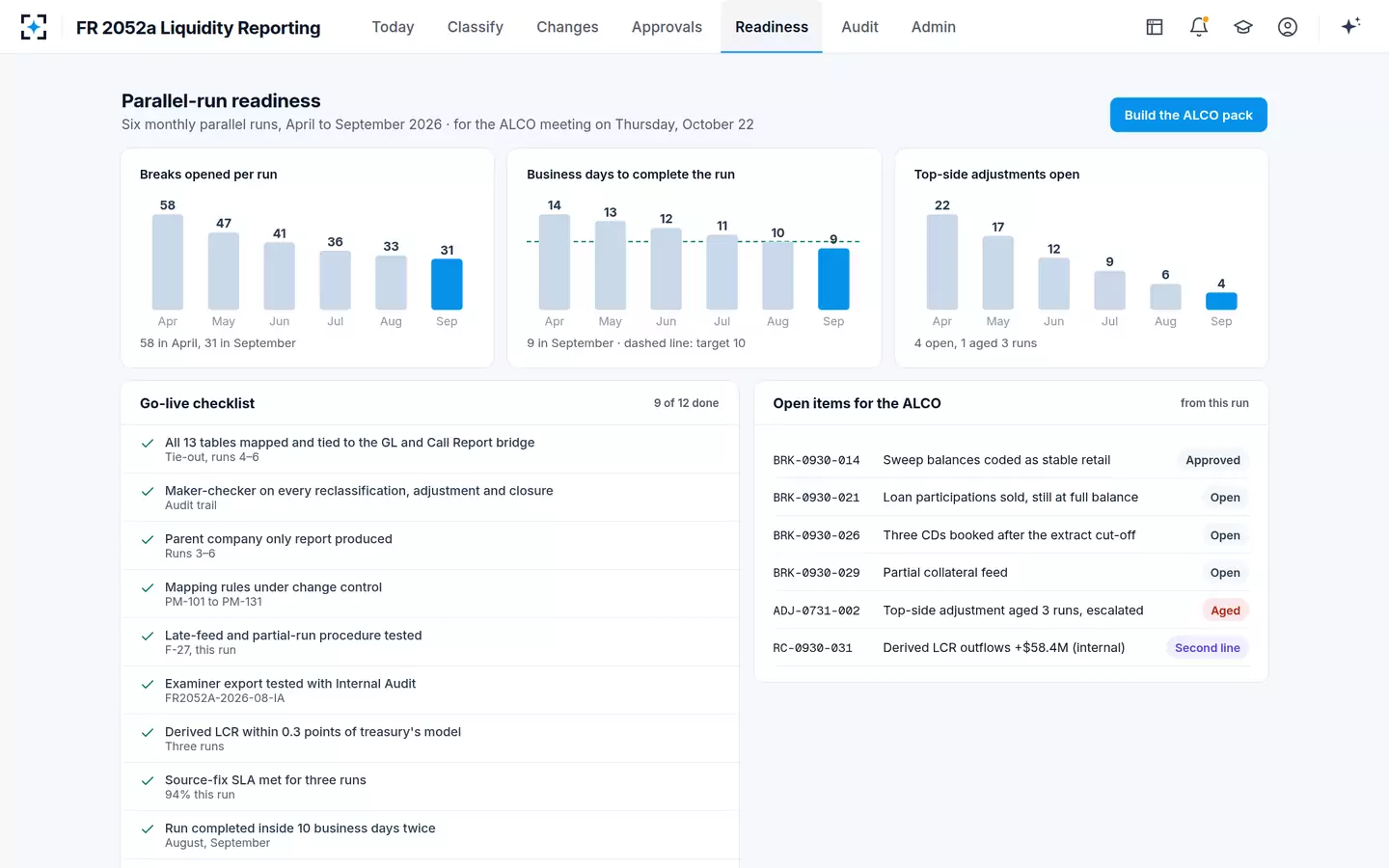
A go-live committee should see trends, not a single clean run. In the solution's sample deployment, a regional bank preparing to cross $100 billion ran six monthly parallel runs from April to September 2026. Breaks opened per run fell from 58 to 31; the run fell from 14 business days to 9 against the bank's internal target of 10; open top-side adjustments fell from 22 to 4, with one aged three runs and escalated. Nine of twelve go-live checklist items were done, and model risk validation of the classifying and checking agents was one of the three still open.
That is what an honest readiness picture looks like: improving, measured, with the gaps named. A committee can decide to file, to run two more months, or to fix a source system first, and each of those is a defensible decision because the evidence is on the table. Three months is a minimum; the sample bank chose six because its first months showed recurring adjustments, which is exactly what a parallel run is for.
FR 2052a Liquidity Reporting turns six parallel months into one go-live decision
Where FR 2052a Liquidity Reporting runs the parallel months
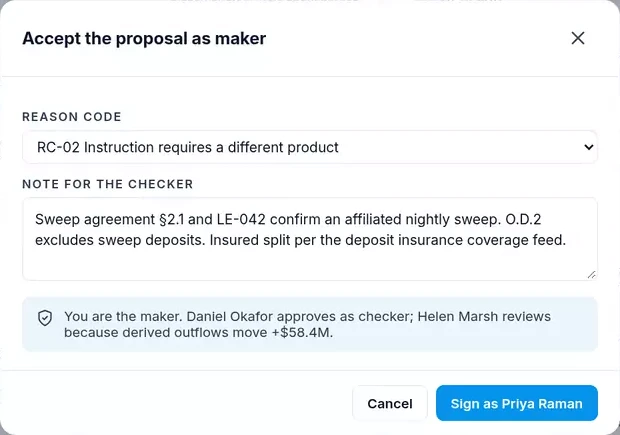
FR 2052a Liquidity Reporting runs each parallel month the way it would run a live one. The Feed monitor checks every feed; the Classifier proposes product, counterparty, collateral class, bucket and insured flag for each position, with sources; the Rule agent re-checks each against the instructions; the Tie-out agent ties every table to the general ledger and the Call Report bridge; the Change agent explains each month's moves. Analysts accept as makers, a manager approves as checker, and the second line sees material changes priced. The Readiness agent then turns the runs into the committee's view, and never marks a checklist item done without its evidence.
To start, the solution needs what only you hold: the feeds for the chosen months, the general ledger and the Call Report bridge, your product mapping rules and the agreements behind your products. The parallel run is also the honest test of any savings claim, ours included; the estimates in the guide to the hours of an FR 2052a run are only worth what your own months confirm. The measures the run should report are set out in the guide to FR 2052a reporting requirements, measured table by table.
The maker accepts with a reason code, and sees who checks next
Questions people ask
Where are the FR 2052a transition rules?
In the Transitions part of the FR 2052a instructions, which tie each change to the category definitions of 12 CFR 252.5 and to the weighted short-term wholesale funding definition in 12 CFR 252.2. The LCR's own transitions are in 12 CFR 249.10(b), 249.30(d) and 249.50.
How many months should an FR 2052a parallel run cover?
At least three closed month-ends, including a quarter-end, so recurring errors can be told apart from one-offs. Firms moving to daily reporting should also run a stretch of consecutive business days, since the daily clock is the new part.
How is a firm's category decided?
From risk-based indicators reported on the FR Y-15, the FR Y-9LP or the Call Report, averaged over four quarters. A firm is deemed to be in a new category in the quarter it files the form that shows it.
Does crossing $100 billion bring the LCR immediately?
No. A Category IV firm is subject to the reduced LCR only with $50 billion or more of average weighted short-term wholesale funding, and a newly covered firm complies from the first day of the third calendar quarter after it becomes subject.
Can a parallel run use the Call Report as filed?
Yes, and it should: a filed Call Report and a closed general ledger give the tie-out a fixed target. Differences then point at the FR 2052a build, not at a general ledger that is still moving.