An LCR calculation tool takes classified positions and applies the liquidity coverage ratio rule: high-quality liquid assets after haircuts and caps, divided by 30-day net cash outflows after the inflow cap, the maturity mismatch add-on and the outflow adjustment percentage. Many exist, from spreadsheets to modules inside regulatory reporting systems, and two regulators publish aids of their own. None of them removes the expensive part of the job. The Federal Reserve estimates 121 hours of work for each monthly FR 2052a response and 221 for each daily one, about 1.03 million hours a year across 41 filers, and those hours go into classifying and proving the data the calculator reads. Botminds' FR 2052a Liquidity Reporting is aimed at those hours, not at the ratio.
This guide does the arithmetic a treasurer or chief financial officer needs before buying either kind of tool: what the Board counts, what it prices the work at, where a calculator helps, and where it does not.
What the FR 2052a costs filers, on the Federal Reserve's own count
1,027,896
hours a year across all filers
$71.8M
estimated annual cost to the public
4,776
responses a year: 250 from each daily filer, 12 from each monthly one
$515K
the Federal Reserve’s own annual cost to collect and process it
Daily filers carry 97% of the hours with 44% of the filers
Is there an LCR calculation tool? Several kinds, and two from regulators
There are LCR calculation tools of three kinds: workbooks a treasury team builds, calculation engines inside regulatory reporting and asset-liability systems, and aids published by supervisors. The last kind is the most instructive, because both regulator aids say plainly what they are not. In Europe, the European Banking Authority publishes an Excel LCR calculation tool, last updated in May 2020, and states that it "is provided for information purposes only and has no legal value" (EBA, May 6, 2020).
In the United States, the Federal Reserve publishes no calculator. What it publishes is a mapping: Appendix VI of the FR 2052a instructions shows which FR 2052a products, fields and values feed each line of the LCR rule, with the level 2 cap formulas written out. Firms subject to the rule also report their own ratio in the file, as product S.L.6, "as a decimal value, with four points of precision" (FR 2052a instructions), which lets the Board compare the firm's number with one it can derive from the same data. The mapping's own status is a separate question, taken up in the guide to Appendix VI.
How many hours does the FR 2052a take? 121 monthly, 221 daily
The Federal Reserve estimates 121 hours for each monthly FR 2052a response and 221 hours for each daily one. With 18 daily filers submitting 250 times a year and 23 monthly filers submitting 12 times, that is 994,500 hours for the daily group and 33,396 for the monthly one, 1,027,896 in all (Federal Register, February 7, 2025). The estimate is the Board's, made for the Paperwork Reduction Act, and it counts "time to gather and maintain data in the required form and to review instructions and complete the information collection", in the wording on the form's cover.
The estimate is an average and it is old in one respect: the respondent counts are based on filings received in 2023. It is also the only public figure we found: no regulator or researcher we know of has published a survey of what filers actually spend, so the Board's number is the defensible baseline for a business case, and any figure above it should be your own measured time, not a vendor's.
What does a daily FR 2052a filer spend in a year?
On the Board's numbers, a daily filer spends 55,250 hours a year on the FR 2052a, 250 responses of 221 hours each. That is about 27 people working full time at 2,080 hours a year, and about $3.9 million at the Board's own staffing rates. A monthly filer spends 1,452 hours, under one full-time person, and about $101,000. The two figures describe different jobs, not different efficiency: a daily filer must classify, tie out and file every business day.
How the Board prices an hour of FR 2052a work, and what that makes a response
| Line | Basis | Amount |
|---|---|---|
| Office and administrative support | 30% of the hours at $23 | $6.90 an hour |
| Financial managers | 45% of the hours at $84 | $37.80 an hour |
| Lawyers | 15% of the hours at $85 | $12.75 an hour |
| Chief executives | 10% of the hours at $124 | $12.40 an hour |
| Blended rate | Sum of the four lines | $69.85 an hour |
| All filers, one year | 1,027,896 hours × $69.85 | $71,798,536 |
| One monthly response | 121 hours × $69.85 | about $8,450 |
| One daily response | 221 hours × $69.85 | about $15,440 |
| One daily filer, one year | 55,250 hours × $69.85 | about $3.86 million |
The Board's mix is a reasonable floor and a poor description of a real desk. It assigns no hours to data engineers, reconciliation analysts or the second line by name, and its rates are national mean wages. A business case should start from the Board's hours, replace the rate with your own, and add the hours the Board does not see: model validation of any calculation engine, internal audit, and the time other teams spend answering the reporting desk's questions.
Why is FR 2052a reporting so expensive when the ratio is simple?
FR 2052a reporting is expensive because the ratio depends on millions of classification decisions, each made against definitions that turn on facts outside the core systems. The arithmetic of the LCR fits on a page of the rule (12 CFR part 249); the inputs do not. Every deposit needs its product, counterparty type and insured flag; every secured transaction its collateral class from an asset category table of about ninety codes; every position its contractual maturity bucket, re-set each as-of date as the calendar rolls.
Volume is part of it. The solution's fictional sample bank, a regional firm preparing to cross $100 billion, produces 1,899,000 position rows from 43 feeds for one monthly run. The Bank for International Settlements observed that "Microsoft Excel spreadsheets, perhaps the most ubiquitous format in financial regulatory reporting, are limited to around 1 million rows and 16,000 columns" (BIS FSI Insights No 19, 2019). A desk that still classifies and ties out in workbooks is splitting its own report into pieces before it can check it.
What an LCR calculation tool does, and what the FR 2052a run still needs
An LCR calculation tool: Positions already classified and bucketed
The FR 2052a run around it: Raw positions from dozens of feeds, some late, some partial
An LCR calculation tool: Haircuts, level 2 caps, outflow and inflow rates, the 75% inflow cap, the add-on
The FR 2052a run around it: Product, counterparty, collateral class, maturity bucket and flags for every new or changed position
An LCR calculation tool: Recalculation matches the rule
The FR 2052a run around it: Each table ties to the general ledger and the Call Report; each move is explained
An LCR calculation tool: A rate or a cap coded wrongly, found once and fixed everywhere
The FR 2052a run around it: A product mapped wrongly, repeated every run until someone looks
An LCR calculation tool: Small: arithmetic on clean data
The FR 2052a run around it: Most of the 121 or 221 hours
Is a spreadsheet enough to calculate the LCR?
A spreadsheet can calculate the LCR from a summary, and is not enough to produce it. The rule's formulas are short: level 1 assets at fair value, level 2A at 85% and level 2B at 50%; the level 2 caps through two "greater of" calculations; outflows less the lesser of inflows and 75% of outflows; the maturity mismatch add-on; and the outflow adjustment percentage of 100, 85 or 70 by category. A well-built workbook gets all of it right.
What a workbook cannot do well is everything upstream: hold the positions, re-bucket them daily, show which source each value came from, and stop one person from changing a formula and approving it. Category I to III firms must calculate the ratio each business day; Category IV firms with $50 billion or more of weighted short-term wholesale funding calculate it as of the last business day of each month. Category IV firms below $50 billion are not subject to the LCR at all, yet still file the FR 2052a monthly: for them an LCR tool is a management aid, and the reporting hours remain. The arithmetic itself is worked through line by line in the guide to calculating the LCR.
What an LCR calculation tool must get right
If you are buying an LCR calculation tool, test it on the parts of the rule that are easy to get subtly wrong and on whether it can show its working. A tool that produces the right ratio for the wrong reasons will be wrong the month your balance sheet changes shape.
Nine tests for an LCR calculation tool
- The level 2 caps
Both cap calculations, using adjusted amounts after unwinding secured transactions maturing within 30 days.
- The 75% inflow cap
Applied to total outflows before the add-on, not table by table.
- The maturity mismatch add-on
The largest cumulative net outflow over days 1 to 30, less the day-30 figure, with open maturities treated as the rule says.
- The outflow adjustment percentage
100, 85 or 70 by category, with the transition dates when a category changes.
- Calculation frequency
Daily at the elected calculation time for Category I to III; month-end for Category IV.
- Operational requirements for HQLA
Assets that fail the operational tests excluded, not just haircut.
- Reconciliation to S.L.6
The tool’s ratio and the one reported in the FR 2052a should agree, with any gap explained.
- Departures from Appendix VI
Where the tool’s reading of the rule differs from the Board’s mapping, documented.
- Evidence
Each component traceable to positions, and each change to the tool versioned and approved.
Where the hours can come down, by our estimate
The hours fall where the first pass can be automated with evidence: counting feeds, proposing classifications, tying tables and drafting explanations. They fall least at sign-off, where a person must still read the run and own it. The table below is Botminds' estimate for one monthly response, kept modest; it is not a measured result from any customer, and the right test of it is a parallel run on your own last three months.
One monthly response, by Botminds' estimate: 121 hours today, about 39 with agents
| Stage | Today | With agents |
|---|---|---|
| Checking feeds for late and partial loads | 10 h | 2 h |
| Mapping new products and positions to products, counterparties and buckets | 34 h | 9 h |
| Tying 13 tables to the general ledger and the Call Report | 30 h | 8 h |
| Chasing data owners and booking top-side adjustments | 17 h | 7 h |
| Explaining month-over-month moves, table by table | 18 h | 5 h |
| Sign-off, the liquidity read and control evidence | 12 h | 8 h |
| Total | 121 h | 39 h |
Six parallel runs: fewer breaks, faster runs, fewer adjustments left open

Where FR 2052a Liquidity Reporting fits next to your LCR engine
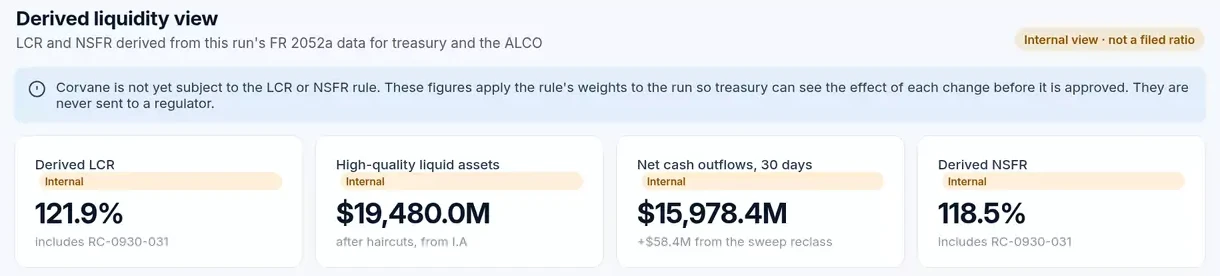
FR 2052a Liquidity Reporting sits upstream of the LCR engine and does not replace it. It classifies new and changed positions with the instruction passage cited, has a second agent re-check each one, ties every table to the general general ledger and the Call Report bridge, and explains each table's move. It also prices every pending change in derived LCR and NSFR terms, so treasury and the second line see the effect of a reclassification before it is approved.
Those derived figures are labelled internal and are never presented as filed ratios. The ratio you report in S.L.6, and disclose publicly if you are subject to the rule, still comes from your LCR calculation of record. In the sample deployment, the derived ratio is held to within 0.3 percentage points of treasury's model for three runs before go-live, which is the right relationship between the two: the reporting desk's view should agree with treasury's, and a gap is a question, not an answer.
FR 2052a Liquidity Reporting prices each change in derived LCR terms, never as a filed ratio
Questions people ask
Does the Federal Reserve provide an LCR calculator for FR 2052a filers?
No. The Board publishes a mapping from FR 2052a data to the LCR rule as Appendix VI of the instructions, and asks firms subject to the rule to report their own ratio as product S.L.6 to four decimal places.
How often is the FR 2052a burden estimate updated?
With each Paperwork Reduction Act renewal, roughly every three years. The current estimate was adopted in February 2025 and the approval runs to February 29, 2028, so the next estimate is due before then.
Does a Category IV firm need an LCR calculation tool?
Only if it has $50 billion or more of average weighted short-term wholesale funding, which makes it subject to the reduced LCR calculated at month-end. Below that, it still files the FR 2052a monthly but has no LCR requirement.
What does the EBA's LCR calculation tool cover?
It covers the European LCR under the Commission's delegated regulation as amended in 2018, built on the EBA's reporting templates of April 2020. The EBA says it has no legal value, and it does not apply to the U.S. rule.
Can FR 2052a Liquidity Reporting produce the filed LCR?
No. Its derived LCR and NSFR are internal figures for pricing pending changes; the ratio a firm reports and discloses comes from its own calculation of record.
What is a realistic saving on an FR 2052a run?
Botminds estimates a monthly response falling from the Board's 121 hours to about 39, with the largest cuts in mapping and tie-out. That is an estimate, and the way to test it is a parallel run on your own recent months.