The FR 2052a reporting requirements apply to U.S. bank holding companies and covered savings and loan holding companies with $100 billion or more in total consolidated assets, and to foreign banking organizations with $100 billion or more in combined U.S. assets. Each files the Federal Reserve's Complex Institution Liquidity Monitoring Report daily or monthly, by category, within two business days or ten calendar days of the as-of date, as 13 tables of inflows, outflows and supplemental items in which every position carries a product, a counterparty type, a contractual maturity bucket and, where relevant, a collateral class and a set of flags. A file can meet every format rule and still be wrong, so this guide sets out the requirements and then four measures of whether a filing meets them. Botminds' FR 2052a Liquidity Reporting checks all four on every run.
The requirements are stable for now. The instructions in force are the March 2023 text, re-issued unchanged when the Board extended the report "without revision" for three years in February 2025 (Federal Register, February 7, 2025); the approval now runs to February 29, 2028. As of October 27, 2026, no proposal to revise the FR 2052a, the liquidity coverage ratio rule or the tailoring thresholds had been published in the Federal Register.
The FR 2052a reporting requirements, in four numbers
$100B
in assets, on a four-quarter average, before a firm reports
13
data tables across inflows, outflows and supplemental items, plus comments
41
filers in the Board’s current estimate: 18 daily, 23 monthly
2028
the year the current OMB approval expires, on February 29
FR 2052a data quality is four measures per table, not one pass rate
1
Complete
Did every source deliver every position?
How to compute it
Rows received ÷ rows expected, per feed and per as-of date; feeds on time; tables marked provisional
Where it bites hardest
Derivatives and Collateral, Deposits, the loan side of Inflows-Unsecured
2
Classified with a citation
Does each new or changed position carry a basis for its codes?
How to compute it
Share of positions whose product, counterparty, collateral class, bucket and flags trace to an instruction passage, an agreement or an approved mapping rule; open rule breaks
Where it bites hardest
Deposits (sweeps, operational, relationship), Outflows-Other commitments, Inflows-Assets collateral classes
3
Tied to the general ledger
Is it the same balance sheet as the general ledger and the Call Report?
How to compute it
Table total against the general ledger and the Call Report bridge, net of documented differences; open breaks; open top-side adjustments and their age
Where it bites hardest
Inflows-Unsecured and Secured (loans, participations), Outflows-Wholesale (cut-offs), Balance Sheet adjustments
4
Explained
Can every move since last period be named?
How to compute it
Share of each table’s change attributed to named drivers; unexplained residual against a limit; required comments present
Where it bites hardest
Deposits, Inflows-Other, Outflows-Other, anything reported as Other
What are the FR 2052a reporting requirements? Who, what, when and how
The FR 2052a reporting requirements come down to four things: which firms file, for which entities, what each table must contain, and when. The table below puts them on one page; everything in it comes from the current instructions and the Board's form page.
The FR 2052a reporting requirements on one page
| Requirement | What the instructions say |
|---|---|
| Who files | Banking organizations subject to Category I, II, III or IV standards under Regulation YY or Regulation LL: top-tier U.S. bank holding companies and covered savings and loan holding companies with $100 billion or more, and foreign banking organizations with $100 billion or more in combined U.S. assets |
| Entities reported | Category I to III: the consolidated entity, the parent company alone and each material entity (every bank subsidiary of $10 billion or more counts). Category IV: the consolidated entity and the parent, plus any material entity the supervisory team asks for |
| Content | Inflows, outflows and supplemental items in 13 tables, by product, counterparty, collateral class and contractual maturity bucket, with a comments table |
| Frequency and timing | Each business day at T+2 for the largest firms; monthly at T+2 for other Category III firms; monthly at T+10 calendar days for Category IV; 3:00 p.m. Eastern |
| Currency | Category IV firms, and Category III firms under $75 billion of weighted short-term wholesale funding, may report in U.S. dollar millions; others report seven currencies separately |
| Confidentiality | Micro data are confidential and not published |
Who has to file the FR 2052a? The four tailoring categories
A firm files the FR 2052a once it is subject to Category I, II, III or IV standards, and its category also sets how often it files and how much detail it gives. The categories come from Regulation YY (12 CFR 252.5): global systemically important bank holding companies are Category I; Category II is $700 billion or more in average total consolidated assets, or $75 billion or more in cross-jurisdictional activity; Category III is $250 billion or more, or $75 billion or more in any of nonbank assets, weighted short-term wholesale funding or off-balance sheet exposure; every other firm at $100 billion or more is Category IV.
Weighted short-term wholesale funding does double duty. At $75 billion it moves a Category III firm from monthly to daily reporting; at $50 billion it brings a Category IV firm under the reduced liquidity coverage ratio and changes how finely it must report maturities. A firm near either line is, in effect, preparing for two versions of the report at once, which is why a parallel run before the switch is worth its cost.
How many tables are in the FR 2052a, and what does each hold?
The FR 2052a has 13 tables. In the instructions' words, the architecture "subdivides the three general categories of inflows, outflows, and supplemental items into 13 distinct data tables and includes a mechanism for tracking comments" (FR 2052a instructions, Appendix I). Each table has its own fields, and each position, or "data element", is a unique combination of non-numeric field values with the amounts summed across it.
The 13 FR 2052a tables and where their data usually come from
| Table | What it holds | Typical source |
|---|---|---|
| I.A Inflows-Assets | Unencumbered assets, borrowing capacity at central banks and FHLBs, reserve balances, encumbered assets | Securities and collateral systems |
| I.U Inflows-Unsecured | Placements, operational balances, loans and other unsecured inflows | Loan subledger, treasury |
| I.S Inflows-Secured | Reverse repo, securities borrowing, margin and other secured lending | Securities financing systems |
| I.O Inflows-Other | Derivative receivables, collateral called for receipt, interest receivable, net 30-day derivative receivables | Derivatives and collateral systems |
| O.W Outflows-Wholesale | Commercial paper, long-term debt, wholesale CDs, draws on committed lines | Treasury funding, debt registers |
| O.S Outflows-Secured | Repo, securities lending, FHLB advances, customer and firm shorts | Securities financing systems |
| O.D Outflows-Deposits | Fifteen deposit products, from transactional accounts to sweeps and reciprocal deposits | Core deposit system, sweep programs |
| O.O Outflows-Other | Derivative payables, credit and liquidity facilities, collateral on downgrade | Loan commitments, derivatives |
| S.DC Supplemental-Derivatives & Collateral | Gross derivative values, margin posted and received, collateral disputes and substitution | Derivatives and collateral systems |
| S.L Supplemental-Liquidity Risk Measurement | Subsidiary liquidity that cannot be transferred, the LCR and NSFR as calculated | Treasury LCR and NSFR calculations |
| S.B Supplemental-Balance Sheet | Capital, other assets and liabilities, netting and carrying value adjustments | General ledger |
| S.I Supplemental-Informational | Client assets and wires, section 23A capacity | Broker-dealer and payments systems |
| S.FX Supplemental-Foreign Exchange | FX spot, forwards and futures, swaps | FX trading systems |
Two rules cut the volume. A data element whose aggregate amount "rounds to less than ten thousand currency units (i.e., 0.01 for this report)" is not reported, and firms below the top categories may report far fewer maturity buckets beyond one year. A third rule adds to it: some exposures are reported twice on purpose, which matters as soon as anyone tries to tie the tables to the general ledger. The fields themselves are mapped to their source systems in the FR 2052a data dictionary guide.
How do you measure FR 2052a data quality? Four measures, every table
FR 2052a data quality is measured as four separate things on each table: completeness, classification, tie-out and explanation. A single score across the file hides the failures that matter, because the measures fail independently. A table can be complete and wrongly classified. It can tie to the general ledger to the dollar while millions inside it sit in the wrong product, because a reclassification between products leaves the total unchanged.
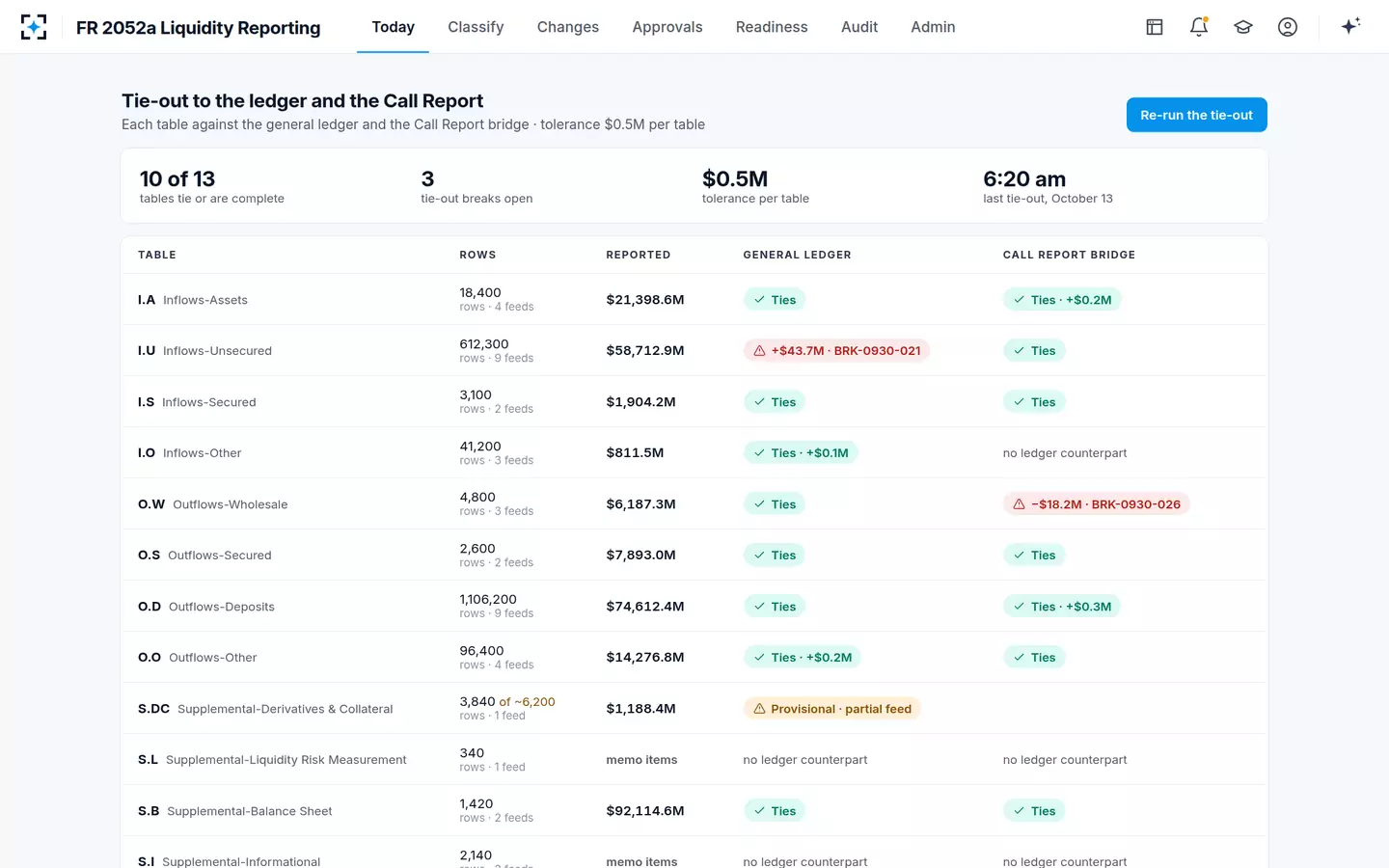
The sample run in FR 2052a Liquidity Reporting shows exactly that. Its Outflows-Deposits table tied to the general general ledger and to the Call Report bridge, and still held $612.0 million of sweep balances coded as relationship deposits: a classification failure invisible to tie-out, worth $58.4 million of derived 30-day outflows. Its Inflows-Unsecured table was fully classified and $43.7 million above the general ledger, because loan participations that had been sold were still carried at full balance. Each measure caught what the others could not.
One sample run, twelve tables, four kinds of result
| Table | Rows | Against the general ledger | Against the Call Report bridge |
|---|---|---|---|
| I.A Inflows-Assets | 18,400 | Ties | Ties, +$0.2M |
| I.U Inflows-Unsecured | 612,300 | Break: +$43.7M | Ties |
| I.S Inflows-Secured | 3,100 | Ties | Ties |
| I.O Inflows-Other | 41,200 | Ties, +$0.1M | No counterpart |
| O.W Outflows-Wholesale | 4,800 | Ties | Break: −$18.2M |
| O.S Outflows-Secured | 2,600 | Ties | Ties |
| O.D Outflows-Deposits | 1,106,200 | Ties (with a $612.0M rule break inside) | Ties, +$0.3M |
| O.O Outflows-Other | 96,400 | Ties, +$0.2M | Ties |
| S.DC Derivatives & Collateral | 3,840 of about 6,200 | Provisional: partial feed | Provisional |
| S.L Liquidity Risk Measurement | 340 | Memo items, no counterpart | No counterpart |
| S.B Balance Sheet | 1,420 | Ties | Ties |
| S.I Informational | 2,140 | Memo items, no counterpart | No counterpart |
What is FR 2052a reconciliation, and why does it never sum to the balance sheet?
FR 2052a reconciliation is the tie-out of each table to the general ledger and, through a bridge, to the Call Report, with every difference either explained or raised as a break. A break is a difference above the agreed tolerance that needs an owner and a fix. A top-side adjustment is a manual change booked to the report's output, rather than to the source system, to correct a value before the source can be fixed; it should be temporary and aged until it is retired.
The tables cannot simply be added up and compared with total assets, because the instructions require deliberate double counting. Appendix V lists 21 cases, among them collateral swaps reported in both the secured inflow and outflow tables, loans reported both by counterparty and in the asset table at market value, and encumbered assets reported both as encumbered and against the transaction they secure. The Supplemental-Balance Sheet table then provides counterparty netting and carrying value adjustments so that an accounting balance sheet can be rebuilt. A sound tie-out encodes those rules once, so the analyst sees only the differences that are not explained by them.
FR 2052a Liquidity Reporting ties every table to the general ledger and the Call Report bridge
How do you validate FR 2052a data before it is filed?
FR 2052a data are validated in three layers before filing: field validity against the instructions' own lists, internal consistency between related products, and accuracy against the source. The first two can be automated almost entirely from the text of the instructions; the third is where judgement and evidence come in.
Field validity checks each data element against the appendices. Appendix II lists which products need a sub-product and which values are allowed, which counterparty types each product accepts, which collateral classes apply and which products may not carry a forward start. Appendix IV-b sets the maturity buckets each category must use. Internal consistency checks the relationships the instructions spell out, the clearest being the downgrade products, which must rise with severity: "1 Notch Downgrade ≤ 2 Notch Downgrade ≤ 3 Notch Downgrade ≤ Change in Financial Condition". Amounts in dispute must appear in both the dispute product and the collateral-called product; a forward purchase must appear both as a forward asset purchase and in the net 30-day derivative measure.
Accuracy is the layer examiners worry about most, because automated mapping makes errors consistent. The OCC's handbook for regulatory reports warns that "the failure to periodically test the accuracy of data flows from the bank's reporting or accounting could result in inaccurate reporting" (Comptroller's Handbook, Regulatory Reporting, 2021). For the FR 2052a that means testing a mapping rule against the agreements and source fields it claims to read, not only against last month's output.
Pre-filing checks an FR 2052a run should pass
- Every feed counted
Rows and arrival time against expectation; a partial feed marks its table provisional.
- Every combination allowed
Product, sub-product, counterparty and collateral class against Appendix II.
- Every bucket valid for the category
Maturity buckets against Appendix IV-b; open maturities only where contractual.
- Every relationship held
Cumulative downgrade products, dispute pairs and the deliberate double counts of Appendix V.
- Every table tied
To the general ledger and the Call Report bridge, net of documented differences.
- Every new position cited
The passage, agreement or approved rule behind its codes.
- Every move explained
Drivers for each table’s change; residual shown, not absorbed.
- Every adjustment aged
Open top-side adjustments listed with the source fix that will retire them.
What the four measures need from the second line and internal audit
The second line and internal audit need the measures broken out by table and by run, with the evidence behind each. A summary that says the report "passed validation" answers the first layer only. What a reviewer can test is a sample of positions with their codes and the passages behind them, the open breaks with their age, the top-side adjustments still in the file, and the share of each table's movement that is explained.
Trends matter as much as levels. A desk that opens fewer breaks each month and retires its adjustments is improving its source data; one that files clean reports by booking more adjustments is not. In the solution's sample deployment, six parallel monthly runs took breaks opened per run from 58 to 31 and open top-side adjustments from 22 to 4, the figures a go-live committee would want to see before relying on the process.
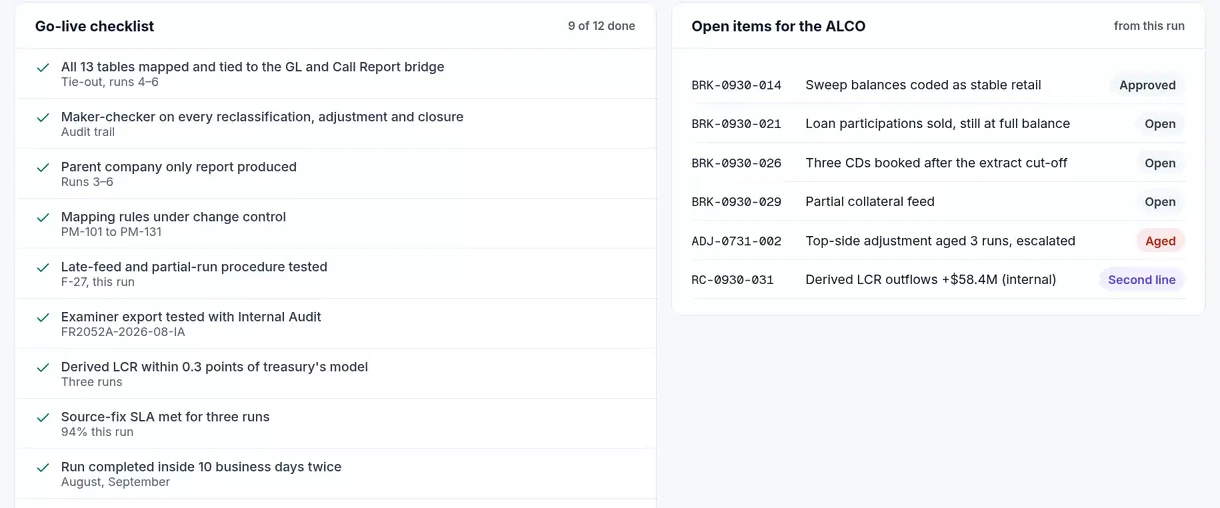
The measures as a go-live view: what is done, and what the ALCO still has open
Where FR 2052a Liquidity Reporting measures each table
FR 2052a Liquidity Reporting turns the four measures into a run that reports on itself. The Feed monitor measures completeness, the Classifier and the separate Rule agent measure classification and cite each basis, the Tie-out agent measures the general ledger and Call Report ties at the tolerance you set, and the Change agent measures explanation and shows any residual over its limit. The design target is all 13 tables tied to the general ledger and the Call Report bridge before the run is signed, with every classification carrying the passage that justifies it.
People keep the decisions. Analysts accept or reject proposals with a reason code; a manager approves as checker; the second line reviews changes with a material effect on the derived liquidity ratios. How the hours of a monthly run shift when the first pass is automated is set out in the guide to what an LCR calculation tool does and does not save.
Questions people ask
Is the FR 2052a changing in 2026?
Not as of October 27, 2026. The Board extended the report without revision in February 2025, and no proposal to revise it, the LCR rule or the tailoring thresholds had been published. In February 2026 the agencies withdrew their public LCR FAQs and said they expect to seek comment on those issues, and on proposed rule changes, at some later date (SR 17-11).
Does every FR 2052a filer report all 76 maturity buckets?
No. Category I and II firms report 76 buckets on every product. Category III and IV firms may aggregate maturities of a year or more, and Category IV firms with less than $50 billion of weighted short-term wholesale funding may also collapse some asset and loan buckets further.
Are FR 2052a positions reported transaction by transaction?
No. A data element is a unique combination of the non-numeric fields, and amounts are summed across it. Two bonds with identical attributes that fall in the same maturity bucket are one element; the same bonds in different buckets are two.
Is the FR 2052a filed on a fixed template?
No. The instructions describe a flat structure with predefined columns and an unconstrained number of rows, so the size of the file grows with the firm. The Board's supporting statement says respondents submit XML files to the Federal Reserve Bank of New York.
Which FR 2052a tables may be reported later than the rest?
The Supplemental-Balance Sheet table and the NSFR supplemental products in the liquidity risk measurement table are reported as of month-end at T+15 calendar days for most firms, and the balance sheet table quarterly for Category IV firms with less than $50 billion of weighted short-term wholesale funding.