To calculate the LCR, the liquidity coverage ratio, divide a firm's high-quality liquid asset amount by its total net cash outflow amount over the next 30 calendar days; under the U.S. rule the result must be at least 1.0, that is 100% (12 CFR 249.10). Each side has rules of its own. Liquid assets are taken at fair value with haircuts of 0, 15 or 50% by level, and capped so that less liquid assets cannot dominate. Outflows and inflows are contractual balances multiplied by rates set in the rule; inflows count only up to 75% of outflows; a maturity mismatch add-on catches outflows bunched early in the month; and the net figure is scaled by an outflow adjustment percentage of 100, 85 or 70 depending on the firm's category. At large U.S. firms the inputs come from the same positions reported on the Federal Reserve's FR 2052a, which is why Botminds' FR 2052a Liquidity Reporting can price each pending change in LCR terms before it is approved.
The example below is illustrative: round numbers for a Category III firm with less than $75 billion of weighted short-term wholesale funding, chosen to show each step, not taken from any bank.
One illustrative LCR, component by component: 126.4%
How do you calculate the liquidity coverage ratio? The formula in the rule's own terms
The liquidity coverage ratio equals the HQLA amount "divided by" the total net cash outflow amount, both as of the calculation date (12 CFR 249.10(c)). Total net cash outflows equal the outflow adjustment percentage multiplied by three terms: the sum of outflows, minus "the lesser of" the sum of inflows and "75 percent" of outflows, plus the maturity mismatch add-on (12 CFR 249.30(a)). Written as one line:
LCR = HQLA amount ÷ [ outflow adjustment % × ( outflows − min(inflows, 75% × outflows) + maturity mismatch add-on ) ] ≥ 1.0
Everything else in part 249 defines one of those terms. The four steps below take them in order, and the worked example later puts numbers through all of them.
Step one: the HQLA amount, its haircuts and its two caps
The HQLA amount is level 1 assets at fair value, level 2A at 85% of fair value and level 2B at 50%, minus an adjustment if level 2 assets exceed the caps (12 CFR 249.21). Level 1 covers cash, Reserve Bank balances and Treasury and other zero-risk-weight sovereign debt, less any reserve balance requirement. Level 2A covers U.S. government-sponsored enterprise debt and 20% risk-weight sovereign debt. Level 2B covers investment-grade corporate debt, investment-grade municipal obligations and certain listed equities. Only assets that meet the rule's operational requirements count as eligible, which in practice means unencumbered and under the control of the function that manages liquidity.
The caps are written as two "greater of" calculations that use odd-looking coefficients. The level 2 cap excess is level 2A plus level 2B "minus 0.6667 times the level 1 liquid asset amount", or zero; the level 2B cap excess is level 2B minus the level 2 cap excess "minus 0.1765 times the sum of the level 1 liquid asset amount and the level 2A liquid asset amount", or zero. The coefficients are ratios: 0.6667 is 40 ÷ 60, which holds level 2 assets to 40% of the stock, and 0.1765 is 15 ÷ 85, which holds level 2B to 15%. The rule then computes the same caps on an adjusted basis, as if secured funding, secured lending and asset exchanges maturing within 30 days had unwound, and subtracts the larger excess.
Step one in the example: $15.9 billion of HQLA, with room under both caps
| Line | Fair value | Factor | Amount |
|---|---|---|---|
| Level 1: reserve balances and Treasuries, eligible | $12,000M | 100% | $12,000M |
| Level 2A: GSE-guaranteed mortgage securities | $4,000M | 85% | $3,400M |
| Level 2B: investment-grade corporate debt | $1,000M | 50% | $500M |
| Level 2 cap excess: max(0, $3,400 + $500 − 0.6667 × $12,000) | $0 | ||
| Level 2B cap excess: max(0, $500 − 0 − 0.1765 × $15,400) | $0 | ||
| HQLA amount | $15,900M |
Step two: outflows, one rate at a time
Outflows are each liability and commitment that could draw cash within 30 days, multiplied by the rate the rule assigns to its type (12 CFR 249.32). The rates run from 3% for stable retail deposits to 100% for unsecured funding from financial firms, and they are where most of the classification work on the FR 2052a pays off: the same balance can carry very different rates depending on its product, counterparty and insured flag.
Step two in the example: $25.2 billion of outflows from $159 billion of balances
| Balance | Amount | Rate in 12 CFR 249.32 | Outflow |
|---|---|---|---|
| Stable retail deposits (fully insured, transactional or relationship) | $60,000M | 3% | $1,800M |
| Other retail deposits | $25,000M | 10% | $2,500M |
| Operational deposits, not fully insured | $20,000M | 25% | $5,000M |
| Non-operational corporate deposits, not fully insured | $15,000M | 40% | $6,000M |
| Unsecured funding from financial sector entities, due within 30 days | $6,000M | 100% | $6,000M |
| Undrawn committed credit facilities to non-financial companies | $30,000M | 10% | $3,000M |
| Undrawn committed liquidity facilities to non-financial companies | $3,000M | 30% | $900M |
| Total outflows | $159,000M | $25,200M |
What is the 75 percent inflow cap, and when does it bite?
The 75% inflow cap limits the inflows a firm may count to three-quarters of its outflows, so that at least a quarter of outflows, before the category adjustment, must be met from liquid assets rather than from money the firm expects to receive. Inflows themselves are contractual payments due within 30 days from performing counterparties, at 50% for retail and non-financial wholesale counterparties and 100% for financial firms and central banks (12 CFR 249.33). Some never count at all: operational deposits the firm holds at other banks, credit lines extended to it, and payments on assets already counted as HQLA.
In the example, $4.0 billion of retail loan payments and $8.0 billion of payments from non-financial companies count at 50%, and $5.0 billion due from financial firms counts in full, for $11.0 billion. Three-quarters of $25.2 billion is $18.9 billion, so the cap does not bind. It binds at firms with large short-term lending to other financial firms, and when it does, extra inflows add nothing: the ratio then moves only with HQLA and outflows.
Step four: the maturity mismatch add-on
The maturity mismatch add-on charges a firm whose outflows fall due earlier in the month than its inflows, even if they net out by day 30. For each of the next 30 days, the rule computes cumulative outflows less cumulative inflows for a defined set of wholesale, secured and similar categories; the add-on is the largest of those daily figures, floored at zero, minus the day-30 figure, also floored at zero (12 CFR 249.30(b)). Open-maturity balances count from day 1 only in the categories the rule names; other open maturities are left out of the add-on (12 CFR 249.31(a)(4)).
This is the step that most depends on the FR 2052a's maturity buckets, which run day by day for the first 60 days. In the example we assume $600 million: wholesale funding that rolls off in the second week while matching inflows arrive in the fourth.
What is the reduced LCR for Category IV? The outflow adjustment percentage
The reduced LCR is the same calculation with net outflows multiplied by 70% instead of 100%. The outflow adjustment percentage is 100% for global systemically important bank holding companies, Category II firms and Category III firms with $75 billion or more of average weighted short-term wholesale funding; 85% for other Category III firms; and 70% for Category IV firms with $50 billion or more of that funding (12 CFR 249.30(c)). Category IV firms below $50 billion are not subject to the LCR at all.
The same balance sheet passes by different margins in each category
107.4%
at a 100% adjustment: $15,900M ÷ $14,800M
126.4%
at 85%, the example firm’s own category: ÷ $12,580M
153.5%
at 70%, the reduced LCR for Category IV: ÷ $10,360M
The calibration also moves with the firm. A firm whose percentage rises may keep the lower one until the first day of the third calendar quarter after the increase; one whose percentage falls must keep the higher one until the first day of the next quarter. The guide to what the LCR does and does not show follows one firm whose reduced ratio sat just above 100% for a year.
The worked example, from balances to ratio
Put together, the example runs from position-level balances to one number. Each line below traces to a rate or formula in part 249, and each balance to a set of FR 2052a products. That traceability is the point of working it by hand once: a ratio that cannot be rebuilt line by line from the positions cannot be defended when it moves.
From FR 2052a positions to the ratio, in five steps
A person decides
ClassifyEach position gets its product, counterparty, collateral class, maturity bucket and insured flag on the FR 2052a.
Agent
Weight the assetsEligible level 1, 2A and 2B assets at 100%, 85% and 50%; caps checked on both bases: $15,900M.
Agent
Rate the flowsOutflows $25,200M; inflows $11,000M, tested against the 75% cap of $18,900M.
Agent
Add the mismatchLargest cumulative net outflow in days 1 to 30 less the day-30 figure: $600M.
A person decides
Adjust and sign85% of $14,800M is $12,580M; LCR 126.4%, reported to four decimals as 1.2639.
How often must the LCR be calculated, and what if it falls below 100%?
The LCR must be calculated "on each business day" at the same elected time, except that a Category IV firm calculates it "on the last business day of the applicable month" (12 CFR 249.10(a)). The elected calculation time was chosen by written notice before December 31, 2019, and cannot be changed without the Board's approval.
A firm must notify the Board on any business day its ratio is calculated to be below the minimum, which for a monthly calculator means the last business day of a month. A daily calculator that is below 100% for three consecutive business days must promptly submit a plan to return to compliance, with weekly progress reports; a monthly calculator below the minimum at month-end must consult the Board on whether a plan is needed (12 CFR 249.40). Firms that report their ratio on the FR 2052a do so as product S.L.6, a decimal to four places (an LCR calculation tool explains why the Board wants it).
What is the NSFR, and how is it calculated?
The net stable funding ratio is available stable funding divided by required stable funding, and it too must be at least 1.0, "on an ongoing basis" (12 CFR 249.100). Where the LCR asks whether a firm survives 30 days, the NSFR asks whether its assets are funded with liabilities that will stay for a year. Each liability gets an available stable funding factor and each asset a required stable funding factor; the required amount is then scaled by an adjustment of 100, 85 or 70% on the same category lines as the LCR.
NSFR factors for a few common items
| Item | Side | Factor |
|---|---|---|
| Regulatory capital; liabilities maturing in one year or more (not retail or brokered) | Available | 100% |
| Stable retail deposits | Available | 95% |
| Other retail deposits (not brokered) | Available | 90% |
| Operational deposits; non-financial wholesale funding under one year | Available | 50% |
| Funding from financial firms maturing in under six months | Available | 0% |
| Cash, Reserve Bank balances, other level 1 assets | Required | 0% |
| Level 2A assets | Required | 15% |
| Level 2B assets; loans to non-financial and retail borrowers under one year | Required | 50% |
| Retail mortgages of one year or more at a risk weight of 50% or less | Required | 65% |
Where the FR 2052a feeds each line, and where FR 2052a Liquidity Reporting comes in
Every input above has a home on the FR 2052a. Level 1, 2A and 2B assets come from the Inflows-Assets table through collateral classes ending in "-Q"; deposits from the fifteen Outflows-Deposits products with their counterparty and insured fields; facilities from Outflows-Other; inflows from the unsecured, secured and other inflow tables; and the add-on from the maturity buckets. The Federal Reserve's own mapping of those fields to the rule is Appendix VI of the instructions, which has a status of its own worth knowing.
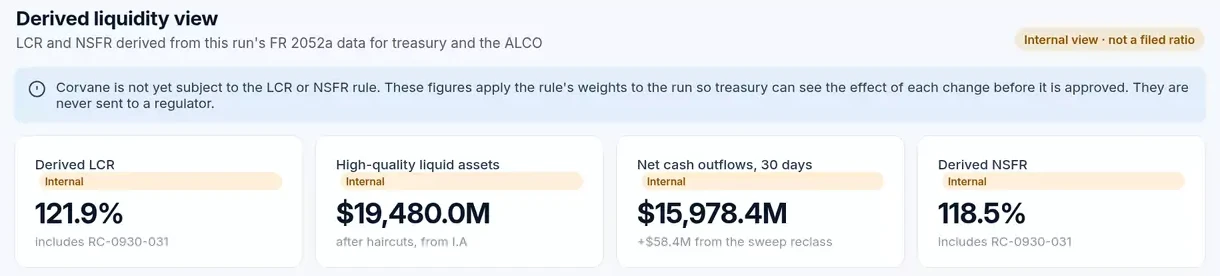
FR 2052a Liquidity Reporting uses those weights for one purpose: to show what a pending reclassification or adjustment would do to the ratio before a person approves it. In its sample deployment, moving $612.0 million of sweep balances from a 3% stable retail product to the affiliated sweep products, at 10% for the insured part and 40% for the rest, raised derived 30-day outflows by $58.4 million and moved the derived LCR from 122.4% to 121.9%. Those figures are labelled internal; the ratio a firm reports is the one from its own calculation of record.
FR 2052a Liquidity Reporting prices each pending change in LCR terms, labelled internal
Questions people ask
What is the LCR formula in one line?
HQLA amount divided by total net cash outflows, where net outflows are the outflow adjustment percentage times outflows, less the lesser of inflows and 75% of outflows, plus the maturity mismatch add-on. The result must be at least 1.0.
What counts as level 2B HQLA in the United States?
Investment-grade corporate debt, investment-grade municipal obligations and certain listed equities, such as U.S. equities in the Russell 1000, that meet the rule's liquidity tests. They count at 50% of fair value and may make up at most 15% of the stock.
Do operational deposits a bank places elsewhere count as inflows?
No. The rule excludes amounts a firm holds in operational deposits at other regulated financial companies from inflows, along with credit lines extended to it and payments on assets it already counts as HQLA.
Is a bank's LCR public?
For holding companies subject to the rule, yes: they publish quarterly disclosures of their ratio and its components under 12 CFR 249.90. The position-level FR 2052a data behind it are confidential.
Why does the U.S. LCR use 0.6667 and 0.1765?
They are the cap ratios written as multipliers: 0.6667 is 40 ÷ 60 and holds level 2 assets to 40% of HQLA, and 0.1765 is 15 ÷ 85 and holds level 2B assets to 15%.