The LCR in banking is the liquidity coverage ratio: high-quality liquid assets divided by the net cash a bank could lose over 30 days of stress, as the regulation assumes that stress, and a covered U.S. firm must keep it at or above 100%. It is a test of the stock of liquid assets against a standard set of run-off rates, not a forecast of what depositors will actually do. Silicon Valley Bank shows the difference. The Federal Reserve calculated its reduced LCR from the FR 2052a reports it filed monthly, and the ratio stayed between 101.8% and 103.1% from March 2022 to February 2023. The bank lost over $40 billion of deposits on March 9, 2023 and failed the next day. Botminds' FR 2052a Liquidity Reporting is built on the view that a correct ratio is where liquidity analysis starts, not where it ends.
A caution about the figures, in the Federal Reserve's own words: for the period shown, SVB's holding company "was not subject to the LCR requirement, and it is possible that SVBFG would have managed its liquidity position differently and had different ratios had it been subject" (Federal Reserve, April 2023). The numbers below are the Board's calculations from SVB's reported data, not ratios SVB filed.
A ratio near 102%, and a run measured in days
101.8–103.1%
SVB’s reduced LCR in each month from March 2022 to February 2023, from its FR 2052a data
94%
of SVB’s total deposits uninsured at year-end 2022, against 41% at other large banking organizations
$40B+
of deposits lost on March 9, 2023, with over $100 billion more expected the next day
What the ratio counted, and what ran: SVB's deposits against its peers
SVB’s holding company, fourth quarter of 2022
- Uninsured deposits · 94%
- Insured · 6%
Other large banking organizations, same quarter
- Uninsured deposits · 41%
- Insured · 59%
What is the LCR in banking? A 30-day test on fixed assumptions
The liquidity coverage ratio is a requirement that a large bank hold enough high-quality liquid assets to cover its net cash outflows over a 30-day stress period, with both sides calculated by formula. The Federal Reserve's review describes it as seeking "to strengthen firms' short-term resilience to funding shocks by requiring large firms to hold a minimum amount of high-quality liquid assets to meet total net cash outflows in a 30-day stress period". The U.S. rule sets the minimum at 1.0, calculated each business day, or at month-end for Category IV firms (12 CFR 249.10).
The ratio began as an international standard. The Basel Committee published the full text in January 2013, saying the LCR "promotes the short-term resilience of a bank's liquidity risk profile" by requiring a stock of unencumbered high-quality liquid assets for "a 30 calendar day liquidity stress scenario" (Basel Committee on Banking Supervision, 2013). The U.S. agencies adopted their version in October 2014 (Federal Register, October 10, 2014), and the 2019 tailoring rule set today's 100%, 85% and 70% calibrations by category.
The assumptions are the rule's, not the bank's. A stable retail deposit runs off at 3%, a fully insured operational deposit at 5%, an uninsured corporate deposit at 40%, unsecured funding from another financial firm at 100%. The ratio treats them the same whether the bank's depositors are thousands of households or a concentrated group of companies that share the same investors. How the formula works, line by line, is in the guide to calculating the LCR.
Did SVB meet the liquidity coverage ratio?
SVB was not subject to the LCR, but it would have met the reduced version every month. Its holding company crossed $50 billion in average weighted short-term wholesale funding in December 2022 and would have had to comply with the reduced LCR and NSFR "at a 70 percent calibration at the start of the fourth quarter of 2023", months after it failed. Using SVB's FR 2052a data, which it had filed monthly since January 2022, the Board found that it "would have met the reduced LCR requirement at the 70 percent calibration in the months leading up to its failure".
SVB's reduced LCR, month by month, from its own FR 2052a data
The run that followed was unlike anything a 30-day calibration contemplates. In the review's words, "On March 9, SVB lost over $40 billion in deposits, and SVBFG management expected to lose over $100 billion more on March 10." The ratio had stayed within about a point of 102% for a year. What it measured was correct; what it measured was not the bank's vulnerability.
What is the reduced LCR, and why it mattered here
The reduced LCR is the liquidity coverage ratio with net cash outflows multiplied by 70% instead of 100%, applied to Category IV firms with $50 billion or more of average weighted short-term wholesale funding (12 CFR 249.30(c)). The review explains the effect: the denominator is multiplied by 70%, "thereby reducing the amount of high-quality liquid assets" needed, and unlike other covered firms, Category IV firms' bank subsidiaries are not subject to the requirement at all.
The calibration is a choice, and the review tested it. Under the requirements in force before the 2019 tailoring rule, SVB "would have been subject to the full LCR and would have had an approximately 9 percent shortfall of HQLA in December 2022, and estimates for February 2023 show an even larger shortfall (approximately 17 percent)". The same data, run through the full calibration, would have shown a bank short of liquid assets. At 70%, they showed a bank with 2% to spare.
Why didn't the LCR catch SVB?
The LCR did not catch SVB for three reasons the Board's review points to: the bank was not subject to it, the calibration it would have faced was reduced, and the ratio's run-off assumptions did not reflect a deposit base that was 94% uninsured and concentrated in one industry. The Vice Chair for Supervision's letter introducing the review named the fixes to consider.
We should re-evaluate the stability of uninsured deposits and the treatment of held to maturity securities in our standardized liquidity rules and in a firm's internal liquidity stress tests.
Michael S. Barr, letter introducing the Federal Reserve's SVB review, April 2023
The same letter added that any change "would, of course, go through normal notice and comment rulemaking". As of October 27, 2026, no such proposal has been published. The text of 12 CFR part 249 in the eCFR was last amended in January 2022, and in February 2026 the agencies rescinded their public LCR FAQs, saying they expected to seek comment on related rule changes later (SR 17-11, revised February 2026). That is not a proposal, and nothing in it changes the rule.
What is the difference between the LCR and internal liquidity stress tests?
The LCR applies the regulation's assumptions to every covered firm; an internal liquidity stress test applies the firm's own assumptions to its own risks, over several horizons, and sets the size of its liquidity buffer. Regulation YY requires bank holding companies of $100 billion or more to run them at least monthly, or quarterly for Category IV firms, over overnight, 30-day, 90-day and one-year horizons, and to hold a buffer that covers 30 days of net stressed cash-flow need (12 CFR 252.35).
This is the test SVB failed while its ratio passed. The review notes that from July 2022, when it first became subject to these requirements, SVB "repeatedly failed its own ILST", and that management "switched to using less conservative stress testing assumptions, which masked some of these risks". It also states the supervisory view of which measure matters: "Since the Global Financial Crisis, ILST has become the industry and supervisory standard for measuring an individual firm's liquidity risk profile and determining required levels of liquidity."
The LCR and an internal liquidity stress test answer different questions
Liquidity coverage ratio: The rule’s run-off and inflow rates, the same for every firm
Internal liquidity stress test: The firm’s own scenarios, reflecting its depositors, markets and legal entities
Liquidity coverage ratio: 30 days
Internal liquidity stress test: Overnight, 30 days, 90 days and one year at least
Liquidity coverage ratio: One ratio, at least 100%
Internal liquidity stress test: A buffer sized to 30 days of net stressed need, plus limits and early warnings
Liquidity coverage ratio: About 102% on the reduced calibration, every month
Internal liquidity stress test: Failed repeatedly from July 2022
Liquidity coverage ratio: Disclosed quarterly by firms subject to it
Internal liquidity stress test: Not published
What does the FR 2052a show about liquidity risk that the ratio hides?
The FR 2052a shows the inputs the ratio compresses: which deposits are insured, who the counterparties are, how the maturities fall day by day, and which legal entity holds the cash. A ratio of 102% is one number; the report behind it carries the insured flag on every deposit balance, the counterparty type of every funding source and the contractual maturity of every inflow and outflow. Those are the fields from which concentrations, like a deposit base that is nearly all uninsured, can be seen.
That only works if the fields are right. An insured flag set from a stale coverage calculation, or a sweep program mapped as relationship deposits, produces a ratio that is precise and wrong, and a concentration that is invisible. The Board's review notes a related warning from SVB's own interest rate risk work: a 2022 gap assessment that found reporting late, data of poor quality and few controls over it (BCBS 239 implementation challenges quotes the finding). That passage concerns interest rate risk, not the FR 2052a, but the lesson carries: a liquidity view is only as good as the classification under it.
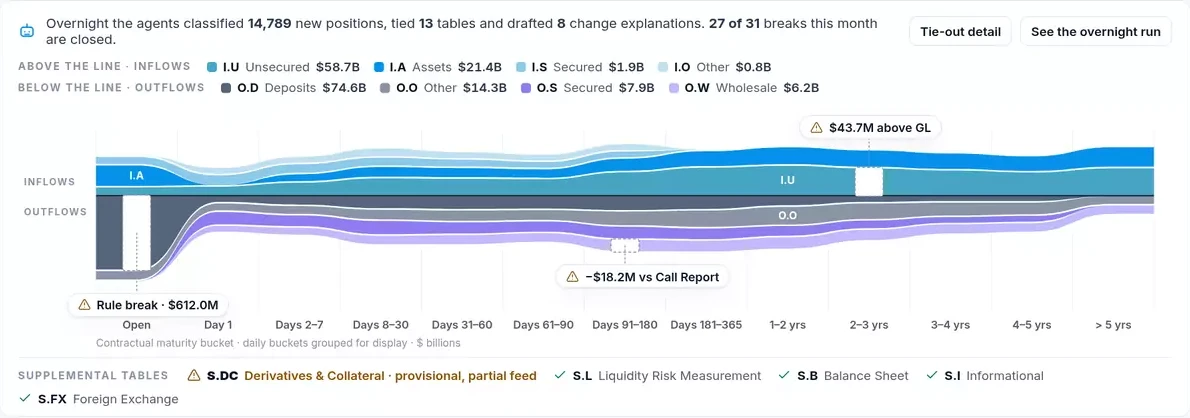
The whole FR 2052a on one strip: maturities, not just a ratio
Where the LCR debate stands in October 2026
The debate has moved from whether the LCR was too lenient to whether it is too rigid, and no rule has changed. In March 2026 the Vice Chair for Supervision, Michelle Bowman, argued that banks hold liquid assets above the minimum and are reluctant to use them in stress: "The LCR effectively becomes an isolated, unusable buffer" (Bowman, March 3, 2026). She tied reform to the discount window and to giving banks credit for collateral pledged for central bank and Federal Home Loan Bank borrowing.
Those are views, and they point in different directions from the 2023 review's. Until a proposal is published and adopted, the rule in 12 CFR part 249 is the rule, the FR 2052a is how the Board monitors it, and a firm's own stress tests carry the judgement the ratio leaves out.
A correct ratio is the start: what FR 2052a Liquidity Reporting adds
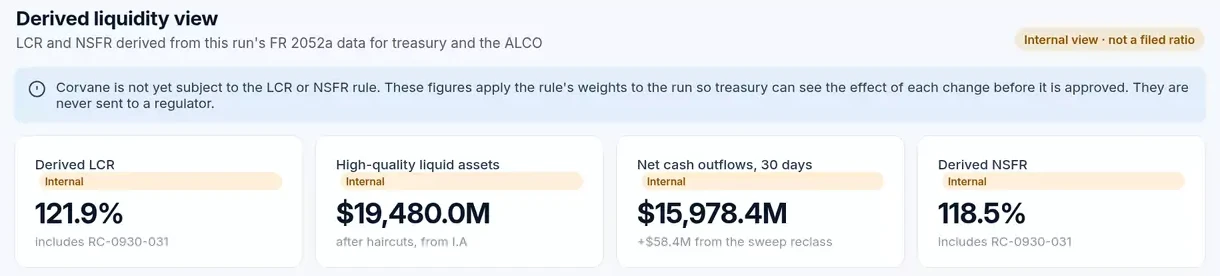
FR 2052a Liquidity Reporting makes the inputs right and shows how each change moves the liquidity position before it is approved. Agents classify new and changed positions with the instruction cited, a second agent re-checks them, every table is tied to the general ledger and the Call Report, and the Liquidity impact agent prices each pending change in derived LCR and NSFR terms, routing material ones to the liquidity risk officer. In its sample deployment, correcting $612.0 million of sweep balances coded as stable retail deposits added $58.4 million to derived 30-day outflows and moved the derived LCR from 122.4% to 121.9%.
It does not replace a stress test or the LCR calculation of record, and its derived figures are labelled internal. What it adds is the confidence that the data under both are classified as the instructions require, and that a material change reaches the second line while it can still be challenged, as described in the guide to who classifies and who decides.
FR 2052a Liquidity Reporting: a derived ratio for pricing changes, never a filed one
Questions people ask
What is a good LCR for a bank?
The rule's minimum is 100%, and a covered firm must notify the Federal Reserve on any business day its ratio is calculated below that; a monthly calculator calculates only on the last business day of each month, so for it the notice and a consultation on a remediation plan follow a month-end shortfall (12 CFR 249.40). How far above 100% a bank should sit is a matter for its own stress tests and risk tolerance, not the ratio itself.
Did SVB file the FR 2052a?
Yes. Its holding company filed the FR 2052a monthly from January 2022, after crossing $100 billion in average total consolidated assets in June 2021. The Board's review calculated its reduced LCR from those reports.
Would the full LCR have flagged SVB?
The Board's analysis suggests it would have. Under the pre-2019 requirements SVB would have faced the full LCR and an estimated shortfall of about 9% of HQLA in December 2022, growing to about 17% by February 2023.
Has the U.S. LCR rule changed since SVB?
Not as of October 27, 2026. The text of the rule's part of the Code of Federal Regulations was last amended in January 2022, no proposal to change it has been published, and the agencies' February 2026 withdrawal of their LCR FAQs did not amend it.
Where can I see a bank's LCR?
In its quarterly LCR disclosure, which holding companies subject to the rule must publish under 12 CFR 249.90. The position-level FR 2052a data behind it are confidential.