The main BCBS 239 implementation challenges are not technical mysteries; supervisors have written them down. The Basel Committee found in 2023 that many adoption programmes "were often underfunded, limited in scope and lacking sufficient attention from boards of directors (boards) and senior management", and that "several banks failed to fully assess the complexity and interdependence of related projects, especially to address IT legacy systems and set ambitious timelines" (BCBS, November 2023). The work is risk data aggregation and reporting under the Basel principles: proving that every figure a board sees is accurate, complete, timely and adaptable. It is hard because the proof runs through legacy systems, spreadsheets and many owners, and it has to be redone as they change. Botminds' BCBS 239 Compliance exists to make that proof continuous: agents trace, reconcile and time each critical figure, so the programme's indicators come from evidence rather than status reports.
Programme figures for the solution come from a fictional sample bank, Corvane National Bank, a $92 billion regional lender, and from Botminds' own estimate of its assessment calendar; both are labelled where they appear.
Thirteen years of BCBS 239: the deadline came early in the story
- Jan 2013 to Jan 2016: time allowed to comply3 yrs
- Jan 2016 to June 2022: past the deadline, 2 of 31 fully compliant6.5 yrs
- June 2022 to Oct 2026: no newer progress report4.3 yrs
- 2016 to May 2018: thematic review, none fully compliant2.4 yrs
- 2018 to 2022: letter to all banks (2019), follow-up3.6 yrs
- 2022 to 2024: on-site inspection campaign2.5 yrs
- May 2024 to Oct 2026: Guide, then escalation with deadlines2.3 yrs
Why is BCBS 239 hard to implement? Five challenges supervisors keep recording
BCBS 239 is hard to implement because it asks for a property of the whole chain, and the chain belongs to many people. The supervisory record names five recurring obstacles, and each has a cost line attached.
Legacy architecture. The Basel Committee describes banks still held back by fragmented IT, old systems and manual steps that do not do the job (the BCBS 239 progress report quotes it), and notes that IT roadmaps "are often subject to changes or delays". Ownership. Its January 2026 newsletter says "Resistance to change, fragmented responsibilities and insufficient attention from senior management continue to hinder progress at certain banks" (BCBS Newsletter 36). Scope creep. Programmes widened beyond risk data to more legal entities, new risks and the bank's financial and supervisory reporting, which "have led to extended implementation timelines".
Plans without end dates. The ECB's 2024 targeted reviews found many banks without a recent, regular gap analysis against the principles, and that "banks repeatedly fail to provide credible target end dates for implementation" (ECB Supervision Newsletter, February 2025). Manual aggregation. The same newsletter lists "high numbers of manual aggregation processes" among the reasons banks have been slow, and adds that "remediation of RDARR deficiencies is often costly, carries significant risk and takes time".
How long does BCBS 239 implementation take?
Longer than anyone planned. The Committee gave the first G-SIBs three years, from January 2013 to January 2016, and expected them "to start making progress towards effectively implementing the Principles from early 2013" (BCBS 239, paragraph 14). By June 2022, six and a half years after that deadline, two of 31 were fully compliant. The ECB began its thematic review in 2016, wrote to all significant institutions in 2019, ran a three-year on-site campaign from 2022 and published its Guide in 2024; its annual report for 2025 still records "insufficient progress".
Two lessons follow for a programme plan. First, the date that matters is the one the supervisor will accept, and the ECB now asks for "clear timelines and interim milestones" for each identified shortcoming, escalating "Where initial measures failed to achieve timely results" (ECB Annual Report 2025). Second, compliance is not a finish line. The 2023 report warns that adoption "is not a static process and must be assessed by banks on an ongoing basis"; a source system release can break a mapping in the week after the self-assessment is signed.
The implementation programmes should be ambitious yet feasible.
ECB Guide on effective risk data aggregation and risk reporting, May 2024, section 3.7
How much does BCBS 239 cost? Price the work, not the label
No regulator publishes what a BCBS 239 programme costs, and any single figure would mislead: a bank's bill depends on how many critical figures it reports, how many hops sit between them and their sources, and how many of those hops are spreadsheets. The Basel Committee was candid in 2013 that "IT systems, data and reporting processes require significant investments of financial and human resources with benefits that may only be realised over the long-term", and equally clear that it believes "the long-term benefits ... will outweigh the investment costs incurred by banks" (BCBS 239, paragraphs 5 and 11). The ECB names the payback: banks with robust capabilities "can reduce their operational and IT costs through automation and IT architecture modernisation".
A useful way to price a programme is to split it into two budgets. The remediation budget pays for architecture: retiring a workbook into a governed transformation, adding a reconciliation control to a mart load, building a data dictionary. It is a project cost with an end date. The evidence budget pays for knowing where you stand: keeping the critical data element inventory current, drawing lineage, reconciling, timing drills, arguing ratings. It recurs every year, and it is the one most banks underestimate, because it is spread across stewards' calendars rather than a project code.
Botminds estimated the evidence budget for one annual assessment cycle at the sample bank by following its calendar: inventory in January and February, lineage from March to June, the self-assessment from August to October, approval and validation in November and December. By hand it comes to about 46 working weeks of effort spread across the data office. With agents doing the tracing, reconciling and drafting, the same cycle comes to about 12.5 weeks, most of it people deciding.
Where one annual BCBS 239 assessment cycle's 46 weeks go, by hand and with agents
By hand: about 46 weeks
- Element inventory · 17%
- Interviews and lineage · 35%
- Sample reconciliation · 9%
- Stress timing · 4%
- Arguing ratings · 22%
- Approval and remediation plan · 13%
With agents: about 12.5 weeks
- Element inventory · 8%
- Confirming lineage · 24%
- Reconciliation review · 8%
- Drill review · 4%
- Deciding ratings · 24%
- Approval and remediation plan · 32%
What are the main BCBS 239 challenges for a board? Seeing the gap before the supervisor does
For a board, the challenge is information. The Basel Committee's January 2026 newsletter puts it plainly: boards are responsible for "gaining assurance from management that processes are sound and ensuring that board members receive appropriate information on RDA", and "must also remain aware of significant problems or shortcomings that could result in material risks". The 2023 report asks banks to give the board a standard set of data quality measures for all material group-level risks, and the ECB Guide asks the management body to set "detailed key performance indicators for monitoring data quality" and to monitor them regularly with action plans for significant deviations (ECB Guide, section 3.1).
A gap assessment alone is not that information. In April 2022 Silicon Valley Bank presented its supervisors with a gap assessment against interest rate risk guidance that highlighted, among other weaknesses, "lack of timely reporting, data quality issues and limited data quality controls" (Federal Reserve review of SVB, April 2023). The review records that "supervisors did not document any supervisory concerns, changes to ratings, or changes to the 2022 supervisory plan". The weaknesses were known and written down before the bank failed. An indicator a board sees every quarter, with an owner and a date beside it, is harder to leave on a slide.
What KPIs track BCBS 239 progress? Indicators that can fail
A good BCBS 239 indicator is one that can go red without anyone choosing to report it. Counts of policies approved or workshops held cannot fail; the share of critical figures traced and reconciled to source can. The table sets out eight indicators that come straight from evidence, with the sample bank's values as an example of what a board would see.
Eight BCBS 239 programme indicators that come from evidence, not status reports
| Indicator | How it is measured | Principle | Sample bank today |
|---|---|---|---|
| Critical data elements with confirmed lineage | Elements whose every hop to source a steward has confirmed, over all elements | P1, P2, P3 | 268 of 312 |
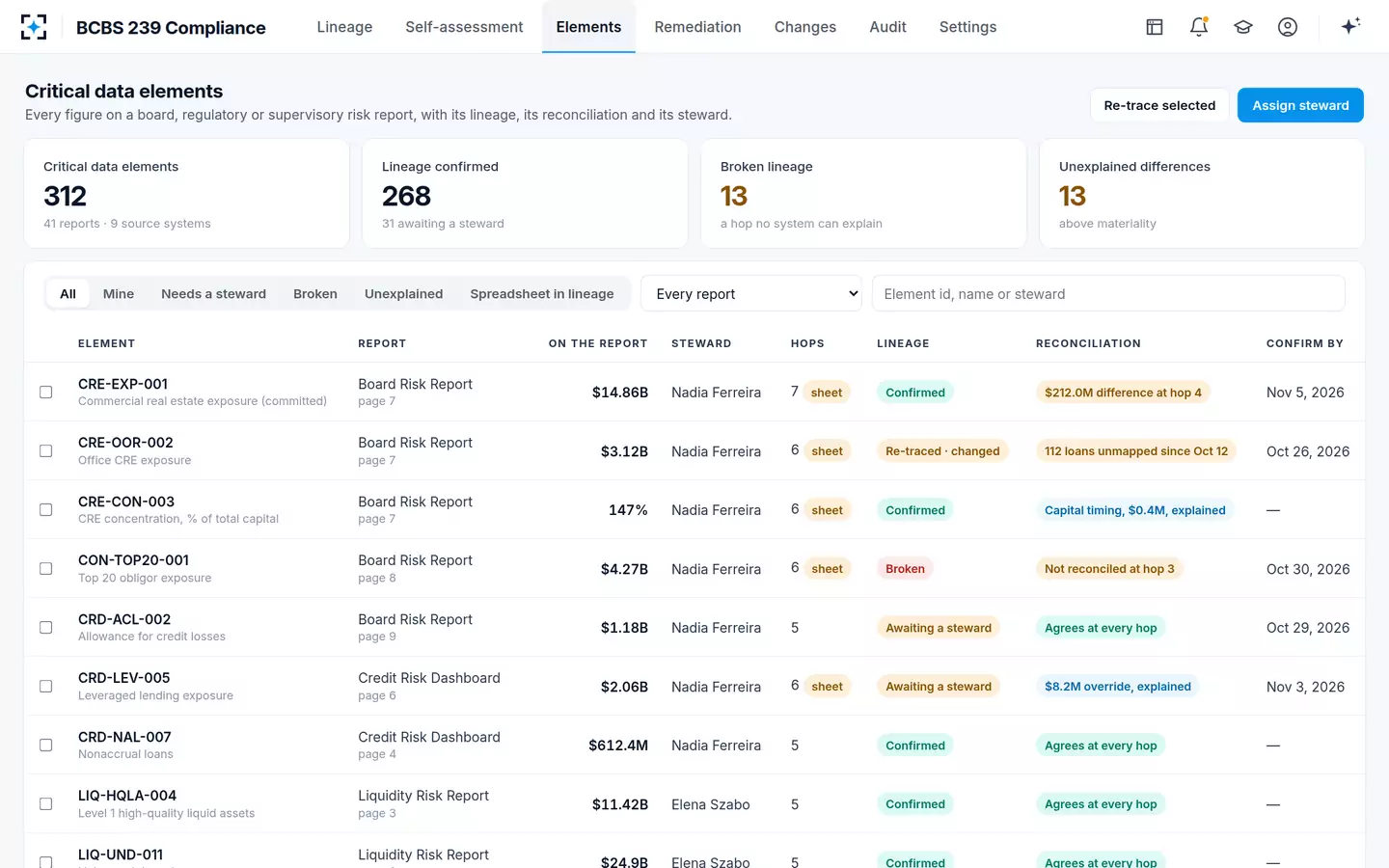
| Elements with an unexplained difference | Elements where a hop differs from the hop before by more than materiality, with no explanation | P3, P7 | 13 |
| Unexplained remainder on the largest element | The part of a hop difference nobody can cite to a row or rule | P3 | $24.6M on CRE exposure |
| Request-to-board hours in the last stress drill | Measured from scheduler and report-platform logs, hop by hop | P5, P6, P10 | 81.6 hours against 24 |
| Reports within the stress target | Reports delivered within the bank’s own stress timing | P5, P10 | 33 of 41 |
| Spreadsheets in lineage rated high | Workbooks found in lineage, rated on materiality, complexity, controls and change history | P3, P6 | 9 of 27 |
| Remediation overdue and escalated | Items past due; items escalated to the CDO after 30 days | P1, P13 | 3 overdue, 2 escalated |
| Ratings that cite findings | Principle ratings with at least one finding and its hop behind them | P1 to P11 | 11 of 11 |
Each indicator answers to a principle, and each moves when something real changes. When the sample bank's loan origination system renamed a property-type field in October, 112 office loans fell out of a spreadsheet mapping, and the Change agent re-traced the 14 elements that read the field and flagged the one that changed, rather than waiting for the next annual cycle. Critical data elements in banking explains how the first three indicators are built, and end user computing controls the sixth.
The inventory behind the indicators: 312 critical data elements in BCBS 239 Compliance
Why do BCBS 239 programmes fail?
They fail when the plan measures activity and the supervisor measures outcomes. The ECB's 2018 review found that "Large-scale IT projects or strategies designed to implement the BCBS principles are defined incompletely", with schedules "not sufficiently clear" and scope "not always clearly defined, resulting in a non-existent or inadequate roadmap" (ECB Thematic Review, 2018). Its Guide expects programmes to define "remedial actions, targets, milestones, roles, responsibilities", with "measures and metrics to control project execution risks" and periodic reporting that includes "analysis of impediments, delays and other factors".
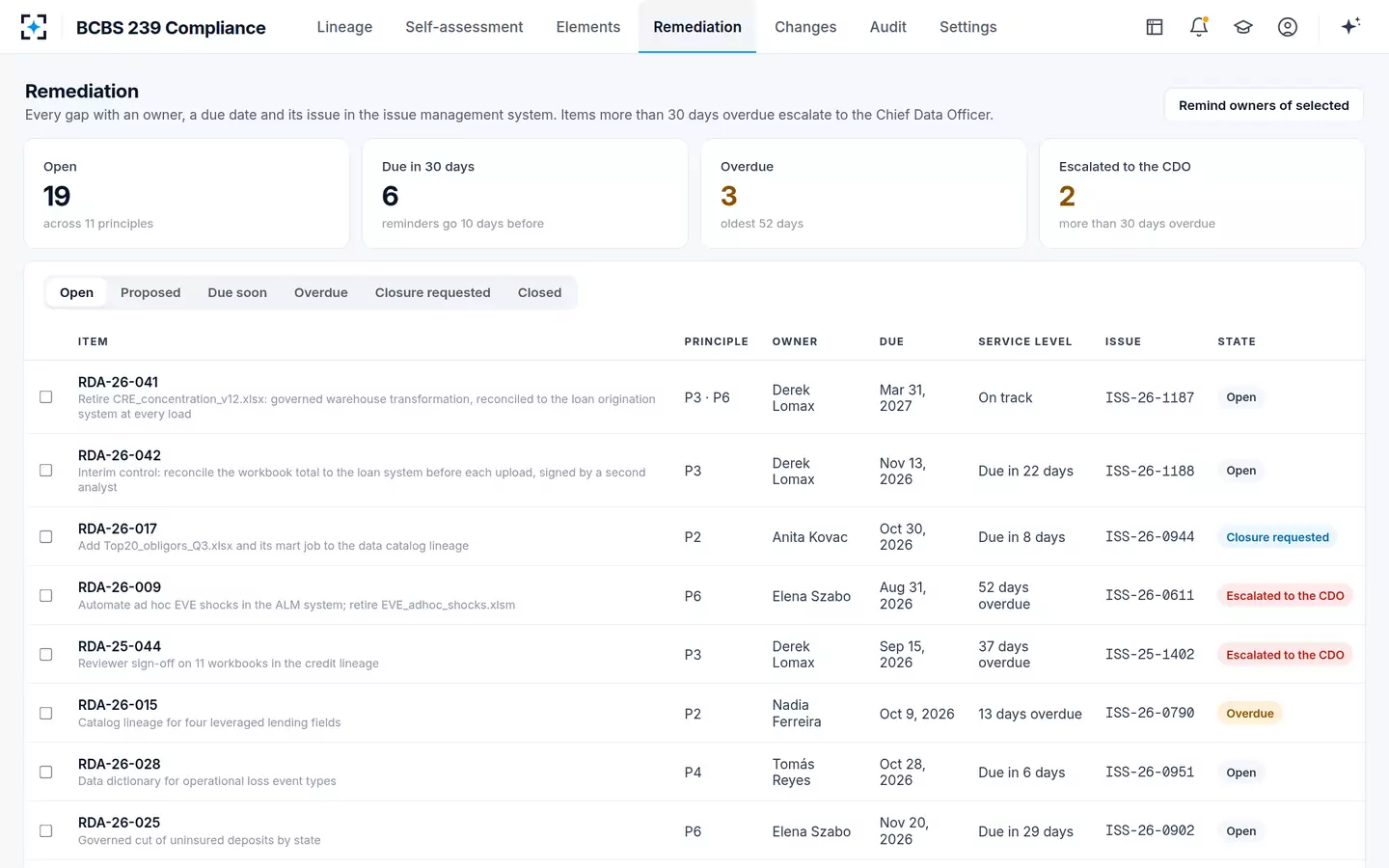
The second failure is a programme with no consequences for missing its dates. The ECB's Guide says that if requirements and timeframes are not met, "the matter is escalated further and can potentially result, for example, in the imposition of enforcement measures, sanctions and capital add-ons", and that deficiencies "may also lead to a reassessment of the suitability of the responsible members and, in severe cases, the removal of such members". A remediation queue in which overdue items escalate automatically to the Chief Data Officer, and from there to the board risk committee, builds the same consequence inside the bank.
What supervisors say the programmes lack
Funding
programmes “often underfunded, limited in scope”
BCBS, 2023
Dates
banks “repeatedly fail to provide credible target end dates”
ECB, 2025
Analysis
many banks without a recent, regular gap analysis
ECB, 2025
Scope
frameworks that do not cover capture to final reporting
ECB, 2025
Where BCBS 239 Compliance fits in the programme, and where it does not
BCBS 239 Compliance is an evidence engine, not an architecture programme. Its six agents trace each critical figure from the board report to its source, reconcile the amount at every hop, replay the last stress drill, rate the spreadsheets they find, draft each principle's rating with its findings cited and watch for system changes that touch a traced figure. People decide: a steward confirms each hop, the Head of Risk Reporting decides each rating and submits, the Chief Data Officer approves and internal audit validates. The solution shows evidence; it never certifies compliance.
What it does not do matters as much for the budget. It does not rebuild the data warehouse or retire a workbook: in the sample bank, retiring the spreadsheet behind commercial real estate exposure is a remediation item owned by the credit analytics data owner, due March 31, 2027, with an interim second-analyst reconciliation due first. It does not edit figures, workbooks or reports; the agents read only. What it changes is the evidence budget, and the speed at which the remediation budget is pointed at the right hop.
Remediation with owners, dates and automatic escalation
If the programme is being restarted, start small and measurable: a BCBS239 assessment on one board report produces the first set of these indicators in two weeks. The BCBS 239 Compliance page shows the agents and their limits.
Questions people ask
What are the main BCBS 239 implementation challenges?
Supervisors repeatedly cite fragmented and legacy IT, manual aggregation and spreadsheets, unclear ownership and insufficient board attention, scope that grows mid-programme, and plans without credible end dates. The Basel Committee's 2023 report found programmes often underfunded and limited in scope.
How long does BCBS 239 take to implement?
The first G-SIBs were given three years, to January 2016, yet only two of 31 were fully compliant on June 2022 data. Treat it as a multi-year remediation with interim milestones, followed by continuous evidence, since the ECB and the Committee both expect adherence to be reassessed as banks change.
How do boards oversee BCBS 239?
By approving the framework, naming accountable executives and watching indicators that can fail. The ECB expects the management body to select one or two of its members to be responsible for the data governance framework and to monitor data quality KPIs with action plans; the Basel Committee asks for a standard KPI set covering all material group-level risks.
Is BCBS 239 worth the investment?
The Basel Committee said in 2013 that it believes the long-term benefits outweigh the costs, and the ECB argues that robust capabilities lower operational and IT costs through automation. The cost of not investing is visible in supervisory escalation, from follow-up letters to capital add-ons and periodic penalty payments.
Who should own a BCBS 239 programme?
An executive member of the management body, typically the chief risk officer, sometimes with the chief financial officer; the ECB Guide describes appointing the CRO, or the CRO together with the CFO, as a pragmatic solution. Day-to-day delivery usually sits with the chief data officer and named data owners.