The FR 2052a report is the Federal Reserve's Complex Institution Liquidity Monitoring Report: a detailed snapshot of a large banking organization's liquidity, filed daily or monthly, in which every asset, liability, funding activity and contingent liability is reported by product, counterparty, collateral and contractual maturity, for the consolidated firm and for its material legal entities. U.S. bank holding companies and covered savings and loan holding companies with $100 billion or more in assets file it, as do foreign banks with $100 billion or more in combined U.S. assets. The Board uses it to watch each firm's liquidity, to see where cash could be trapped inside a group, and to monitor compliance with the liquidity coverage ratio and net stable funding ratio rules. Botminds' FR 2052a Liquidity Reporting helps the teams that build it, and the eight numbers below explain why that work is hard.
The FR 2052a report in eight numbers
$100B
The line
Total consolidated assets, on a four-quarter average, at which a U.S. holding company starts to file; combined U.S. assets for a foreign bank.
41
Filers
18 file every business day and 23 monthly, in the Board’s 2025 estimate, based on filings received in 2023.
T+2 · T+10
The clock
Two business days for daily filers and Category III monthly filers; ten calendar days for Category IV; 3:00 p.m. Eastern.
13
Tables
Inflows, outflows and supplemental items in 13 tables plus comments, holding 147 products.
121–221
Hours a response
The Board’s estimate for one monthly and one daily response.
15.4%
Of the Board’s paperwork
1,027,896 hours a year, about 15.4% of all the paperwork burden the Board imposes.
2007–08
The reason
The financial crisis showed supervisors had no timely, entity-by-entity liquidity data.
0
Firm-level data published
Micro data are confidential; only aggregates that identify no firm may be released.
What is the FR 2052a? The report behind the liquidity rules
The FR 2052a is a data collection, not a form with boxes. The Board's own description: it "collects quantitative information on selected assets, liabilities, funding activities, and contingent liabilities on a consolidated basis and by material entity subsidiary" (Federal Reserve, FR 2052a form page). Each row is a combination of a product, a counterparty type, a maturity bucket and other fields, with the amounts summed, and the file grows with the firm. A large firm's submission is an XML file sent by secure file transfer to the Federal Reserve Bank of New York.
It serves three purposes. Supervisors use it to see firm-specific liquidity risk early, above all in periods of stress. The Board uses it "to monitor compliance with the Liquidity Coverage Ratio (LCR) and Net Stable Funding Ratio (NSFR) rules" (Federal Register, February 7, 2025). And it feeds analysis of the system as a whole: in October 2026, the Vice Chair for Supervision cited FR 2052a data to show dealers' total Treasury positions rising "from roughly $600 billion at the beginning of the modification period to over $700 billion at the end of April" after the leverage rule changed (Bowman, October 1, 2026).
What does FR 2052a stand for?
FR 2052a is the Federal Reserve's form number for the Complex Institution Liquidity Monitoring Report, OMB control number 7100-0361. It once had a companion, the FR 2052b, a simpler quarterly Liquidity Monitoring Report for smaller holding companies, which the Board later terminated. The report's name says what it is for: monitoring the liquidity of complex institutions, ones whose cash sits in many legal entities, currencies and business lines.
Who files the FR 2052a? Numbers one and two: $100 billion and 41 firms
The FR 2052a is filed by banking organizations subject to Category I, II, III or IV standards under the Board's Regulation YY and Regulation LL: top-tier U.S. bank holding companies with $100 billion or more in total consolidated assets that are not owned by a foreign bank, top-tier covered savings and loan holding companies of that size, and foreign banking organizations with $100 billion or more in combined U.S. assets. Size is measured as a four-quarter average, so a firm crosses the line over a year, not on a single quarter-end.
The Board's current estimate counts 41 filers: 18 daily and 23 monthly, based on the filings it received in 2023 (supporting statement, February 2025). The split follows the tailoring categories: the largest and most wholesale-funded firms file every business day, the rest monthly. Which category a firm is in, and what that means for its FR 2052a reporting requirements, is set by size, cross-jurisdictional activity, nonbank assets, off-balance sheet exposure and weighted short-term wholesale funding.
Why the FR 2052a exists: number seven, 2007 and 2008
The FR 2052a exists because the financial crisis showed supervisors could not see liquidity fast enough or in enough detail. The Board says so plainly on the form page: "The financial crisis of 2007 and 2008 highlighted the need for timely liquidity data to identify and monitor liquidity risks at individual firms as well as in aggregate across the financial system." The deeper lesson was about structure.
A single, consolidated view is not sufficient to provide meaningful insight into an institution's liquidity profile.
Federal Reserve Board, FR 2052a form page
Cash at a broker-dealer subsidiary may not be free to move to the parent, and a bank's deposits may be needed where they are. That is why the report asks for the parent company alone and for each material entity, not only the consolidated group, and why its supplemental tables carry subsidiary liquidity that "cannot be transferred". The form page lists versions back to September 2014. In 2015 the Board proposed moving the collection from a spreadsheet to XML, the format it is filed in today, and moved the submission time to 3:00 p.m. Eastern (Federal Register, November 17, 2015).
The FR 2052a in five dates, from 2014 to an approval that runs to 2028
- Earliest version listedSep 2014
- Revision; 3 p.m. deadlineNov 2015
- NSFR data added2022
- Current textMar 2023
- Extended without revision to 2028Feb 2025
How big is the FR 2052a? 13 tables, 147 products, 76 buckets
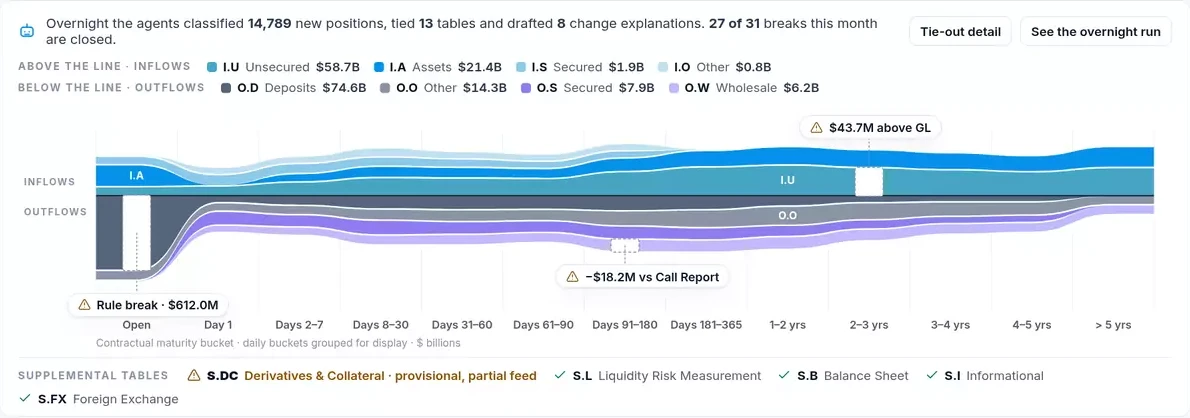
The FR 2052a divides inflows, outflows and supplemental items into 13 tables, from Inflows-Assets to Supplemental-Foreign Exchange, with a comments table beside them. Our count of the instructions finds 147 products across those tables, 41 named fields, 18 counterparty types and up to 76 maturity buckets. Size scales with the firm: a Category IV firm reports fewer entities and coarser maturities than a global systemically important one, and may report in U.S. dollars only.
147 products, unevenly spread: the contingent and derivative tables are the longest
The tables are not uniform. Outflows-Other alone has 22 products, from derivative payables to collateral required on a downgrade, because it is where the report captures contingent calls on liquidity: undrawn credit and liquidity facilities, collateral a firm would owe after a one-, two- or three-notch downgrade, and the loss of the right to re-use collateral. Supplemental-Derivatives and Collateral has 21, covering margin posted and received, disputes and collateral that could be substituted. Supplemental-Foreign Exchange has three. Product count is not volume, though. Where the volume really lies depends on the business: the solution's fictional sample bank, a regional lender, puts 1.1 million of its 1.9 million monthly rows in the deposits table. The fields and where each comes from are set out in the FR 2052a data dictionary guide.
A whole FR 2052a on one strip, across the contractual maturity buckets
What does the FR 2052a cost? Numbers five and six
The Board estimates 121 hours of work for each monthly response and 221 for each daily one. Across all filers that is 1,027,896 hours a year, which the Board's supporting statement says represents "approximately 15.4 percent of the Board's total paperwork burden", and an estimated $71.8 million a year at its staffing rates. The daily filers carry almost all of it: 250 responses a year each. The breakdown, and what a calculation tool does and does not save, is in the guide to the hours of an FR 2052a run.
Is FR 2052a data public? Number eight: zero
No. The Board states that "Micro data from the FR 2052a are considered confidential and are not published", and the instructions add that only aggregate data for several firms, which identify none of them, may be released in limited circumstances. The Board's legal basis is that the report is part of the supervisory process and so "generally entitled to confidential treatment under exemption 8 of the Freedom of Information Act"; firms may also ask for commercial information to be protected under exemption 4 (supporting statement, 2025).
What is public is the ratio. Holding companies subject to the LCR and NSFR must publish quarterly disclosures of the ratios and their main components (12 CFR 249.90). The positions behind them, the counterparties, the maturities, the entity-by-entity view, stay with the supervisor.
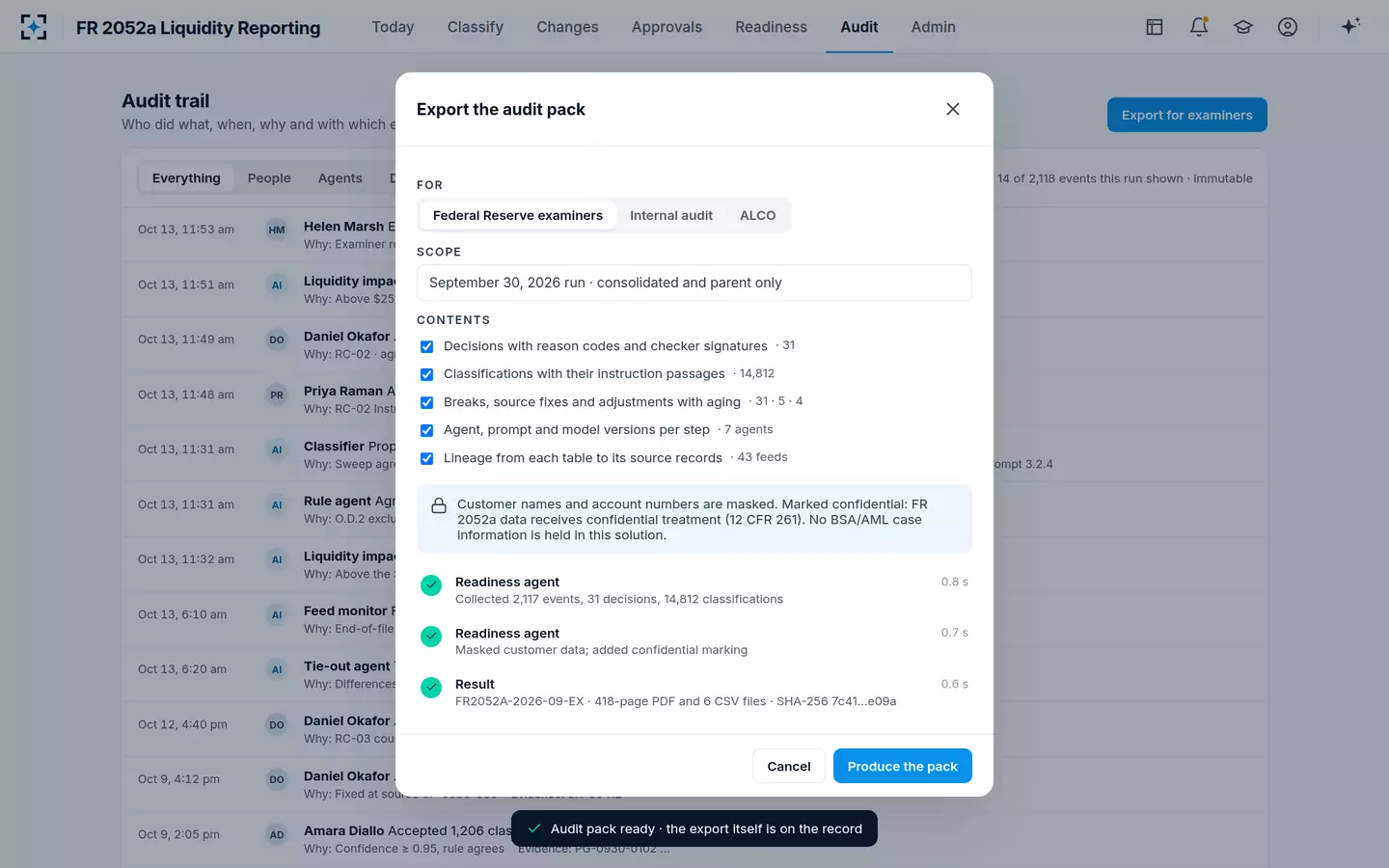
FR 2052a Liquidity Reporting exports for examiners, masked and marked confidential
What is the difference between the FR 2052a and the FR 2052b?
The FR 2052b was the FR 2052a's smaller sibling, and it no longer exists. In 2015 it was a quarterly Liquidity Monitoring Report for U.S. bank holding companies with $10 billion to $50 billion in assets, due 15 days after quarter-end, with 52 respondents at an estimated 60 hours each, against 48 FR 2052a respondents at 120 to 400 hours (Federal Register, November 17, 2015). By 2018 the Board was citing it as a burden-reducing change: "the Board terminated the FR 2052b" (Federal Register, March 21, 2018).
FR 2052a and FR 2052b, as they stood in 2015
FR 2052a: The largest U.S. firms and foreign banks, by asset and custody thresholds
FR 2052b: U.S. bank holding companies with $10 to $50 billion in assets
FR 2052a: Daily or monthly
FR 2052b: Quarterly
FR 2052a: T+2 or T+10, by 3:00 p.m. Eastern
FR 2052b: T+15
FR 2052a: 48 respondents, 120 to 400 hours per response
FR 2052b: 52 respondents, 60 hours per response
FR 2052a: Category I to IV firms at $100 billion and up; 41 filers
FR 2052b: Terminated
Where are the FR 2052a FAQs?
The Board has issued FR 2052a FAQs in numbered volumes, but we found no public copy. Its 2022 supporting statement refers to changing a definition "to match the definition provided in Question 5 of the FR 2052a FAQ Volume 12" (supporting statement, 2022), so at least twelve volumes exist. The Board's FR 2052a form page does not link to them as of October 27, 2026, and documents that appear in searches under names such as a "6G FAQ" could not be found on the Federal Reserve's public sites, so we do not describe their contents.
The practical route is the one the instructions themselves point to: the supervisory team, which the instructions send firms to more than a dozen times, from naming material entities to categorizing specific assets. The interagency FAQs on the liquidity coverage ratio are a different set; the agencies rescinded them in February 2026 but left them posted, as the guide to Appendix VI explains.
Where FR 2052a Liquidity Reporting fits
FR 2052a Liquidity Reporting works on the part of the FR 2052a the numbers above make expensive: the classification of each new or changed position, the tie-out of 13 tables to the general ledger and the Call Report, and the explanation of each month's moves. Agents propose and cite; a second agent checks; analysts, managers and the second line decide. It sits beside the regulatory reporting system that produces the file and the LCR calculation of record, and keeps every decision with its evidence for examiners.
Questions people ask
Is the FR 2052a filed by banks or by holding companies?
By the top-tier holding company, or for a foreign bank by its combined U.S. operations. The holding company reports the consolidated group, the parent alone and, for Category I to III firms, each material entity, including bank subsidiaries of $10 billion or more.
What does the FR 2052a collect, positions or ratios?
Mainly positions, aggregated by product, counterparty, maturity and other fields. Firms subject to the LCR and NSFR also report their own calculated ratios as products S.L.6 and S.L.10, to four decimal places.
Which regulator receives the FR 2052a?
The Federal Reserve. Files go to the Federal Reserve Bank of New York by secure file transfer, and the Board uses the data in its supervision of each firm and its monitoring of the system.
Is the FR 2052a changing in 2026?
Not as of October 27, 2026. The Board extended it without revision in February 2025, its approval runs to February 29, 2028, and it is not on the Board's list of collections under review.
Does a firm below $100 billion file any liquidity report to the Fed?
Not the FR 2052a, and its smaller-firm companion, the FR 2052b, was terminated. Below the line, a firm's balance sheet reaches supervisors through reports such as the Call Report and, for holding companies of $3 billion or more, the FR Y-9C.