FR 2052a Appendix VI is a document Federal Reserve staff wrote to help firms subject to the liquidity coverage ratio map each provision of the LCR rule to the data identifiers reported on the FR 2052a. It runs to 140 numbered entries, from high-quality liquid assets to "other cash inflow amount", each listing the products, counterparties, maturity buckets, flags and collateral classes that feed one line of the rule. Its first paragraph sets its status: "This mapping document is not a part of the LCR Rule nor a component of the FR 2052a report. Firms may use this mapping document solely at their discretion" (FR 2052a instructions, Appendix VI). The rule is 12 CFR part 249; the mapping is a reading of it. Botminds' FR 2052a Liquidity Reporting cites the rule and the instructions behind each classification and treats the mapping as a cross-check, for the reasons below.
The distinction matters more in 2026. In February the agencies also rescinded their public LCR FAQs, another layer of interpretation firms had leaned on, while leaving them posted. A firm whose LCR engine is the mapping, line for line, has built on two documents that are not the rule.
Four places where Appendix VI and the LCR rule read differently
What the Appendix VI entry keys on: Products O.D.1 and O.D.2, counterparty Retail or Small Business, insured flag FDIC
What the rule text requires: Fully insured and in a transactional account, or with another relationship the firm "demonstrates to the satisfaction of the Board" makes withdrawal highly unlikely
What the Appendix VI entry keys on: Products O.D.9, 10 and 11 with the insured flag "Not FDIC", a value the field itself does not list
What the rule text requires: "Less than the entire amount of the deposit balance is covered by deposit insurance", and deposit insurance means FDIC insurance
What the Appendix VI entry keys on: Open maturities are reported as Open, and "the LCR calculation will convert Open to day 1 pursuant to section 31(a)(4)"
What the rule text requires: Day 1 applies only to open-maturity items in the categories 249.31(a)(4) names; other open maturities are left out of the add-on
What the Appendix VI entry keys on: Collateral class ending in -Q and the Treasury Control flag set to Y
What the rule text requires: The full operational requirements of 249.22, which the flag summarizes and the firm must still meet and evidence
What is FR 2052a Appendix VI? A staff map from rule lines to report fields
Appendix VI of the FR 2052a instructions is a set of 140 mapping tables, one or more for each component of the LCR rule, that say which FR 2052a data elements feed it. It opens with the LCR formulas, including the level 2 cap calculations, then works through HQLA, outflows and inflows in the rule's order: entry (10) maps "Stable Retail Deposits (§.32(a)(1))", entry (45) "Insured Affiliated Sweeps (§.32(g)(7))", entry (140) "Other Cash Inflow Amount (§.33(h))". Each entry is a short table of FR 2052a fields and the values that select the data.
Three staff mappings, one status
140
Appendix VI entries mapping the LCR rule to FR 2052a data
114
Appendix VIII entries mapping the NSFR rule
24
Appendix VII entries mapping the FR Y-15 short-term wholesale funding indicator
Is the FR 2052a LCR mapping binding?
No. The mapping says so twice over: it is "not a part of the LCR Rule nor a component of the FR 2052a report", and firms may use it "solely at their discretion". It also warns that it may change: "From time to time, to ensure accuracy, an updated mapping document may be published and reporting firms will be notified of these changes." What binds a firm is the rule's text and the FR 2052a instructions; the mapping is staff's view of how one connects to the other.
That does not make the mapping unimportant. It is the most detailed public statement of how the Federal Reserve's staff read the rule against the report, and a firm whose LCR calculation departs from it should expect to be asked why. The right posture is the one its own text invites: use it, test it, and write down every place where your reading is different and the reason, so that the difference is a decision and not an accident.
Who wrote the FR 2052a LCR mapping, and how does it change?
Federal Reserve Board staff wrote it: "Staff of the Board of Governors of the Federal Reserve System (Board) has developed this document to assist reporting firms subject to the liquidity coverage ratio rule". It travels inside the FR 2052a instructions PDF, so it changes when the instructions do. The instructions in force are the March 2023 text, re-issued with a new approval date when the Board extended the report without revision in February 2025 (FR 2052a form page); the mapping a firm should test against is the one in that document, not an earlier copy kept on a shared drive.
The NSFR and short-term wholesale funding mappings carry the same warning. Appendix VII, which maps the FR Y-15 short-term wholesale funding indicator, goes further: it "is not a part of any regulation nor a component of official guidance related to the FR 2052a or FR Y‐15 reports".
What do the *, # and NULL symbols mean in Appendix VI?
The key at the top of Appendix VI defines three symbols. An asterisk marks "Values relevant to the LCR", the field whose amount is summed into that line of the rule. A hash marks "Values not relevant to the LCR": the field can take any value without changing the mapping. NULL means the field "Should not have an associated value" for that line. Every entry also names the reporting entity as the "LCR Firm", the entity subject to the rule; one narrows it to an LCR firm that is a depository institution.
Three collateral groups recur. "HQLA" means every asset category in Appendix III with a "-Q" suffix; "Other" means only collateral classes C-1, P-1, P-2, LC-1, LC-2 and Z-1; and "Non-HQLA" is everything else. A firm reading the mapping must apply those definitions exactly, because a collateral class moved between groups changes which entry, and which outflow or inflow rate, a transaction falls under.
How do you map FR 2052a to the LCR? Read one entry
To map FR 2052a data to the LCR, take each entry, select the data elements whose fields match its values, sum the field marked with an asterisk, and apply the rule's rate for that line. Entry (10), for stable retail deposits, is the simplest. It selects products O.D.1 and O.D.2, with counterparty Retail or Small Business and the insured flag set to FDIC, and sums the maturity amount; the rule's rate for stable retail deposits is 3%.
Appendix VI entry (10), Stable Retail Deposits, read field by field
| Field | Value in the mapping | What it means |
|---|---|---|
| Reporting Entity | LCR Firm | The entity subject to the LCR |
| PID | O.D.1 and 2 | Transactional accounts and non-transactional relationship accounts |
| Counterparty | Retail or Small Business | Natural persons, and businesses managed like retail customers |
| Maturity Amount | * | The amount summed into the line |
| Insured | FDIC | Only balances fully insured by the FDIC |
| Maturity Bucket, Collateral, Trigger, Business Line and others | # | Any value; not relevant to this line |
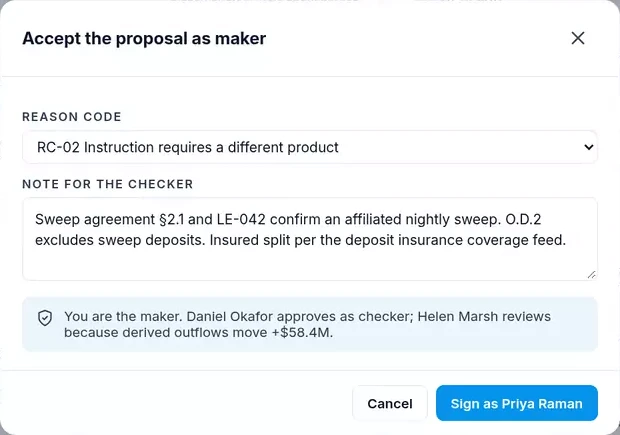
The entry is right, and it shows where the work really is. Whether a balance is a stable retail deposit is decided upstream, when the position is put in O.D.2 rather than another product. The rule defines a stable retail deposit as one "entirely covered by deposit insurance" and either held in a transactional account or backed by another relationship that the firm "demonstrates to the satisfaction of the Board" makes withdrawal highly unlikely (12 CFR 249.3). The mapping cannot test that; the product code carries it. A sweep program misfiled as relationship deposits flows through entry (10) at 3% instead of through entries (45) and (47) at 10% and 40%, and the mapping will not object. That is the break the solution's sample bank found, worth $58.4 million of derived outflows.
Four places the mapping and the rule read differently, and what to do
The four rows in the comparison above share a pattern: each mapping entry is a sensible shorthand, and each depends on a judgement made somewhere else. For stable retail deposits, the judgement is the product code. For sweeps that are not fully insured, the mapping keys on "Not FDIC", while the insured field's own values are FDIC, Other and Uninsured; reading "Not FDIC" as Other or Uninsured matches the rule, because the rule counts only FDIC insurance as deposit insurance, but it is a reading a firm should write down.
The add-on footnote says the LCR calculation "will convert Open to day 1 pursuant to section 31(a)(4)". The rule is narrower. Section 249.31(a)(4) sets day 1 for open-maturity transactions in named categories, such as financial sector funding and secured transactions, and section 249.30(b)(3) leaves other open maturities out of the add-on altogether (12 CFR 249.31; 12 CFR 249.30). An engine that converts every Open balance to day 1 would overstate the add-on. For HQLA, the mapping relies on the Treasury Control flag, which the instructions define as meeting the operational requirements other than being unencumbered; the requirements themselves are in the rule (12 CFR 249.22), and the flag is only as good as the firm's test behind it.
Using Appendix VI without treating it as law
- Build from the rule text
Each line of the calculation cites 12 CFR part 249, with the mapping entry noted beside it.
- Test against the mapping
Run the mapping as an independent calculation and explain every difference.
- Write down every departure
Where your reading differs, write down the rule text, your reading and who approved it.
- Check the judgements upstream
Product codes, insured flags and Treasury Control flags decide which entry applies; test those, not only the arithmetic.
- Reconcile S.L.6
The ratio reported in the FR 2052a should equal your calculation of record to four decimal places.
- Use the current mapping
The one in the instructions in force, re-checked whenever the instructions change.
The rescinded LCR FAQs: what changed in February 2026
In February 2026 the Federal Reserve, the OCC and the FDIC rescinded their public FAQs on the LCR rule. The revised supervisory letter says the agencies "are rescinding the public FAQs with respect to the LCR rule but leaving the rescinded FAQs posted on their websites", and that they "anticipate seeking comment on the issues addressed in the FAQs, as well as on proposed regulatory changes, in the future" (SR 17-11, revised February 11, 2026).
Neither the FAQs nor their rescission amend the requirements of the LCR rule. To the extent subject institutions have relied on these FAQs to confirm or clarify the rule requirements, they may continue to do so.
SR 17-11, revised February 11, 2026
The effect is to leave firms with the rule and with readings that have no formal standing: the rescinded FAQs, which may still be relied on, and the staff mapping, which may be used at the firm's discretion. As of October 27, 2026 no proposal to change the LCR rule has been published. Until one is, a firm's own documented reading of the rule, tested against both, is the strongest position it can hold. The FAQs themselves remain on the Board's LCR FAQ page.
Is there an NSFR mapping for the FR 2052a?
Yes. Appendix VIII maps the net stable funding ratio rule to FR 2052a data in 114 entries, with the same status: it "is not a part of the LRM Standards nor a component of the FR 2052a report", and firms may use it "solely at their discretion". Its key uses the same symbols, with the asterisk marking values "aggregated to determine ASF or RSF amount". Appendix VII does the same for the FR Y-15's short-term wholesale funding indicator, the measure that decides whether a firm's LCR calibration is 70, 85 or 100%. The calculation those mappings feed is worked through in the guide to calculating the LCR.
Where FR 2052a Liquidity Reporting cites the rule, not the map
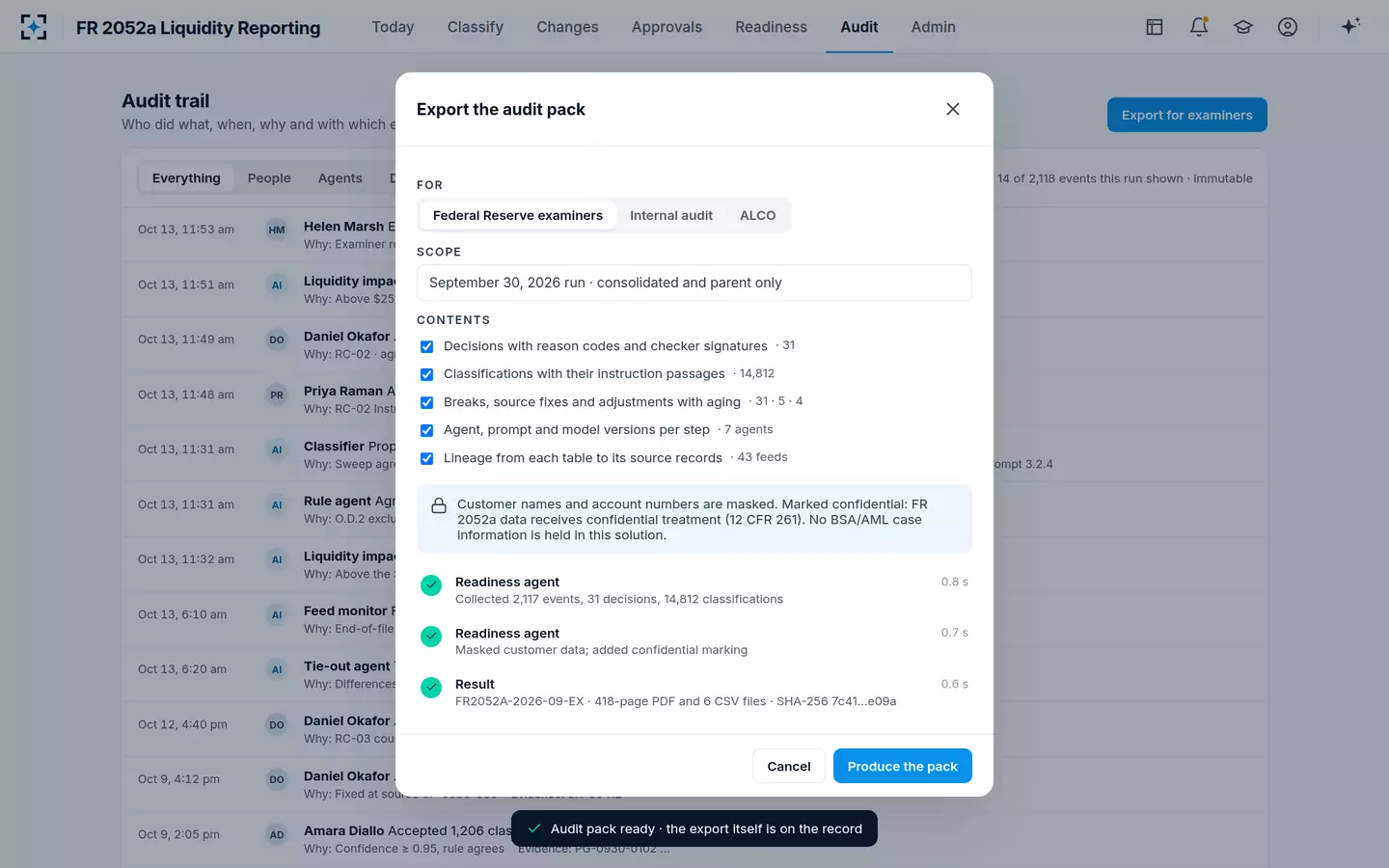
FR 2052a Liquidity Reporting works at the point the mapping cannot reach: the classification that decides which entry a position falls under. Its Classifier proposes product, counterparty, collateral class, maturity bucket and insured flag for each new or changed position and cites the FR 2052a instruction passage, the agreement and the source entry behind it; its Rule agent re-checks each proposal against the instructions and either agrees or opens a rule break. Neither agent treats the mapping as law. When the solution prices a change in derived LCR terms, it applies the rule's rates and labels the result internal.
The design follows from this page. If the mapping is right but the product code is wrong, the ratio is wrong; so the product code is where the evidence has to be. In the sample deployment, the analyst who corrected the sweep program recorded the reason as "instruction requires a different product", and every classification goes into the examiner export with its instruction passage attached. Where the instructions route a decision to the supervisory team, the solution routes it to a person, as described in the guide to who classifies and who decides.
The analyst writes down why the product changed, in the instructions' terms
FR 2052a Liquidity Reporting exports every classification with its instruction passage
Questions people ask
Does the Federal Reserve calculate a firm's LCR from the FR 2052a?
The Board says it uses the FR 2052a to monitor compliance with the LCR and NSFR rules, and firms subject to them also report their own ratios in the file. How the Board's own calculations are built is not published; the staff mapping is the public guide to how the data line up with the rule.
Can firms still rely on the rescinded LCR FAQs?
Yes, for now. The agencies said firms that relied on the FAQs to confirm or clarify the rule may continue to do so, and that neither the FAQs nor their rescission amend the rule.
Which collateral classes count as "Other" in Appendix VI?
Only C-1, P-1, P-2, LC-1, LC-2 and Z-1. Every Appendix III category with a "-Q" suffix is HQLA, and everything else is Non-HQLA.
Does Appendix VI cover the maturity mismatch add-on?
Yes. It writes out the add-on formula and adds a footnote that Open maturities are still reported as Open on the FR 2052a, with the conversion to day 1 done in the LCR calculation under section 31(a)(4) of the rule.
How often is the FR 2052a LCR mapping updated?
"From time to time", in its own words, with reporting firms notified. Because it sits inside the instructions, the current version is the one in the instructions in force, the March 2023 text approved through February 29, 2028.