FR 2052a liquidity reporting can be handed to agents up to a precise line. Agents can do the first pass on every position: propose its product, counterparty type, collateral class, maturity bucket and insured flag, cite the passage of the instructions behind each choice, have a second agent re-check it independently, tie every table to the general general ledger and price the change in liquidity terms. People must keep three things: every classification the agents do not agree on or are unsure of, every change that moves the liquidity coverage ratio materially, and every reading of the instructions that the Federal Reserve leaves to the firm and its supervisory team. Botminds' FR 2052a Liquidity Reporting is built on that division, and this guide sets out where the line sits and why.
The question matters more in 2026 than it did. The Federal Reserve's revised model risk guidance, issued in April, leaves generative and agentic AI outside its scope, so a firm deploying agents on a regulatory report cannot point to a settled supervisory framework for them. It has to draw the boundary itself, write it down and be able to show an examiner who decided each value.
Where the agents stop and a person decides, on one FR 2052a run
Classify a new or changed position
What the agents doClassifier proposes product, counterparty, collateral class, maturity bucket and insured flag, with sources. Rule agent re-checks it on its own.
What a person decidesAn analyst decides anything the two agents do not agree on, or any proposal below the confidence line.
Sample setting0.95 and above with the Rule agent agreeing: classified without a person. 0.80 to 0.95: analyst. Below 0.80: by hand.
Change a filed or approved classification
What the agents doNever on its own. It may open a break that says the earlier code looks wrong.
What a person decidesThe analyst accepts as maker with a reason code; a different person approves as checker.
Sample settingMaker and checker must differ; administrators cannot approve.
Book a top-side adjustment
What the agents doNever. The Tie-out agent opens the break and drafts the source fix.
What a person decidesMaker and checker, with the adjustment aged run by run until the source is fixed.
Sample settingEscalates after 2 runs.
Accept a change with a material liquidity effect
What the agents doThe Liquidity impact agent prices it in derived LCR and NSFR terms, labelled internal.
What a person decidesThe Liquidity Risk Officer acknowledges or challenges after the manager approves.
Sample settingDerived outflows move by more than $25.0 million.
Fill in a late or partial feed
What the agents doNever. The Feed monitor marks the table provisional and escalates to the data owner.
What a person decidesThe data owner reloads it; the table is rebuilt when the feed lands and its break is reviewed.
Sample settingLate after the calendar time plus 60 minutes.
Explain a month-over-month move
What the agents doThe Change agent drafts drivers tied to journals and subledgers, with any residual shown.
What a person decidesThe analyst edits it; the manager approves it with the run.
Sample settingA residual over $5.0 million is never hidden.
Can FR 2052a reporting be automated? The arithmetic yes, the judgement in part
Most FR 2052a reporting can be automated, and at large firms most of it already is: positions flow from source systems through mapping rules into the 13 tables, and the file goes to the Federal Reserve Bank of New York as XML. What resists automation is classification at the edges, the new product, the unusual counterparty, the deposit whose stability depends on facts outside the core system, and the explanation of why the numbers moved.
That edge is where errors cost most, because a single product code decides an outflow rate. Under the liquidity coverage ratio rule, fully insured stable retail deposits carry a 3% outflow, an affiliated sweep that is fully insured carries 10%, and a sweep that is not fully insured carries 40% (12 CFR 249.32). A mapping rule that sends a new sweep program to a relationship deposit product understates outflows on every run until someone looks. Rule-based mapping is fast and consistent; its weakness is that it applies last year's judgement to this year's products without saying so.
How are FR 2052a products classified, and why is it still judgement?
FR 2052a positions are classified by product and sub-product, counterparty type, collateral class from the asset category table, contractual maturity bucket and a set of flags, each defined in the instructions. Many of those definitions turn on facts a system does not hold. A relationship deposit needs another established relationship that the firm has proved to its supervisors makes withdrawal highly unlikely (liquidity reporting in US banks quotes the definition). An affiliated sweep needs a contractual feature that moves funds from an affiliated financial company at each day's close, and a stable one needs to meet the NSFR rule's test for stability as well.
The instructions also send more than a dozen questions back to the supervisor. They tell firms to consult or coordinate with the supervisory team on which material entities to report, before using the "Other" counterparty type, on "the categorization of specific assets", on allocating exposures across entities, on non-consolidated special purpose entities and on business line values. A reporting process that resolves those points silently, by code or by agent, has taken a decision the Federal Reserve expected to hear about.
Thirteen times, the instructions send the firm to its supervisor
13
places the instructions refer the firm to its supervisory team, from material entities to the Other counterparty type
76
maturity buckets a Category I or II firm reports, from Open to Perpetual
3%vs 40%
outflow rates for a stable retail deposit and a sweep that is not fully insured
Who approves FR 2052a classifications? Senior management, by regulation
No line of the FR 2052a instructions names a signer, but Regulation YY assigns the responsibility. For a bank holding company with $100 billion or more, senior management "must oversee the development and implementation of liquidity risk measurement and reporting systems", must approve new products and business lines after evaluating their liquidity risk "before the company implements the business line or offers the product", and must determine at least quarterly that the firm complies with the liquidity rules. The board approves the liquidity risk tolerance, and an independent review function, "independent of management functions that execute funding", evaluates the whole framework at least annually (12 CFR 252.34).
In practice that becomes a chain. An analyst prepares and proposes; a treasury reporting manager approves; the liquidity risk function in the second line reviews changes that matter to the liquidity position; internal audit tests the process. The new-product clause is the one an agent design must respect: the decision that a product is new, and how it maps, belongs to people who approved the product, not to whoever first sees it in a feed.
One reclassification, from proposal to source fix
Agent
ClassifierReads the deposit system, the agreement and the legal entity master, and proposes a product, counterparty and insured flag with each source cited.
Never: changes a filed or approved classification
Agent
Rule agentRe-reads the instruction passages on its own and agrees or opens a rule break.
Never: accepts a classification it cannot cite
Agent
Liquidity impact agentPrices the change in derived LCR and NSFR terms and routes material ones to the second line.
Never: presents a derived ratio as a filed one
A person decides
Liquidity Reporting AnalystAccepts or rejects as maker, with a reason code and a note for the checker.
A person decides
Treasury Reporting ManagerApproves as checker and opens the source fix for the data owner.
A person decides
Liquidity Risk OfficerAcknowledges or challenges any change above the materiality threshold before sign-off.
What does the rule agent check in FR 2052a reporting?
The Rule agent checks each proposed classification against the text of the FR 2052a instructions and the firm's own product mapping rules, independently of the agent that proposed it. It either agrees, citing the passages, or opens a rule break that a person must close. It never accepts a classification it cannot cite, and it never approves anything.
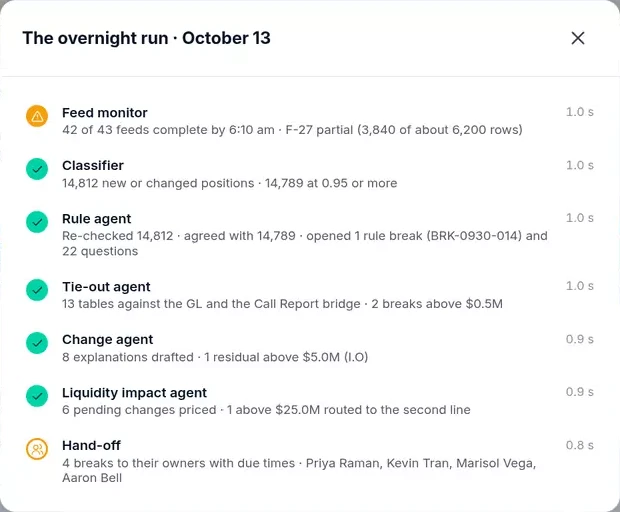
Two agents rather than one is a control, not a flourish. A model that proposed a code has already committed to a reading; asking it to grade its own answer mostly confirms the answer. A separate check that must find its own support in the instruction text catches the cases where the proposal rests on a near miss, the right table and the wrong product, or the right product and a counterparty read from the parent rather than the legal entity. In the sample run, the Rule agent re-checked 14,812 proposals, agreed with 14,789, and opened one rule break and 22 questions for analysts.
The overnight run: every proposal re-checked before anyone logs in
When must an FR 2052a change go to the second line?
A change should go to the second line when it moves the liquidity position by more than a threshold the firm has set and written down. The FR 2052a instructions set no such threshold; the firm's liquidity risk policy does, and the Regulation YY requirement for an independent review function means someone outside the reporting line must be able to see what changed and why.
The useful threshold is in liquidity terms, not balance terms. A $600 million reclassification between two products with the same outflow rate changes nothing that matters; a $60 million one from a 3% product to a 40% product changes the ratio. In the sample deployment, any change that moves derived outflows by more than $25 million waits for the Liquidity Risk Officer after the manager approves, and the derived figures are labelled internal so nobody mistakes them for a filed ratio. A sweep program reclassified from relationship deposits to affiliated sweeps, $612.0 million of balances, moved derived outflows by $58.4 million and went to the second line on that rule.
What is the role of the liquidity risk officer in FR 2052a reporting?
The liquidity risk officer's role in FR 2052a reporting is challenge, not preparation. The second line does not classify positions or tie tables; it asks whether the changes that do move the liquidity position are right, whether the assumptions behind internal stress tests still match what the report shows, and whether data-quality problems are being fixed at the source. Without a threshold, that review happens at sign-off, after the classifications are made; with one, it happens on the few changes that matter, while they can still be reversed.
The officer also guards the line between the reporting desk and the treasury model. A derived ratio built from reporting data is useful early warning; it is not the ratio the firm calculates under the LCR rule and reports in the file. Keeping the two labelled is part of the second line's job, and part of the solution's design.
Can AI classify liquidity positions? What the evidence and the 2026 guidance say
AI can propose classifications well when the facts are in the documents and the taxonomy is spelled out, and it is weakest exactly where FR 2052a classification is hardest: linking a fact to a fine-grained category. A 2025 benchmark of large language models on financial reporting taxonomies found that "while models generalize well in extraction, they struggle significantly with fine grained concept linking" (FinTagging, arXiv 2505.20650, a preprint not yet peer reviewed). That argues for citations on every proposal and a person on every disagreement, not for keeping agents out.
The supervisory frame is unsettled. The revised model risk guidance of April 17, 2026 says "Generative AI and agentic AI models are novel and rapidly evolving. As such, they are not within the scope of this guidance", and also excludes "deterministic rule-based processes" from its definition of a model (SR 26-2). The agencies said they plan a request for information on AI; none had appeared in the Federal Register by October 27, 2026. Regulators' own practice points the same way as the design here: the GAO found that agencies using AI on filed data let it neither decide on its own nor serve as their only input (GAO-25-107197, May 2025; the finding is quoted in AI regulatory change management).
A mapping table and an agent with citations fail in different ways
Rule-based mapping: Falls to a default mapping, often the nearest existing product, with no flag
Agents that cite and check: Proposed from the agreement and the instructions, with the passages shown; a person decides
Rule-based mapping: The first matching rule wins
Agents that cite and check: The Rule agent must find its own support; disagreement becomes a question
Rule-based mapping: Perfect, including when wrong
Agents that cite and check: Held by approved classifications, which agents never change
Rule-based mapping: In rule code and in a few people
Agents that cite and check: On every position: the instruction passage, the agreement and the source
Rule-based mapping: Deterministic rules are outside the model definition in SR 26-2
Agents that cite and check: Outside SR 26-2 as well, which leaves the firm to set its own validation
What to ask before buying agents for FR 2052a liquidity reporting
The useful questions are about authority and evidence, not accuracy claims. A vendor's accuracy figure on its own test set says little about your product mix; what you can verify is whether every proposal shows its source, whether a second check is independent, and whether the boundary in the figure above is enforced by the software or only by policy.
Eight questions for an FR 2052a agent demonstration
- Show the passage behind one classification
The instruction text, the agreement and the source system field, opened from the position itself.
- Show the second check failing
A case where the checking agent disagreed, and what a person saw.
- Try to approve your own change
The software, not the procedure manual, should stop a maker from being the checker.
- Change a threshold
Confidence, tolerance and materiality should be settings, versioned, with a manager approving the change.
- Feed it a partial file
A table built on half a feed must be marked provisional, never quietly filled.
- Ask for the derived ratio, then the filed one
Internal estimates must be labelled; the filed ratio comes from your LCR calculation, not the agent.
- Re-run last month
Approved classifications must not move unless a person reopens them.
- Export the file for an examiner
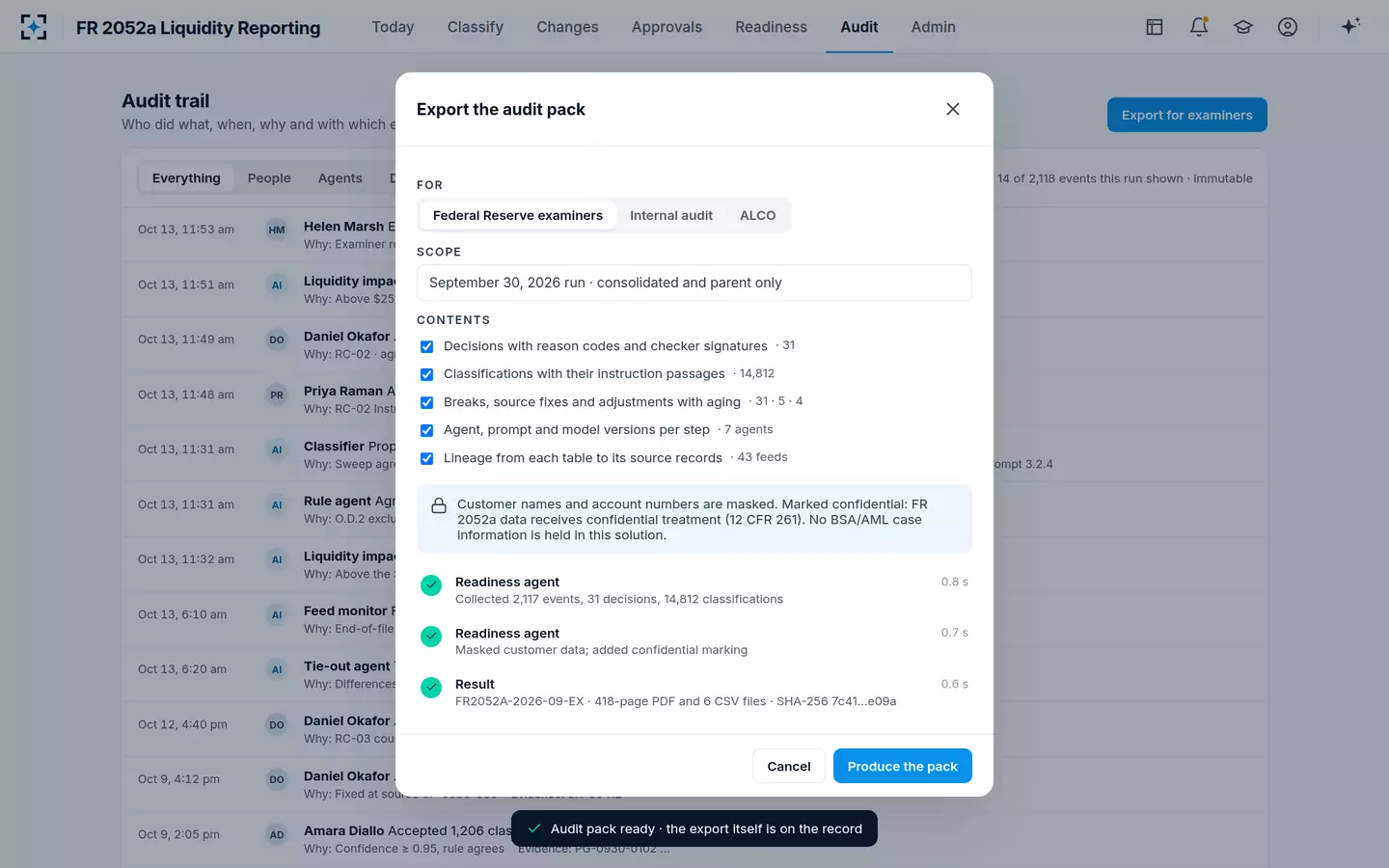
Decisions with reason codes, agent and model versions, masked, in one pack.
Where FR 2052a Liquidity Reporting fits, and where it does not
FR 2052a Liquidity Reporting sits between your source systems and your regulatory reporting system. It classifies new and changed positions with citations, re-checks them, ties every table to the general ledger and the Call Report bridge, explains month-over-month moves, prices pending changes in derived LCR and NSFR terms and keeps the decisions with their evidence. Customer names and account numbers are masked except for data owners, and the examiner export gathers decisions, passages and agent and model versions into one confidential pack.
It does not replace the system that produces the XML file or your LCR calculation of record, it does not decide questions the instructions route to your supervisory team, and it does not make a rule out of the Federal Reserve's mapping appendix, which the appendix itself says is not part of the LCR rule. It also needs inputs only you hold: your product mapping rules, the agreements behind your products and the bridge to your Call Report. Before go-live, the sample deployment shows model risk validation of the Classifier and Rule agent still open on the checklist; with SR 26-2 silent on agents, that validation is set by your own policy. The parallel run on three past months is how a firm tests the boundary on its own data before relying on it.
One pack for examiners, with every decision and its evidence
Questions people ask
Is an AI-proposed FR 2052a classification acceptable to examiners?
We found no U.S. supervisory guidance specific to AI in preparing regulatory reports, so acceptability rests on the firm's controls. Regulation YY makes senior management responsible for liquidity reporting systems, which in practice means showing who decided each value and on what evidence.
Does SR 26-2 apply to agents used in FR 2052a reporting?
Not directly. SR 26-2 says generative and agentic AI models are outside its scope and excludes deterministic rule-based processes from its definition of a model; the agencies plan a separate request for information on AI.
Can agents resubmit or change an FR 2052a that was already filed?
In FR 2052a Liquidity Reporting they cannot: agents never change a filed or approved classification. Resubmission is a management decision, and when the Board revised the report in 2022 it said resubmissions "must be based on the FR 2052a requirements as of the original filing date" (supporting statement, 2022).
What happens to a classification the agents are unsure of?
It goes to a person. In the sample deployment, proposals between 0.80 and 0.95 confidence go to an analyst, those below 0.80 are classified by hand, and any proposal the Rule agent disagrees with becomes a rule break.
Do the agents use the Federal Reserve's LCR mapping appendix as a rule?
No. Appendix VI describes itself as a staff aid that sits outside both the LCR rule and the report, so the agents cite the instructions and the rule text, and treat the mapping as a reference a person may choose to follow.
Who owns a break that the agents find?
The data owner of the source system owns the fix; the analyst owns the decision on the reported value until then. In the sample deployment a source fix is due in five business days and a top-side adjustment escalates after two runs.