The FR 2052a data dictionary is the Federal Reserve's instructions themselves: the field definitions in the general instructions, Appendix I's list of the fields each of the 13 tables carries, Appendix II's allowed values for products, counterparties and collateral, Appendix III's asset categories and Appendix IV's maturity buckets. The Board's form page publishes the form with the instructions "included with forms", and no separate data dictionary file (Federal Reserve, FR 2052a). Between them they define 41 named fields, a currency and a converted flag on every amount, 147 products and 18 counterparty types. The practical problem is that no single system holds them: product comes from one, counterparty type from another, collateral class from a third. Botminds' FR 2052a Liquidity Reporting reads each field from the system that owns it and cites the source, and this guide maps the fields to those systems.
The FR 2052a data dictionary, counted
41
named fields across the 13 tables in Appendix I
147
products, from I.A.1 Unencumbered Assets to S.FX.3 Swaps
18
counterparty types, defined by the legal counterparty, not its parent
76
maturity buckets at the most granular, from Open to Perpetual
Where FR 2052a data come from: one deposit position, five owners
A person decides
Deposit data ownerCore deposit system: account, balance, product code, contractual maturity, sweep flag, and the coverage that sets the insured flag.
A person decides
Reference data ownerLegal entity master: the counterparty’s legal form for the counterparty type, and whether a sweeping firm is an affiliate.
A person decides
Product ownerThe agreement behind the product: what makes an account operational, a sweep or a relationship account.
Agent
ClassifierAssembles product, counterparty, bucket and insured flag from the three, and cites each source.
Never: changes a filed or approved classification
A person decides
Liquidity reporting analystDecides the reported value; the O.D table carries it with 15 fields.
Is there an FR 2052a data dictionary? Yes, inside the instructions
There is no stand-alone FR 2052a data dictionary on the Federal Reserve's site; the dictionary is spread across the instructions. The general instructions define each field and its allowed values. Appendix I draws every table with its fields and types, text, numeric or percent, and marks which are mandatory for each product and which are dependent, required only for some transactions. Appendix II lists the allowed product and sub-product pairs, the counterparty types each product accepts, the collateral classes and the products that may not have a forward start. Appendix III is the asset category table; Appendix IV the maturity buckets and how many each category of firm must use.
A firm's own data dictionary should add three things the instructions cannot: the system of record for each field, the owner of that system, and the transformation that turns a source value into an FR 2052a value. That is the document examiners and internal audit ask for when a number is questioned, and the one most often held in a spreadsheet that only two people understand.
What fields are in the FR 2052a, and which system holds each?
The FR 2052a fields fall into five groups: identity (reporting entity, product, sub-product), the counterparty (counterparty type, G-SIB, internal counterparty), time (maturity bucket, effective maturity bucket, forward start bucket, maturity optionality), value (maturity amount, market value, lendable value, collateral value) and flags (insured, trigger, treasury control, encumbrance type, rehypothecated, unencumbered and others). The table below is a working dictionary for the fields that drive most breaks.
A working FR 2052a data dictionary: field, rule, system of record, owner
| Field | What the instructions require | Usual system of record | Usual owner |
|---|---|---|---|
| Reporting entity | Consolidated firm, parent only and each material entity, named as agreed with the supervisory team | Legal entity master | Regulatory reporting |
| Product, sub-product | One of 147 products; sub-product only where Appendix II requires it | Product or account type in each source, through mapping rules | Product owners, with reporting |
| Counterparty | One of 18 types, by the legal counterparty to the exposure | Legal entity and customer masters | Reference data |
| G-SIB | The counterparty’s name as on the Financial Stability Board list; Category I firms | Legal entity master | Reference data |
| Maturity bucket | Contractual maturity in calendar days after the as-of date; Open, Perpetual | Each source system’s terms and schedules | Each source owner |
| Maturity optionality | Evergreen, extendible or accelerated, on the tables that carry it | Contract terms | Product owners |
| Collateral class | An Appendix III asset category; the lowest quality where there are several | Securities and collateral systems | Collateral management |
| Collateral value, market value | Fair value under GAAP at close-of-business marks | Pricing and collateral systems | Valuation and collateral |
| Insured | FDIC, Other (fully insured abroad) or Uninsured | Deposit insurance coverage calculation | Deposit operations |
| Internal, internal counterparty | Flags and names affiliated transactions within the consolidated group | Intercompany and entity masters | Finance and treasury |
| Treasury control | Assets meeting the HQLA operational tests other than being unencumbered | Treasury and securities systems | Treasury |
| Encumbrance type | What an encumbered asset secures, from seven types | Collateral and pledge systems | Collateral management |
| Business line | Category I firms; values agreed with the supervisory team | Organizational hierarchy | Finance |
What is a maturity bucket in FR 2052a reporting?
A maturity bucket is the period, counted in calendar days after the as-of date, in which a position contractually matures. "Day 1" means the next calendar day; the buckets run day by day to Day 60, then widen to weekly, monthly, quarterly and yearly bands, and end with "> 5 Yr" and "Perpetual" (FR 2052a instructions, Appendix IV-a). Balances that can be withdrawn on demand, such as demand deposits, are "Open". Perpetual is for balances with no contractual maturity that cannot be realized on demand, such as common equity.
The bucket is contractual by rule. The instructions say: "Do not report based on behavioral or projected assumptions." Embedded options follow the LCR rule's maturity tests, so a liability the investor can put back early is reported at its earliest possible date, and payments due on a weekend or holiday go in the bucket of the day they will actually settle. Two related fields catch special cases. The effective maturity bucket shows how long an asset received as collateral stays encumbered when it has been re-used; the forward start bucket shows when a forward transaction opens.
How many maturity buckets each firm reports
What counterparty types does the FR 2052a use?
The FR 2052a uses 18 counterparty types: Retail, Small Business, Non-Financial Corporate, Sovereign, Central Bank, Government Sponsored Entity, Public Sector Entity, Multilateral Development Bank, Other Supranational, Pension Fund, Bank, Broker-Dealer, Investment Company or Advisor, Financial Market Utility, Other Supervised Non-Bank Financial Entity, Debt Issuing SPE, Non-Regulated Fund and Other. The rule for choosing one is that the type "should align with the classification of the legal counterparty to a given exposure and not the counterparty's ultimate parent", with two exceptions written into the Debt Issuing SPE and Bank definitions for credit and liquidity facilities.
Several definitions borrow from statutes and thresholds a customer master rarely holds. A pension fund is an employee benefit plan as ERISA defines it; a broker-dealer includes swap dealers and futures commission merchants; a small business is managed like a retail customer and has raised no more than $1.5 million in aggregate funding from the consolidated firm, counted across affiliated businesses. "Other" exists, but a firm must consult its supervisory team before using it and describe the counterparty in the comments table at least monthly.
What is the FR 2052a collateral class?
The collateral class is the code from the asset category table in Appendix III that identifies the type of asset behind a position: the asset itself in the Inflows-Assets table, the collateral received or pledged in the secured tables. A "-Q" suffix "indicates that assets meet all the asset-specific tests detailed in section 20 of Regulation WW", the LCR rule's high-quality liquid asset criteria; the same asset without the suffix failed one of those tests. A-1-Q is Treasury debt; G-2-Q is plain-vanilla debt guaranteed by a government-sponsored enterprise, pass-through mortgage-backed securities included; IG-1-Q is investment-grade corporate debt that qualifies as level 2B.
Three rules decide most disputes. A security with several credit risk profiles is reported at the lowest. Risk weights follow the standardized approach of the capital rule. And firms are told to work with their supervisory teams on how specific assets should be categorized. The table has about ninety codes, 23 of them high-quality liquid asset categories, and a wrong suffix moves an asset in or out of the liquidity stock with no change to its balance.
What is the insured flag in FR 2052a reporting?
The insured flag, on the Outflows-Deposits table only, says whether a deposit balance is fully insured: "FDIC" for deposits fully insured by FDIC deposit insurance, "Other" for deposits fully insured by a non-U.S. government scheme, and "Uninsured" for anything not fully insured. It looks like a yes-or-no field and carries much of the deposit side of the liquidity coverage ratio.
The LCR rule defines deposit insurance as FDIC insurance only (12 CFR 249.3), and many of its outflow rates turn on whether "the entire amount" is covered: 3% for a stable retail deposit, which must be fully insured, against 10% for other retail deposits; 10% for a fully insured affiliated sweep against 40% for one that is not (12 CFR 249.32). The flag therefore depends on a deposit insurance coverage calculation, and the field's owner is whoever runs that calculation, not whoever owns the account.
Who owns FR 2052a source data, and why most breaks are a field read from the wrong place
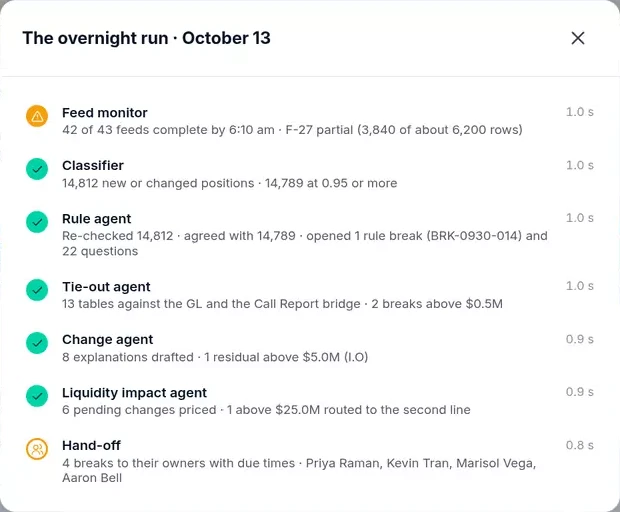
The source system's owner owns each field; the reporting team owns the transformation and the reported value. Breaks happen at the seams, where a field is read from a system that holds a stale or partial version of it. In the solution's sample run, each of the four open breaks was a seam: loan participations sold but still carried at full balance in the extract ($43.7 million above the general ledger), three certificates of deposit booked after the extract cut-off ($18.2 million against the Call Report), a sweep program whose affiliation lived in the legal entity master while the deposit system mapped it as an ordinary relationship deposit ($612.0 million), and a collateral feed that delivered 3,840 of about 6,200 rows.
None of those is a misunderstanding of the instructions. Each is a field taken from the wrong source, at the wrong time, or not at all. A data dictionary that names the system of record and owner for every field turns those breaks from a hunt into a routing decision, and it is the precondition for the four measures of FR 2052a data quality.
The source behind a field: the agreement passage that makes balances a sweep
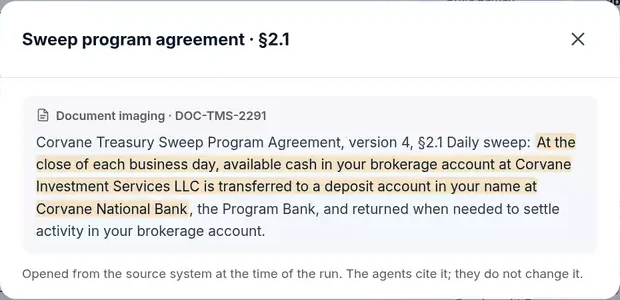
Where FR 2052a Liquidity Reporting reads each field
FR 2052a Liquidity Reporting reads each field where it lives: the deposit system and its coverage calculation, the loan subledger, the securities, collateral and treasury systems, the legal entity master, and the agreements in document imaging. A Feed monitor checks that each of the sample bank's 43 feeds arrived whole; the Classifier proposes product, counterparty, collateral class, maturity bucket and insured flag for each new or changed position and cites every source it used; a separate Rule agent re-checks each proposal against the instructions.
When a field is wrong at the source, the fix goes to its owner. The analyst accepts the corrected value as maker, a manager approves as checker, and the data owner receives a drafted source fix with the product code, the accounts, the rule and the evidence, due in five business days in the sample deployment. The override retires when the source is fixed. How agents and people divide that work is set out in the guide to FR 2052a liquidity reporting with agents.
FR 2052a Liquidity Reporting checks each field at its source overnight
Questions people ask
What is a PID in FR 2052a reporting?
PID is the product identifier: the table prefix and product number, such as I.A.1 for Unencumbered Assets or O.D.9 for Stable Affiliated Sweep Account Balances. Appendix VI of the instructions uses PIDs to map products to the lines of the LCR rule.
What is the difference between the Internal and Internal Counterparty fields?
Internal flags a transaction with another entity inside the firm's scope of consolidation; Internal Counterparty names that entity. Both apply only to affiliated transactions, and they let the Federal Reserve see liquidity moving between legal entities.
What does the Treasury Control field mean?
It flags assets, or transactions secured by assets, that meet the operational requirements for eligible HQLA other than being unencumbered: the firm can monetize them, and the function that manages liquidity controls them.
Do all FR 2052a fields apply to every firm?
No. Business Line and G-SIB are required of Category I firms; Risk Weight and Loss Absorbency are not required of Category IV firms with less than $50 billion of weighted short-term wholesale funding; and each field applies only to the tables Appendix I lists for it.
What does the Converted field mean?
It is set to "True" when amounts have been converted to U.S. dollar equivalents. Firms that report by currency use seven currency codes and convert all others to dollars at the 6:30 p.m. Eastern closing rate on the as-of date.