A contingency funding plan (CFP), the document most people mean when they search for a contingency funding plan PDF or template, sets out how a bank or credit union would replace funding it loses in a stress event: which events it plans for, the stages of severity and what triggers each, the early warning indicators it watches, the contingent sources it would draw on and how much each would provide, who decides and who acts, how it communicates, and how often the plan is tested and updated. U.S. regulators expect every institution to have one, scaled to its complexity: the 2010 interagency policy statement and its July 2023 addendum set the content for banks, and NCUA's rule at 12 CFR 741.12 requires one from credit unions with $50 million or more in assets. A template can supply the structure. It cannot supply the parts that make a plan work, which are numbers and tests that go stale within weeks. Botminds' Contingency Funding Plan keeps those parts current: it runs each source's live test, recounts capacity loan by loan, reruns the scenarios and drafts the next version of the plan for the treasurer and ALCO.
We do not offer a downloadable plan, and the outline below says why. Where it uses examples, they come from Tessaly Community Bank, a fictional $3.4 billion community bank whose sample data runs through the solution.
The annotated outline: ten sections, the rule behind each, and the test that proves it
1. Purpose, scope and governance
What it must sayWhich entities and currencies the plan covers; who owns it; who approves it and how often.
The rule behind itFDIC RMS 6.1: boards review and approve liquidity policies at least annually
The test that proves itApproval minutes and a revision log with dates
2. Risk tolerance and coverage floors
What it must sayThe board’s limits, such as minimum coverage in each scenario, with amber and red levels.
The rule behind it2010 statement: stress tests confirm exposures stay within tolerance
The test that proves itEvery scenario result shown against its floor
3. Stress events and scenarios
What it must sayBank-specific and market-wide events, their horizons, outflow and source assumptions.
The rule behind it2010 statement: identify stress events; NCUA 741.12(d)(3)
The test that proves itScenarios rerun on current data; assumptions back-tested
4. Stages and triggers
What it must sayLevels of severity, what moves the plan between them, and who decides.
The rule behind it2010 statement: assess levels of severity and timing
The test that proves itA stage change rehearsed, with its decision recorded
5. Early warning indicators
What it must sayThe indicators, their thresholds and their source systems, read on a set cadence.
The rule behind it2010 statement: monitoring framework for contingent events
The test that proves itIndicators computed from source data, not typed in
6. Sources and capacity
What it must sayEach contingent source, by lender, with collateral, haircut, capacity and time to cash.
The rule behind itNCUA 741.12(d)(1)-(2); 2023 addendum on collateral
The test that proves itCapacity reconciled loan by loan to what each lender would accept
7. Operational readiness
What it must sayAgreements, authorization lists, credentials, contacts, cut-off times, collateral movement.
The rule behind it2023 addendum: operational readiness for the discount window
The test that proves itA live test borrowing per source, evidenced step by step
8. Crisis team and escalation
What it must sayNames, alternates, decision rights and reporting frequency at each stage.
The rule behind it2010 statement: lines of responsibility; NCUA 741.12(d)(4)-(5)
The test that proves itContacts checked before every test; late-day exercise
9. Communications
What it must sayCounterparties, depositors, staff, press and regulators, with prepared messages.
The rule behind it2010 statement: effective communication when problems arise
The test that proves itMessages and contact lists reviewed in the exercise
10. Testing and updating
What it must sayWhat is tested, how often, by whom, and how findings change the plan.
The rule behind itNCUA 741.12(d)(6); 2023 addendum on regular testing
The test that proves itA test log and an action register with owners and dates
What should a contingency funding plan include?
The 2010 interagency policy statement, issued by the Federal Reserve, FDIC, OCC and NCUA with the Conference of State Bank Supervisors, is still the base text, and its definition is short: "A CFP should delineate policies to manage a range of stress environments, establish clear lines of responsibility, and articulate clear implementation and escalation procedures. It should be regularly tested and updated to ensure that it is operationally sound" (Interagency Policy Statement). It then lists what a plan should do: identify stress events; assess levels of severity and timing; assess funding sources and needs with a quantitative projection; identify potential funding sources; establish liquidity event management processes; and establish a monitoring framework of early warning indicators and triggers.
Two details in the statement are often missed by templates. Banks that rely on brokered deposits "should also incorporate PCA-related downgrade triggers into their CFPs", because a fall below well capitalized restricts both the rates the bank may pay and its access to brokered funds. And "the ability of a financially stressed institution to meet calls for additional collateral should be considered in the CFP", which ties the plan's capacity to the bank's own condition, not only to markets.
What does NCUA 741.12 require in a CFP?
For federally insured credit unions the content is a rule, scaled by size. Below $50 million in assets, a credit union needs a basic written liquidity policy with a list of contingent sources. At $50 million or more, it "must establish and document a contingency funding plan (CFP)"; at $250 million or more, it must also document access to a contingent federal liquidity source, either the Central Liquidity Facility or the discount window, and test it periodically. The thresholds apply once two consecutive Call Reports show the assets, with 120 days to comply.
What a credit union CFP must address at a minimum, mostly in the rule's own words
- "The sufficiency of the institution’s liquidity sources to meet normal operating requirements as well as contingent events"
12 CFR 741.12(d)(1)
- "The identification of contingent liquidity sources"
(d)(2)
- "Policies to manage a range of stress environments, identification of some possible stress events, and identification of likely liquidity responses to such events"
(d)(3)
- "Lines of responsibility within the institution to respond to liquidity events"
(d)(4)
- "Management processes that include clear implementation and escalation procedures for liquidity events"
(d)(5)
- How often the institution will test and update the plan
(d)(6), paraphrased
What does the 2023 CFP addendum require?
The addendum of July 28, 2023, issued jointly by the Federal Reserve, FDIC, OCC and NCUA after the spring bank failures, adds no new section to the plan; it raises the bar on three that already existed. Contingent sources must be broad and realistic, readiness must be operational rather than documentary, and the plan must be revised as the funding mix changes. The OCC's version says simply: "This addendum applies to community banks" (OCC Bulletin 2023-25).
As part of operational readiness, depository institutions should regularly test any contingency borrowing lines to ensure the institution's staff are well versed in how to access them and that they function as envisioned.
Addendum to the Interagency Policy Statement on Funding and Liquidity Risk Management, July 28, 2023
The addendum also asks plans to "recognize that during times of stress, contingency lines may become unavailable", with repo lines as its example, and to scale capacity to the funding mix: "an institution that increases the share of its liabilities comprised of less stable funding should consider whether it needs to increase its capacity to borrow from contingency funding sources." That last sentence is a trigger a plan can write down. A rise in uninsured or brokered funding above a set share should prompt a review of the capacity table, not wait for the annual update.
What are CFP stages, and what moves a plan between them?
Stages are the plan's levels of severity, each with its own monitoring, reporting and actions. The FDIC's examination manual expects that "Comprehensive CFPs also delineate various stages and severity levels for each potential contingent liquidity event", from temporary disruptions to long-term ones, and that banks use those stages to design scenarios and early warning indicators (FDIC RMS Manual, section 6.1). What makes stages useful is that their triggers are objective and their decision rights are named.
The sample bank's four stages, their triggers and who decides
| Stage | Trigger | Actions the plan sets | Who decides |
|---|---|---|---|
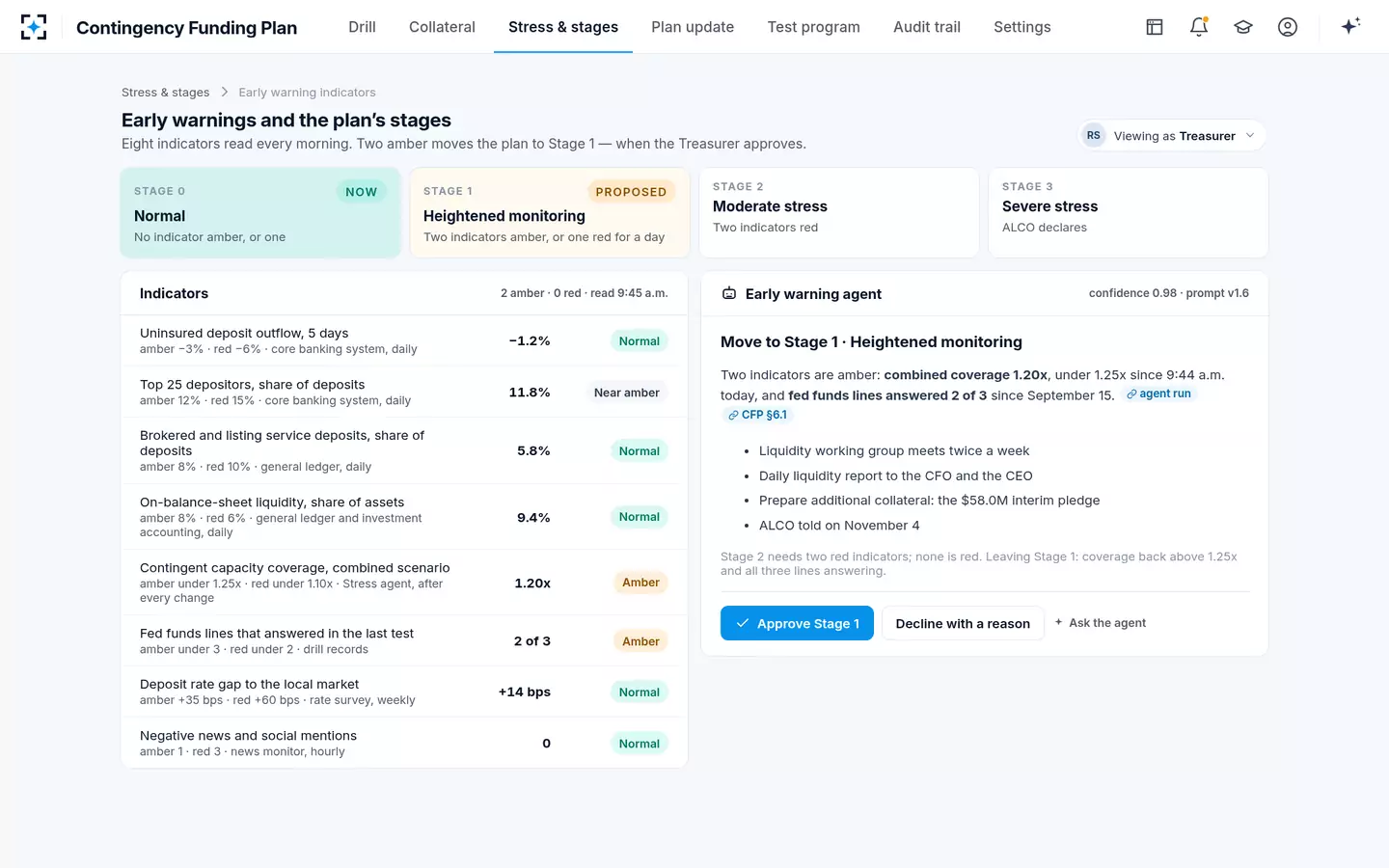
| 0 · Normal | No indicator amber, or one | Eight indicators read every morning; the annual test program | — |
| 1 · Heightened monitoring | Two indicators amber, or one red for a day | Liquidity working group twice a week, daily report to the CFO and CEO, collateral prepared, ALCO informed | Treasurer |
| 2 · Moderate stress | Two indicators red | The plan’s Stage 2 actions | CFO |
| 3 · Severe stress | Declared | The plan’s Stage 3 actions | ALCO declares |
What early warning indicators belong in a CFP?
Indicators that the bank can compute from its own data, that move before the funding does, and that are tied to a stage. The 2010 statement names examples such as negative publicity about an asset class the bank holds and widening spreads; the OCC's booklet adds deposit runs, early redemption of large CDs, rising funding costs and lenders asking for more collateral. The sample bank reads eight every morning, each with amber and red thresholds: uninsured deposit outflow over five days, the top 25 depositors' share of deposits, brokered and listing service deposits, on-balance-sheet liquidity, contingent capacity coverage in the combined scenario, fed funds lines that answered their last test, the deposit rate gap to the local market, and negative news.
Two of those eight are unusual and worth copying. Coverage in the combined scenario turns a collateral problem into an early warning, so loans falling out of eligibility can move the plan's stage. And "fed funds lines that answered in the last test" turns the test program into an indicator, so a line that fails is a risk signal, not a footnote. On October 20, 2026, both were amber at the sample bank, and the plan proposed Stage 1.
Early warning indicators feeding the stages in Contingency Funding Plan
How often should a CFP be updated, and who approves it?
At least annually as a document, and continually as data. The addendum asks institutions to review and revise their plans periodically, and more often as markets and strategy change, and the OCC's booklet says that "As conditions and circumstances change, CFP plans should be continually revised to most accurately project the amount of funding needs and availability of primary and contingent sources" (OCC, Liquidity). On approval, the FDIC's manual notes that "Boards that review and approve liquidity policies at least annually ensure such policies remain relevant and appropriate", and many banks route the CFP through ALCO to the board with the liquidity policy.
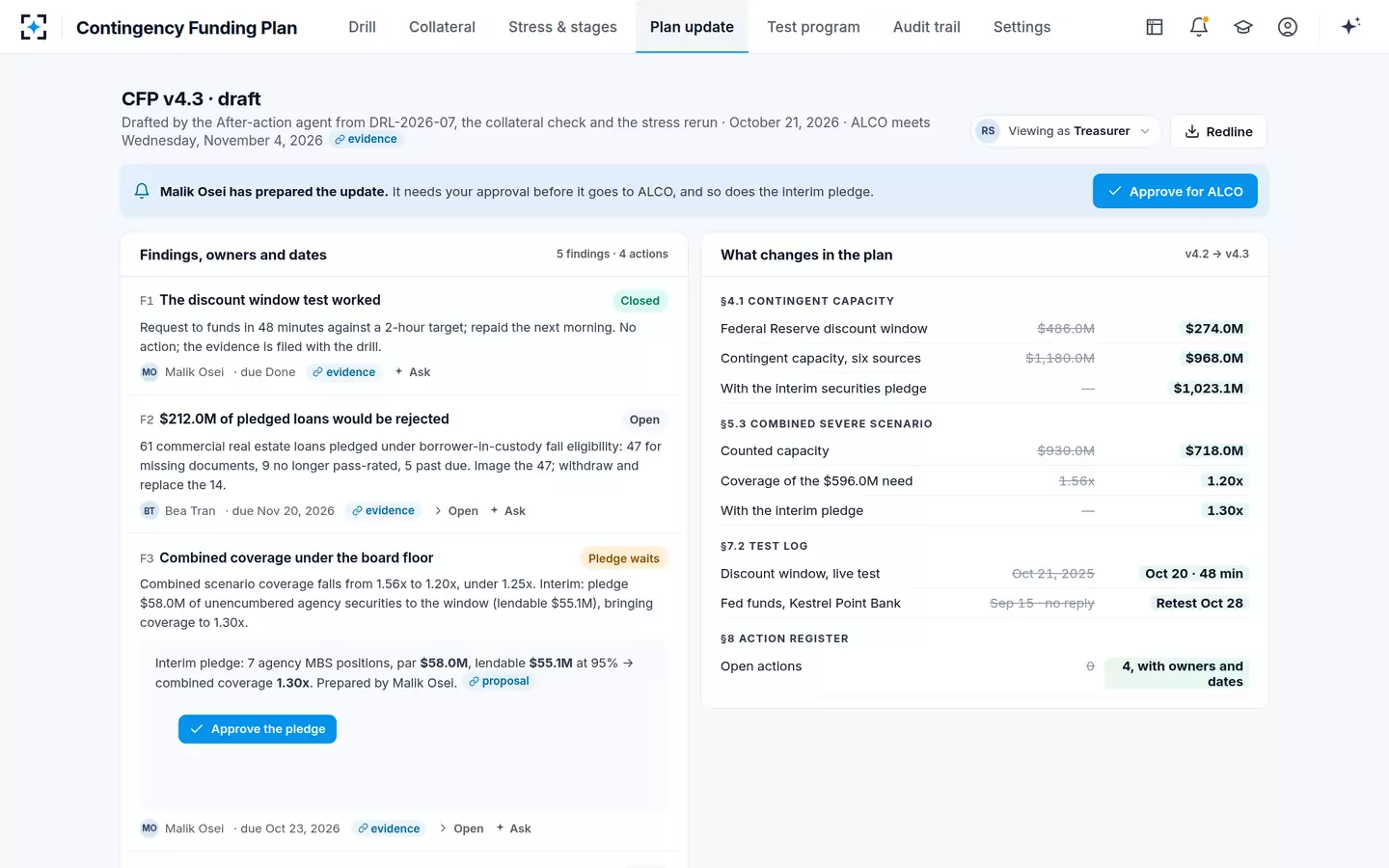
The practical answer is to split the document. The narrative, its governance, roles, stages and policies, changes rarely and goes to the board each year. The schedules, the capacity table, the scenario results, the test log and the action register, change whenever the bank's data does, and should be versioned on their own with each change approved. The sample bank's plan runs this way: each test, collateral check and stress rerun produces a redline of the schedules, which the treasurer approves before ALCO adopts the new version.
What examiners read when they open the plan
Examiners read the plan alongside the minutes. The OCC's examination procedure begins: "Review the liquidity CFP and the minutes of ALCO meetings and board meetings, and discuss with management the adequacy of the bank's contingent planning processes for liquidity", and its checklist includes "the reasonableness of the assumptions used in forecasting potential contingent liquidity needs and the frequency of management's review of these assumptions to ensure that they remain valid." A plan whose capacity table cannot be traced to the loans behind it fails that test even if every section is present.
The 2023 failures showed the cost of a plan that exists only as a document. In its review of Signature Bank, the FDIC found that "management never developed appropriate and sufficient funds management policies or an adequate contingency funding plan" (FDIC, Supervision of Signature Bank). The OCC's booklet puts the standard in one line: "it is important to know that a CFP not only exists but has been tested and is effective in guiding management actions."
The next plan version, drafted from the test, the collateral check and the stress rerun
Where Contingency Funding Plan fits, and where a template is enough
A template is enough for the narrative. A small credit union with a basic liquidity policy, or a bank whose only contingent source is a securities pledge it can see in Discount Window Direct, can write a sound plan from the outline above and keep its schedules in a spreadsheet. The solution earns its place where the schedules are large and moving: thousands of pledged loans under borrower-in-custody and FHLB liens, several sources each with its own test, scenarios that should be rerun when collateral changes, and examiners who will ask for the evidence behind every number.
What it produces is the part a template cannot: a live test of each source each year, every step timestamped with its record; capacity counted loan by loan at each lender's haircut, with a fix list for the loans that fail; scenarios rerun after every change; stage proposals when indicators breach; and a redline of the plan's schedules with findings, owners and dates. What it does not do is write the bank's policy for it, approve anything, or decide what a lender will accept. How the collateral count works is in discount window collateral eligibility, how a pilot on your own plan runs in discount window readiness, and the solution is at Contingency Funding Plan.
Questions people ask
Do the regulators publish a contingency funding plan template?
The agencies publish the required content rather than a fill-in plan. The OCC's liquidity booklet includes worked examples a plan can borrow from, including a projected sources and uses statement, a liquidity gap report, a table of stress events and triggers, and example contingency funding scenarios.
Can the CFP be part of the liquidity policy?
Yes. NCUA's rule says the CFP "may be a separate policy or may be incorporated into an existing policy such as an asset/liability policy, a funds management policy, or a business continuity policy." Banks often do the same; what matters is that the plan's required elements are all present and tested.
How long should a contingency funding plan be?
No rule sets a length; the plan should be "commensurate with" the institution's complexity, risk profile and scope of operations, in the words of both the 2010 statement and NCUA's rule. A community bank plan is often a narrative of modest length plus schedules that carry most of the numbers.
Should a CFP include the discount window if the bank never borrows?
The agencies "encourage depository institutions to incorporate the discount window as part of their contingency funding arrangements", and a plan that includes it should keep the window operationally ready. For credit unions of $250 million or more, documented access to the discount window or the Central Liquidity Facility is required.
What is the difference between a CFP and a liquidity stress test?
The stress test estimates how much funding the bank could lose and when; the plan says how it would replace it, who decides and how the sources are kept ready. The two share the capacity table, which is why a stress test can only be as accurate as the plan's capacity.