A collateral management system in banking is the software a bank uses to track the assets it has pledged and the collateral it holds, and the phrase covers two different jobs. In capital markets it means managing margin on derivatives, repo and securities lending, moving and optimizing collateral across counterparties. In a community or regional bank's treasury it means the system of record for pledged collateral: which loans and securities are pledged to the Federal Reserve, the Federal Home Loan Bank and public depositors, under which agreements, and what each lender's statement says they are worth. That second kind of system is good at records and weak at one thing a contingency funding plan depends on: knowing, every day, which pledged loans each lender would still accept and at what value, because the data that decides it sits in other systems. Botminds' Contingency Funding Plan reads the collateral system, the loan subledger, the core and document imaging, re-tests every pledged loan, and feeds the result to the plan, without replacing the system or changing a pledge.
Examples come from Tessaly Community Bank, a fictional $3.4 billion community bank whose sample data runs through the solution, which keeps 4,900 pledged loans in its collateral management system.
Where the lendable-value check sits: between the systems of record and the plan
Agent
Read the pledgesPledge listings for the Reserve Bank and the FHLB from the collateral management system, and securities positions from investment accounting.
Never: writes to the collateral system
Agent
Read the loan dataRisk ratings from the loan subledger, payment status from the core, documents from imaging, lien position from the collateral record.
Never: edits a rating or a record
Agent
Test and valueEach lender’s criteria and the haircut table in force, loan by loan; failures listed with reason and fix.
Never: marks a loan fixed
A person decides
Collateral manager works the listRequests documents, prepares withdrawals and substitutions; a second person checks each fix.
A person decides
Treasurer approvesEvery pledge change and withdrawal, and the restated capacity before it goes to ALCO.
What is a collateral management system in banking?
For a bank's treasury and loan operations, it is the inventory of pledged assets and the workflow around it: pledging, releasing and substituting collateral, producing the files each lender wants, and reconciling to each lender's statement. Examiners expect one that fits the bank. The FDIC's manual tells them to "determine whether the institution has collateral management and reporting systems that are commensurate with the institution's funding structure, potential borrowing needs, and overall risk profile, including determining whether reporting systems facilitate the monitoring and management of assets pledged and of assets that can be pledged as collateral for borrowed funds" (FDIC RMS Manual, section 6.1).
The capital-markets meaning shares the name and little else. A dealer's collateral system manages margin calls, eligibility schedules in credit support annexes and the allocation of securities across many counterparties every day. A community bank's needs are narrower and its hardest problem is different: its collateral is mostly loans, whose eligibility depends on data recorded in other systems.
What does a collateral management system do, and what does it leave out?
It keeps the record of the pledge; it does not, on its own, keep the pledge true. The record says a loan is pledged to the Reserve Bank and carries a rating and a balance as of the last feed. Whether that loan is still acceptable depends on today's rating in the loan subledger, today's payment status in the core, and whether the documents the lender's lien depends on are actually in imaging. Most collateral systems take those fields in batches and do not test them against each lender's criteria.
What stays in the collateral management system, and what the check adds
The system of record keeps
- Which loans and securities are pledged, to which lender, under which agreement
- Pledge, release and substitution history, with approvals
- Collateral schedules and listings sent to the Reserve Bank and the FHLB
- Lien and UCC data, custodians and storage locations
- Public deposit pledges and letters of credit
- Statements received from each lender
The lendable-value check adds
- Each pledged loan re-tested against each lender’s criteria when its rating, payment status or documents change
- Lendable value recomputed with the haircut table in force
- Every failure listed with its reason, its record and a fix, owner and date
- Capacity by source restated for the contingency funding plan
- Stress scenarios rerun on the restated capacity
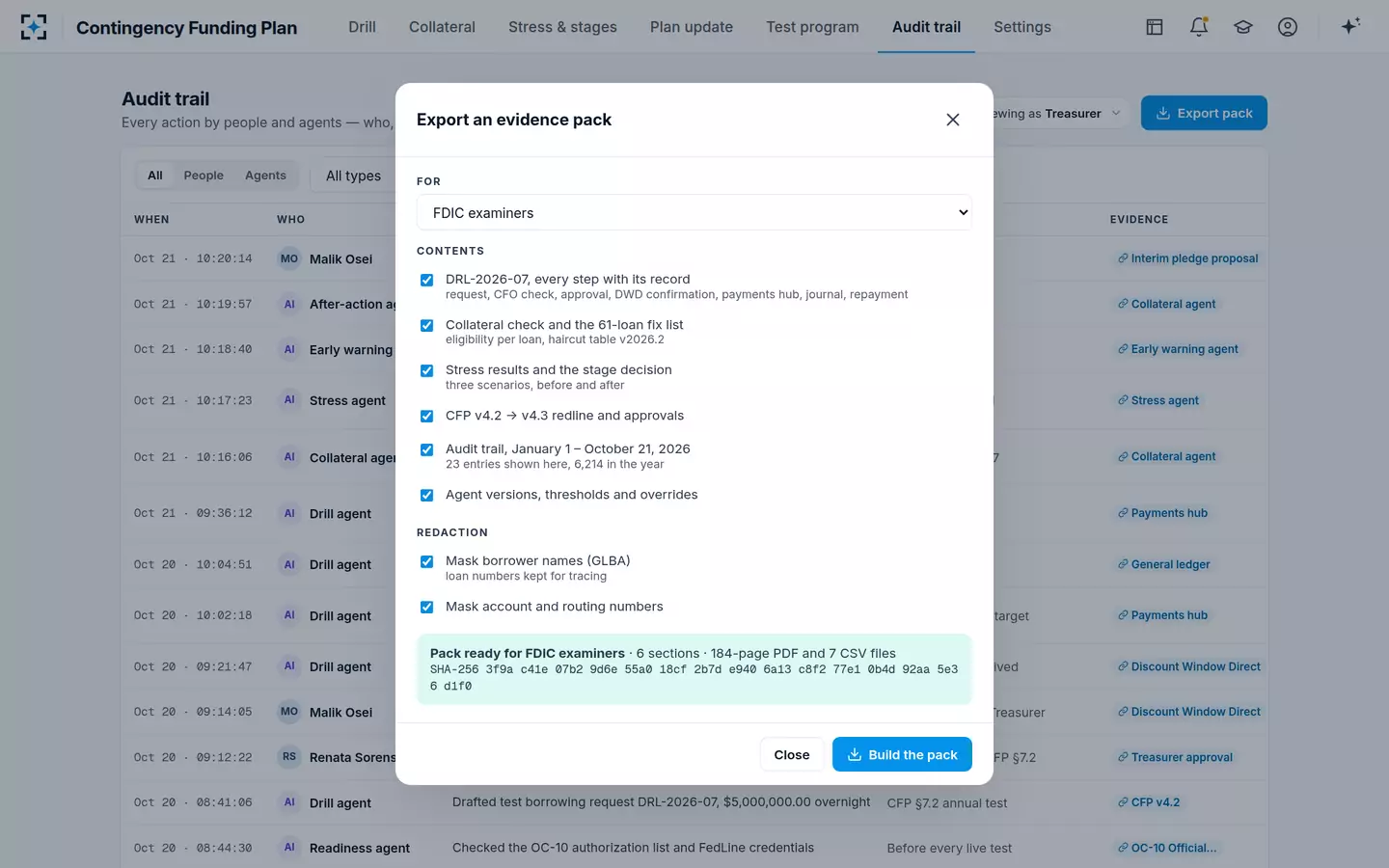
- An evidence file an examiner or auditor can follow
Does a collateral system check discount window eligibility?
Usually only partly. A collateral system can hold the flags a bank sets, such as eligible or ineligible, and send the data fields the Reserve Bank asks for. It rarely re-derives eligibility from source data each day, and the Reserve Bank's valuation is unforgiving about data: "If a loan's value or its margin cannot be determined due to missing information about a pledged loan, or any other reason, the loan will receive zero collateral value" (Federal Reserve, Collateral Valuation). Institutions of $50 billion or more must report a longer list of loan-level fields, which raises the stakes on data quality further.
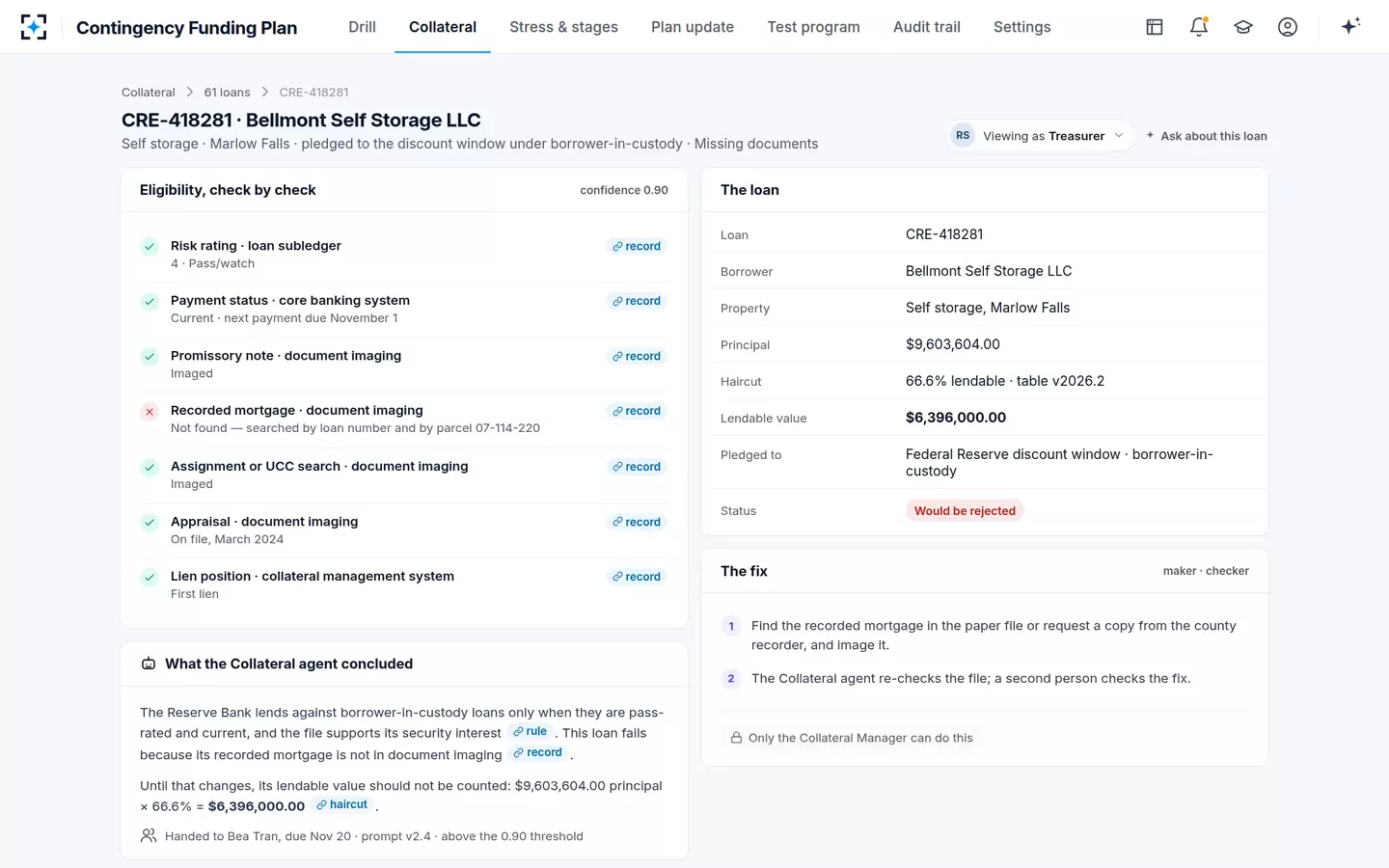
At the sample bank, the collateral system's pledge listings held 4,900 loans, every one of them listed as pledged collateral. A loan-by-loan check against the subledger, the core and imaging found 61 that the Reserve Bank would refuse: 47 missing a document, 9 downgraded to special mention, 5 past due. Their lendable value was $212.0 million. Nothing in the collateral system was wrong as a record. It was wrong as a description of what the bank could borrow.
One pledged loan, checked against five systems in Contingency Funding Plan
How do you reconcile pledged collateral across lenders?
Three reconciliations, each with its own failure. First, the bank's listing against each lender's statement: the Reserve Bank's collateral value appears in Discount Window Direct and in statements of collateral holdings, and the FHLB reports borrowing capacity on its own terms. Second, lender against lender, so the same loan never backs both: "In some cases, a Federal Home Loan Bank (FHLB) may have a 'blanket lien' that already encumbers some portion of a depository institution's assets. The Reserve Banks and FHLBs coordinate to ensure that advances to the same borrower are not secured by the same collateral" (89 FR 73415). Third, both against the plan: the capacity table should equal what the lenders would lend, by source, after the bank's own eligibility check.
The second reconciliation is where 2023 hurt. On March 10, the FHLB of New York "subordinated its interest in a total of approximately $7.1 billion of Signature Bank's excess pledged securities collateral to the Federal Reserve Bank of New York to allow Signature Bank to access discount window funding", and a second agreement for more collateral was not finished before the bank closed (GAO-26-109282). Since then the two systems have built procedures: some ran tabletop exercises and real collateral transfers between them, and in January 2025 they formed a working group on subordination agreements, information sharing and an emergency playbook. The Reserve Banks describe the goal as "to enhance interoperability among Reserve Banks and FHLBs to reduce operational complexity and improve the member institution experience when positioning collateral" (Discount Window Modernization).
What is collateral optimization, and does a community bank need it?
Collateral optimization means pledging each asset where it is worth most, cheapest to deliver and quickest to move. Dealers run optimization engines across hundreds of obligations. A community bank's version is a short set of decisions the plan should record: which assets go to the Reserve Bank, which to the FHLB, which stay unencumbered for same-day use, and which public deposit pledges tie up securities, since public deposit "pledging requirements vary by state and are based on banks' financial condition metrics" (OCC, Liquidity).
The numbers that drive those decisions are the lenders' haircuts and clocks. At the sample bank's own estimates, pass-rated commercial real estate lends 66.6% at the discount window and multifamily and commercial real estate 60.0% at the FHLB, while agency mortgage-backed securities lend 95% at the window and can be pledged the same day. That is why the bank's fix for a coverage shortfall was a $58.0 million pledge of agency securities, worth $55.1 million of lendable value, rather than more loans: it was quick, cheap in haircut, and did not depend on curing files. A spreadsheet can do this arithmetic for a few hundred loans; it cannot keep the inputs true for thousands.
How often should pledged collateral be revalued?
The lenders set their own cadence; the bank's should be faster. The Reserve Banks estimate each pledged loan's fair market value monthly from the bank's data and value securities from vendor prices, and borrower-in-custody participants must send schedules at least monthly (Pledging Loans). The plan cannot wait for the next month: a downgrade, a delinquency or a missing document changes what the bank can borrow the day it happens. The sample bank's check runs on every change to rating, payment status or imaging and on every new haircut table, and the stress scenarios rerun when capacity moves.
What integrations does collateral management need?
Read access to the systems that hold the loan data, and no write access to anything that holds a pledge. The sample bank's set-up is typical of a community bank and shows how little has to change.
Six read-only connections behind a lendable-value check
- Collateral management system
Pledge listings for the Reserve Bank and the FHLB; lien positions; custodians.
- Core banking system and loan subledger
Balances, payment status and risk ratings for every pledged loan.
- Document imaging
Loan files searched for each required document, and the Operating Circular 10 agreements.
- General ledger and investment accounting
Journals for every test borrowing, and securities available to pledge.
- Payments hub
Fedwire credits and debits, so a test borrowing and its repayment are seen as they land.
- Discount Window Direct and the FHLB member portal
Advance confirmations and collateral statements, read only, to reconcile the plan to each lender.
Do I need a new collateral system for the discount window?
No. The Reserve Banks do not require a particular system; they require that pledged loans be identified as pledged in the bank's loan accounting system, labelled where the notes are kept, reported at least monthly in the required format, and eligible. Since September 2026, schedules can be uploaded in Discount Window Direct. A bank whose collateral system produces those files and flags is equipped; what it may lack is the daily test of eligibility and value, which can be added on top.
Replace the collateral system, or add a lendable-value check?
Replace the system: New schedule formats and new reconciliations to prove
Add a check on top: Nothing: the same schedules from the same system
Replace the system: Every pledge, release and lien record moved and verified
Add a check on top: None; read access to six systems
Replace the system: Inside the new system, if it reads ratings, payments and documents
Add a check on top: In the check, from the source systems, every time they change
Replace the system: A cut-over on the system that feeds the lenders
Add a check on top: The record of the pledge is untouched; the check only reads
Replace the system: The current system cannot flag pledged loans or produce the required files
Add a check on top: The system keeps good records but the plan cannot trust its totals
That is the honest scope of Botminds' Contingency Funding Plan in this part of the bank: it adds a lendable-value check, a fix list, restated capacity and an evidence trail to the collateral system you have, and leaves the pledge itself to your people. A 30-day pilot on your own pledges is laid out in discount window readiness; the people who work the fix list are described in pledged loans and the collateral desk; the solution is at Contingency Funding Plan.
The evidence an examiner sees: the check, the fixes and the approvals in one package
Questions people ask
Does Contingency Funding Plan write to our collateral system?
No. It reads pledge listings and the loan data behind them and produces a fix list and restated capacity. Pledges, releases, withdrawals and schedules stay in the bank's own system and are changed by the bank's people, each withdrawal approved by the treasurer.
Can it handle public deposit collateral?
Public deposit pledges tie up securities and, through FHLB letters of credit, borrowing capacity, so they belong in the capacity picture. State pledging rules vary, and the sample bank's set-up covers the Reserve Bank and FHLB pledges; extending the check to a state's public deposit rules would be part of a bank's own configuration.
Is a spreadsheet good enough for pledged collateral?
For a small book, often yes, if someone updates it from the source systems and reconciles it to each lender's statement. The risk grows with the number of pledged loans, the number of lenders and the number of people whose work changes eligibility; at thousands of loans, a spreadsheet becomes a copy of last month.
What do examiners look at in collateral management?
The FDIC's manual tells examiners to review collateral tracking or pledged asset reports and to judge whether the institution's systems are commensurate with its funding structure, potential borrowing needs and risk profile. In practice that means whether the bank can show what is pledged, what is free to pledge, and what each lender would lend.
How does the check handle each lender's different rules?
Rules and haircuts are set per collateral type and per lender, versioned with effective dates, and changed only with the treasurer's approval. The sample bank's table version 2026.2, effective July 1, 2026, carries separate values for the discount window under borrower-in-custody, the discount window for securities, the FHLB and the repo line.