Pledged loans are loans a bank has assigned as collateral to a lender, most often the Federal Reserve's discount window under a borrower-in-custody arrangement or a Federal Home Loan Bank under a blanket lien or a loan listing, so that it can borrow against them on short notice. The loans stay on the balance sheet and keep paying, but they are spoken for, and each one is worth only its lendable value: the lender's estimate of its value after a haircut, and nothing at all if it is downgraded, past due or missing a document. That makes the collateral manager in loan operations, who keeps thousands of pledged loans eligible, the quiet author of the largest line in a bank's contingency funding plan. Botminds' Contingency Funding Plan checks every pledged loan against each lender's rules and haircuts and hands that seat a fix list before a lender refuses anything. (If you were looking for a loan secured by your own investments, that is a pledged-asset loan, a consumer product this page does not cover.)
The examples below come from Tessaly Community Bank, a fictional $3.4 billion community bank, as its sample data runs through the solution. The research figures come from regulators and are linked where they appear.
Pledging has become a bigger share of the balance sheet
53%
median share of assets pledged by midsize banks ($10 billion to $100 billion), up from 36% five years earlier
33%
the same median across the whole industry, up from 24%
4,900
pledged loans at the fictional sample bank: 1,640 with the Reserve Bank, 3,260 with its FHLB
What are pledged loans? Loans that are on your books but spoken for
A pledged loan is a loan in which a lender, not the bank, holds a security interest. The bank still owns it, books its interest and services the borrower, but it cannot sell it, securitize it or pledge it again without first releasing it. Whether it counts as encumbered depends on the measure: for the net stable funding ratio, the OCC's liquidity booklet treats a pledged asset as encumbered "with an exception for transactions with a central bank or U.S. GSE when potential credit secured by the asset is not currently extended to the bank", so a loan prepositioned at the discount window with nothing drawn is not encumbered for that ratio, while the same loan backing an FHLB advance is.
For a community bank, two lenders take almost all pledged loans. The Federal Reserve Banks take commercial, agricultural, consumer and real estate loans through the borrower-in-custody program, in which the notes stay in the bank's own vault or imaging system, labelled as pledged. The Federal Home Loan Banks take residential mortgages, multifamily and commercial real estate and, from smaller members, some small business and farm loans, usually under a blanket lien backed by reporting, sometimes under a listing of specific loans or physical delivery of the notes. A loan pledged to one cannot back an advance from the other until the bank moves it, which takes paperwork and time.
The pledge itself is the easy part. The hard part is that eligibility is a state, not an event: a loan that qualified on the day it was listed stops qualifying the day credit review downgrades it, the day it goes past due, or the day someone discovers its recorded mortgage was never imaged. The plan's capacity table does not notice. Someone in loan operations has to.
Who manages pledged collateral at a bank?
At many community and regional banks, pledged collateral belongs to a collateral manager or collateral analyst in loan operations, sometimes inside treasury, who reports to the treasurer on capacity and to the chief credit officer's world for everything that changes it. The role often does not appear in the contingency funding plan's list of responsibilities, which names the treasurer, the CFO, ALCO and the board. Yet the plan's biggest sources, the discount window and the FHLB line, are only as large as that person's listings are clean.
The collateral desk, and the four seats whose work changes its numbers
Today
Reconciles pledged collateral to the Reserve Bank and FHLB statements once a quarter, in totals, and learns a document is missing when a loan is refused or an inspection samples it.
With agents
Works a fix list of the loans that would fail, each with its reason, the missing page, an owner and a due date, and requests documents in bulk.
Still theirs: every pledge, release and withdrawal, and the monthly schedule sign-off
Today
Signs a capacity table built from collateral report totals and hears about a refused loan at the next ALCO.
With agents
Sees capacity counted the way each lender would count it, and approves every pledge change and withdrawal with a reason.
Still theirs: the approval of every money step and pledge change
Today
Downgrades a loan at the quarterly risk rating review; nobody tells the collateral desk the rating has a second meaning.
With agents
Rating changes reach the eligibility check the day they post to the loan subledger.
Still theirs: the rating itself
Today
Samples pledged files once a year for the borrower-in-custody certification.
With agents
Reads the full check, loan by loan, with the evidence behind each result.
Still theirs: the independent certification
What waits on the collateral manager is a list of other people's events. Credit review changes ratings, collections changes payment status, closing and post-closing decide which documents reach imaging, and payoffs and renewals change balances and maturities every day. What the collateral manager waits on is mostly paper: a recorded mortgage back from the county, an assignment, a corrected rating. The job is the reconciliation between the two lists, and the lender only sees the result once a month.
A bank should have the ability to calculate all of its collateral positions, including the value of assets currently pledged relative to the amount of security required and unencumbered assets available to be pledged.
OCC, Comptroller's Handbook, Liquidity, version 1.2 (May 2023)
What is lendable value? The balance minus what the lender will not lend
Lendable value, which the Reserve Banks call collateral value, is the amount a lender will advance against a pledged asset: its estimated value multiplied by a margin, or its unpaid balance less a haircut. At the discount window, the Reserve Banks estimate each pledged loan's fair market value monthly from the data the bank reports, then apply a margin from a published table that varies by loan type, fixed or floating rate, maturity and whether the bank's own rating maps to "minimal" or "normal" risk. Missing data on a required field means zero value for that loan.
The ranges are wide. In the table effective July 1, 2026 for banks under $50 billion, a fixed-rate commercial real estate loan of normal risk maturing in five years carries a margin of 75, meaning collateral value of 75% of the Reserve Banks' value estimate, while the same loan maturing in ten years carries 61 and a one-year loan 93 (Federal Reserve, Collateral Valuation). That is why a bank's capacity table should be built loan by loan, not from a portfolio balance times one percentage.
Anatomy of one pledged loan: every line has to hold for the last line to count
Pledged to
Sample loanFederal Reserve discount window, borrower-in-custody
Why it mattersCollateral pledged to one lender is not available to another until it is released and re-pledged.
Internal risk rating
Sample loan4 · pass/watch, loan subledger
Why it mattersSpecial mention or worse and the loan is no longer acceptable to a Reserve Bank.
Payment status
Sample loanCurrent, next payment due November 1
Why it mattersCommercial loans more than 30 days past due fall outside the Reserve Banks’ published criteria.
Documents
Sample loanNote, assignment, appraisal imaged · recorded mortgage not found
Why it mattersA file that cannot support the lender’s security interest does not support lendable value either.
Lien position
Sample loanFirst lien
Why it mattersThe Reserve Bank needs a perfected, first-priority security interest.
Principal
Sample loan$9,603,604.00
Why it mattersThe starting point, not the answer: the lender values the loan, then applies a margin.
Haircut and lendable value
Sample loan66.6% · $6,396,000.00
Why it mattersThe number that sits in the plan’s capacity table, if every line above holds.
What makes a pledged loan ineligible, and how much it costs the plan
Three things take most pledged commercial loans out of eligibility: a rating of special mention or worse, a payment more than 30 days late, and a file that does not support the lender's lien. The Reserve Banks also refuse loans to insiders and affiliates, loans that cannot be assigned, and, except with prior approval, loans to foreign obligors. The full test, item by item, is in discount window collateral eligibility; the FHLB's rules differ in places, starting with a 90-day delinquency limit on first mortgages.
When the sample bank's 4,900 pledged loans were checked one by one, 61 commercial real estate loans failed. Their principal was $318.3 million and their lendable value $212.0 million, about 18% of the $1,180.0 million of contingent capacity in the plan. Documents were the largest cause by far, which surprises treasurers more than collateral managers: a downgrade is visible in a credit report, a missing recorded mortgage is visible only when someone opens the file.
Why 61 pledged loans would be refused, by lendable value lost
What happens when a pledged loan is downgraded?
When a pledged commercial loan is downgraded to special mention, it stops being acceptable collateral at the discount window at once, whatever its balance or payment record. The Reserve Banks map each grade on the bank's own rating scale to minimal, normal or excessive risk when they approve a borrower-in-custody arrangement, and special mention, substandard, doubtful and loss sit outside what they accept. The bank's job is to stop counting it and take it off the next schedule.
In practice the gap opens between two calendars. Credit review downgrades loans at its own cadence, often quarterly. The collateral schedule goes to the Reserve Bank monthly. The contingency funding plan's capacity table is refreshed for ALCO, often quarterly too, and usually from the collateral report's totals. A loan downgraded on the last day of a quarter can sit in the plan's count for weeks after it stopped being collateral anyone would lend on. One borrower-in-custody loan's 37 days follows that gap day by day.
How often are pledged loans reviewed?
Pledged loans are reviewed by the lender monthly at most, for most banks, and by the bank as often as its own process allows. The Reserve Banks require borrower-in-custody participants to send a collateral schedule "at a minimum, monthly", and to submit an annual certification backed by an audit (Federal Reserve, Pledging Loans). The FHFA's examination manual expects the FHLBs to refresh loan listings at least quarterly: "If a member is on listing status, the FHLBank should obtain updated information about the collateral from its members at least quarterly" (FHFA, Advances and Collateral, 2014).
None of those cadences matches the speed at which eligibility changes. Payment status moves daily, ratings move at every review and every watch-list decision, and documents move whenever imaging or closing catches up. A bank whose plan counts pledged loans at last month's eligibility is counting a number the lender has not yet seen and may not accept.
What to re-check on pledged loans, and when
- Every business day: payment status
A commercial loan more than 30 days past due is outside the Reserve Banks’ published criteria; consumer and residential loans have 60 days.
- At every rating action: the grade
Special mention or worse removes a loan from discount window eligibility; a watch grade may change the margin category.
- At every imaging or closing change: the file
Note, recorded mortgage, assignment or UCC search, and the evidence that the lien is first.
- At every renewal or modification: the data
A modification is generally treated as a new origination, and a loan maturing within 30 days of the schedule date receives no value.
- Monthly: the schedule to the Reserve Bank
Submitted by someone with the "pledge collateral" designation on the authorization list, with the same two signatures if the resolutions require any two.
- Quarterly: the FHLB listing and the plan
The capacity table in the contingency funding plan should be rebuilt from the loans, not carried forward from totals.
Who keeps the discount window collateral listing, and who signs it?
The listing, which the Reserve Banks call the collateral schedule, is kept by loan operations and signed by people the bank's board has authorized. Collateral schedules "must be submitted by individual(s) who have authority to pledge collateral on behalf of the depository institutions", meaning those named on the Operating Circular 10 Official Authorization List with the pledge-collateral designation. If the bank's resolutions require any two people to act, the schedule needs two.
That signature carries a responsibility most banks underweight. Each schedule should contain only loans that meet every eligibility requirement, so a schedule that still lists a downgraded or undocumented loan is the bank's error, not the Reserve Bank's to find. The same is true of the plan: the FDIC's examination manual describes effective managers as those who "maintain a detailed inventory of pledged assets posted to various funds providers and know their remaining capacity to post additional unencumbered assets to execute borrowings quickly" (FDIC RMS Manual, section 6.1).
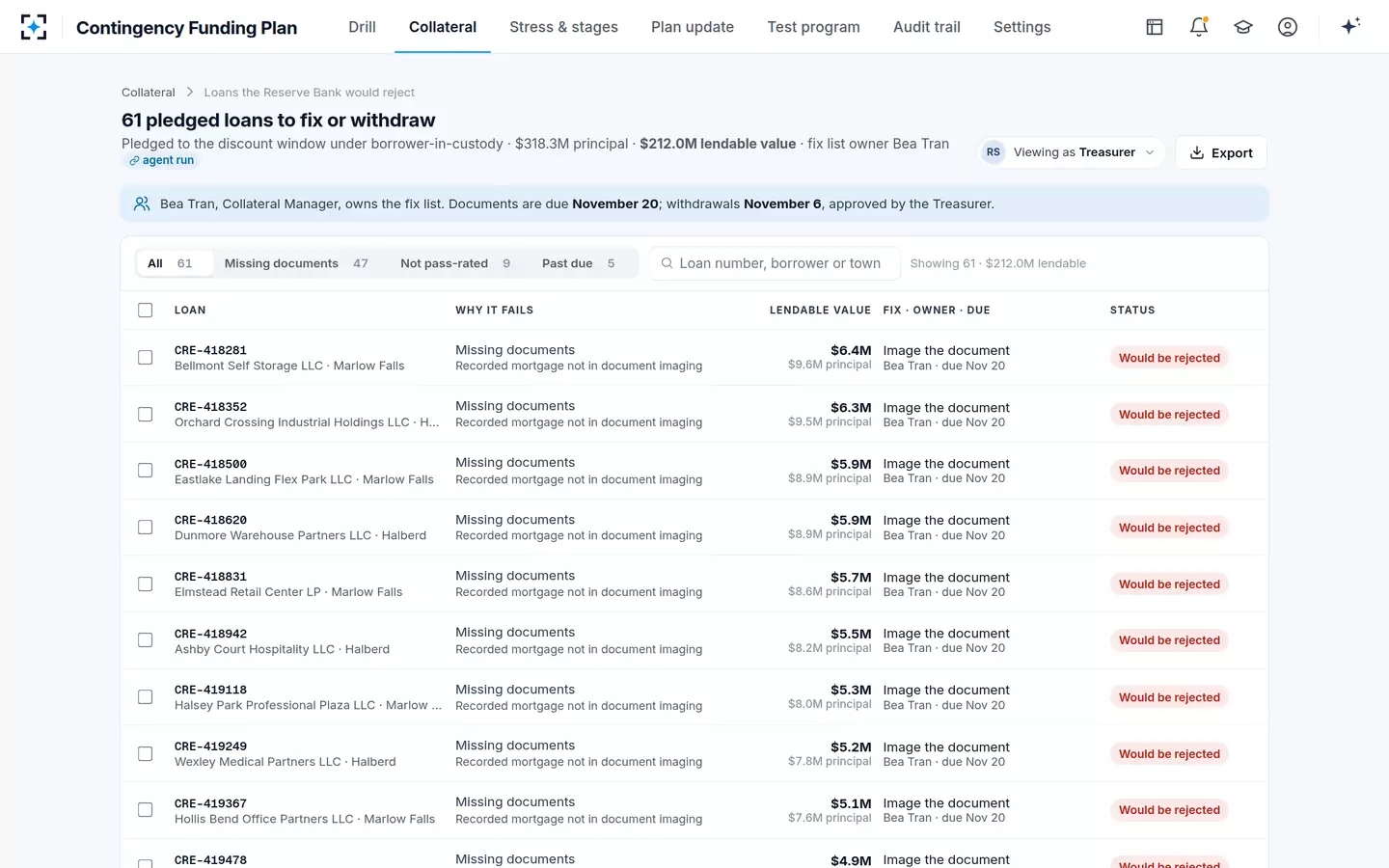
Contingency Funding Plan's fix list: 61 pledged loans, each with its reason, owner and date
A collateral desk that sees the failures before the lender does
Contingency Funding Plan gives the collateral manager the check the job always needed and never had time for. Its Collateral agent reads the pledge listings for the Reserve Bank and the FHLB, applies each lender's haircut from the bank's current table, and checks every loan's risk rating in the loan subledger, its payment status in the core banking system and its documents in imaging. At the sample bank the run covered 1,640 borrower-in-custody loans, 3,260 FHLB-listed loans and 43 securities positions and found the 61 failures in one pass.
Each failure arrives with its evidence and its fix, and the people stay in charge of the pledge. The collateral manager requested the 47 missing documents in one action, due November 20; the 14 loans that cannot be cured are withdrawn from the listing by November 6, each withdrawal approved by the treasurer. The agent never changes a pledge, never marks a loan fixed, and hands any result below its confidence threshold to a person. The 2023 interagency addendum asks banks to "engage in planning that recognizes the operational challenges involved in moving and posting collateral to access critical funding in a timely fashion" (2023 addendum to the interagency policy statement); a list of loans that would fail is where that planning starts.
Borrowing capacity counted loan by loan, before and after the check
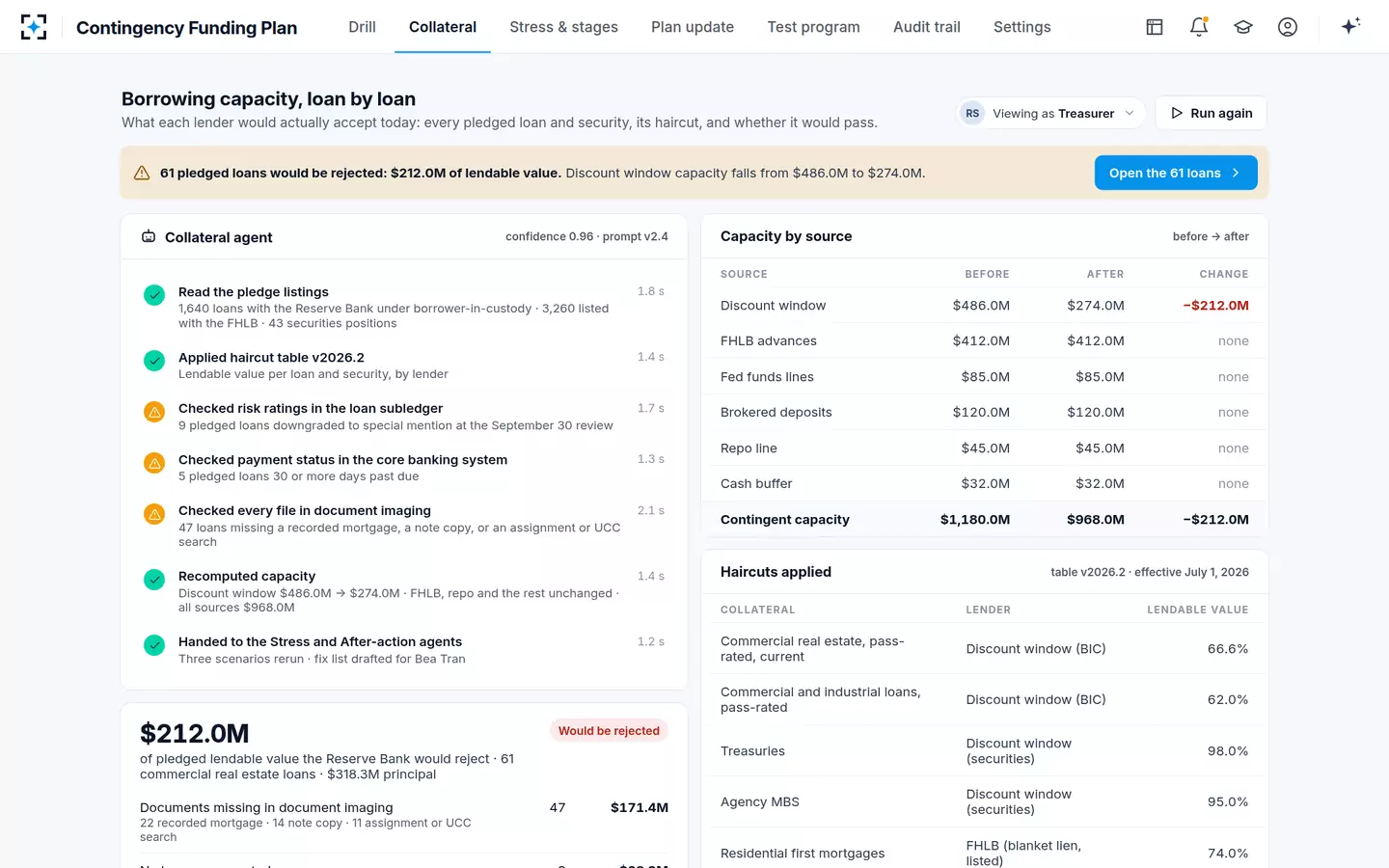
The capacity that results is lower, and more useful: $968.0 million of contingent capacity the bank can defend, against $1,180.0 million it could not. What that does to the plan's stress coverage is the subject of the liquidity stress test and the CFP; the full solution is at Contingency Funding Plan.
Questions people ask
What documents does a pledged loan need?
For the discount window, the bank must hold a properly executed, complete file in line with its own loan policy: the note, any amendments and assignments, and the documents that support a first-priority lien, such as the recorded mortgage for real estate. Notes signed on paper, imaged and then destroyed are acceptable if the bank's controls establish the imaged copy as the true copy, subject to state law.
Can a loan be pledged to the Federal Reserve and an FHLB at the same time?
No. Collateral pledged to one cannot secure the other's advances, and the Reserve Banks and FHLBs coordinate so the same assets do not back both. A bank can move excess collateral from one to the other, but it needs releases, lien searches and sometimes a subordination agreement, which is why the move takes time.
Is a pledged loan still on the bank's balance sheet?
Yes. Pledging grants a security interest; the bank keeps the loan, its income and its servicing. What changes is control: the loan cannot be sold or pledged to another lender until it is released, and the Reserve Bank's or FHLB's lien follows it until then.
What is the difference between principal and lendable value?
Principal is what the borrower owes; lendable value is what the lender will advance against it. At the discount window it is the Reserve Banks' monthly fair value estimate times a margin; for commercial real estate pledged by banks under $50 billion, the July 2026 table runs from 95 for one-year loans of minimal risk to the low 30s for 30-year floating-rate loans of normal risk.
What happens if a bank keeps an ineligible loan on its pledge listing?
The Reserve Bank may give it no value, and a schedule that is late or incomplete can see the whole pledge's value reduced or the borrower-in-custody arrangement ended. The larger risk is inside the bank: a plan that counts the loan reports capacity that would not be there when it is asked for.