Discount window stigma is the reluctance of banks to borrow from their Federal Reserve Bank, even when they are sound and the loan is cheap, because they fear markets, depositors or supervisors will read the borrowing as a sign of trouble. Research on the 2008 crisis found banks paid substantially more for other funding to avoid the window, and in 2023 the stigma had a quieter cost: banks that had never borrowed had never tested whether they could. Since then the official view has turned. The 2023 interagency addendum asks banks that rely on the window to consider small, regular test transactions; in March 2026 the Federal Reserve's Vice Chair for Supervision called the window "a critical but underutilized tool" and the Treasury urged routine testing and credit for prepositioned collateral in liquidity rules, which remain proposals in speeches, not rules. For a contingency funding plan, the practical result is simple: a test borrowing is now what a well-run bank does, and the evidence of it is worth keeping. Botminds' Contingency Funding Plan runs each year's test step by step and files every record.
Discount window stigma: the view before March 2023, and the 2026 direction
Before March 2023: Optional in practice. SVB did not test its access in 2022.
The 2026 direction: Expected: the 2023 addendum asks banks to consider small test transactions; the Treasury speaks of "normalizing routine testing of central bank facilities."
Before March 2023: No credit for discount window capacity in the liquidity coverage ratio.
The 2026 direction: Capped recognition of prepositioned capacity urged by the Treasury in March 2026. Speeches only: no rule had been proposed as of October 27, 2026.
Before March 2023: Prepositioning and testing left to each bank.
The 2026 direction: Fed examiners told not to require prepositioning as a condition of future borrowing; the FDIC’s manual says occasional primary credit use is not to be criticised automatically.
Before March 2023: Weekly aggregates; borrower names about two years later.
The 2026 direction: Unchanged. Weekly aggregates are what the Vice Chair for Supervision cites as a source of stigma.
Before March 2023: Phone requests, paper agreements, Reserve Bank by Reserve Bank.
The 2026 direction: Discount Window Direct since 2024, a streamlined borrower-in-custody program from September 2026, and a Fed and FHLB interoperability effort.
What is discount window stigma, and how large is it?
Discount window stigma is a price banks pay to avoid being seen to need the Fed. The best measurement comes from the 2007–08 crisis, when banks could also borrow from the Fed through the Term Auction Facility. Comparing what banks paid across the two and other funding sources, a New York Fed staff study finds that banks "were willing to pay a premium of around 44 basis points across funding sources (126 basis points after the bankruptcy of Lehman Brothers) to avoid borrowing from the DW", and that the stigma "increased some banks' borrowing cost by 32 basis points of their pre-tax return on assets (ROA) during the crisis" (Armantier, Ghysels, Sarkar and Shrader, NY Fed Staff Report 483).
What stigma cost in the last crisis, and what a test costs now
44bp
premium banks paid across funding sources to avoid the window in 2007–08
126bp
the same premium after Lehman Brothers failed
12bp
gap between the primary credit rate (4.00%) and the effective fed funds rate (3.88%) in the week of October 19, 2026
Why do banks avoid the discount window?
Three reasons, in the Fed's own account: disclosure, cost and interpretation. In March 2026 Vice Chair for Supervision Bowman set them out in four sentences.
As we have seen, banks avoid the discount window, even in times of stress, because of the stigma that disclosure and higher borrowing costs present. Weekly aggregate disclosure makes borrowing potentially detectable by markets. Above-market interest rates make borrowing costly, even for testing. Markets interpret any usage as a sign of fragility.
Michelle W. Bowman, Vice Chair for Supervision, March 3, 2026
The Treasury's remarks the same day added a fourth, structural reason: the liquidity rules themselves taught banks to treat the window as a last resort. "And here's an irony: by driving banks to exhaust regulatory buffers before accessing the discount window, we have entrenched discount window stigma. If you only go to the window when things are really bad, then going to the window signals that things are really bad" (Treasury, "A Reset on Liquidity Regulation"). Stigma, on this account, is self-fulfilling: the fewer healthy banks borrow, the more any borrowing means.
Is discount window borrowing disclosed?
Yes, in two ways and on two clocks. Aggregate borrowing appears every week in the Federal Reserve's H.4.1 statistical release. Borrowers are named only later: "The Board of Governors is required by law to publicly disclose the following information about primary, secondary and seasonal credit advances, generally about two years after a discount window advance is extended to a borrower", including the institution's name and the collateral pledged (Discount Window FAQ). The Board publishes the loan data quarterly with that lag; the first period covered was July 22 to September 30, 2010 (Federal Reserve, Discount Window).
The Fed does not publish which banks are eligible for primary credit, and it "does not routinely share information about institutions' borrowing activities with bank regulators", though it will provide a regulator a list of its supervised institutions that have signed borrowing agreements and pledged collateral, and borrowing information in connection with a potential supervisory problem. A small test advance, then, becomes public as one line among many, two years on.
What did the 2023 failures show about the discount window?
That access untested is access unknown. The Federal Reserve's own review found that "SVB did not test its capacity to borrow at the discount window in 2022 and did not have appropriate collateral and operational arrangements in place to obtain liquidity" (Federal Reserve, SVB review). The Treasury's 2026 remarks generalized the point to all three spring failures: "SVB, Signature, and First Republic each had substantial holdings of Treasuries and agency MBS. But that liquidity existed only on paper. Collateral was not fully prepositioned. Discount window access was untested."
The window was used heavily once stigma no longer mattered. The week after SVB failed, primary credit outstanding jumped from an average of about $4.4 billion to an average of about $85.0 billion, and stood at $152.9 billion on Wednesday, March 15, 2023, alongside the new Bank Term Funding Program the Fed opened on March 13.
Primary credit outstanding, the week the stigma stopped mattering
Will regulators count discount window capacity in the LCR?
Not yet. The Treasury argued in March 2026 that "the liquidity coverage ratio requirements and other liquidity rules should give appropriate capped recognition of borrowing capacity associated with collateral prepositioned at the discount window", and suggested the cap could be sized by a bank's "demonstrated usage of the discount window", which would tie credit to testing. As of October 27, 2026 no proposal to change the liquidity coverage ratio or the other liquidity rules had been published in the Federal Register. The ratio applies to larger banks in any case; what the LCR measures is explained on our regulatory reporting pages.
Supervisory posture has moved further than the rules. The Federal Reserve's 2026 operating principles tell examiners they "should not require firms to preposition assets at the discount window as a condition to future discount window secured borrowings" (Updated Statement of Supervisory Operating Principles). And the FDIC's examination manual already said that "examiners should not automatically criticize the occasional use of primary credit" (FDIC RMS Manual, section 6.1).
Does testing the discount window signal weakness?
The evidence now runs the other way. Primary credit is offered, in Vice Chair Jefferson's words, "on a 'no questions asked' basis" to banks in generally sound condition, and in September 2026 he noted that "we have recently seen more use of the discount window amid periods associated with temporary upward pressure on money market rates, such as those observed at quarter-ends" (Jefferson, September 22, 2026). Ordinary use for ordinary reasons is the cure the Treasury described, and a scheduled annual test is the most ordinary use there is.
The cost argument has also shrunk. Primary credit was 12 basis points over the effective federal funds rate in October 2026, so an overnight $5,000,000 test cost about $16 more than the same money in the fed funds market would have. A bank that will not spend that to know its plan works is paying for stigma with its own readiness.
What stigma does to a contingency funding plan
Stigma turns the plan's largest source into its last. A plan can list the discount window at hundreds of millions of dollars while management's unwritten rule is to touch it only after every other line has been drawn and every security sold, which is the sequence the Treasury says entrenches the stigma. The FDIC's examination manual describes a different order. Its example of a funding hierarchy puts cash and cash equivalents first and operationalized discount window lines second, ahead of unencumbered securities and FHLB lines (FDIC RMS Manual, section 6.1).
The word that matters there is operationalized. A line is operational when its agreements, people, credentials and collateral have been proven by use, and the only proof is a borrowing. A plan that ranks the window high but has never borrowed from it is ranking a source it cannot vouch for; a plan that ranks it low because borrowing looks bad is leaving its cheapest secured funding for the moment it is most likely to fail. Either way, the plan's sequence of actions should say when the window is used, and the test should show that it can be.
What is primary credit?
Primary credit is the discount window's main program: "a lending program that serves as the principal safety valve for ensuring adequate liquidity in the banking system" (Primary and Secondary Credit Programs). It is available to institutions in generally sound condition, in most cases a CAMELS composite of 3 or better and at least adequately capitalized, priced relative to the Federal Open Market Committee's target range, available overnight or for up to 90 days, and usable for any purpose. Secondary credit, for institutions that do not qualify, carries a higher rate, more oversight and restrictions on use, and it is the program whose use truly signals trouble.
From stigma to routine: the milestones, 2020 to 2026
| Date | What happened | Status |
|---|---|---|
| March 15, 2020 | Fed narrows the primary credit spread and offers terms up to 90 days | In effect |
| March 12–13, 2023 | Bank Term Funding Program announced and opened after SVB fails | Ended |
| July 28, 2023 | Interagency addendum: test contingent lines; consider small discount window transactions | Guidance in effect |
| January 2024 | Discount Window Direct launched | In use |
| September 10, 2024 | Fed request for information on discount window operations | Closed; informs modernization |
| November 17, 2025 | Fedwire to run 22 hours a day, six days a week, in 2028 or 2029; discount window days under review | Planned |
| March 3, 2026 | Treasury and Vice Chair Bowman call for reform of stigma and capped LCR recognition | Speeches; no proposal |
| September 8, 2026 | Borrower-in-custody program streamlined across Reserve Banks | In effect |
Making a test routine: what a stigma-free test looks like
A routine test is scheduled, small enough to be unremarkable and large enough to exercise the bank's own approvals, approved like any other borrowing, and recorded so that its purpose is never in doubt. At the sample bank, a fictional $3.4 billion community bank whose data runs through the solution, the annual discount window test is set in the plan, prepared by the treasury analyst, checked by the CFO and approved by the treasurer, who must pick a reason code that distinguishes an annual test from an ad hoc one and from a real liquidity need. Two years from now, when the advance appears in the Fed's published data, the bank's own records will say why it borrowed.
In Contingency Funding Plan, the reason for a borrowing is recorded with the approval
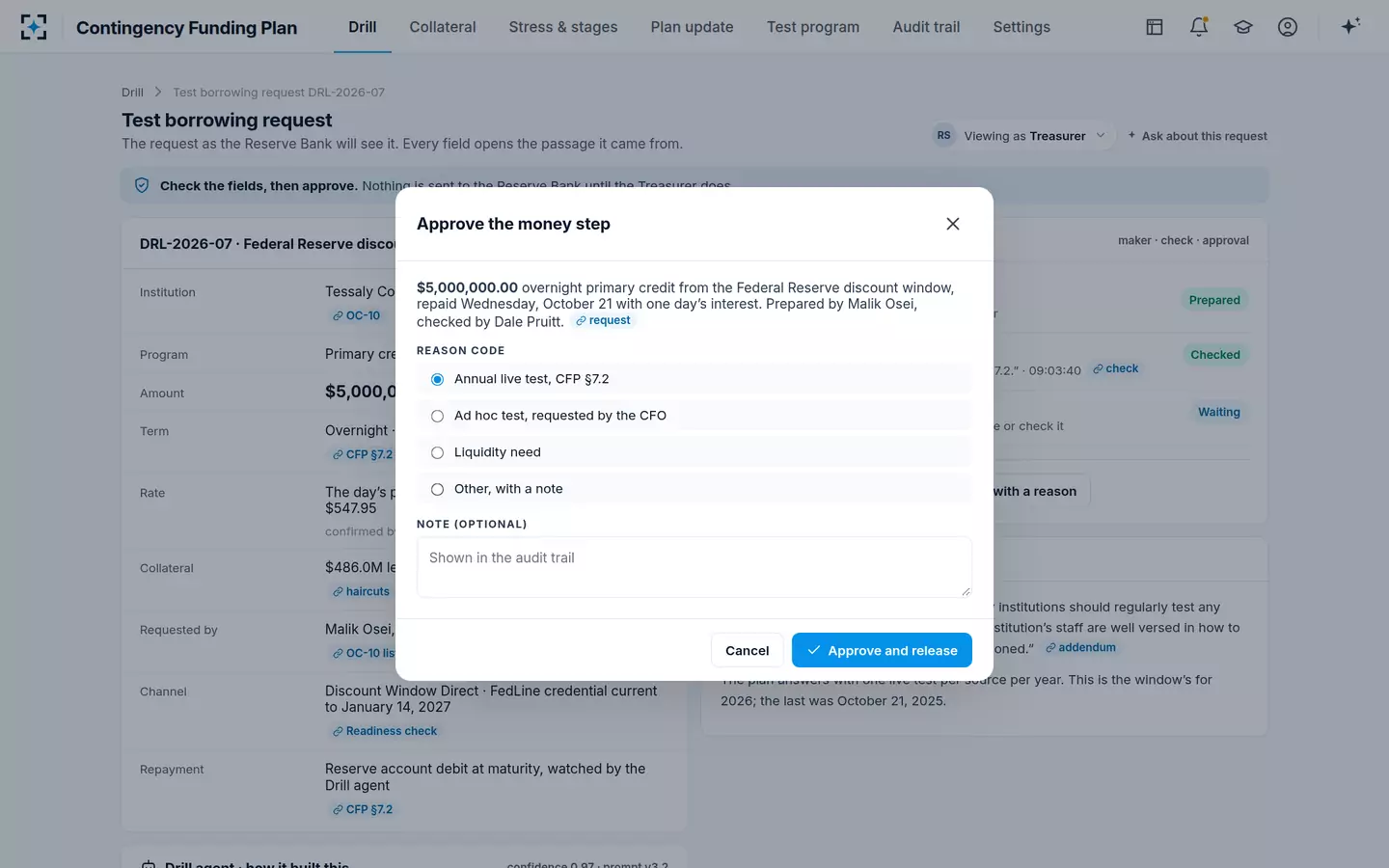
The test only removes stigma if it also proves something. That means checking the collateral behind the window and the people who can reach it, not just placing a call, which is the subject of discount window readiness; the mechanics of who may borrow and how are in discount window borrowing procedures. The solution is at Contingency Funding Plan.
Questions people ask
What is the Treasury's proposal on the discount window?
It is a call, not a published rule: in March 2026 the Treasury urged that the liquidity coverage ratio and other liquidity rules give capped credit for borrowing capacity backed by collateral prepositioned at the window, possibly sized to a bank's demonstrated use. No proposal had appeared in the Federal Register as of October 27, 2026.
Did the Bank Term Funding Program carry stigma?
It was used heavily: the GAO reported that it peaked at more than $167 billion in outstanding loans before it ended in early 2024. Because it was created for a system-wide stress and lent against par value of eligible securities, it is not a clean test of ordinary discount window stigma.
Does the Fed tell our examiners when we borrow?
Not routinely. On request, the Reserve Banks give each regulator a list of its supervised institutions that have signed borrowing agreements and pledged collateral, and regulators may obtain borrowing information in connection with a potential supervisory problem.
Is secondary credit stigmatised in a way primary credit is not?
Secondary credit exists for institutions that do not qualify for primary credit, carries a higher rate and closer oversight, and may not fund asset growth. Its use does signal weakness, which is one reason a plan should test primary credit while the bank qualifies for it.
Will the discount window open on weekends?
Not yet. The Federal Reserve plans to run Fedwire Funds 22 hours a day, six days a week, in 2028 or 2029, and has said it is exploring whether to expand discount window operating days to match.