Discount window borrowing procedures are the steps a bank must have in place, and its people must know, to borrow from its Federal Reserve Bank: executed Operating Circular 10 agreements, including board resolutions and an Official Authorization List of the people allowed to borrow; collateral pledged and valued; a request made by one of those authorized people, by phone or through the Discount Window Direct portal, stating the amount and the term; and the credit and repayment posted to the bank's account. Banks write them into their contingency funding plan and rehearse them with a small test borrowing, because the procedure is rarely used and goes stale between uses: signers leave, credentials expire, resolutions lag the board. Botminds' Contingency Funding Plan runs each source's annual live test step by step and keeps the authorization details current; its agents draft and check the borrowing request, but only named people approve it and send it.
The drill on this page belongs to Tessaly Community Bank, a fictional $3.4 billion community bank whose sample data runs through the solution: a $5,000,000.00 overnight primary credit test on Tuesday, October 20, 2026. The rules come from the Federal Reserve System and are linked where they appear.
A test borrowing from draft to repayment: three agent steps, four people
Agent
Drill agent drafts the requestBuilds the $5,000,000.00 overnight primary credit request from the plan’s test section, every field cited to its source.
Never: sends a request or moves money
Agent
Readiness agent checks who can actConfirms the requester is on the current Official Authorization List and that his FedLine credential is valid.
Never: edits the authorization list
A person decides
Treasury analyst preparesReviews the draft and submits it for approval at 8:47 a.m.
A person decides
CFO checks"Amount, term and collateral match" the plan, at 9:03 a.m.
A person decides
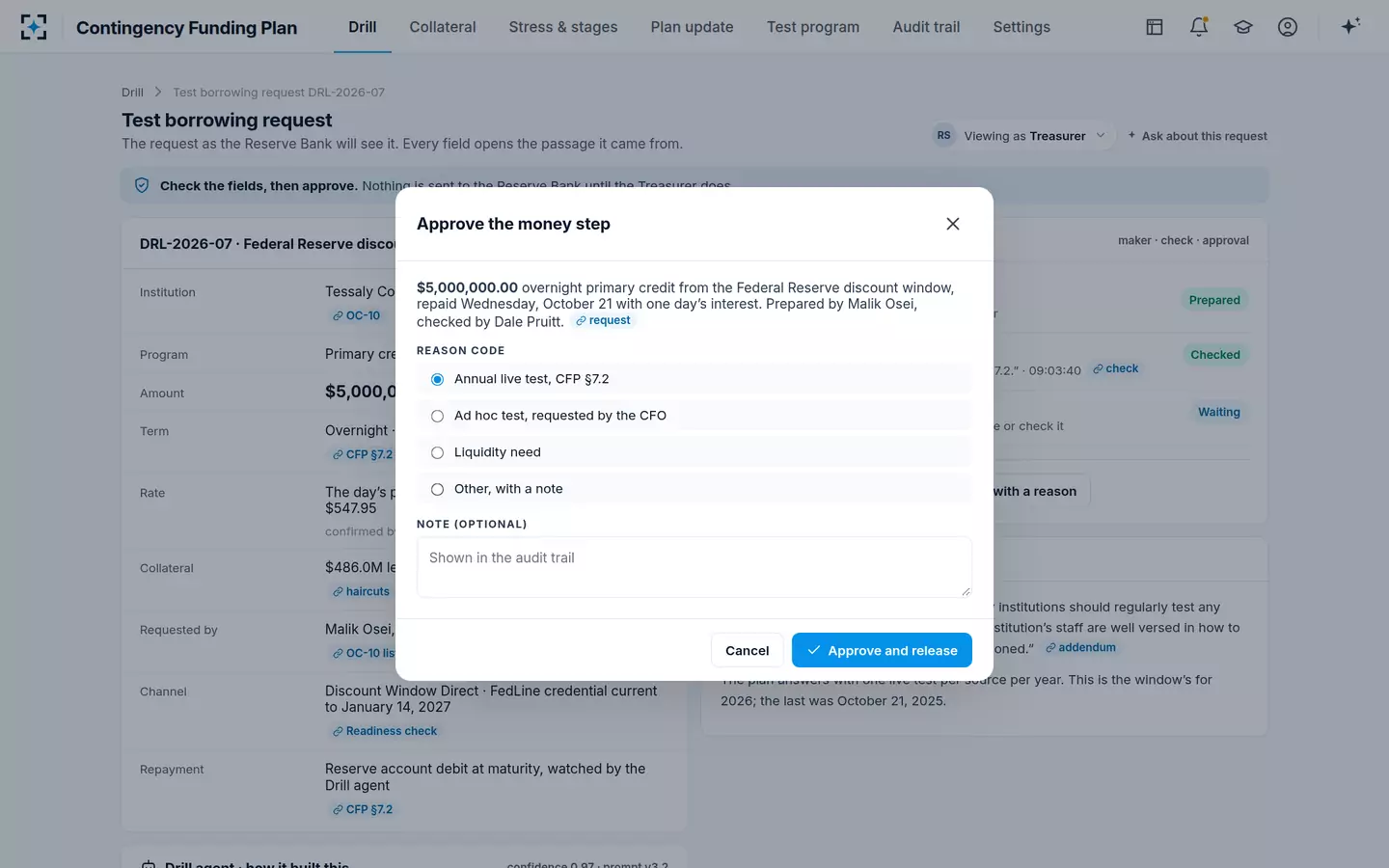
Treasurer approvesReleases the money step at 9:12 a.m. with the reason code for the annual live test.
A person decides
Authorized officer sendsSubmits the request in Discount Window Direct at 9:14 a.m.; the Reserve Bank approves it at 9:21 a.m.
Agent
Drill agent watches and postsWatches the reserve account for the credit, checks the general ledger journal and the next-day repayment, and timestamps each step with its record.
Never: repays, reverses or re-sends
What are the discount window borrowing procedures, step by step?
The Federal Reserve System's own guide to community banks breaks discount window access into five steps: complete and update the legal documents, establish collateral arrangements, understand and document the mechanics of borrowing, test the borrowing process, and use Discount Window Direct (Community Banking Connections, 2024). The first two are one-off projects that need refreshing. The third is the procedure itself, and the guide is specific about what it should contain: "a current list of authorized individuals who are able to request advances", the Reserve Bank's contact information, and the information a request needs, which it lists as the bank's legal name, location and routing number, the requester's telephone number, the amount and the number of days.
Primary credit, the program through which banks overwhelmingly borrow, asks very little at the moment of borrowing. The Reserve Banks say borrowers "are ordinarily asked to provide only the minimum information necessary to process an advance, usually the amount and term", need not seek other funding first, and may use the money for any purpose (Primary and Secondary Credit Programs). Eligibility is decided beforehand: in most cases a composite CAMELS rating of 3 or better and at least adequately capitalized status. The burden of the procedure therefore sits in the preparation, which is exactly the part that decays.
What is Operating Circular 10, and which agreements does it require?
Operating Circular 10 is the Reserve Banks' lending circular, the contract that governs every discount window advance and the collateral behind it. A bank accepts it by returning four agreements to its local Reserve Bank, and the Reserve Bank then files a financing statement against the bank so that its security interest in pledged collateral is perfected. None of the four is complicated; all four have to be right on the day.
The four Operating Circular 10 agreements, and what makes each go stale
| Agreement | What it does | What breaks it |
|---|---|---|
| Letter of Agreement | Evidences the bank’s acceptance of the terms of Operating Circular 10. | A merger, charter change or new legal name. |
| Authorizing Resolutions for Borrowers | Evidences the board’s authorization to borrow from and pledge assets to a Reserve Bank, and whether one or any two people must act. | A board that has not re-approved them since officers changed; the Reserve Bank’s timeline depends on when the board can meet. |
| Official Authorization List | Names the individuals, with titles, authorized to borrow and to pledge or withdraw collateral. | Departures, promotions and role changes that never reach the list. |
| OC-10 Certificate | Gives the Reserve Bank what it needs to file an effective UCC-1 financing statement against the borrower. | A change in the bank’s legal name, state of organization or address. |
Who is authorized to borrow from the discount window?
Only the people the bank's board has named. "The Official Authorization List is a list of individuals who are authorized to borrow and/or pledge/withdraw collateral", the Reserve Banks' agreements page says (OC-10 Agreements), and the Federal Reserve Board's 2024 request for information put it as a rule of operation: "A request may be made only by an authorized person identified on the depository institution's current official authorization list" (89 FR 73415). If the resolutions require any two individuals, two of them act together.
The list is the weakest link in most procedures because nothing forces anyone to look at it until it is needed. The Federal Reserve's guide encourages management "to periodically review the Official Authorization List to be sure that the list of individuals who can act on behalf of the bank is current", and the 2010 interagency policy statement lists the same check among the operational tests of a plan: "ensuring that roles and responsibilities are up-to-date and appropriate" (Interagency Policy Statement). At the sample bank, the solution's Readiness agent checked the list before the drill, found the analyst and the treasurer on the version dated March 3, 2026, and confirmed the analyst's FedLine credential ran to January 14, 2027. One of the bank's three fed funds lines had not answered its September test because the desk contact on file had left, the kind of detail the same agent now keeps current.
How do you request a discount window advance?
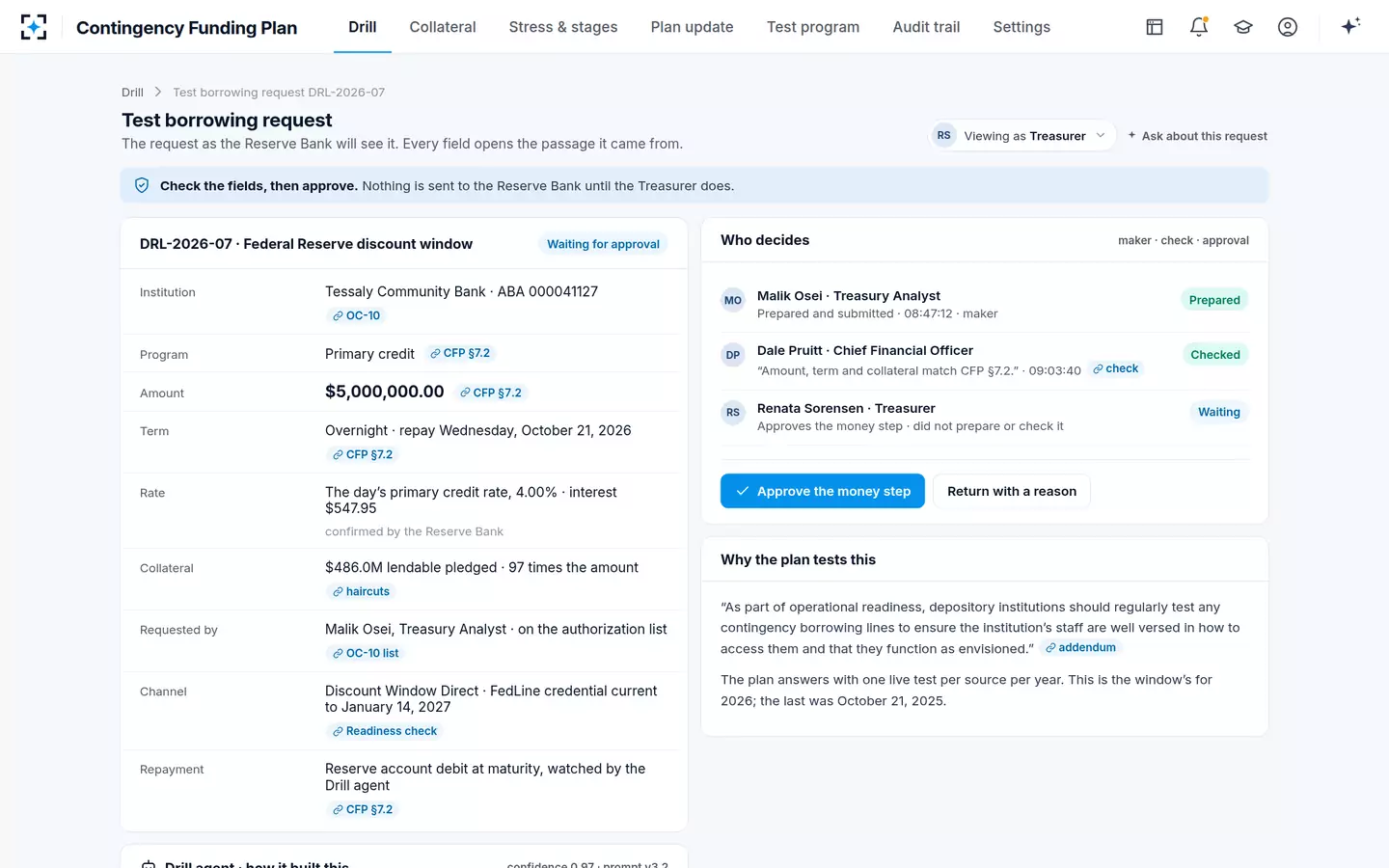
An authorized person requests the advance by calling the Reserve Bank's discount window desk or by submitting it in Discount Window Direct, stating the amount and the term. Primary credit is usually overnight and can run up to 90 days, prepayable at any time without penalty; the minimum advance is $1,000. Interest is "charged for 24 hours (or a multiple thereof, for multi-day advances) on the basis of a 365-day year" (The Discount Window), so the sample bank's overnight $5,000,000.00 at the 4.00% primary credit rate in force that week cost $547.95.
Timing is where procedures often mislead their readers. The Reserve Banks normally credit an approved advance at the close of the Fedwire day, not when it is approved, and pay earlier only if the bank asks and the Reserve Bank agrees. A procedure that says "request the advance" without saying "ask for earlier availability, and know who can" describes a loan that arrives after the wires it was meant to cover have gone. The consequences for a contingency funding plan's timing are worked through in FHLB borrowing capacity, quoted in dollars and used in hours.
The test borrowing request in Contingency Funding Plan, each field cited to its source
What is Discount Window Direct, and who can use it?
Discount Window Direct is the Reserve Banks' online portal for discount window business, launched in January 2024 and reached through FedLine. Banks use it to request advances, make payments, upload loan collateral schedules, see loan and collateral balances and message their Reserve Bank. More than 1,800 institutions are registered to borrow through it (Discount Window Modernization), and Vice Chair Jefferson said in September 2026 that "over 60 percent of discount window loan requests are submitted through DWD" (Jefferson, September 22, 2026).
Access is personal. Only Operating Circular 10 authorized individuals with a current email on file and existing FedLine credentials can have their institution's FedLine administrator add the application to their profile, and requests can be made only during the local Reserve Bank's business hours; lending stays open until the close of Fedwire, generally 7 p.m. Eastern. A procedure therefore needs two lists to agree, the board's authorization list and the FedLine profiles, and a test proves both. A phone request remains available to the same authorized people.
Can an AI system request a discount window loan?
No. Under the Reserve Banks' procedures a request may be made only by a person on the bank's authorization list, through credentials issued to that person; the procedure is built around named people and has no place for software acting on its own. What an agent can do well is everything around the request: draft it from the plan, check that the requester is authorized and the collateral covers it, watch for the credit, post the journal and confirm repayment.
The line matters more for agents than for any earlier tool, and supervisors have begun to say why. The Financial Stability Board's final sound practices on artificial intelligence, published in October 2026, name the problem for any approval chain: once agents are used at scale, people cannot watch each of their decisions as it happens (FSB, 15 October 2026; the sentence is quoted in questions to ask of liquidity monitoring tools). If people cannot watch an agent in real time, the stops have to be built into the procedure, before the money moves. The banking agencies' revised model risk guidance of April 2026 leaves generative and agentic AI outside its scope, so a bank cannot lean on its model risk program to govern an agent that touches a borrowing; what the 2026 model risk guidance covers is set out on our customer risk rating page. The control has to be built into the procedure itself.
Who may do what in a test borrowing: the authority matrix
Draft the request from the plan
Drill agentDoes
Readiness agentNever
Treasury analyst—
CFO—
Treasurer—
Confirm the requester is on the authorization list and the credential is current
Drill agent—
Readiness agentDoes
Treasury analyst—
CFO—
Treasurer—
Prepare and submit for approval
Drill agentNever
Readiness agentNever
Treasury analystDoes
CFO—
Treasurer—
Check amount, term and collateral against the plan
Drill agentNever
Readiness agentNever
Treasury analyst—
CFODoes
Treasurer—
Approve the money step, with a reason code
Drill agentNever
Readiness agentNever
Treasury analystNever
CFONever
TreasurerDoes
Send the request through Discount Window Direct
Drill agentNever
Readiness agentNever
Treasury analystDoes
CFO—
Treasurer—
Watch the account, post the journal, confirm repayment
Drill agentDoes
Readiness agent—
Treasury analystReviews
CFO—
Treasurer—
Change the authorization list
Drill agentNever
Readiness agentNever: flags
Treasury analyst—
CFO—
TreasurerBoard resolution
Who approves a test borrowing, and why the approver must not prepare it
The plan should name the approver, and the approver should be someone who neither drafted nor checked the request. At the sample bank the treasury analyst prepares, the chief financial officer checks amount, term and collateral against the plan, and the treasurer approves the money step with a reason code; the screen will not let a person approve an item they prepared or checked. A test borrowing is real money and a real loan from the Federal Reserve, so it deserves the same maker, checker and approver as any other wire of its size.
The treasurer approves the money step, and must say why
Why the procedure should be rehearsed at 4 p.m., not only at 9 a.m.
A morning test proves the paperwork; an afternoon test proves the procedure. Real liquidity needs often arrive late, when outgoing wires exceed the balance, counterparties are closing and the people on the list may be in a meeting or on a plane. The FDIC's examination manual says so directly.
Simulations or tests performed late in the day can highlight specific problems such as difficulty in selling assets or borrowing new funds at a time when the capital markets may be less active.
FDIC, RMS Manual of Examination Policies, section 6.1 (October 2025)
For a community bank the cheapest version is to vary the test: one annual drill in the morning with every step documented, and one unannounced exercise later in the day that stops short of sending, timed from the moment the need is declared to the moment an authorized person could submit. If the second takes three times as long as the first, the plan's timing assumptions are the morning's, not the crisis's.
What records should a test borrowing leave?
A test borrowing should leave a file an examiner can follow without asking anyone: the request and why its fields are what they are, who was authorized, who approved, what the Reserve Bank confirmed, what reached the account and the books, and what the bank learned. The sample bank's drill files each step with its record, and the findings go into the next version of the plan.
The evidence file for one discount window test
- The request, with its source
Amount, term, program and collateral, each tied to the plan section that sets the test.
- The authorization evidence
The version of the Official Authorization List in force, and the requester’s FedLine credential status on the day.
- The approvals
Preparer, checker and approver with times and reason code, none the same person.
- The Reserve Bank’s confirmation
The advance as approved in Discount Window Direct or confirmed by phone, with its rate.
- The money
The credit to the reserve account, the general ledger journal and the repayment with interest, each with its reference.
- The timing
Each step timestamped, so the plan’s assumption about how long the window takes is measured, not remembered.
- The findings
What failed or nearly failed, an owner and a date, and the plan change that follows.
How the same evidence becomes a pilot a bank can run on its own plan in a month is in discount window readiness: a 30-day test. The full solution is at Contingency Funding Plan.
Questions people ask
How long does it take to set up discount window access?
It depends mostly on the bank. The Reserve Banks review the Operating Circular 10 agreements as quickly as they can, but the timing turns on whether the documents are accurate and when the board can meet to pass the resolutions; pledging loans adds a borrower-in-custody application on top. The 2010 interagency policy statement warned that establishing lines can take weeks, which is why plans set them up in advance.
Is there a fee to borrow from the discount window?
There is no fee for using Discount Window Direct or for borrowing under primary or seasonal credit, and advances can be prepaid without penalty. The cost is the interest: primary credit was 4.00% in the week of October 19, 2026, against an effective federal funds rate of 3.88%.
Can a correspondent bank borrow on our behalf?
A bank without its own master account can designate a correspondent as the settlement point for discount window advances under an ancillary Operating Circular 10 agreement. The borrowing is still the bank's, requested by its own authorized people against its own pledged collateral.
How often should the authorization list be reviewed?
The Federal Reserve's 2024 guide sets no frequency; it encourages a periodic review. A sensible rule is to check it before every test, after every departure or change of role among the named people, and whenever the board re-approves the resolutions.
What happens if no authorized person is available?
Then the bank cannot borrow until one is, which is why plans name more people than the minimum and why the 2010 interagency statement treats up-to-date roles as something to test. A board can amend the resolutions and the list, but the Reserve Bank has to receive and accept the new documents first, which is not something to attempt during a run.