Discount window collateral eligibility is the set of tests a security or loan must pass for a Federal Reserve Bank to lend against it. Securities must generally be investment grade, priced by the Reserve Banks' vendors and held where the Reserve Bank controls them. Loans must be in U.S. dollars under U.S. law, assignable, free of prior liens, rated pass on the bank's own scale, and no more than 30 days past due for commercial loans or 60 days for consumer and residential loans, with a complete file behind them; loans to insiders, affiliates and, without approval, foreign obligors are out. A loan that passes is then valued and cut by a margin. The hard part is that eligibility is checked by the bank, continually, and a loan stays on the listing until someone takes it off. Botminds' Contingency Funding Plan re-tests every pledged loan against those rules and its haircut, so the contingency funding plan counts lendable value, not listed balances.
Figures marked as sample come from Tessaly Community Bank, a fictional $3.4 billion community bank whose data runs through the solution. Every rule is quoted from the Reserve Banks' own pages, linked where it appears.
Two questions, four boxes: being on the listing and being eligible today are different tests
Listed and eligible
1,579 loans
The borrower-in-custody loans that passed every check. Counted, and rightly so.
Listed, but not eligible today
61 loans · $212.0M
Downgraded, past due or missing a document. Still in the plan’s count; a Reserve Bank would give them nothing.
Eligible, but not pledged
$58.0M of agency MBS
Unencumbered securities that could be pledged the same day. Not counted, though they could be: the plan’s fix.
Neither listed nor eligible
Not counted
Insider loans, special mention credits, loans that cannot be assigned. Correctly outside the plan.
What collateral is eligible for the discount window?
The Reserve Banks accept, in their words, "a wide range of securities and loans as collateral" (Collateral Eligibility). On the securities side that means U.S. Treasury and fully guaranteed agency securities, government-sponsored enterprise debt and agency mortgage-backed securities, and investment-grade municipal, corporate, asset-backed and non-agency mortgage-backed securities, with AAA required for some classes. Securities may not be the bank's own obligations or an affiliate's, and one without a vendor price gets no value at all.
On the loan side the list is longer than many treasurers assume: commercial and industrial, commercial real estate, construction, raw land, agricultural, consumer, residential first and second liens, student loans, credit card receivables and guaranteed portions of agency loans. Most community banks pledge loans through the borrower-in-custody program, which leaves the files on their premises. That convenience is also the source of most eligibility failures, because the Reserve Bank sees the bank's data, not the bank's files.
The Reserve Banks' acceptance criteria for pledged loans, in brief
| Test | The rule | Where it usually fails |
|---|---|---|
| Rating | Not classified special mention, substandard, doubtful or loss, or otherwise unacceptable after the Reserve Bank reviews the bank’s rating policy. | A downgrade at the quarterly review that never reaches the listing. |
| Payment status | Commercial, construction, land and agricultural loans generally accepted if not more than 30 days past due; consumer and residential loans, 60 days. | A large commercial loan that slips past the limit between monthly schedules. |
| Lien and rights | The Reserve Bank must obtain a perfected, first-priority security interest free of others’ claims. | A competing lien, or an FHLB blanket lien that covers the same loans. |
| Transferability | Readily negotiable and assignable; syndicated loans only if they allow a pledge to a Reserve Bank. | Participations and syndications with consent clauses. |
| Documents | The note and supporting documents present, executed and complete, stored securely; imaged notes acceptable with controls, subject to state law. | A recorded mortgage, note copy or assignment that never reached imaging. |
| Parties | Not to insiders, affiliates or the bank itself; foreign obligors only in limited cases with prior written approval. | A capital call facility whose investors sit abroad. |
Do loans need to be pass rated for the discount window?
Yes. The Reserve Banks list as unacceptable "Loans classified as Special Mention, Substandard, Doubtful or Loss, or that are otherwise deemed unacceptable by the Reserve Bank following a review of the pledging institution's internal risk rating policy" (Collateral Eligibility). For commercial pledges the bank sends its rating scale and definitions with its borrower-in-custody application, and the Reserve Bank decides which of its grades count as minimal risk, which as normal risk and which as unacceptable. A pass-watch grade can therefore be acceptable at one bank and not at another, depending on how its definitions read.
There is a second wording to reconcile. The Federal Reserve System's guide for community banks puts the program rule more tightly: "Loans must be pass-rated and current" (Community Banking Connections, 2024). The acceptance criteria allow commercial loans up to 30 days past due. A bank that wants its plan to count only collateral beyond argument applies the stricter reading, which is what the sample bank does: its rule fails any pledged loan 30 or more days past due.
Can past due loans be pledged to the discount window?
Up to a point. Commercial and industrial, commercial real estate, construction, raw land and agricultural loans are "generally accepted if not more than 30 days past due"; consumer loans, residential first and second liens, student loans and credit card receivables have 60 days. Beyond that the loan has no collateral value, whatever its balance. The FDIC's examination manual makes the same point about secured borrowing in general: "If asset quality issues exist, management may find that delinquent loans do not qualify as collateral" (FDIC RMS Manual, section 6.1).
The Federal Home Loan Banks draw the line elsewhere: their regulation allows first mortgages up to 90 days delinquent, and each FHLB can be stricter. A loan can therefore be good collateral at one lender and none at the other on the same day, which is one more reason the plan's capacity table should be built per lender, not per loan. How FHLB capacity is calculated covers the other side.
What makes a loan ineligible for borrower in custody?
Beyond rating and payment status, three things disqualify loans that look perfectly good on a balance report: the file, the lien and the parties. "Loan documents must be present, properly executed, and complete in accordance with the depository institution's internal loan policies and procedures", the Reserve Banks' borrower-in-custody requirements say (Pledging Loans). A commercial real estate loan without its recorded mortgage in the file cannot support the Reserve Bank's security interest, however well it pays.
The parties test is the one that ended Signature Bank's hopes in March 2023. The bank had grown a book of capital call loans and planned to pledge them at the discount window, but the Federal Reserve Bank of New York found them ineligible because many of the funds behind them had foreign limited partners. The FDIC's review describes what the bank did next.
SBNY pursued efforts to pledge these loans for months, hiring two law firms to make the case for FRB-NY to accept the loans. During the weekend SBNY failed, management again tried, unsuccessfully, to pledge this portfolio to FRB-NY.
FDIC, Supervision of Signature Bank, April 28, 2023
The lesson is not that foreign obligors are a trap. It is that a collateral calculation can include loans the lender has already declined: the FDIC found that management kept trying to count the portfolio in its collateral calculations until hours before the bank failed, though it had no confirmed way to borrow against it. Nobody downstream of the calculation could tell.
How are discount window haircuts applied? Margins, not one percentage
The Reserve Banks apply margins rather than a single haircut. For securities, the margin is a percentage of market value set by asset type, rating and duration: Treasuries run from 99 for the shortest to 95 for durations over ten years. For loans, the Reserve Banks estimate each loan's fair market value monthly from the data the bank reports, then multiply by a margin that depends on loan type, fixed or floating rate, maturity, amortization and risk category, with separate tables for the largest institutions, generally those of $50 billion and more, and for everyone else (Collateral Valuation). Borrowers under secondary credit generally get an additional margin on everything except Treasury and agency securities.
The same commercial real estate loan is worth less to a Reserve Bank the longer it runs
Two consequences follow for the plan. First, the lendable value of a commercial real estate book is not its balance times one number; a portfolio of long fixed-rate loans can be worth little more than half its principal. Second, a bank's own haircut table, which most capacity tables use, is an estimate of the Reserve Banks' arithmetic. The sample bank's table puts pass-rated commercial real estate at 66.6% across the board, a reasonable average for its mix and exactly the kind of number to reconcile against the "Discount Window Total Collateral" the Reserve Bank reports back.
Why would the Fed reject collateral that is on the listing?
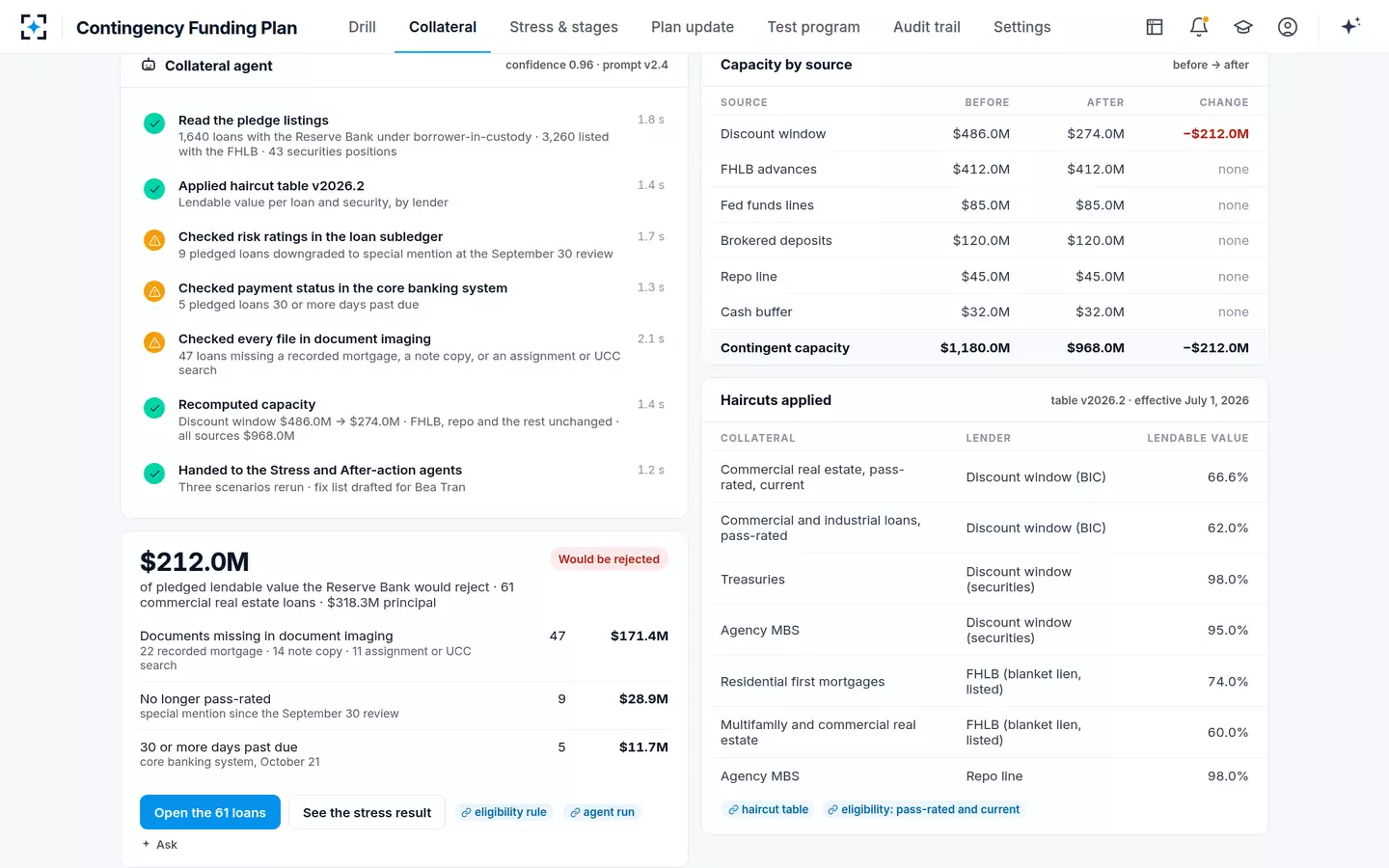
Because the listing records what was true when it was sent, and eligibility changes after. A Reserve Bank rejects, or values at zero, a pledged loan that has been downgraded, gone past due, matured, lost a required data field or turned out to lack its documents. At the sample bank, a loan-by-loan check of its 1,640 borrower-in-custody loans found 61 that would fail. They were few by count and large by value.
Few loans, most of the value: accuracy has to be measured in dollars
3.7%
of the sample bank’s 1,640 borrower-in-custody loans failed a check
43.6%
of the discount window line’s $486.0 million of lendable value stood on those loans
$274.0M
what the line was worth once they were taken out
That gap is why a sample-based check misleads. An annual audit that tests 60 random pledged files and finds two failures reports a 3% error rate and a clean opinion. The capacity it leaves in the plan can still be wrong by more than two fifths, because the failures that matter are concentrated in the large commercial loans whose files are the most complex. The accurate measure of a capacity table is the share of counted lendable value that survives a test of every loan, not the share of loans that pass.
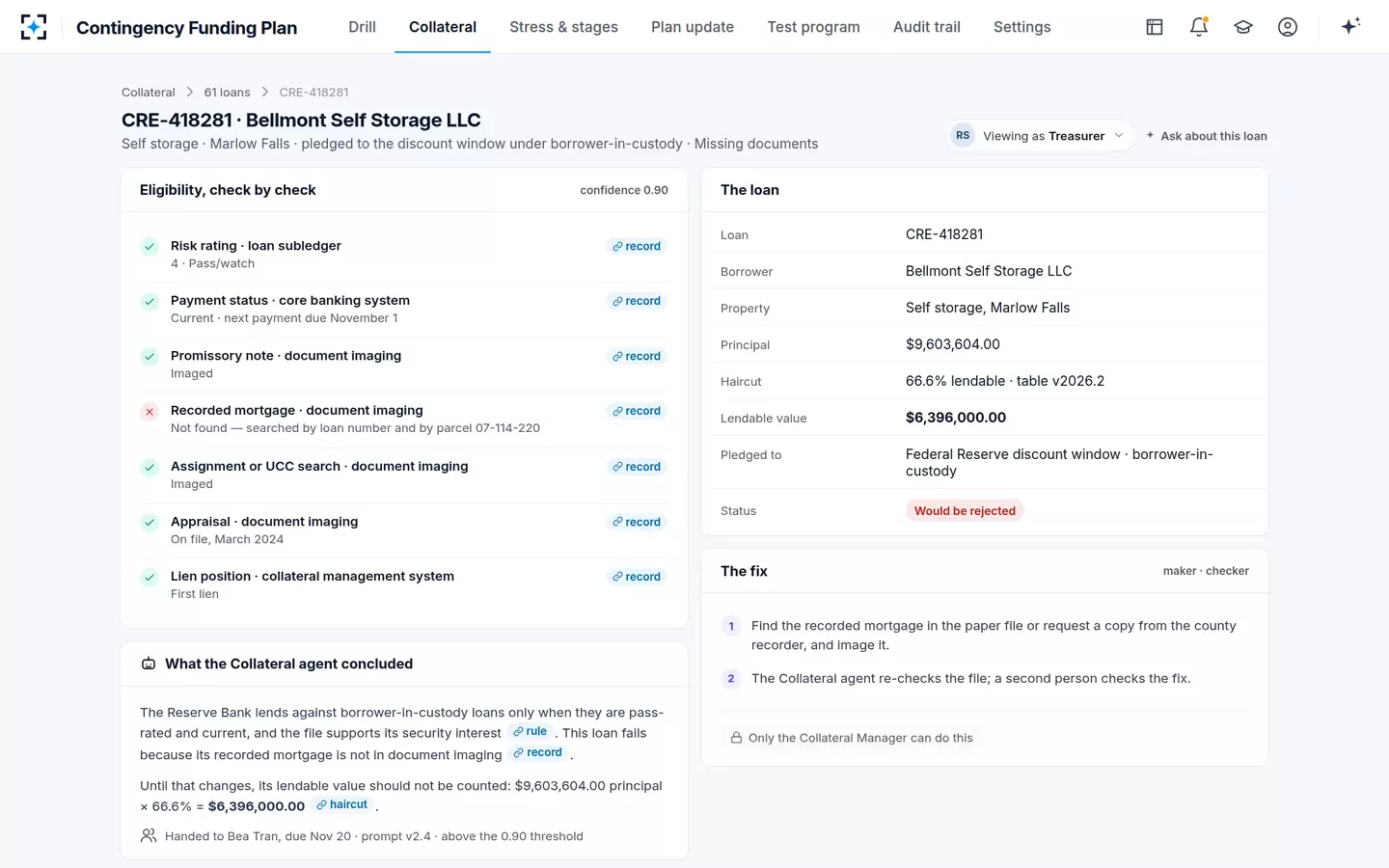
One loan's eligibility, check by check, in Contingency Funding Plan
How often should collateral eligibility be checked?
Every time something that decides it changes, which for a pledged commercial book means daily. The Reserve Banks revalue pledged loans monthly from the bank's collateral schedule, and the Federal Reserve Bank of Minneapolis's borrower-in-custody booklet warns that if a schedule is not received by its due date, "the collateral value of the pledged loans may be reduced to zero". Monthly is the lender's cadence. The plan needs the bank's, which is the cadence of its rating changes, its delinquencies and its document imaging.
Nine eligibility tests to run on every pledged loan, and the system each reads
- Internal rating is pass, and maps to an accepted category
Loan subledger, against the rating scale filed with the Reserve Bank.
- Not more than 30 days past due (60 for consumer and residential)
Core banking system; the sample bank uses the stricter "current".
- Note present and executed, or imaged with controls
Document imaging, searched by loan number.
- Lien documents present
Recorded mortgage, assignment or UCC search, searched by loan number and parcel.
- First-priority lien, no competing claim
Collateral management system and the lien search.
- Assignable, with no consent clause blocking a pledge
Loan agreement terms for participations and syndications.
- Not an insider, affiliate or unapproved foreign obligor
Customer master and Regulation O records.
- Matures more than 30 days after the schedule date
Loan subledger; a loan inside that window receives no value.
- Every required data field reported
Balance, rate, maturity, rating and the rest; a missing field means zero value.
What Contingency Funding Plan changes for collateral eligibility
The solution's Collateral agent runs those tests on every pledged loan and security, with each lender's haircut, and lists every failure with its reason and fix. At the sample bank it found 47 loans missing a document, 9 downgraded to special mention at the September 30 review and 5 past due, and recomputed discount window capacity from $486.0 million to $274.0 million. It does not decide eligibility for the Reserve Bank, change a pledge, or mark a loan fixed: the collateral manager works the fix list, a second person checks each fix, and the treasurer approves each withdrawal. The 47 document requests went out in one action, due November 20.
The loans a Reserve Bank would refuse, grouped by reason
What a downgraded loan does to the plan between the review and the withdrawal is followed day by day in borrower in custody loans: one loan's 37 days, and what the lost capacity does to stress coverage in the liquidity stress test and the CFP. The solution itself is at Contingency Funding Plan.
Questions people ask
Can a loan pledged to the FHLB also be pledged to the discount window?
Not at the same time. Collateral securing one lender's advances cannot secure the other's, and where an FHLB holds a blanket lien the Reserve Bank needs that lien released or subordinated before it can take the loans. The two systems coordinate so the same assets do not back both.
Are participations and syndicated loans eligible?
Generally yes, if structured as true purchase and sale for participations, and for syndications only if the agreement explicitly allows a pledge to a Reserve Bank. The eligibility tests apply to the underlying loans too, and a participation copy is acceptable only where the bank is not the lead.
Does the Fed accept imaged or electronically signed loans?
Yes, subject to state law and to controls. Loans signed digitally and stored electronically, and paper loans imaged with the original destroyed, can be pledged if the bank can show the original was destroyed and the image is the true copy.
How do I see what the Reserve Bank thinks my collateral is worth?
Discount Window Direct shows it as "Discount Window Total Collateral", and the Account Management Information application shows intraday balances; a bank can also ask for a Statement of Collateral Holdings by secure email daily, weekly or monthly. Reconciling that figure to the plan's discount window line is the simplest accuracy test there is.
Did the 2026 borrower-in-custody changes loosen eligibility?
No. The changes effective September 8, 2026 simplified forms, ended most pre-enrollment inspections and moved collateral schedules online, but the Reserve Banks state that they "do not change" the eligibility requirements for the program, the published acceptance criteria for loans, or loan valuation and margins.