FHLB borrowing capacity is the amount a Federal Home Loan Bank will lend a member right now: the value of the eligible collateral the member has pledged, after the FHLB's haircuts, limited by the credit limit the FHLB sets as a share of the member's assets and reduced by advances and letters of credit already outstanding. It is usually the second-largest line in a community bank's contingency funding plan, after the discount window, and both are quoted in dollars. In a run they are used in hours: an advance requested after the FHLB's same-day cut-off arrives tomorrow, a discount window advance is normally credited at the close of the Fedwire day, and a line that has not been tested may not answer at all. Botminds' Contingency Funding Plan runs a live test of every source each year and recounts the collateral behind it, so the plan says what each source would deliver and by when.
Capacity figures marked as sample belong to Tessaly Community Bank, a fictional $3.4 billion community bank whose data runs through the solution. Timing rules come from the Federal Reserve, the FDIC, the FHFA and the GAO and are linked where they appear.
Six sources, $1,180.0 million, four different clocks
How is FHLB borrowing capacity calculated?
FHLB borrowing capacity is calculated from the collateral, then capped by credit. Most FHLBs take a blanket lien and value the member's eligible loans from its regulatory reports or loan-level files; some require a listing of specific loans or physical delivery of notes, more often for larger or weaker members. Each loan type gets a haircut, and the FHFA's examination manual gives the order of magnitude for residential mortgages: "For 1-4 family mortgages, the FHLBanks typically use anywhere from 15 to 40 percent haircuts, lending 60 percent to 85 percent of UPB" (FHFA, Advances and Collateral, 2014).
The credit side is separate. When an institution joins, its FHLB "assigns it a financing limit, typically based on a percentage of the applicant's total assets", and it "generally lends the requested amount if it is within the lesser of the member's available borrowing capacity or its credit limit (subject to market conditions)", the GAO told Congress in July 2026 (GAO-26-109282). Advances also require the member to buy FHLB stock, on which the FHLB holds a lien too.
FHLB borrowing capacity, term by term
Eligible collateral
Unpaid balance of pledged loans, or market value of securities
First mortgages up to 90 days delinquent, agency securities, cash, other real estate collateral including commercial real estate; small business and farm loans for smaller members
Collateral manager
Haircut
× (1 − haircut by loan type)
Residential first mortgages at the sample bank lend 74.0% under a blanket lien with listing; multifamily and commercial real estate 60.0%
The FHLB, from member data and reviews
Credit limit
Lesser of collateral value and the limit
Usually a percentage of total assets, reassessed as the member’s condition changes
The FHLB
Already used
− advances and letters of credit outstanding
Letters of credit securing public deposits use the same collateral
Treasury
At the sample bank the result is $412.0 million on 3,260 listed loans, and the solution's loan-by-loan check found every one of them passing on October 20. The FHLB line was not where the plan's error lay. That is worth knowing, because a bank that discovers a collateral problem usually assumes it is everywhere; here it was concentrated in commercial real estate pledged to the discount window.
What reduces FHLB borrowing capacity?
Capacity falls when the collateral changes, when the member's condition changes, and when the FHLB itself is stretched. Collateral falls through amortization, payoffs, sales and delinquency. The member's condition matters directly: an FHLB "may reduce a member's borrowing capacity, require more collateral, or take physical possession of collateral as a condition for new or outstanding advances" if the member's financial condition deteriorates (GAO-26-109282), and FHFA regulations prohibit new advances to members without positive tangible capital.
The 2022–23 rate rise added a quieter channel. The FDIC's examination manual warns banks with unrealized securities losses to understand restrictions "should the unrealized losses affect certain capital measures, such as GAAP equity", which "may include a curtailment of new advances or placements (based on law or policy) at institutions that report a low or negative GAAP equity position" (FDIC RMS Manual, section 6.1). And on a day when many members borrow at once, the same manual notes, an FHLB may hit "their own liquidity capacity limitation on a given business day".
How fast can a bank draw an FHLB advance?
On a normal day, the same day, if the request reaches the FHLB before its funding cut-off and fits within capacity. On a bad day, the answer depends on the hour and the size. On the afternoon of March 9, 2023, as Silicon Valley Bank lost more than $40 billion of deposits, its FHLB "was unable to fill a $20 billion advance request from SVB", which FHLB representatives attributed "to market conditions, the size and late timing of the request, and the FHLBank's need to better understand ongoing events" (GAO-26-109282).
Signature Bank's last afternoon ran the same way. Its deposits fell by $18.6 billion on March 10, most of it late in the day, and the FDIC's review found that management reached its FHLB too late to draw on its line and had too little collateral at the discount window to cover the wires waiting to go out; the Reserve Bank's funding came only after the FHLB subordinated its claim on some collateral (FDIC, Supervision of Signature Bank). The FHFA, which supervises the FHLBs, has since said plainly what the system is and is not.
The FHLBank System does not have the functional capacity to serve as the lender of last resort for troubled members that could have significant borrowing needs over a short period of time.
FHFA, FHLBank System at 100: Focusing on the Future, fact sheet
The FDIC's manual draws the planning conclusion. Effective managers "are also aware of the execution constraints that may arise when attempting to borrow at the end of a business day or week and ensure CFPs acknowledge these constraints." A plan that lists the FHLB line at its full value with no cut-off time attached has not acknowledged them.
Hours to cash: the same capacity on different clocks
Every contingent source has a clock, and the plan should record it next to the dollars. Securities held in a Fedwire Securities account can be moved to a discount window pledge account "even late in the day", Vice Chair Jefferson said in September 2026, which makes "pledging Treasury collateral and receiving a same-day loan" straightforward for banks with arrangements in place (Jefferson, September 22, 2026). Loans are slower: a 2024 Federal Reserve guide put a first borrower-in-custody approval at up to 30 days, and the 2010 interagency policy statement warned of "time constraints, sometimes lasting weeks, encountered in initially establishing lines with FRB and/or FHLB" (Interagency Policy Statement).
Even prepositioned discount window capacity has a clock. "Proceeds of approved discount window advances are normally made available at the close of Fedwire Funds Service and FedNow Service (usually 7:00 pm EST)" (Discount Window FAQ), and "Reserve Banks may approve earlier availability of advance proceeds if requested by the borrowing institution" (89 FR 73415). A bank with collateral pledged can also draw intraday credit against the same collateral. The point for the plan is that whoever requests the advance must know to ask for early funds, and the test should prove the Reserve Bank grants it.
From request to usable cash, by source, on the sample bank's test targets
- Call the desk15 min
- Counterparty decides45 min
- Draft to approval31 min
- Send9 min
- Early credit, if granted≤ 80 min
- Draft to approval31 min
- Request to funding, before the cut-offsame day
What a lost day costs: the capacity you can reach by the close
The cost of delay is not the interest on the advance; it is the outflow the bank cannot cover in the hours it has. At the sample bank, after the collateral check, the combined severe scenario counts $718.0 million of capacity against a 30-day need of $596.0 million: cash, the FHLB line and the corrected discount window line. Whether that capacity covers a bad afternoon depends on the clock.
The same $718.0 million, reachable at three moments of a stress day
Cash buffer
Counted$32.0M
Asked by noon$32.0M
Asked at 4 p.m.$32.0M
Next business day$32.0M
FHLB advances, blanket lien
Counted$412.0M
Asked by noon$412.0M
Asked at 4 p.m.$0 if past the FHLB’s cut-off
Next business day$412.0M
Discount window, after the collateral check
Counted$274.0M
Asked by noonApproved; usable intraday only if early availability is granted
Asked at 4 p.m.$274.0M credited
Next business day$274.0M
Reachable total
Counted$718.0M
Asked by noonup to $718.0M
Asked at 4 p.m.$306.0M to $718.0M
Next business day$718.0M
Read the middle column against what the 2023 failures showed. Silicon Valley Bank lost more than $40 billion on March 9 and its management expected more than twice that the next morning (Federal Reserve, SVB review); Signature's outflow was concentrated in the last two hours of a day. A capacity table that is right in dollars and silent on hours prices the first morning correctly and the first afternoon not at all. The FDIC's manual suggests exactly this test, a run that starts late on a Friday, which is worked through in the liquidity stress test and the CFP.
Is FHLB capacity counted in liquidity stress tests?
In a bank's own stress tests, yes, and supervisors have been told not to object. The Federal Reserve's 2026 operating principles instruct examiners not to discourage firms from counting FHLB liquidity in their internal stress tests unless law or regulation requires it. The liquidity coverage ratio, which applies to larger banks, is another matter: it gives no credit for borrowing capacity at the FHLB or the discount window, and the 2026 proposals to change that remain speeches, not rules (discount window stigma follows that debate).
What a stress test should not do is count FHLB capacity at its quiet-day value. The FDIC's manual expects examiners to review "the institution's analysis of FHLB borrowing capacity in the event of severe market stress", and the OCC's sample contingency scenarios cut FHLB and other borrowing lines progressively as stress deepens. A haircut on the line in a severe scenario, and a cut-off time in the event-day scenario, are the two adjustments most plans lack.
Fed funds lines: capacity that answers only if it wants to
Fed funds lines are unsecured and, in practice, at the lender's discretion every time they are drawn, which makes them the least reliable dollar in a plan. Research on the 2008 crisis found the market did not stop working but became selective: after Lehman's failure, "poorly performing large banks see an increase in spreads of 25 basis points, but are borrowing 1 percent less", and the market "does not seem to expand to meet latent demand" (Afonso, Kovner and Schoar, NY Fed Staff Report 437).
The sample bank's experience is smaller and more common. One of its three fed funds lines did not answer its September test because the desk contact on file had left. The plan still listed $85.0 million of fed funds capacity; the stress scenarios, sensibly, count it at zero.
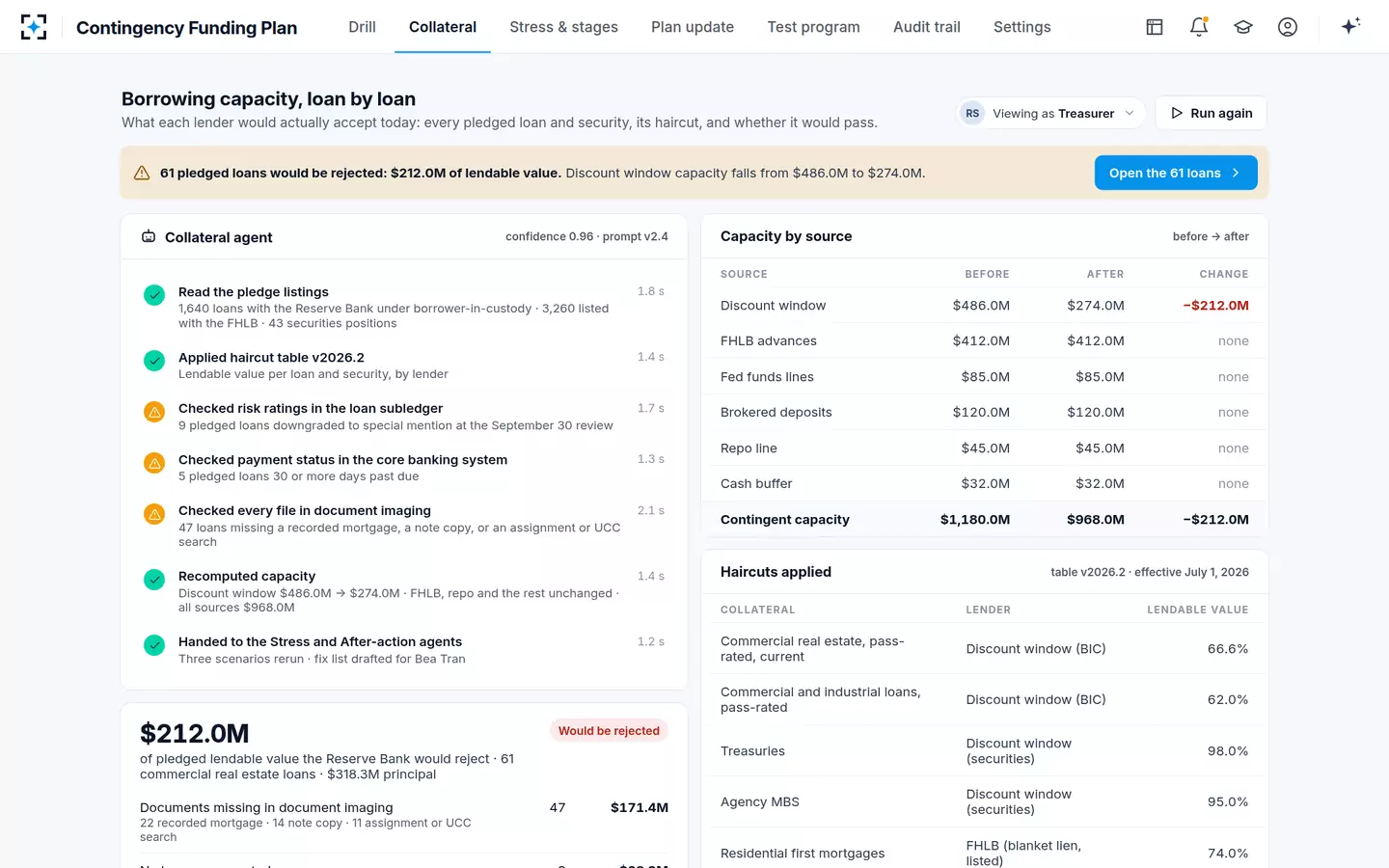
Capacity by source in Contingency Funding Plan, before and after counting what lenders would accept
How much collateral should be prepositioned?
No rule sets a number. The 2023 interagency addendum asks banks that use the discount window to ensure "collateral is available for borrowing in an amount appropriate for a depository institution's potential contingency funding needs" and notes that "pre-pledging collateral can be useful if liquidity needs arise quickly". A practical sizing starts from the plan's most severe 30-day need net of cash, splits it across the lenders by how fast each pays, adds the haircuts, and then adds a margin for loans that will fall out of eligibility between checks. At the sample bank that last margin was not small: 18% of its contingent capacity stood on loans a lender would refuse.
Prepositioning has a cost the plan should record. Collateral pledged to one lender cannot back another: "Collateral pledged to the discount window cannot be shared with other funding providers", the FDIC's manual says, and moving it takes releases, lien searches and sometimes a subordination agreement. SVB was "not prepared to quickly reposition collateral from the FHLBank to access additional discount window funding", the GAO found. The sample bank's fix, a $58.0 million pledge of agency securities that adds $55.1 million of lendable value, could be made the same day precisely because it used securities already in its own account. The broader Fed and FHLB effort to make collateral move faster is covered in collateral management systems in banking; the solution is at Contingency Funding Plan.
Questions people ask
How long does discount window borrower-in-custody approval take?
A 2024 Federal Reserve guide said the first approval can take as long as a month and advised plans to allow for it (one loan's 37 days quotes the guide). Since September 8, 2026 most institutions no longer need a pre-enrollment inspection, and the Reserve Banks now say the review time depends on complete documentation and prompt responses, so the honest planning assumption is still weeks, not hours.
Does an FHLB lend to a bank in trouble?
Within limits. FHFA rules prohibit new advances to members without positive tangible capital, and an FHLB may cut capacity, demand more collateral or take possession of it as a member weakens. The FHFA's position is that the FHLBs are not lenders of last resort and should coordinate with members' regulators and the Reserve Banks when a member no longer meets their credit criteria.
How many banks are FHLB members?
The GAO reported that as of June 2025, 93 percent of banks were FHLB members and more than three quarters had taken at least one advance over the prior ten years. In the first quarter of 2025, 4,100 banks were members of both an FHLB and a Federal Reserve Bank.
Will longer Fedwire hours change the timing?
Eventually. The Federal Reserve announced in November 2025 that Fedwire Funds will run 22 hours a day, six days a week, expected in 2028 or 2029, and said it is exploring whether to extend discount window operating days to match. Until then, the Fedwire close remains the practical deadline for same-day funding.
Should a plan test the FHLB line if the bank borrows from it every month?
Routine borrowing proves the mechanics, not the stress case. The useful test is a larger or later-in-the-day request than usual, and a check that the collateral behind the line would still be eligible if the bank's condition or its loans deteriorated.