A bank's liquidity stress test and its contingency funding plan (CFP) are two halves of one calculation. The stress test projects how much funding the bank would lose in each scenario over a set horizon, usually 30 days for the plan's core scenarios; the CFP lists the contingent sources that would replace it, from cash to the discount window and the FHLB, and how much each would give. Coverage, sources divided by need, is the number boards set floors on. The weakness is that most stress tests take capacity from the plan's capacity table as given, and that table is built from collateral totals refreshed for ALCO, not from what each lender would accept today. A pledged loan downgraded last month is still in it. Botminds' Contingency Funding Plan reruns the plan's scenarios against capacity counted loan by loan, every time eligibility changes, so the stress test describes the plan the bank actually has.
The scenarios and figures below are sample data from Tessaly Community Bank, a fictional $3.4 billion community bank, as it runs through the solution. The supervisory texts are linked where they are quoted.
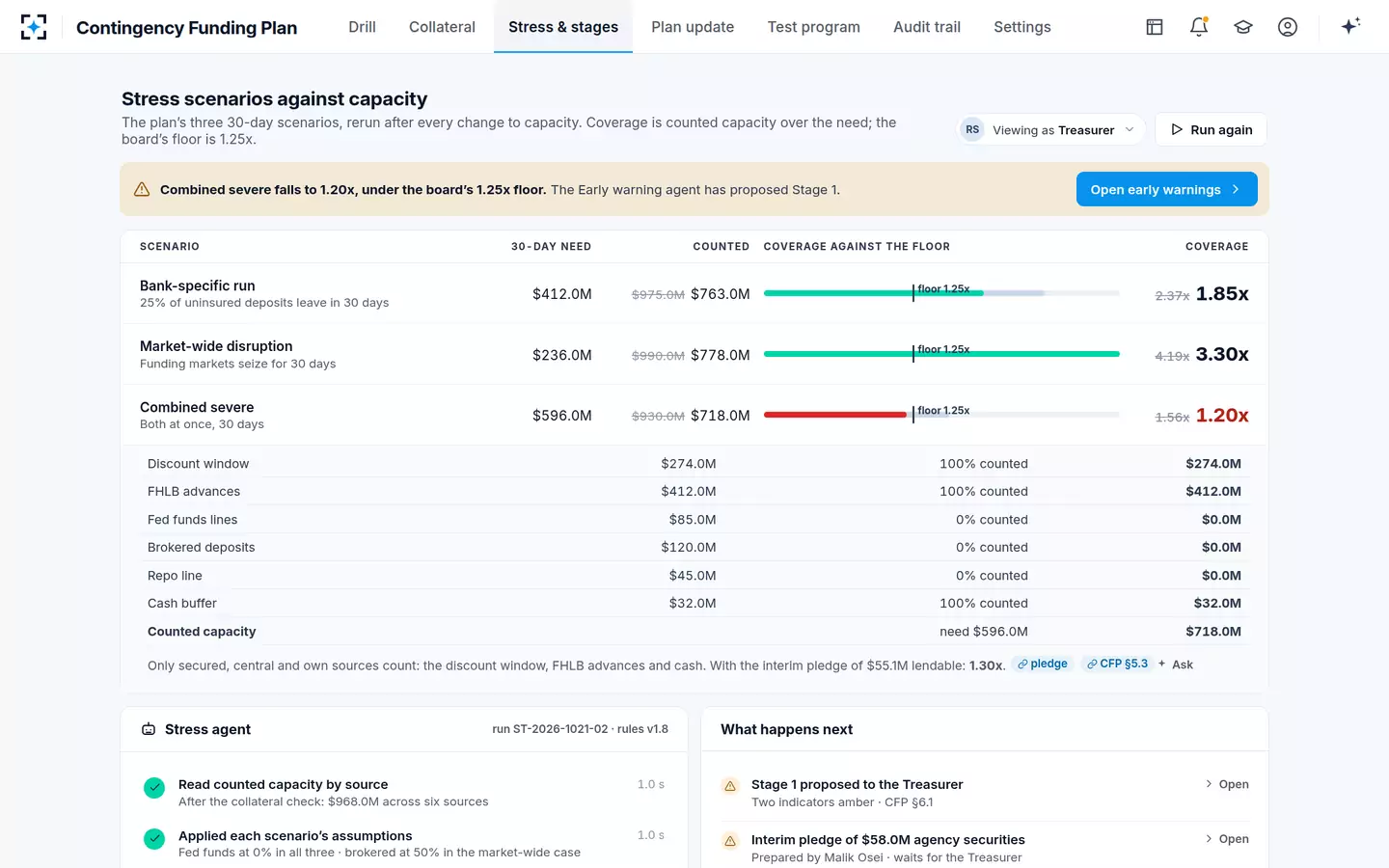
The sample bank's three 30-day scenarios, before and after counting only what lenders would accept
As the plan reported: $975.0M counted · 2.37x
After the loan-level collateral check: $763.0M counted · 1.85x
As the plan reported: $990.0M counted · 4.19x
After the loan-level collateral check: $778.0M counted · 3.30x
As the plan reported: $930.0M counted · 1.56x, above the 1.25x floor
After the loan-level collateral check: $718.0M counted · 1.20x, under the floor
As the plan reported: Not needed
After the loan-level collateral check: $773.1M counted · 1.30x
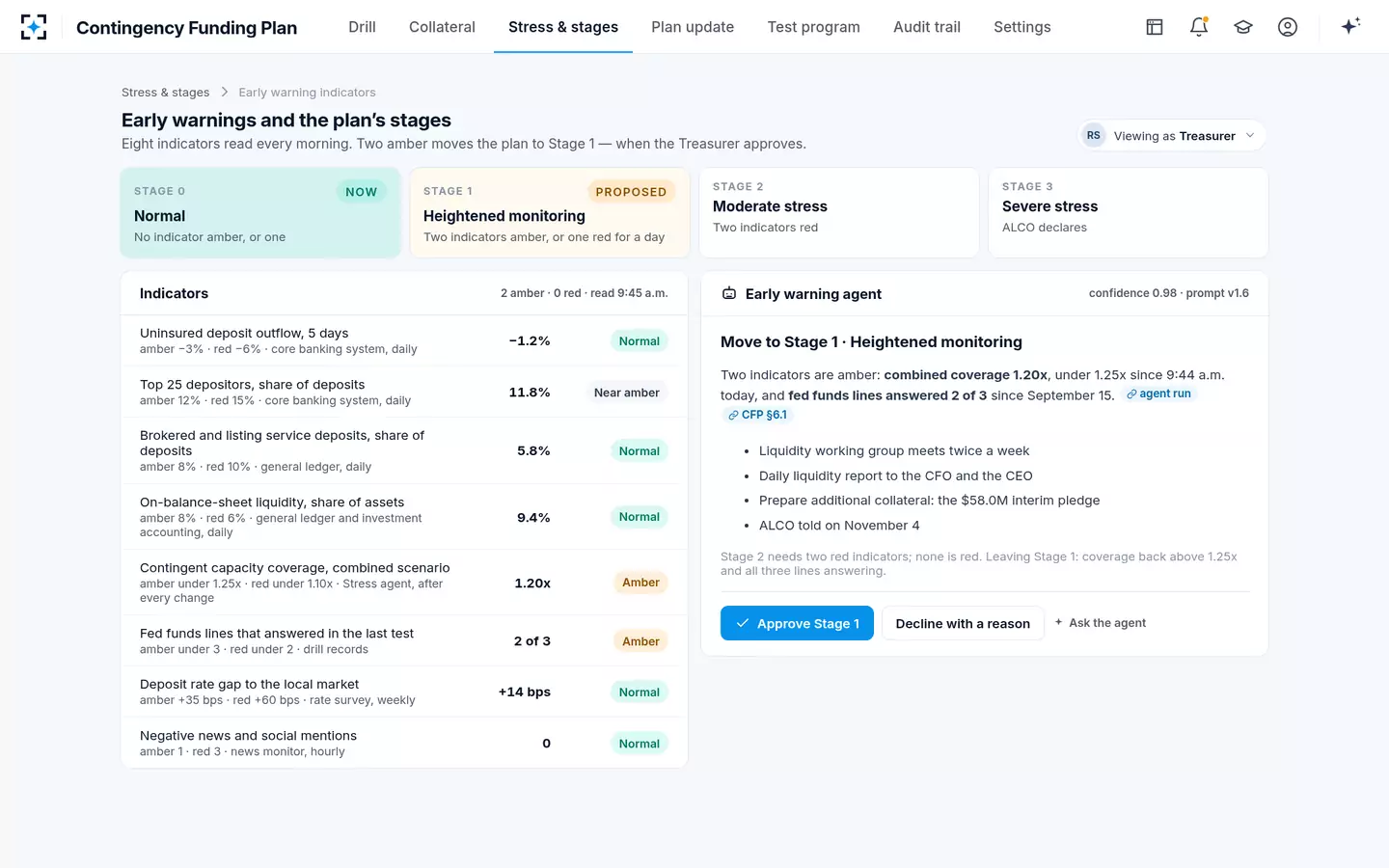
As the plan reported: Stage 0, normal
After the loan-level collateral check: Stage 1, heightened monitoring, proposed to the treasurer
How does a liquidity stress test relate to the CFP?
The stress test supplies the need and the plan supplies the answer, and each is meaningless without the other. The 2010 interagency policy statement, still the base text for U.S. banks and credit unions, makes the link explicit: "The results of stress tests should also play a key role in shaping the institution's contingency planning. As such, stress testing and contingency planning are closely intertwined" (Interagency Policy Statement on Funding and Liquidity Risk Management). In practice the link usually runs one way. Stress results shape the plan's stages and actions; the plan's capacity table is fed back into the stress test once a quarter, as a number.
That direction of travel is where the error enters. Capacity is not a constant: it changes every time a pledged loan is downgraded, goes past due, pays down or turns out to lack a document, and every time a haircut table changes. A stress test that reads last quarter's capacity measures last quarter's plan against this quarter's risk.
How an eligibility change should travel through the plan
Agent
Collateral agent recountsA rating, payment or document change makes a pledged loan fail; lendable value is recomputed with the lender’s haircut.
Never: changes a pledge or a listing
Agent
Stress agent rerunsAll three 30-day scenarios are counted again on the new capacity and compared with the board’s floor.
Never: changes an assumption or a floor
Agent
Early warning agent proposesCoverage under 1.25x turns an indicator amber; two amber indicators propose Stage 1 with the plan’s own actions.
Never: changes a stage
A person decides
Treasurer decidesApproves or declines Stage 1 with a reason, and approves any interim pledge.
A person decides
ALCO approves the planThe next plan version, with the restated capacity and stress results, goes to ALCO.
Should ineligible collateral be excluded from stress tests?
Yes, and the supervisory texts expect more than that: they expect collateral values themselves to be stressed. The FDIC's examination manual describes the practice: "Potential collateral values are also normally subjected to stress tests, because devaluations or market uncertainties could reduce the amount of contingent funding available from a pledged asset." A loan a lender would already refuse is the limiting case: its stressed value is zero, and so is its unstressed value.
At the sample bank, excluding the refused loans changed only one line, the discount window, but that line is the one the combined severe scenario leans on hardest, because the scenario assumes fed funds, brokered deposits and the repo line are gone. The bars below show the counted capacity in that scenario before and after the check.
Capacity counted in the combined severe scenario, by source
What assumptions drive CFP stress scenarios?
Two sets: assumptions about outflows and assumptions about sources. The FDIC's examination manual lists what examiners look for on the outflow side, including "Significant runoff of surge, uninsured, or volatile deposits", "Curtailment of committed borrowing lines", "Material reduction in asset values" and "Regulatory restrictions on brokered deposits or interest rates paid on deposits" (FDIC RMS Manual, section 6.1). The source side gets less attention and deserves more, because it is where a plan quietly assumes lines that will not be there.
The OCC's liquidity booklet includes a worked example of contingency funding scenarios that shows how sources should shrink as stress deepens. Unsecured lines go first, then brokered deposits as capital falls, then secured lines as collateral values fall and haircuts rise.
How the OCC's example scenarios shrink contingent sources as stress deepens
| Source | Actual | Moderate | Severe | Crisis | The OCC’s assumption |
|---|---|---|---|---|---|
| Unpledged investments | 30 | 30 | 20 | 5 | Sale or repo activity |
| Unsecured federal funds lines | 5 | 5 | 0 | 0 | Initial build-up, then inability to attract unsecured funds |
| Brokered CDs within policy and regulatory limits | 10 | 10 | 10 | 0 | PCA restriction on brokered deposits |
| FHLB and other borrowing lines | 20 | 20 | 10 | 0 | Reflect loss of collateral, increased haircuts, and elimination or freezing of lines |
| Loans available to securitize or sell | 20 | 20 | 15 | 0 | Initial funding source, then lack of secondary market acceptance |
The sample bank's scenarios follow the same logic in their own settings: fed funds lines at zero in all three, brokered deposits at half in the market-wide case and zero in the combined case, and only secured, central bank and own sources counted when both stresses hit at once. What the OCC's table cannot show, and the bank's own data can, is that a secured line can lose capacity in a calm month too, for reasons that have nothing to do with markets.
What coverage ratio should a CFP show under stress?
There is no regulatory coverage floor for a community bank's CFP scenarios; the board sets one as part of its liquidity risk tolerance, and the 2010 statement asks that stress tests "be used to ensure that current exposures are consistent with the financial institution's established liquidity risk tolerance." The liquidity coverage ratio's 100% minimum applies to larger banks under a prescribed formula and is a different measure (what the LCR is). The sample bank's board set an amber floor of 1.25x and a red floor of 1.10x on its own scenarios.
A floor only means something if the numerator is honest. At the sample bank, the plan had reported 1.56x on the combined scenario, comfortably above the floor, while 23% of the capacity counted in that scenario stood on loans the Reserve Bank would refuse. The board had been approving a margin of safety that did not exist. Once corrected, coverage sat at 1.20x, and a $58.0 million pledge of the bank's own agency securities, worth $55.1 million at the sample bank's 95% haircut, brought it back to 1.30x the same day.
Management should discuss the results of stress tests and take remedial or mitigating actions to limit the institution's exposures, build up a liquidity cushion, and adjust its liquidity profile to fit its risk tolerance.
Interagency Policy Statement on Funding and Liquidity Risk Management, 2010
Contingency Funding Plan's stress screen: three scenarios rerun against the new capacity
What happens when stress test capacity is wrong?
The bank learns it on the day it needs the capacity, which is the worst possible day. Signature Bank's plan was criticised for exactly the gap this page is about: the FDIC found that "The plan did not identify metrics that would measure the impact of stress events to liquidity and capital to ensure the institution could survive the entire stress time horizon" (FDIC, Supervision of Signature Bank), and on its last afternoon management had difficulty establishing how much it needed to borrow to fund pending wires.
Supervisors have since turned their attention to the assumptions. The Federal Reserve reported that its liquidity examinations in the second half of 2025 concentrated on firms' deposit assumptions in internal stress tests. The source side deserves the same scrutiny, and it is easier to test: whether a pledged loan is eligible can be checked, not forecast. A plan that cannot reconcile its counted capacity to the loans behind it has an error that no deposit study will find.
How often should the CFP stress test be rerun?
On a calendar, and on every change that moves capacity. The FDIC's manual sets the calendar by risk: "If liquidity risk becomes elevated, management could benefit from conducting more frequent stress testing, while large or complex institutions may also benefit from daily liquidity stress testing to inform, in part, day-to-day liquidity management." A quarterly run for ALCO is a sensible floor for the outflow side.
The source side should not wait for the quarter. A rating review, a batch of delinquencies, a missing document found in an inspection or a new haircut table each changes counted capacity, and each should trigger a rerun. In the sample bank's plan, the rerun is automatic and immediate, and the only thing that waits is the decision: the treasurer approves or declines the stage the result implies.
How many stress scenarios should a CFP have?
Enough to cover different speeds as well as different severities. The FDIC's manual expects scenarios "ranging from low- to severe-stress scenarios" and singles out one that most community bank plans lack: a run that starts late on a Friday, because "the modeling and testing of a severe stress event that begins on a Friday afternoon may expose vulnerabilities in the ability to execute a CFP (e.g., the ability to quickly monetize unencumbered collateral and execute on borrowing lines) that would not be identified in longer-duration scenarios." The sample bank's three 30-day scenarios are a reasonable core; a fourth, intraday scenario would test the hours each source needs, which is worked through in FHLB borrowing capacity in hours.
The Federal Reserve's 2026 operating principles tell its examiners not to discourage firms from counting FHLB liquidity in their internal stress tests unless law or regulation requires otherwise (Updated Statement of Supervisory Operating Principles). That makes accurate FHLB capacity more important, not less. If the stress test may count the FHLB line, the line should be counted at what the FHLB would lend against the bank's collateral in the scenario, after the haircuts and limits a deteriorating member would face.
Who approves CFP stress scenarios and their assumptions?
The board approves the risk tolerance and, usually through ALCO, the scenarios and the floor; management owns the assumptions and must be able to defend them. At the sample bank, scenarios, assumptions, floors and stage triggers are settings: an administrator proposes a change, the treasurer approves it before it applies, and the change is on the audit trail. The Stress agent never changes an assumption or a floor, and the Early warning agent proposes a stage without changing it; Stage 1 goes to the treasurer, Stages 2 and 3 need the CFO, and ALCO declares Stage 3.
Early warnings and the plan's stages: Stage 1 proposed, the treasurer decides
What the plan document should say about scenarios, stages and their tests is laid out in what a contingency funding plan must contain; the solution itself is at Contingency Funding Plan.
Questions people ask
What time horizon should CFP stress scenarios use?
The 2010 statement asks for stress tests across multiple time horizons and says a scenario's length should encompass the duration of the event modeled. Thirty days is common for core scenarios and matches the liquidity coverage ratio's horizon, but a plan should add at least one intraday or end-of-week scenario and one longer one.
Is a liquidity stress test the same as the LCR?
No. The liquidity coverage ratio is a prescribed regulatory formula for larger banks with set outflow rates and eligible assets. A bank's own stress test uses its own scenarios and assumptions, and it can count sources the LCR ignores, such as FHLB borrowing capacity.
Should FHLB capacity be haircut in a severe scenario?
Yes, if the scenario includes the bank's own deterioration. The OCC's example halves FHLB and other borrowing lines in its severe case and removes them in its crisis case, reflecting loss of collateral, higher haircuts and frozen lines.
What should happen when coverage falls below the floor?
The plan's escalation should start: in the sample bank's plan, coverage under 1.25x is an amber early warning indicator, and two amber indicators propose Stage 1, with more frequent monitoring, daily reporting to the CFO and CEO, and collateral prepared. The treasurer decides; the fix may be as simple as pledging securities the bank already holds.
Can a stress test count collateral that is eligible but not yet pledged?
Only if the plan can show how fast it could be pledged. Securities in a Fedwire account can be pledged to a Reserve Bank the same day; loans not yet in a borrower-in-custody arrangement may take weeks. Counting the second as same-day capacity repeats the error this page is about.