Discount window readiness is a bank's proven ability to borrow from its Federal Reserve Bank when it needs to: Operating Circular 10 agreements current, authorized people able to request an advance through Discount Window Direct or by phone, collateral pledged in an amount the plan needs and valued as the plan assumes, and the borrowing and repayment flowing through the bank's accounts and books without surprises. The 2023 interagency addendum asks banks that rely on the window to keep that readiness and to consider small test transactions; most banks test at least once a year. Readiness is proved by a test, not asserted in a plan, and the test that matters checks the collateral as well as the call. Botminds' Contingency Funding Plan can be piloted on a bank's own plan in 30 days: one live test borrowing, every pledged loan checked against the Reserve Bank's rules, and the plan's capacity restated from what is actually lendable.
The pilot plan and its pass marks are design targets, not results. The worked examples come from Tessaly Community Bank, a fictional $3.4 billion community bank whose sample data runs through the solution.
What a readiness test proves, and who proves it
Agent
Legal and peopleReadiness agent checks the authorization list, the resolutions on file and each requester’s Discount Window Direct access.
Never: edits the authorization list
Agent
CollateralCollateral agent re-tests every pledged loan and security against the Reserve Bank’s criteria and the plan’s haircuts.
Never: changes a pledge or a listing
A person decides
The live borrowingAnalyst prepares, CFO checks, treasurer approves, an authorized officer sends a small advance.
Agent
The money and the booksDrill agent watches the reserve account, the journal and the repayment, and times every step.
Never: moves money
Agent
The planStress agent reruns the scenarios on the corrected capacity; After-action agent drafts the findings and the plan redline.
Never: approves or closes a finding without evidence
A person decides
The decisionTreasurer approves the findings and any interim pledge; ALCO approves the new plan version.
Do regulators expect discount window testing?
They expect readiness and encourage testing. The July 2023 addendum to the interagency policy statement, issued by the Federal Reserve, FDIC, OCC and NCUA after the spring failures, says banks that use the discount window in their plans "should establish and maintain operational readiness to borrow", and adds: "Depository institutions that include the discount window as part of their contingency funding plan should also consider conducting small value transactions at regular intervals to ensure familiarity with discount window operations" (Interagency Policy Statement, with the 2023 addendum). The Reserve Banks' own set-up guidance encourages institutions "to borrow from the discount window periodically during normal times so they are familiar with the mechanics of borrowing" (Discount Window Set-up).
For credit unions the expectation is a rule. Federally insured credit unions with $250 million or more in assets must document access to a federal liquidity source, the Central Liquidity Facility or the discount window, and "must conduct advance planning and periodic testing to ensure that contingent funding sources are readily available when needed" (12 CFR 741.12(c)). The case for both came from Silicon Valley Bank.
SVBFG had limited collateral pledged to the Federal Reserve's discount window, had not conducted test transactions, and was not able to move securities collateral quickly from its custody bank or the FHLB to the discount window.
Federal Reserve, Review of the Federal Reserve's Supervision and Regulation of Silicon Valley Bank, April 28, 2023
What is a discount window test transaction, and what is the minimum?
A test transaction is a real primary credit advance, usually overnight, requested by an authorized person through the normal channel and repaid at maturity. The Federal Reserve's guide for community banks puts the floor and the norm in one sentence: "Test loans typically have a low dollar balance (minimum $1,000). While most banks test their discount window access at least annually, the appropriate frequency of testing depends on the risk and complexity of the organization" (Community Banking Connections, 2024).
The cost is negligible. Interest is charged for each day on a 365-day year, so at the 4.00% primary credit rate in force in October 2026 (H.15) a $1,000 overnight test costs 11 cents and the sample bank's $5,000,000.00 test cost $547.95. The sample bank tests larger than the minimum on purpose: an advance big enough to need the treasurer's approval exercises the bank's own approval chain, and one large enough to matter to the reserve account tests the payments and accounting steps a $1,000 loan never touches. Larger is not required; the amount is the plan's choice.
How often should you test the discount window?
At least annually, and again whenever something the test proves has changed. The FDIC's examination manual describes common practice in the same terms as the Federal Reserve's guide: "Generally, management tests contingent funding sources at least annually" (FDIC RMS Manual, section 6.1). Credit union plans must state their own test frequency. A sensible plan sets the annual live test as the floor and adds triggers: a new signer or a departure from the authorization list, a new or modified borrower-in-custody arrangement, collateral moved between the FHLB and the Reserve Bank, and any finding from the last test.
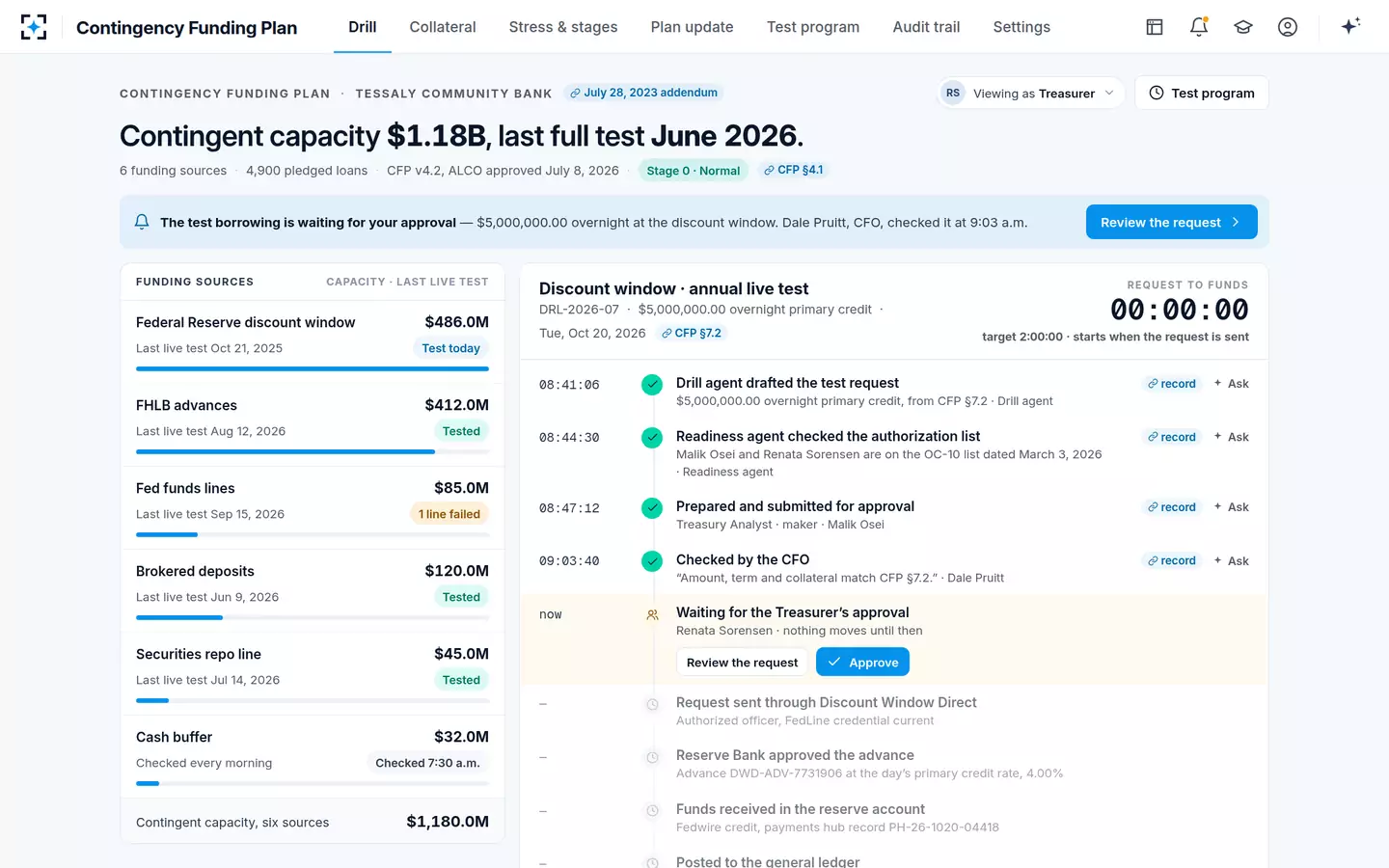
The sample bank's settings show how this looks across a whole plan: one live test a year per source, at amounts set per source ($5,000,000 at the discount window, $10,000,000 at the FHLB, $2,000,000 on each fed funds line, $1,000,000 of brokered deposits and $5,000,000 on the repo line), a full test of the plan each June, the stress scenarios every quarter, and the cash buffer checked every morning.
Contingency Funding Plan's home screen: six sources, each with its last live test
How do you test discount window readiness beyond the call itself?
A readiness test should prove six things, and a test borrowing on its own proves only two of them. The other four are where the 2023 failures happened: collateral that was not where the plan said, could not be moved in time, or would not be accepted.
Six things a discount window readiness test should prove
- The agreements are current
Letter of Agreement, resolutions, Official Authorization List and certificate match the bank’s name, board and officers today.
- The people can act
At least two authorized people can request an advance, each with working Discount Window Direct access, and know to ask for early availability if funds are needed before the Fedwire close.
- The collateral is worth what the plan says
The plan’s discount window line reconciles to the Reserve Bank’s own collateral value, and every pledged loan passes the acceptance criteria.
- Collateral can be moved
Securities can be pledged the same day; excess FHLB collateral has a tested route to the Reserve Bank.
- The money flows
The advance is credited, posted to the general ledger and repaid with the right interest, each with its record.
- The plan learns
Findings get an owner and a date and change the plan, its capacity table and its stress results.
What are common discount window test failures?
The common failures are dull, which is why they survive. They sit between departments: the authorization list belongs to the corporate secretary, credentials to the FedLine administrator, collateral to loan operations, the plan to treasury. A test that only treasury runs finds only treasury's problems.
Where readiness tests fail, and the check that catches each
| Failure | How it shows up | The check that catches it |
|---|---|---|
| Stale authorization list | The person at the desk is not on the list, or the list still names someone who left | Compare the list to the HR roster and FedLine profiles before every test |
| Expired or missing credential | The requester cannot sign in to Discount Window Direct | Credential expiry dates tracked per authorized person |
| Collateral worth less than the plan says | Downgraded, past due or undocumented loans still listed | Every pledged loan re-tested, not a sample |
| Collateral in the wrong place | Eligible assets sit at the FHLB or a custodian and cannot move in time | A rehearsed same-day securities pledge and a written route for loan collateral |
| Funds too late to help | The advance is credited at the Fedwire close, after the wires it was meant to cover | Ask for early availability in the test, and time it |
| Findings that change nothing | The issue is noted in ALCO minutes and fixed months later, while the plan keeps counting the capacity | Each finding with an owner, a date and a redline of the plan |
Who should be involved in a discount window test?
More people than usually are. The treasurer owns the test and approves the money step; the treasury analyst prepares it; the CFO, or whoever the plan names, checks it. The collateral manager owns the pledge and the eligibility evidence; the payments or wire room sees the credit and the repayment; accounting books both; whoever administers FedLine owns the credentials; and the corporate secretary owns the resolutions. Internal audit should read the evidence afterwards rather than take part, so its review stays independent. At the sample bank, three named people sign each test borrowing and none approves an item they prepared or checked.
A 30-day pilot of Contingency Funding Plan on your own plan
A pilot answers the buyer's question honestly: on your plan, your pledge listings and your next live test, what does the solution find that you did not know, and is that worth the change? The plan below is a target schedule for a community bank with one Reserve Bank and one FHLB relationship. A bank with more lenders, or a loan collateral book spread across several systems, should expect longer.
The pilot, week by week (target schedule)
- Week 1 · plan, listings, feedsinputs
- Week 2 · every loan checkedfix list
- Week 3 · live testone advance
- Week 4 · stress, redline, ALCO packagedecision
What a bank brings is mostly what it already has: the contingency funding plan with its sources, scenarios, stages and test rules; the pledge listings for the Reserve Bank and the FHLB from the collateral management system; risk ratings from the loan subledger and payment status from the core; read access to loan files and the Operating Circular 10 agreements in document imaging; and the Fedwire activity and general ledger journals that show the test borrowing land. Deposit, rate and news feeds for the early warning indicators can come later.
The pilot's pass marks: what Contingency Funding Plan has to show by day 30
Every pledged loan checked
100% of pledged loans and securities tested against each lender’s rules and haircut, with the failures listed
Every failure explained
Each failing loan has a reason, the record behind it, a fix, an owner and a due date
One live test, fully evidenced
Request, authorizations, approvals, confirmation, credit, journal and repayment, each timestamped with its record
Capacity restated
The plan’s capacity table and stress coverage recomputed from what the lenders would accept
Findings into the plan
A redline of the next plan version with owners and dates, for the treasurer and ALCO to approve
Where the pilot will not help, and what it cannot promise
The solution is built for banks whose contingent capacity rests on pledged loans, especially commercial loans under borrower-in-custody, and on several lenders. A bank that pledges only Treasury and agency securities at one Reserve Bank can see their value in Discount Window Direct and will gain less from a loan-level check; its readiness test is mostly the call and the paperwork. A bank whose plan is already rebuilt loan by loan every month will find fewer surprises, and should judge the pilot on time saved and evidence produced rather than on capacity found.
No test makes funding certain, and the FDIC says so: "establishing lines in advance and testing the lines does not guarantee funding sources will be available within the same time frames or on the same terms during stress events" (FDIC RMS Manual, section 6.1). What a test does is remove the failures that are the bank's own: the wrong signer, the missing document, the collateral in the wrong place, the finding that never reached the plan. At the sample bank those were worth $212.0 million of the $486.0 million the plan counted at the window. Why banks long avoided the test that finds them is the subject of discount window stigma; the evidence a test should leave is set out in discount window borrowing procedures.
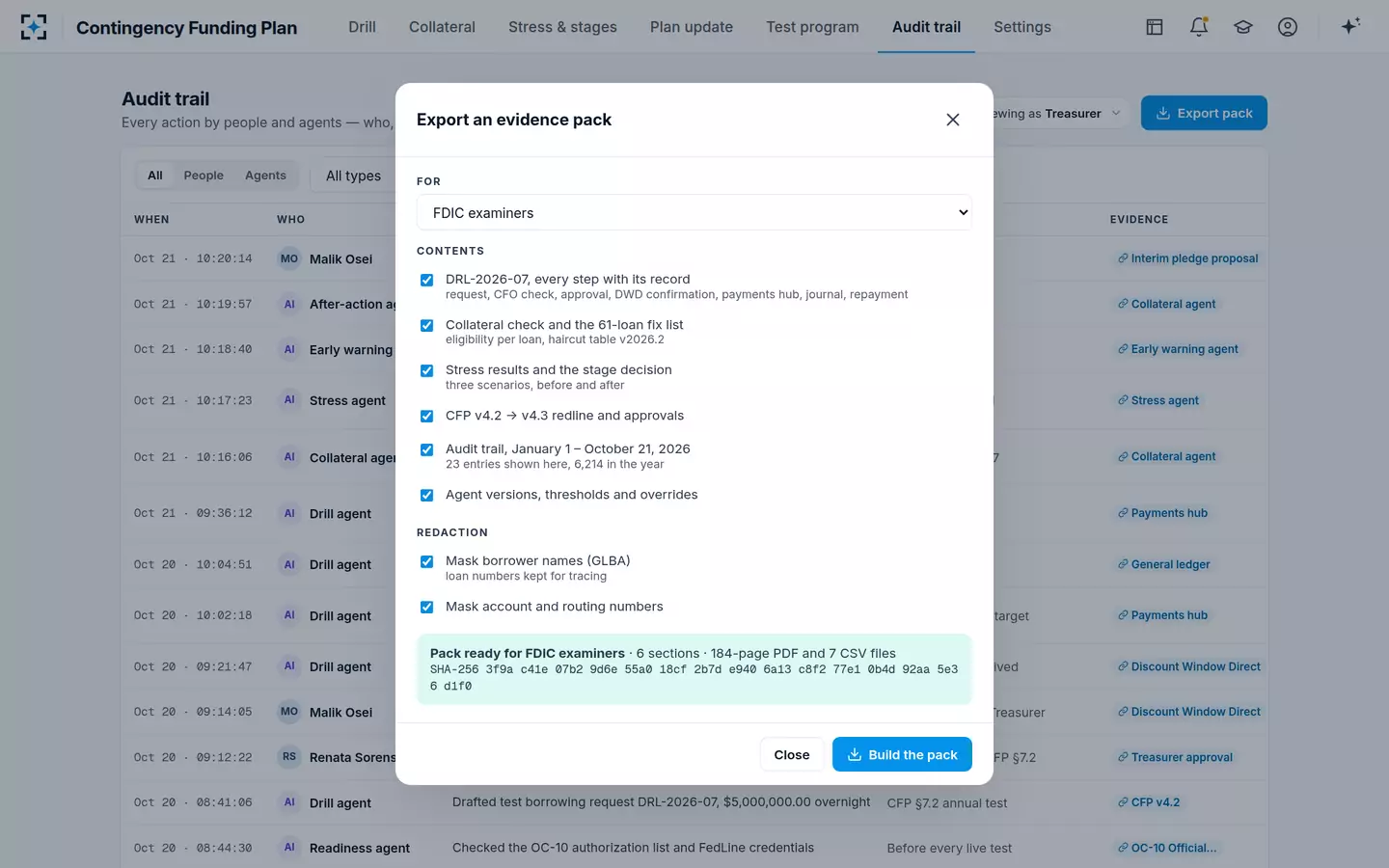
The examiner's file the test leaves behind
Questions people ask
Does a discount window test signal that the bank is in trouble?
The agencies' 2023 addendum treats small, regular tests as normal practice for banks that rely on the window. Individual advances are published only with a delay of about two years, and the 2026 policy debate has moved toward normalizing routine testing.
Can a test be done by phone instead of Discount Window Direct?
Yes. An authorized person can still call the Reserve Bank to request an advance or make a payment. Testing both channels over time is sensible, because the phone is the fallback if FedLine is unavailable.
Should the test advance be overnight or term?
Overnight is usual and enough to prove the mechanics. Primary credit can run up to 90 days and be prepaid at any time, so a bank whose plan relies on term borrowing can test a short term advance and repay it early.
Do we need to test the FHLB line too?
Yes, if the plan relies on it. The 2023 addendum asks banks to test any contingency borrowing line, and the sample bank tests every source once a year, the FHLB with a $10,000,000 advance.
What should the test report to ALCO?
The timings against the plan's targets, the collateral value the Reserve Bank showed against the plan's figure, every finding with an owner and a date, and what changed in the plan. A one-line "test completed successfully" tells ALCO nothing it can act on.