Borrower in custody (BIC) loans are loans a bank pledges as collateral to its Federal Reserve Bank under the borrower-in-custody program, which lets the bank keep the notes and files on its own premises or with an approved custodian, labelled as pledged, while the Reserve Bank holds a perfected security interest and values the loans from a collateral schedule the bank sends at least monthly. Most community banks that pledge loans to the discount window do it this way, and the program makes those loans the largest source in many contingency funding plans. The catch is that the Reserve Bank lends only against loans that remain eligible, and it is the bank's job to notice when one stops being eligible. A loan downgraded at a quarterly review can stay on the listing, and in the plan's capacity, for weeks. Botminds' Contingency Funding Plan checks every pledged loan against the Reserve Bank's criteria whenever its rating, payment status or documents change; this case shows one loan's journey through that gap, day by day.
The loan is an illustration built on Tessaly Community Bank, a fictional $3.4 billion community bank whose sample data runs through the solution: its dates, rules and haircut are the sample bank's, and the loan is one of the nine pledged loans its September 30 review downgraded. Its balance is ours.
One borrower-in-custody loan: 37 days from downgrade to withdrawal
- Counted, though ineligible20 days
- Withdrawal pending17 days
- Counted, though ineligible, until the year-end refresh92 days
What is the borrower in custody program?
It is the Reserve Banks' way of taking loans as collateral without taking the paper. "The BIC Program allows depository institutions to pledge their loans to Reserve Banks while maintaining possession of the loan documentation either on their own premises or on the premises of an approved third-party custodian by establishing a BIC arrangement" (Federal Reserve, Pledging Loans). Institutions eligible for primary credit generally qualify; others may, at their Reserve Bank's discretion.
In exchange for keeping the files, the bank takes on the custody duties. Pledged notes must be stored securely, and "All pledged loans must be prominently identified as pledged to the Reserve Bank and subject exclusively to the Reserve Bank's written instructions", both on the files or in the electronic vault and in the loan accounting system. The bank sends a collateral schedule listing each pledged loan with its data, at least monthly, and certifies its compliance each year with an audit behind the certificate.
How long does BIC approval take?
Weeks, for planning purposes. The Federal Reserve's 2024 guide for community banks put it directly: "The initial BIC application and approval process may take up to 30 days before completion. Although the process often occurs more quickly, a bank should consider this time frame in contingency funding plan scenarios when urgency may be a factor" (Community Banking Connections, 2024). Delays come from documents and liens: the Reserve Bank must be able to perfect a senior security interest, so a competing blanket lien has to be resolved first.
The process became lighter on September 8, 2026. Most institutions no longer need a pre-enrollment inspection, forms are standard across the Reserve Banks, and collateral schedules can be uploaded in Discount Window Direct (Federal Reserve, BIC program improvements). A first schedule must follow within 12 months of the approval letter. None of this helps a bank that waits for a run to apply, which is why a plan should count loan capacity only once the arrangement is approved and the loans are pledged.
Day 0: the downgrade that changes nothing on the listing
On September 30, 2026, the sample bank's quarterly risk rating review moved nine pledged commercial real estate loans to special mention. Take one of them: an owner-occupied industrial loan with $4.3 million of principal, pledged under borrower-in-custody, current on its payments, its file complete. At the bank's own haircut for pass-rated commercial real estate, 66.6%, it had been carrying $2.86 million of lendable value in the plan's discount window line.
The downgrade ended that. When a Reserve Bank approves a borrower-in-custody arrangement it reads the bank's rating scale and sorts each grade into one of three categories: "Reserve Bank categories are 'Minimal' risk (typically equivalent to investment grade), 'Normal' risk (typically equivalent to below investment grade but still acceptable), or 'Excessive' risk (not acceptable)." Special mention, substandard, doubtful and loss are outside what the Reserve Banks accept. The loan was still performing; it was simply no longer collateral. Nothing in the collateral system, the listing or the plan changed that day, because the rating lives in the loan subledger and the pledge lives somewhere else.
What is a BIC pledge listing, and what happens when a loan on it is downgraded?
The listing, which the Reserve Banks call the collateral schedule, is a file with one row per pledged loan: its number, obligor, balances, rate, the bank's internal risk rating, origination and maturity dates, payment due dates, location and call report code, among other fields. The Reserve Bank values each loan from that data. Its instructions for the file are blunt: "Files should only contain loans that meet all applicable eligibility requirements for the pledge program" (Pledging Loans).
So a downgraded loan is the bank's to remove. If it reaches the next schedule with its new rating, the Reserve Bank's valuation will give it nothing; if it reaches the schedule with a stale rating, the error is the bank's and an inspection may find it. Either way the plan should stop counting it the day it fails. The same applies to delinquency: a commercial loan more than 30 days past due, or a consumer or residential loan more than 60, falls outside the published criteria, and so does a loan that matures within 30 days of the schedule date.
Days 1 to 20: counted, and worth nothing
For twenty days the loan sat in the plan's capacity table at $2.86 million. It was not alone. The sample bank's eight other downgraded loans carried $26.0 million more between them, and 52 further pledged loans had been failing for longer on documents and delinquency. Together they put $212.0 million of lendable value into a discount window line the Reserve Bank would have valued at $274.0 million, not $486.0 million.
What the plan was counting while nobody looked
The illustrative loan
$2.86M
lendable value counted every day for 20 days after it stopped being acceptable collateral
All nine loans downgraded on September 30
$28.9M
counted in the plan until the loan-level check on October 20
All 61 failing pledged loans
$212.0M
18% of the plan’s $1,180.0 million of contingent capacity; combined stress coverage reported as 1.56x was 1.20x, under the board’s 1.25x floor
None of this was visible from the treasurer's chair. The plan's capacity table came from the collateral report's totals, which still listed the loans; the stress scenarios read the capacity table; the board's coverage floor was measured against the scenarios. Every number downstream of the listing was arithmetically right and substantively wrong.
Day 20: the check that finds it
On October 20, as part of the bank's annual discount window test, the solution's Collateral agent re-tested every pledged loan: 1,640 under borrower-in-custody, 3,260 listed with the FHLB, and 43 securities positions. It read each loan's rating in the loan subledger, its payment status in the core banking system and its documents in imaging, applied the bank's haircut table, and failed 61 loans with a reason for each. The illustrative loan failed on one line: rating 5, special mention, since the September 30 review.
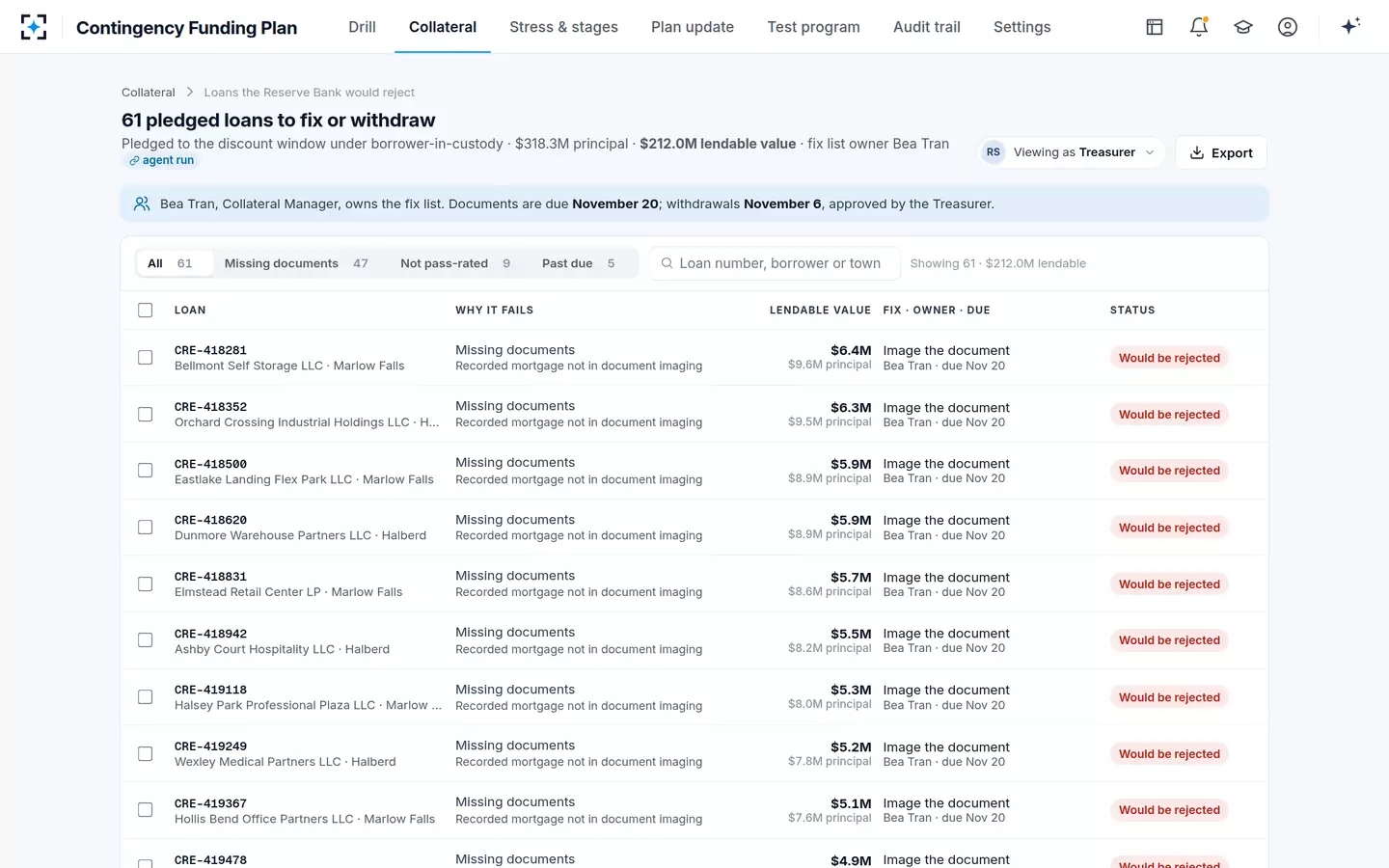
A downgrade has no cure the collateral desk can apply, so the fix for this loan was withdrawal. The fix list assigned it to the collateral manager with a withdrawal date of November 6. Working capacity dropped the same day: the discount window line to $274.0 million, contingent capacity to $968.0 million, combined stress coverage to 1.20x, and the early warning indicator on coverage turned amber.
The fix list in Contingency Funding Plan: the downgraded loans are filtered as 'not pass-rated'
How quickly must ineligible loans be removed?
The Reserve Banks' public pages do not set a number of days. They require collateral schedules to be current as Operating Circular 10 prescribes, submitted at least monthly by the agreed due date, and to contain only eligible loans, and they warn that institutions that fail the reporting requirements "may be subject to penalties, which could include reduced collateral value or termination of their BIC arrangement." In practice, a downgraded loan should leave the next schedule, and the bank's own procedures should say who removes it and by when.
The plan should be stricter than the schedule. A schedule can wait for its due date; the plan's capacity cannot, because the plan is what the treasurer would act on tomorrow. At the sample bank the working capacity changed the day the check ran, the plan ALCO receives changed at its next meeting, and the listing changed when the treasurer approved the withdrawal: three clocks, each with an owner.
Days 21 to 37: from the finding to a clean listing
Agent
Stress agent rerunsAll three scenarios on the lower capacity, the same day.
Never: changes an assumption or a floor
Agent
After-action agent draftsThe plan update: capacity, scenario results, the test log and an action register.
Never: approves
A person decides
Collateral manager prepares the withdrawalRemoves the loan from the next collateral schedule, with the reason and the record.
A person decides
Treasurer approvesThe withdrawal by November 6, and the plan update before ALCO.
A person decides
ALCO adopts the new planOn November 4, with the restated capacity and coverage.
How are BIC loans monitored? Audits, inspections and the bank's own checks
By three parties, at three speeds. The Reserve Bank monitors through the monthly schedule and periodic inspections; the bank's auditor certifies compliance once a year; and the bank's own staff are supposed to keep the pledge clean in between. Since September 8, 2026 the Reserve Banks have narrowed their inspections to three things and made most of them remote and risk-based.
What a Reserve Bank inspection of borrower-in-custody loans now focuses on
- Data quality validation
"accuracy of an institution’s collateral schedules"
- Acceptance criteria satisfaction
"verification that pledged collateral meets the eligibility requirements"
- Internal controls confirmation
"confirmation that pledged collateral is identified as pledged to the Reserve Bank and subject to the Reserve Bank’s control under the UCC"
The first two items are exactly what a loan-level check produces every day. A bank that can show an inspector the check, the failures it found, and the dates each was fixed or withdrawn has answered the inspection before it starts. A bank that cannot will learn its error rate from the inspector's sample, which is the most expensive way to find it.
For the illustrative loan, the counterfactual is the second lane of the timeline above: a bank that rebuilds capacity from totals each quarter would have counted the loan until the year-end refresh, 92 days or more, and every stress result, stage and ALCO conversation in between would have rested on it. How the whole collateral check works is in discount window collateral eligibility, the collateral manager's seat in pledged loans and the collateral desk, and the solution at Contingency Funding Plan.
Questions people ask
Do BIC notes have to be kept separate from other loan files?
Not necessarily. The Federal Reserve Bank of Minneapolis's borrower-in-custody booklet (June 2026) "encourages, but does not require, segregating" pledged notes; where they are not segregated, the bank needs an electronic pledged flag in its loan system or a current list of pledged notes, and signage where the notes are stored saying how to identify them.
Can a bank that is not eligible for primary credit use BIC?
Possibly. The Reserve Banks say institutions eligible for primary credit generally qualify, and one that is not "may qualify for a BIC arrangement at the discretion of its Reserve Bank", with additional criteria and requirements.
When can a Reserve Bank end a BIC arrangement?
At any time. The Reserve Banks list examples including an institution that pledges no loans within the first 12 months or for any consecutive 12 months, material noncompliance with the requirements, and an institution that does not survive a merger.
Can BIC loans be imaged rather than kept on paper?
Yes, subject to state law and controls. Notes signed on paper, imaged and then destroyed can be pledged if the bank's policies establish that the original was destroyed and that the imaged copy is the true and correct copy, and notes signed digitally can be pledged from an electronic vault.
Does the Reserve Bank tell us when a pledged loan becomes ineligible?
Not in advance. The Reserve Bank values what the bank's schedule reports, and a loan reported with a disqualifying rating or past its delinquency limit simply receives no value. Finding the loan, and taking it off the listing and out of the plan, is the bank's job.