LP questions are the questions limited partners send a private fund between its reports: how much was our distribution, what is our capital account balance, how much of our commitment is unfunded, has our wire arrived, when will the tax documents come. Almost every one is answered by one record of that investor, such as a capital account statement, a distribution or capital call notice or a cash receipt, and one clause, in the limited partnership agreement or the investor's side letter. The hard part is not the answer but the lookup: the record sits with the fund administrator, the clause in a document library, and the right to see either depends on who is asking. Botminds' Investor Relations AI is built on that map. It checks the sender's entitlement, reads only that LP's own records, finds the governing clause and drafts a cited reply for a person to approve, sending on its own only from wording an IR manager and compliance approved.
The examples come from the solution's sample data: a fictional manager, Quillfield Capital, and a fictional Swiss pension fund, Pensionskasse Aaretal, with a EUR 40,000,000 commitment to Quillfield European Infrastructure Fund IV.
Twelve LP questions: the record that answers each, the clause that governs it, and who may send it
How much was our distribution?
RecordDistribution notice; the quarter's capital account (income and return of capital)
ClauseDistribution clause of the LPA
Who may sendTemplate once approved
What is our capital account balance?
RecordLatest capital account statement, and its valuation date
ClauseReporting clause: what is sent, and when
Who may sendTemplate once approved
How much of our commitment is unfunded?
RecordCommitment less contributions to date, from the capital account
ClauseCapital contribution and recallable-distribution terms
Who may sendTemplate once approved
Has our capital call wire arrived?
RecordThe administrator's cash receipt against the call notice
ClauseCapital call notice terms; late-payment terms
Who may sendTemplate once approved
When will our tax documents come?
RecordThe fund-wide notice of the date already given
ClauseTax information clause; any side letter on timing
Who may sendTemplate once approved
Why was our K-1 amended?
RecordThe K-1 notice and the investor's own K-1
ClauseTax clause; any side-letter tax terms
Who may sendWave, after approval
When is the quarterly report out?
RecordThe fund's reporting calendar
ClauseReporting clause (for example, within 60 days of quarter-end)
Who may sendWave, after approval
What fees and carry were charged to us?
RecordAllocations on the capital account
ClauseManagement fee and distribution waterfall clauses
Who may sendA person approves
What does our side letter give us?
RecordThe investor's side letter, clause by clause
ClauseSide letter; the MFN election
Who may sendA person approves
Can our consultant see our account?
RecordAuthorized contacts and signatory list
ClauseConfidentiality clause; the investor's written instruction
Who may sendA person approves
When is the next capital call, and what will we earn?
RecordNone: it asks for a forecast
ClauseNone; promises of performance are marketing
Who may sendA person, with approved wording
Please send future distributions to our new bank
RecordNone: it is an instruction, not a question
ClauseNotice and payment instruction terms
Who may sendNever answered by agents: call-back and two people
What questions do LPs ask most?
LPs ask most about money they have received, money they have sent and documents they are waiting for. Distribution amounts, capital account balances, unfunded commitments, wire receipts and tax documents fill an IR inbox; the volume spikes after each quarter's statements, each distribution and capital call, and every tax season. No regulator or independent study publishes how many questions a fund receives or how they split by topic, so the only reliable count is a fund's own: export a quarter of the IR mailbox and the portal messages, and sort each by the record it needed.
The sample night in the solution shows the shape. Between midnight and 09:05 on a Monday, 642 questions arrived in 11 languages, up 38% on a normal Monday because Fund IV's third-quarter distribution notices and capital account statements had just gone out; distribution and tax-date questions were 31% of the total. That is sample data, but it is the pattern to look for in your own export: the questions follow the documents you send.
Where each LP answer lives: one record and one clause
Every routine LP answer has two halves: a number or a date about that investor, and the term that makes it so. "Your third-quarter distribution was EUR 1,284,500" is the record; "paid under the agreement's distribution clause, as current income and a return of capital" is the clause. A reply with only the first half invites the next question, and a reply with only the second answers nobody.
The two halves fail differently. The record fails by belonging to someone else: the wrong LP's capital account, last quarter's statement, a figure in the wrong currency format. The clause fails by being the wrong document: the agreement says one thing and the investor's side letter another. That is why the map above names both, and why the dangerous questions are the ones in its last rows, where there is no record to read at all.
Where is an LP's capital account figure held?
With the fund administrator. The administrator keeps each partner's capital account: commitment, contributions, distributions, allocations of income, expenses and fees, and the resulting balance, and sends a capital account statement each quarter. The figure an LP quotes back, though, is usually from a document: the last statement it received, with its own valuation date. In the sample, Pensionskasse Aaretal's third-quarter statement showed EUR 27,600,000 contributed, 69% of its EUR 40,000,000 commitment, distributions since inception of EUR 4,912,300 and a net asset value of EUR 31,846,900 at 30 June 2026.
The trap is the date. A third-quarter statement that carries a June valuation is normal for funds that value a quarter in arrears, and an answer that quotes it without the date tells the LP something untrue about today. One figure on a capital account statement, traced from the notice to the reply, follows the number through every hop.
One LP question, with the record and the clause it needs side by side
When will my K-1 arrive? The agreement sets the date
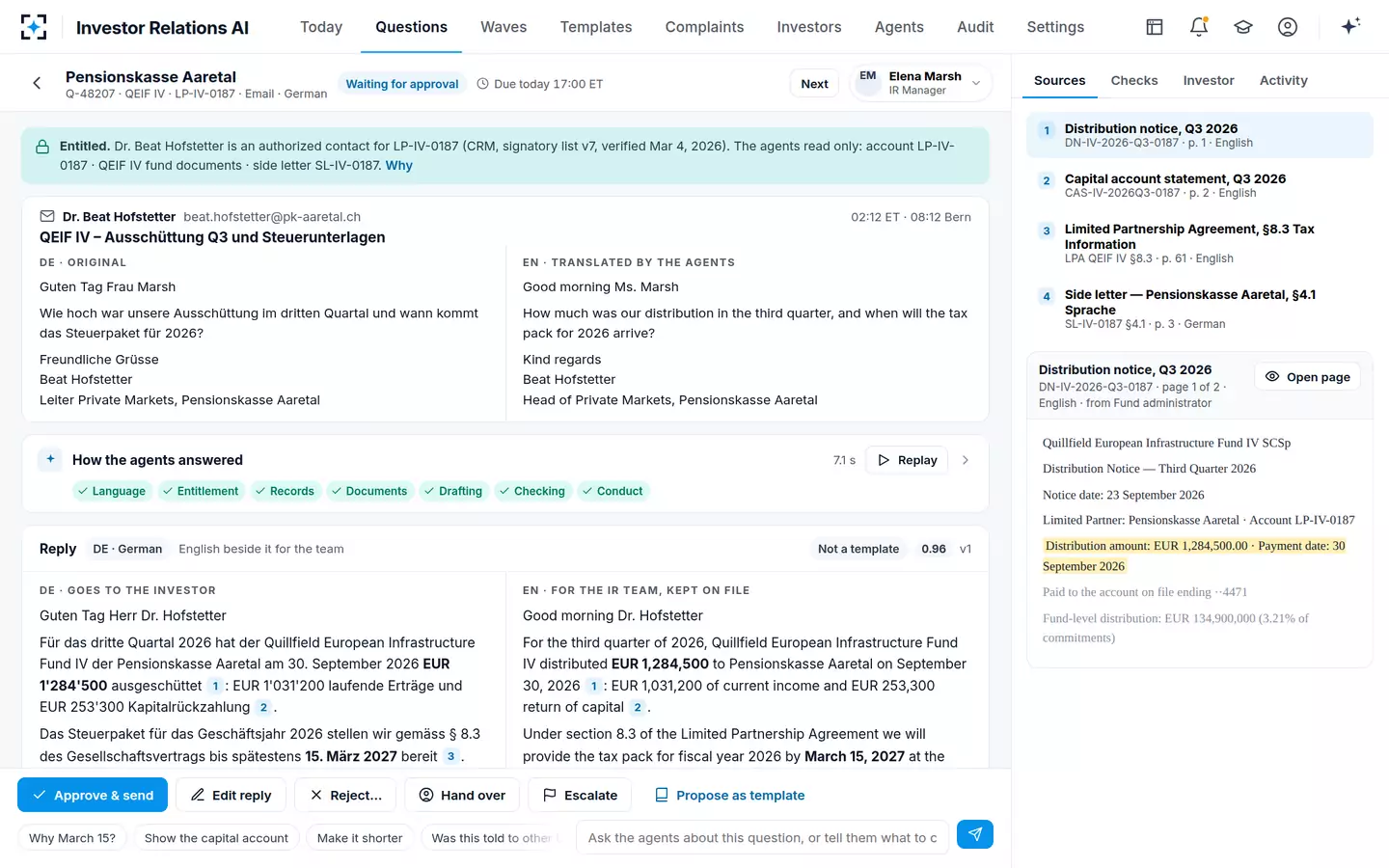
The fund's agreement sets the date the manager has promised, and the tax law sets the outer limit. In the sample, section 8.3 of the Fund IV agreement promises tax information to each partner "no later than March 15 of each year", so the answer to "when will the 2026 tax documents come?" is 15 March 2027, cited to page 61 of the agreement. The side letter was read too: it asks for correspondence in German and does not move the date. Where that side letter came from, and the booklet that set up the account, is covered in subscription documents in private equity.
The question becomes hard when the answer depends on other funds' K-1s, as it does for a fund of funds, or when an amended K-1 has already gone out. Both are covered elsewhere: when K-1s are due to recipients, and what an investor does with an amended K-1. For the IR desk the rule is simpler: quote the date the fund has already given every partner, never a better one.
Has my wire been received? Cash receipts, and the instruction that is not a question
A wire question is answered by the administrator's cash receipt matched to the capital call notice: amount, value date, and whether it settled the call in full. It is one of the safest questions to answer from approved wording, because the record is unambiguous. In the sample audit trail, a wire-receipt question was sent from an approved template at a confidence of 0.97, citing the cash receipt it relied on.
The neighbouring message is the most dangerous one in the inbox: an LP, or someone pretending to be one, asking to change where distributions go. It is not a question and must never be answered as one. In the sample, an email from a domain that swapped a capital I for the letter l asked, urgently, for distributions to go to a new bank; it was held before any account was read, and the change waits for a call to the number on file and a second person. The FBI's Internet Crime Complaint Center counted $3.05 billion of reported business email compromise losses in 2025 (IC3 2025 Internet Crime Report), and a transfer agent's own case shows how it starts: in a 2024 settled order, the SEC found that an intruder had taken over an existing email thread with an issuer client, posed as its employee and drained client funds, part of losses of more than $6.6 million (SEC, Equiniti Trust Co., 20 August 2024). The same controls protect capital calls going the other way: capital call wire fraud, tested with planted fake notices.
What does my side letter entitle me to?
Only the side letter can say, and the honest answer quotes it. Side letters change reporting, language, fees, transfer rights and confidentiality for one investor, and a most-favoured-nation clause may let an LP elect terms given to others. A reply that promises an LP something its side letter does not give, or forgets something it does, is the quiet failure IR teams fear most, because nobody notices until the LP does.
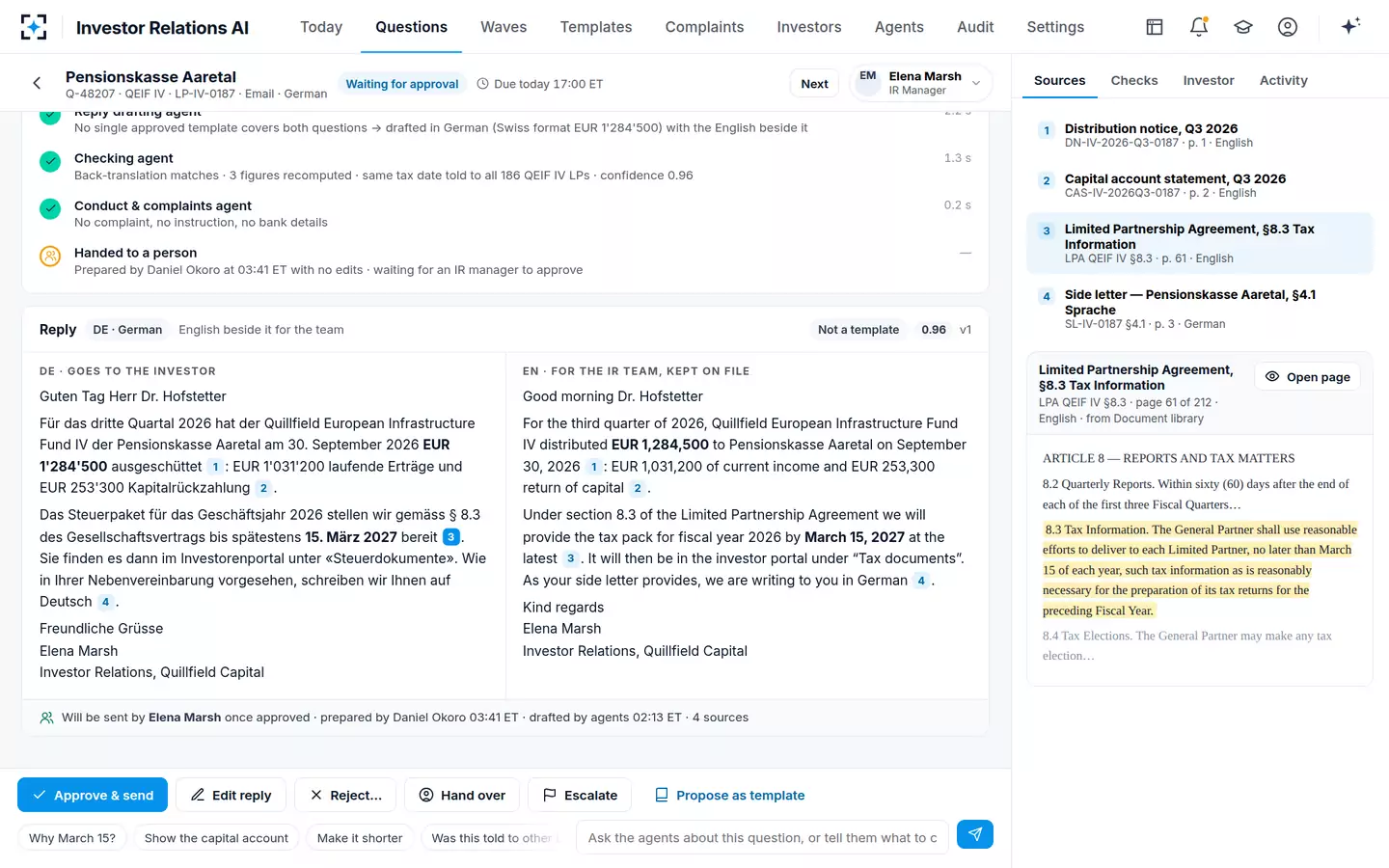
That is why side-letter requests and fee negotiations sit on the solution's never-automatic list, and why its Checking agent reads every clause of the asker's side letter before any reply, routine or not. In the sample, all 14 clauses of Pensionskasse Aaretal's side letter were read; one, section 4.1, asks for German correspondence, so the reply went out in German with the English kept on file. In the US, the SEC's 2023 rule restricting preferential treatment was vacated with the rest of its private fund adviser rules in June 2024, so what an LP is owed rests on the agreement and the side letters themselves; private equity reporting requirements after the vacatur sets out what remains.
Who may an LP's adviser ask on its behalf?
Whoever the LP has authorised, for the scope it authorised, and nobody else. Pension funds and endowments often have consultants, custodians and several internal staff who all write in; each should appear on the investor's authorized-contact list with what they may see. The check has to come before any record is opened, not after a draft exists.
In the sample, a contact authorised to receive one fund's reports asked about a different fund's account and was held with no records read. The rule that sits behind this in the US is the general anti-fraud rule for pooled vehicles, which makes it fraudulent for an adviser to make an untrue or misleading statement of material fact to any investor or prospective investor (17 CFR 275.206(4)-8); the data-protection side, for funds and transfer agents covered by Regulation S-P, is in the Regulation S-P amendments and who may see investor data.
Must every LP be told the same thing? Consistency without Regulation FD
Not by Regulation FD, which does not reach private funds. The regulation covers issuers with securities registered under Section 12 or reporting under Section 15(d); it names closed-end funds as included and leaves every other kind of investment company out (17 CFR 243.101(b)). A listed company's investor relations team works under it; a private fund's IR team does not, and neither does a mutual fund's. Regulation FD for public companies is explained in its own guide.
Private funds still have every reason to tell LPs the same thing. Telling one LP an earlier tax date than the rest, or a figure the others were not given, can breach the agreement's most-favoured-nation and reporting terms and, if the statement is untrue or misleading, the anti-fraud rule. In the sample, before the Aaretal reply went to a person, the agents confirmed that all 186 Fund IV LPs had been given the same 15 March date in the fund-wide notice of 1 October.
Where the hours go on one LP reply
Most of the time on an LP reply goes to looking up, writing and approving, not to knowing the answer. The solution's own estimate for one translated, two-part reply that no approved wording covers puts the total at about eight hours by hand and about an hour and a half with the agents, most of what is left being a person reading and approving.
One translated, two-part LP reply: where eight hours go by hand, and where 1.4 go with agents
By hand · 8.0 h
- Sender check 0.5 h · 6%
- Looking up records and clauses 1.5 h · 19%
- Writing and translating 3 h · 37%
- Rechecking 1 h · 13%
- Approval and filing 2 h · 25%
With the agents · 1.4 h
- Sender check 0.1 h · 7%
- Lookups 0.1 h · 7%
- Writing and translating 0.5 h · 36%
- Rechecking 0.2 h · 14%
- Approval and filing 0.5 h · 36%
The estimate matters less than the shape. Agents remove the lookups and most of the writing; they do not remove the approval, and on a reply that no template covers they should not. Where approved wording does exist, the solution sends it without a person, which is how 418 of the 642 sample questions were answered overnight. Researchers have measured the same pattern elsewhere: in a peer-reviewed study of more than 5,000 customer-support agents, AI assistance raised issues resolved per hour by 15% on average, with the gains concentrated among the least experienced staff (Brynjolfsson, Li and Raymond, Quarterly Journal of Economics, 2025).
How Investor Relations AI answers LP questions from the record and the clause
The agents follow the map. The Entitlement agent decides what may be read; the Investor records agent reads only that LP's notices, statements and receipts; the Fund documents agent finds the clause in its original language with its page; the Reply drafting agent writes in the LP's language with the English beside it; the Checking agent back-translates, recomputes every figure, reads the side letter and compares with what other LPs were told. Every figure carries a numbered citation that opens its page.
A citation in the reply opens the clause it rests on
Firms are moving this way carefully. In the Bank of England and FCA's 2026 survey of 196 UK financial firms, about one in six already used agents to automate customer communications, and about a third would once planned deployments were counted (16% and 34%; Bank of England and FCA, 2026). Customer communication is one of the first places firms let agents act, which is why the controls on what they may send matter more than the drafting. The checks below are the ones to insist on, by hand or by agent.
Six checks before any LP answer leaves the building
- Is the sender entitled to this account and this topic?
Against the authorized-contact and signatory list, before any record is opened.
- Does every figure come from this LP's own record, with its date?
Notice, statement or receipt, cited to the page; valuation dates stated.
- Which clause governs, and does the side letter change it?
Read the agreement and the side letter before writing, not after.
- Were other LPs told the same thing?
Same date, same figure basis, no LP told something earlier or better.
- Is it really a question?
Complaints, payment instructions, forecasts, legal threats and vulnerability go to a named person.
- Is it right in the LP's language and number format?
Back-translate and check separators: EUR 1'284'500 in Swiss German is EUR 1,284,500 in English.
The same map runs in reverse for documents a fund publishes. An LP who has just been sent a statement asks what it means for them, and a portal that only holds the document cannot answer; investor portal software for private equity, compared with answering the question, makes that case. For letters to investors rather than answers, Botminds' AI use cases for investor relations guide covers the quarterly letter. To see LP questions answered from the record and the clause, start from Investor Relations AI.
Questions people ask
What do LPs ask in due diligence, as opposed to after investing?
Before investing, LPs ask about strategy, team, track record, terms and operations, usually in a due diligence questionnaire. After investing, the questions turn to their own account: distributions, balances, calls, tax documents and side-letter terms. This guide covers the second kind, which arrive all year and are answered from each LP's own records.
Can an LP ask for another LP's information?
An LP may be entitled to fund-level information under the agreement, but never to another LP's account. A request that reaches another investor's figures should be held before any record is read and go to a person.
How quickly should a fund answer an LP question?
No US rule sets a deadline for a private fund's answers; the agreement and the firm's own service levels do. The sample solution uses one business day for routine questions and two for sensitive ones. In the UK, a question that carries dissatisfaction may be a complaint with its own regulatory clock.
Do private funds have to send quarterly statements?
Not under an SEC rule since June 2024, when the Fifth Circuit vacated the quarterly statement rule with the rest of the private fund adviser rules. Funds relying on the custody rule's audit route must deliver audited financial statements within 120 days of fiscal year-end; quarterly reporting is whatever the agreement and side letters require.
Should an IR team answer a question about future returns?
Not with a forecast. Expected returns and performance promises raise marketing and anti-fraud questions, and in the sample solution they are on the never-automatic list. When a sample investor asked for a 2027 return forecast, that part was declined with approved wording and the factual parts were answered for an IR manager to approve.