The DISP complaint definition, in the FCA Handbook, makes a complaint "any oral or written expression of dissatisfaction, whether justified or not, from, or on behalf of, a person about the provision of, or failure to provide, a financial service", which alleges that the complainant has suffered or may suffer financial loss, material distress or material inconvenience (FCA Glossary). Nothing in it requires the word "complaint", a formal letter or a demand. An investor who asks when a late dividend will arrive and adds that it is the second time is complaining, and under DISP 1.6 the firm owes a final response, or a written explanation of the delay, by the end of eight weeks from receipt. For a fund manager's IR or investor services desk that is the hard part: the complaint arrives looking like a question, in any language, in the same inbox as everything else. Botminds' Investor Relations AI reads every message for complaints before any reply is drafted, starts the clock the moment it finds one, and never answers a complaint itself.
The examples are written for UK fund managers and transfer agents answering investors, with the rule text quoted from the FCA Handbook as in force on 28 October 2026. Where the solution appears, it is on its fictional sample data.
Six investor messages: the routine question, and the same topic as a complaint
A question: "When will the quarterly dividend be paid?"
A complaint under DISP: "This is the second time my dividend has been paid late. I would like compensation for the interest I have lost."
A question: "Can you resend my September statement?"
A complaint under DISP: "Your statement shows the wrong number of units again, and I have spent hours trying to get it corrected."
A question: "What is the cut-off for redeeming this week?"
A complaint under DISP: "I sent my redemption on time and you priced it a day late. I have lost money."
A question: "Who is my contact for transfers?"
A complaint under DISP: "I rang twice last week and was cut off both times."
A question: "Which share class has the lower ongoing charge?"
A complaint under DISP: "No one told me I was in the expensive share class, and I have paid more for years."
A question: "When will my tax voucher arrive?"
A complaint under DISP: "Your late tax voucher means I have had to pay my accountant twice."
What is the DISP complaint definition?
It has three parts, and the third is the one teams miss. There must be an expression of dissatisfaction, oral or written, justified or not; it must be about the provision of, or failure to provide, a financial service; and it must allege that the complainant has suffered or may suffer financial loss, material distress or material inconvenience. For most of DISP the definition adds a fourth element: the activity must be one that comes under the Financial Ombudsman Service's jurisdiction (FCA Glossary, complaint, (2)).
For fund managers that fourth element drops away in one important place. The Glossary applies the shorter definition, without the Ombudsman link, in DISP 1.1, in PRIN, and "in relation to collective portfolio management" in the consumer awareness rules, the complaints handling rules and the complaints record rule (FCA Glossary, complaint, (3)). The definition also includes part of a complaint, so a message that is mostly a question and partly a complaint is a complaint.
Does a complaint have to be in writing?
No. The definition covers oral expressions of dissatisfaction, and DISP 1.3 expects a firm's procedures to accept complaints made in any reasonable way and to treat each one as something to resolve (DISP 1.3.2G; FCA complaints handling timescales takes the clocks for a client service desk). Complaints must be free to make. A phone call, a portal message, a remark in a call transcript and an email written in German all count, and a UK UCITS management company must let unitholders complain in any official language of the fund's home state and of every state into which the fund has been notified for marketing (DISP 1.3.1BR).
That is the operational problem in one sentence. The firm's procedures must "recognise" complaints, and the clock runs from receipt, not from the moment someone notices. A complaint hidden in a call transcript or a portal message in Japanese has been running since it arrived.
Who is an eligible complainant?
An eligible complainant is someone who could take the complaint to the Financial Ombudsman Service: a consumer; a micro-enterprise; a small business; charities below £6.5 million of annual income; trustees of trusts below £5 million of net assets; and some others (DISP 2.7.3R). Most of DISP 1, including the eight-week rule, applies to a firm's complaints from eligible complainants (DISP 1.1.3R). A large pension scheme or an endowment investing in a fund is usually not one; a retail investor in a UK unit trust is.
Three rules keep that line from becoming an excuse. First, for collective portfolio management by a UK UCITS management company, the consumer awareness, complaints handling and record rules apply to complaints from unitholders, not only eligible complainants (DISP 1.1.10ER). Second, a firm that claims exemption because it has no eligible complainants still keeps those three sets of rules for complaints about collective portfolio management (DISP 1.1.12R). Third, the guidance is plain about doubt: a firm unsure whether a business, charity or trust is eligible should handle the complaint as though it were (DISP 2.7.5G). A firm may also choose to go further and run every investor complaint on the DISP timetable; nothing in DISP stops it.
When does the eight-week clock start?
On receipt. DISP 1.6 requires a prompt written acknowledgement on receiving a complaint, telling the complainant a written response will follow within eight weeks, and then, "by the end of eight weeks after its receipt of the complaint", either a final response or a written response explaining why the firm cannot yet give one and when it expects to (DISP 1.6.1R, 1.6.2R). Either response must tell the complainant they may now go to the Financial Ombudsman Service, enclose its leaflet and give its website. The complainant then generally has six months from the final response to refer the complaint (DISP 2.8.2R).
Two routes for one complaint: resolved in three business days, or the eight-week response
- Resolved3 bd
- Acknowledgepromptly
- Investigate, assess, decide; final or holding response by the end of week 8to week 8
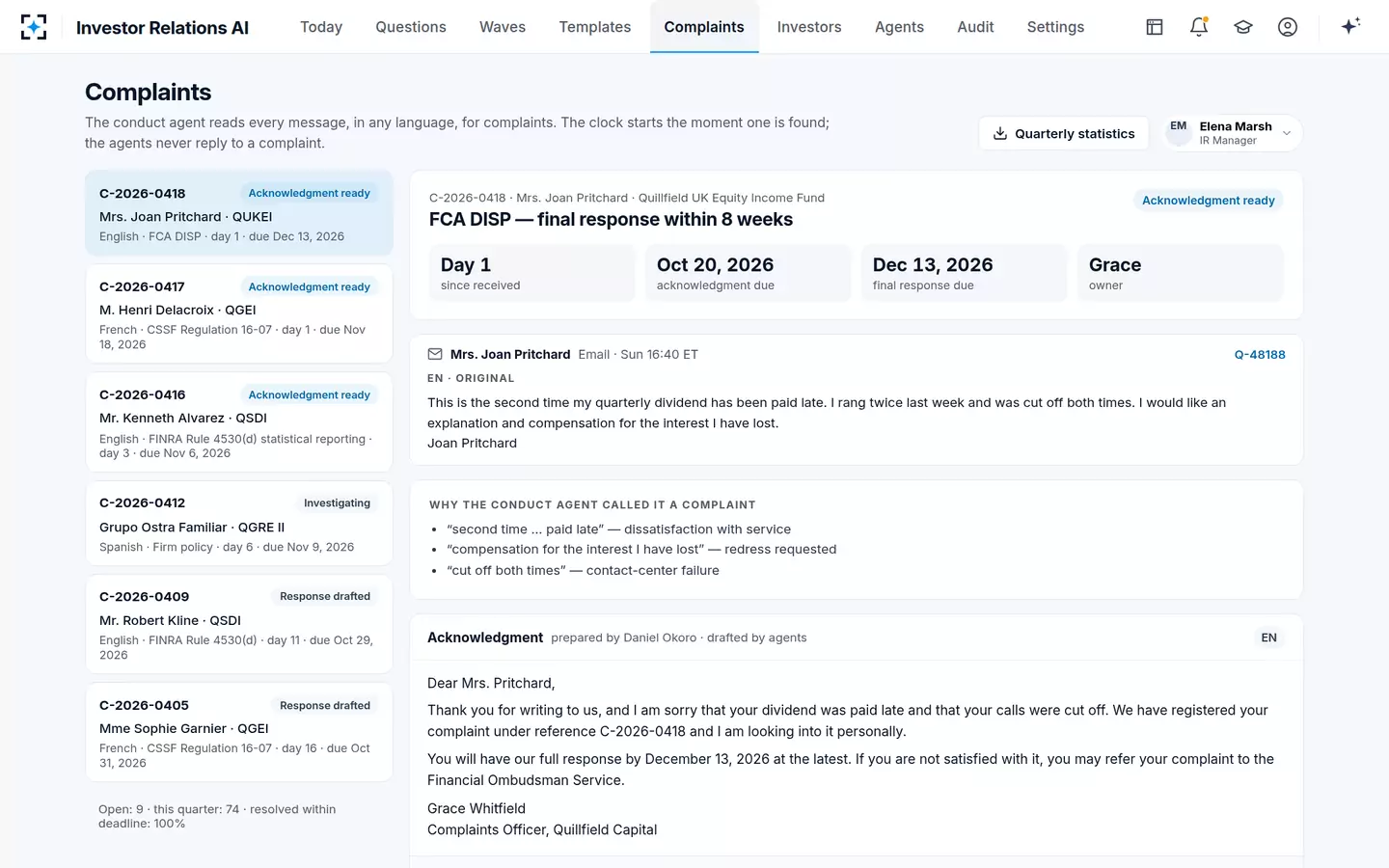
Count it the way the sample data does. In Investor Relations AI's fictional complaints list, a retail investor in a UK equity income fund emailed on Sunday 18 October 2026 that her dividend had been paid late a second time and her calls cut off. The agents found the complaint on day 1, set the acknowledgement due on 20 October under the firm's policy, and the final response due on 13 December 2026, eight weeks after receipt.
What is a summary resolution communication?
It is the letter or message that closes a complaint settled within three business days of receipt. A complaint is resolved when the complainant has indicated acceptance of the firm's response, and neither the response nor the acceptance has to be in writing; but once the firm considers it resolved it must promptly send a summary resolution communication that refers to the complaint, says the firm considers it resolved, tells the complainant they may be able to refer it to the Ombudsman if they later become dissatisfied, gives the Ombudsman's website and states whether the firm waives the referral time limits (DISP 1.5.2AR, 1.5.4R).
The three-day route switches off the time-limit and forwarding rules, not the duty to resolve the complaint properly: complaints closed this way "are still subject to the complaints resolution rules" (DISP 1.5.2G), which require a competent, diligent and impartial investigation and a fair, clear and not misleading explanation (DISP 1.4.1R). The route is common, as the figures below show. It is not a reason to answer a complaint as if it were a question.
How many investment complaints does the FCA record?
The FCA's latest figures, published on 22 October 2026, count 1.85 million complaints reported by firms in the first half of 2026, 6.3% more than in the previous six months; firms upheld 54.8% of those they closed (FCA complaints data, 2026 H1). Investment products are a small slice: firms reported 54,280 investment complaints in the second half of 2025, down 6.9% from 58,305 in the first (FCA, 2025 H2).
Most complaints close in three days; one in eighteen runs past eight weeks
The figures say nothing about how many complaints were never recognised as complaints. Firms report what they logged. The only way to know your own miss rate is to sample: take a month of investor messages your desk answered as routine, read them against the definition, and count how many should have started a clock.
Complaints on a cross-border fund desk: DISP, Luxembourg and the US
A fund sold in several countries answers complaints under several regimes at once, and the clocks differ. A Luxembourg fund's professionals must acknowledge a complaint within ten business days unless they answer it within that time, and answer within one month of receipt, or explain the delay and give a date (CSSF Regulation No 16-07, Article 15). In the US, federal securities rules set no general complaint-response deadline for funds or advisers; broker-dealers must report statistics on written customer complaints to FINRA by the 15th day of the month after each calendar quarter (FINRA Rule 4530(d)), and firms set their own response times.
Three regimes a fund's investor desk may meet in one inbox
| Regime | Who it covers | Acknowledge | Answer |
|---|---|---|---|
| FCA DISP (UK) | Complaints from eligible complainants; for UK UCITS management companies, unitholders for the handling rules | Promptly, in writing (DISP 1.6.1R) | Final or holding response by the end of 8 weeks (DISP 1.6.2R), or resolve by day 3 with a summary resolution communication (DISP 1.5) |
| CSSF Regulation 16-07 (Luxembourg) | Complaints to professionals supervised by the CSSF | Within 10 business days, unless answered sooner | Within one month of receipt, or explain the delay and give a date |
| Firm policy (US funds and advisers) | Investors in funds and advisory clients | As the firm's policy sets | As the firm's policy sets; broker-dealers report complaint statistics to FINRA |
Can AI decide whether something is a complaint?
It can find one; it should not be the one to decide that something is not. Reading every message for dissatisfaction and alleged loss, in any language, is exactly the kind of tireless first pass software does well, and it is the step people skip when the inbox is full. Deciding that a message which looks like a complaint is not one changes a customer's rights, and DISP expects firms to assess complaints competently, diligently and impartially. FINRA, in its 2026 oversight report, lists among the risks of AI agents that they may act without human validation and beyond the scope a user intended; a classification that silently closes a complaint is both.
Complaints found in three languages, each with its regime, its clock and the words that made it one
Complaints and expressions of dissatisfaction: locked on the never-automatic list
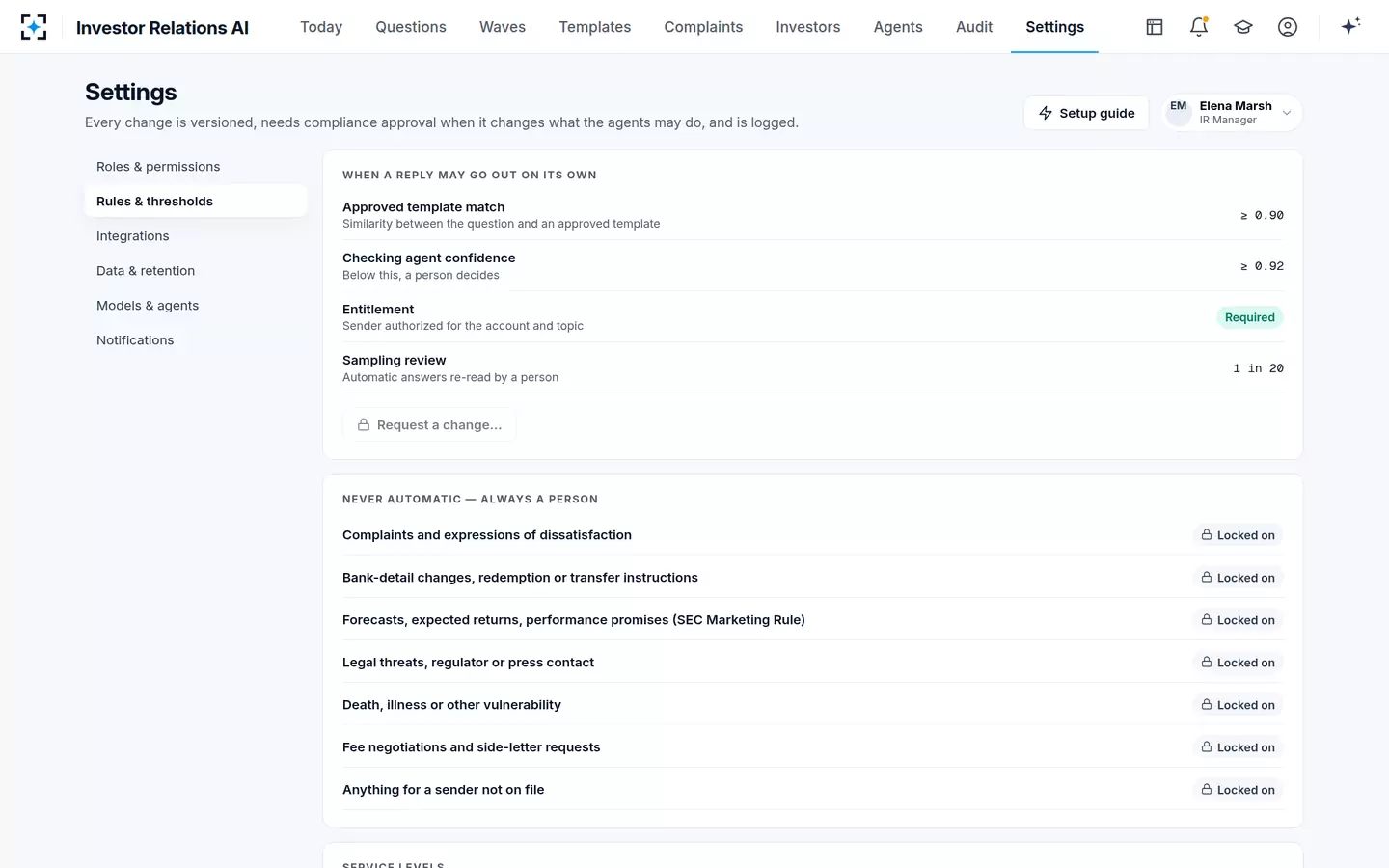
That is the division of labour the solution enforces. The Conduct & complaints agent reads every message before any reply is drafted, routes complaints to a named complaints officer with the clock already running, and can never reply to one or reclassify it; calling something "not a complaint" needs a reason and the Head of Compliance's approval, and the clock keeps running while they decide. Every complaint and every measure taken is on the record DISP 1.9 requires, kept at least three years, or five for complaints about a UK UCITS (DISP 1.9.1R). What each agent may read and never send sets out the rest of the limits, and US banks' version of the same problem is covered in Botminds' Complaint Management guides. To see complaints found and routed in any language, start from Investor Relations AI.
Questions people ask
Is a request for information a complaint?
Not on its own. A request becomes a complaint when it also expresses dissatisfaction about the service and alleges loss, distress or inconvenience. "Please resend my statement" is a request; "this is the third time I have asked for my statement and I have missed a tax deadline" is a complaint.
How many days does a firm have to answer a complaint under DISP?
Eight weeks from receipt for a final response or a written holding response, after a prompt written acknowledgement. If it is settled within three business days, a summary resolution communication is enough. Payment services and e-money complaints have shorter limits: 15 business days, or 35 in exceptional cases.
Do complaints from professional investors count?
They count as complaints, but most professional investors are not eligible complainants, so the Ombudsman route and much of DISP 1 do not apply to them. For UK UCITS management companies, the complaints handling and record rules still apply to complaints from any unitholder, and firms in doubt should treat a complainant as eligible.
What records of complaints must be kept?
A record of each complaint and the measures taken to resolve it, kept for at least five years where the complaint concerns collective portfolio management for a UK UCITS and three years for other complaints, from the date received (DISP 1.9.1R).
Can a complaint be in another language?
Yes, and for a UK UCITS management company unitholders must be able to complain in any official language of the fund's home state or of any state it was marketed into. In the solution's sample data, complaints arrived in English, French and Spanish and were each found with their regime and clock.
Does the eight-week clock pause while we wait for the investor?
Not under DISP 1.6.2R as written: the response, final or holding, is due by the end of eight weeks after receipt. A firm that cannot give a final response by then must send the written response explaining why and when it expects to, with the Ombudsman information.