A lost shareholder, in US securities rules, is a holder to whom correspondence sent at the address on the transfer agent's master file has come back undeliverable, and for whom no new address has arrived. Rule 17Ad-17 then requires the recordkeeping transfer agent, or the broker-dealer holding the account, to run two database searches for the holder, free of charge, on a fixed schedule (17 CFR 240.17Ad-17). If the holder stays lost, state unclaimed property law eventually treats the shares as abandoned and the transfer agent remits them, a step called escheatment. The rule matters because escheat is expensive for the investor: the SEC notes that states generally make holders whole only for the value at the time the shares were handed over. The SEC proposed in September 2026 to add a second trigger, based on 18 months without account activity rather than returned mail. Botminds' Investor Relations AI does not run the searches; it answers holders' questions, and every question a holder sends is evidence of interest in the account, which is what the states and the proposal both look for.
The rule text and the figures come from the eCFR, the SEC's 2026 proposal and the Delaware Code, linked where they appear. Where the solution appears, the examples use its fictional sample data.
From returned mail to escheat: today's searches and the proposed notices, on a three-year state clock
- Mail returned; first search due by month 120–12 mo
- Second search, 6–12 months after the firstto 24 mo
- Waiting out the state dormancy periodto 36 mo
- No account activity observed for 18 months18 mo
- Notice 1to 24 mo
- Notice 2to 30 mo
- Dormancyto 36 mo
What is a lost shareholder?
A lost shareholder, or lost securityholder, is defined by returned mail. Under Rule 17Ad-17(b)(2) a holder is lost when an item of correspondence sent to the address in the transfer agent's master securityholder file, or a broker-dealer's customer account records, is returned undeliverable and no new address has been received. If the agent re-sends the item within a month, it may treat the holder as lost from the day the re-sent item comes back (17 CFR 240.17Ad-17(b)(2)).
The definition says nothing about whether the holder is still interested in the investment. A holder who moved house, never updated the address, but logs on to the investor portal every month is "lost" under the federal rule. A holder whose mail arrives but who has not opened an envelope or answered anything in a decade is not. That gap is what the SEC's 2026 proposal tries to close, and it is why the question of what counts as activity matters to everyone who answers investors.
What does Rule 17Ad-17 require? Two searches, on a schedule
The rule requires reasonable care to find the holder's correct address, including two database searches using at least one information database service. The first must run between three and twelve months after the holder becomes lost; the second between six and twelve months after the first. Searches go by taxpayer identification number, or by name where a number search is not likely to work, and the holder may not be charged for them, or for any other search method used before the two are done (17 CFR 240.17Ad-17(a)).
Rule 17Ad-17 in its own terms: who, when, and the exceptions
| Element | What the rule says | Where |
|---|---|---|
| Who must search | Every recordkeeping transfer agent whose master file includes lost holders, and every broker-dealer with lost holders in customer accounts | (a)(1) |
| How many searches | Two, using at least one information database service | (a)(1) |
| When | First between 3 and 12 months after the holder becomes lost; second between 6 and 12 months after the first | (a)(1)(i)–(ii) |
| What a database must cover | Addresses for the entire US, names of at least 50% of the US adult population, indexed by tax ID or name, updated at least four times a year (or a comparable service) | (b)(1) |
| Cost to the holder | None for the two searches; no paid search method may be used before they are done | (a)(1)–(2) |
| No search needed | Documentation that the holder has died; total account value under $25; holder not a natural person | (a)(3) |
| Uncashed checks | Paying agents send at least one written notice to an unresponsive payee within 7 months (210 days) of the unpaid check; not for checks under $25 | (c) |
| Records | Written procedures describing the method, kept with the other transfer agent records | (d) |
The exceptions are narrower than they look. The $25 floor counts everything in the account, including unpaid dividends and interest, and the rule exempts holders that are not natural persons, so a lost company or other entity holder need not be searched for under this rule at all. The SEC estimates the cost of one database search at about $17, which is why the expensive part of the process is not the search but what comes after: verifying that a found address belongs to the holder, and handling the holder who then writes in.
What is a lost shareholder report?
The term is used loosely, but the report regulators see is in Form TA-2, the annual filing every registered transfer agent makes. It asks about lost securityholder accounts, including how many were searched for and how many searches produced a different address (SEC, 91 FR 56946).
The SEC published a decade of those figures with its 2026 proposal, averaged across the reporting periods from 2016 to 2025. They show that the searches work more often than not.
The two searches find most lost holders, when they are run
80%
of recordkeeping transfer agents filing Form TA-2 ran database searches
3.18m
accounts searched by recordkeeping transfer agents
68%
of searched accounts produced a different address
58%
discovery rate at non-recordkeeping transfer agents, which searched far fewer accounts
A different address is not a found holder. The search returns where someone with that name or number now lives; confirming that it is the holder, and that the letter reaching them is not reaching a fraudster, is the transfer agent's work. That is the moment the shareholder services desk takes over.
When are mutual fund shares escheated? The state dormancy clock
When state law says the property is presumed abandoned, and for securities that is increasingly three years. State law sets the dormancy period and the trigger, and the SEC describes two common triggers: returned mail, and a period since the owner's last contact or activity whether or not mail is delivered (91 FR 56946). Delaware's code is typical of the shorter clocks: a security is presumed abandoned "3 years after the last indication of interest in the property" (12 Del. C. §1133(13)).
The SEC's release notes "a recent trend among some states to reduce the dormancy period for securities from five years to three years", naming New York, Arizona, South Dakota, Maryland and New Hampshire, and that many states now use an inactivity standard instead of, or as well as, returned mail. Florida went the other way in 2026, the release says, pairing a returned-communication test with a ten-year period to show interest. Each state's periods for each property type are listed in escheatment dormancy periods by state; for a fund's shareholder desk the practical point is that the clock may be shorter than the search schedule assumes.
What happens to shares after escheat?
The holder can usually reclaim from the state, but not the growth. The SEC put it plainly in the 2026 release: states "generally indemnify holders only for the value of the securities at the time of escheatment, not for subsequent market appreciation, dividend streams, or tax consequences" (91 FR 56946). A holder who comes back years later recovers the value recorded when the state took the property and loses what the shares earned since; the SEC's own list adds the tax consequences.
The numbers reaching the states are large. Transfer agents filing Form TA-2 remitted between 417,000 and 505,000 lost-holder accounts to states each year from 2016 to 2022. The count halved in 2023, which the SEC attributes mainly to the largest remitter ceasing operations, and has stayed near 165,000 since.
Lost securityholder accounts remitted to the states each year
What would the SEC's 2026 proposal change? The 18-month inactive holder
It would add an inactivity trigger next to returned mail. Proposed Rule 17Ad-17(b)(3) would define an inactive securityholder as one for whom the transfer agent, broker or dealer "has not observed any account activity for a period of 18 months", and proposed paragraph (a)(3) would require "not less than two written notifications" telling the holder the account is inactive, that some jurisdictions may treat it as abandoned, and how to show activity. The first notice would be due within six months of the holder becoming inactive and the second within six months of the first (91 FR 56946). It is a proposal; comments are due by 3 November 2026, and the rest of the package is read line by line in the SEC transfer agent proposal.
The proposal defines activity broadly, and every item on its list is something a shareholder services desk sees first.
What counts as account activity under the SEC's proposal, and where the desk sees it
| Activity in the proposed definition | Where it shows up |
|---|---|
| Electronically accessing the account, including login or email access | Investor portal and email logs |
| Any electronic communication with the transfer agent, broker or dealer about the account | The question itself, by email or portal message |
| A transaction in the account, including deposits or withdrawals | Dealing and payments |
| Indication of receipt of communications, such as read receipts | Email and portal delivery data |
| Any other affirmative act showing the holder is reachable and engaged | A call, a letter, a returned form |
The SEC estimates the notice duty would cost each affected transfer agent about $7,500 to set up and $840 a year, across 305 firms. The larger cost is operational: if every question, login and read receipt resets an 18-month clock, the systems that receive them must record them against the right account, and the person answering a holder must be able to see when the holder last showed interest.
Uncashed checks: the unresponsive payee rule
A holder who stops cashing checks is often the first sign of a lost one. Rule 17Ad-17(c) makes a securityholder an unresponsive payee when a check is not cashed before the next regular check is sent or six months pass, whichever is first, and requires the paying agent to send at least one written notice within seven months of the unpaid check. Checks under $25 are excluded, and the notice does not change state escheatment law (17 CFR 240.17Ad-17(c)). The 2026 proposal would extend the notice to electronic payments that are rejected and returned.
The rule's definition of paying agent is wide: any issuer, transfer agent, broker, dealer, investment adviser, indenture trustee, custodian or other person that accepts payments from an issuer and distributes them to holders. A fund's IR team that sends distribution notices is close to that work even when it does not move the money, and a holder's question about a missing payment is, if made in writing to a registered transfer agent, a claim under Rule 17Ad-5 that must be answered within ten business days, or twenty if the payment is more than six months old.
When a lost holder writes in: a question is evidence of interest
When a lost or inactive holder writes in, the right response is to treat the message as two things at once: a question to answer, and evidence that the holder is reachable, which must reach the people who keep the lost-holder and escheat files. The danger runs the other way too. A message from someone claiming to be a long-lost holder, asking to update the address and send the money, is exactly what an impostor sends.
A message from a holder the register lists as lost, handled by agents and people
Agent
Read the message and recognise the accountReads it in any language, identifies the holder and account, and notes that the register shows returned mail or no activity.
Never: treat an address in the message as the address on file
Agent
Check the sender against the contacts on fileCompares the sender with the authorized contacts and the register; a new address or email is not on file, so nothing is read and the message is held.
Never: read the account for a sender who is not on file
A person decides
Verify the holderThe transfer agency supervisor confirms identity through the firm's procedure, such as a call-back to a number already on file or documents, before any detail is disclosed.
A person decides
Update the address, with a second personThe change to the register is made by people, and a second person confirms it.
Agent
Draft the answer from the holder's own accountHoldings, unpaid distributions and uncashed checks, each figure cited to its source.
Never: promise that escheated shares can be recovered in full
A person decides
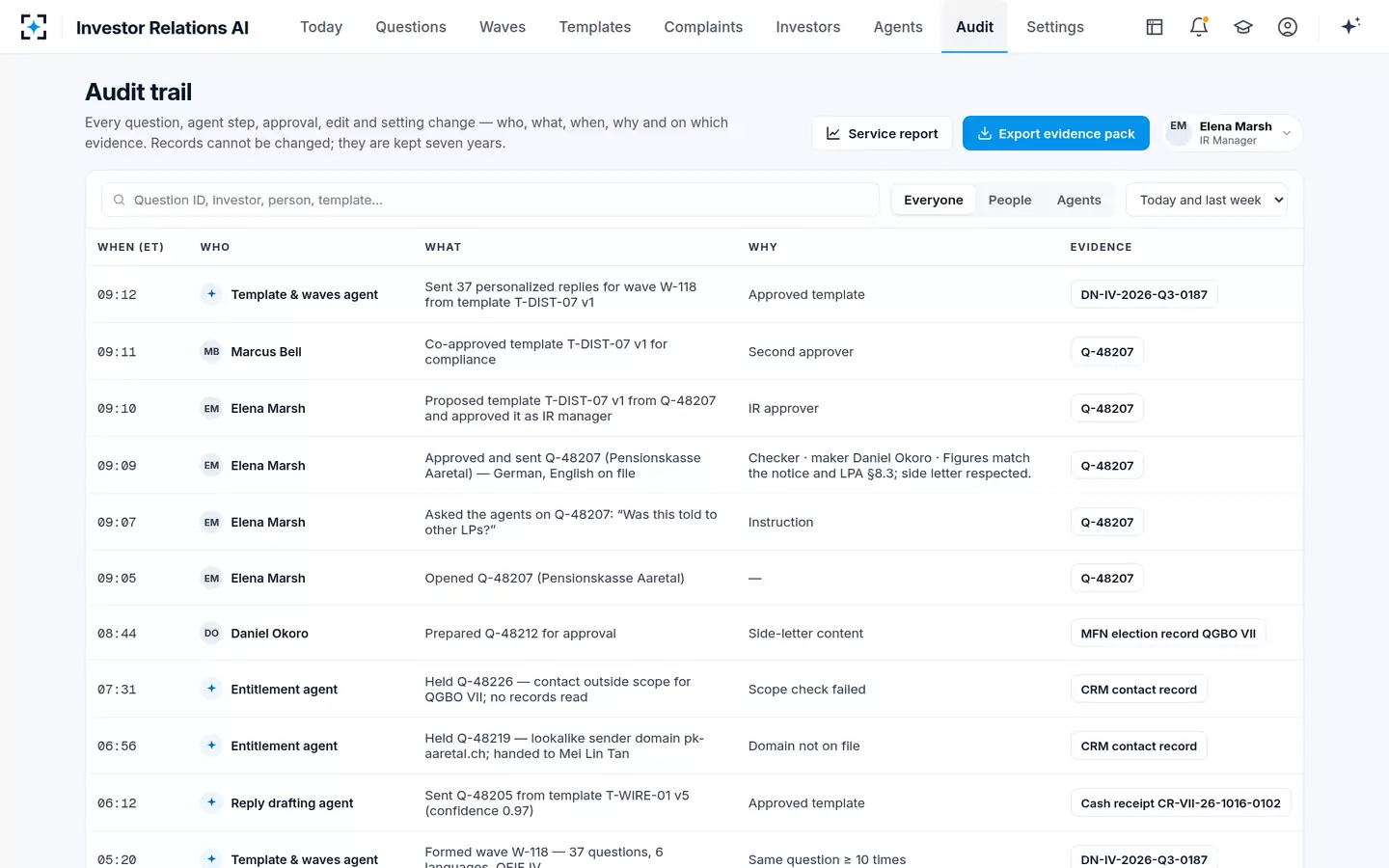
Approve and send, and log the contactAn IR manager approves; the contact is on the audit trail, where the lost-holder and escheat team can see it.
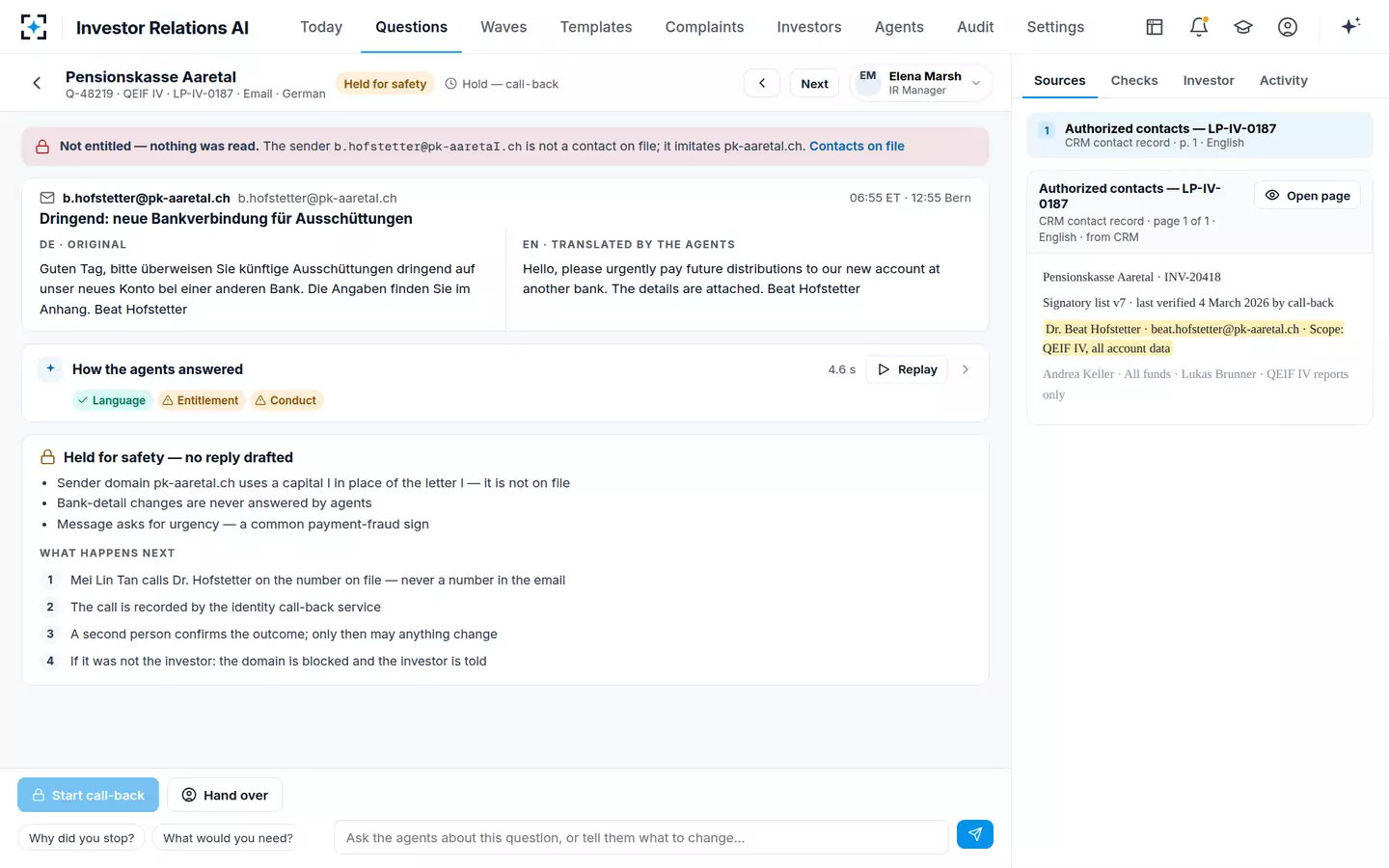
The same holds that protect against bank-detail fraud protect lost holders. In the solution's sample data, a request to change where distributions are paid, from a domain one letter away from the investor's own, was held before any account was read, and the change waits for a call to the number on file and a second person. A lost holder's change of address deserves the same treatment, because the holder is, by definition, someone the firm cannot currently reach to check.
A change of payment details from a sender not on file: held, nothing read
Every contact on the audit trail, by person and by agent
A fund's shareholder desk cannot stop a state's clock, but it can make sure the holder's own signs of life are not lost. What a transfer agent does, seat by seat places the lost-holder work among the desk's other jobs, and investor queries answered by agents sets out the holds in full. To see questions answered and logged against each holder's account, start from Investor Relations AI.
Questions people ask
How do I find my lost shares?
Start with the issuer's or fund's transfer agent, which can search its register by name and tax ID once it has verified who you are. If the shares have already been escheated, the unclaimed property office of the state of your last known address usually holds the claim. Expect the state to repay the value at escheatment, not what the shares would be worth today.
How do I check for unclaimed mutual funds?
Contact the fund's transfer agent with your old account details, and search the unclaimed property office of each state you have lived in. Mutual fund shares are securities, and a growing number of states, Delaware among them, presume a security abandoned three years after the owner's last indication of interest.
Does a transfer agent charge to find a lost shareholder?
Not for the two searches Rule 17Ad-17 requires: they must be free to the holder, and no paid search method may be used before they are done. A holder may be charged for other services, such as replacing a lost certificate.
Is an investor who never logs in a lost shareholder?
Not under today's federal rule, which turns on returned mail. Under the SEC's 2026 proposal, a holder with no observed account activity for 18 months would be an inactive securityholder owed two written notices. Many states already use an inactivity standard for escheat.
Does answering an investor's email count as activity?
Under the SEC's proposal, any electronic communication with the transfer agent about the account would count. Under state law, contact from the owner is generally an indication of interest. Either way, the contact has to be logged against the right account to count.