Escheatment dormancy periods by state for bank deposits are either three years or five. On the state-by-state listing kept by the National Association of Unclaimed Property Administrators, 27 of the 51 jurisdictions (the 50 states and the District of Columbia) presume a checking account abandoned after three years without owner activity, and 24 after five (NAUPA). The period that applies is the one of the state of the owner's last known address, and it runs from the owner's last indication of interest, not from the core system's last-activity date. The period is the easy half. The hard half is the starting date, because interest postings, returned statements and system conversions all write to the field a core calls last activity, and none of them is the owner. That is why Botminds' Dormant Account & Escheatment Management dates every account from the owner's last real contact before it applies any state's period.
The table below takes each state's period from its own statute or unclaimed property office, in the words each uses for what starts the clock. Those words differ more than the numbers do, and they decide which events a bank may treat as the owner's.
Dormancy periods for checking and savings accounts, from each state's own law
| State | Period | What starts the clock |
|---|---|---|
| Delaware | 5 years | The earlier of maturity or the owner’s last indication of interest |
| Florida | 5 years | The owner’s last listed activity: a deposit or withdrawal, written or documented phone contact, a record of interest |
| North Carolina | 5 years | The last documented instance of positive owner contact |
| Pennsylvania | 3 years | The owner’s last change to the deposit other than credited interest, written contact, or record of interest |
| New York | 3 years | The last customer-generated activity or contact |
| Texas | 3 years | The depositor’s last dealing with the account, by transaction or by letter |
| Washington | 3 years | The later of maturity or the owner’s last indication of interest |
| RUUPA model | 3 years | The later of maturity or the owner’s last indication of interest |
What are the escheatment dormancy periods by state?
Three years in a small majority of jurisdictions, five in the rest, for ordinary checking and savings accounts. The three-year group includes Pennsylvania, New York, Texas, Washington, California, Illinois and Massachusetts on NAUPA's listing; the five-year group includes Delaware, Florida, North Carolina, Ohio, Virginia and Georgia. The uniform act of 2016 set three years: a demand, savings or time deposit is presumed abandoned "three years after the later of maturity, if applicable, of the card or deposit or the owner's last indication of interest" (RUUPA § 201(5)).
Washington's legislative staff summed up the state's current law in 2025: "The dormancy period is generally three years with some exceptions." (House Bill Report on HB 1127) The exceptions matter as much as the rule. Certificates of deposit, retirement accounts, safe deposit boxes and accounts of owners known to have died all run on clocks of their own, set out further down.
Checking accounts: three-year and five-year jurisdictions
How long before a bank account is escheated?
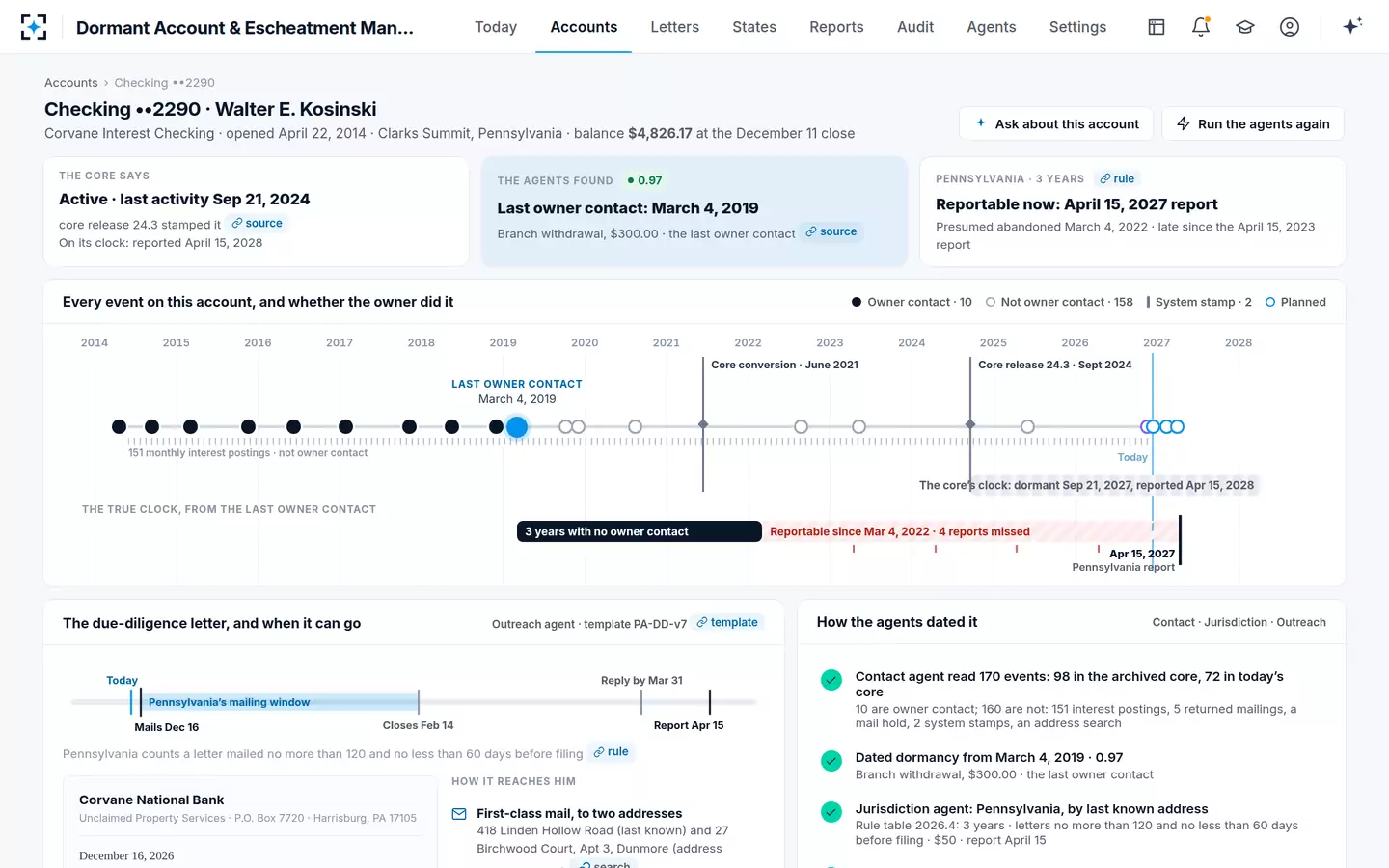
Longer than the dormancy period, because the account waits for the next cut-off and then for the report date. An account whose owner last acted on March 4, 2019 is presumed abandoned in Pennsylvania on March 4, 2022, belongs to the calendar year 2022 cohort, and is due in the report of April 15, 2023: four years and a month after the owner's last act. The same account in Delaware is presumed abandoned in March 2024 and due with the bank's report of November 10, 2024, five years and eight months on.
Cut-offs can add almost a full year. Texas counts abandonment periods to a March 1 cut-off and wants the report by July 1 (Texas Comptroller). An account presumed abandoned on March 4, 2022 missed that year's cut-off by three days and waits for the report of July 1, 2023. One wrong day in the dormancy date can move an account across a cut-off in either direction, and the late direction costs money: Pennsylvania's holder book warns that a report filed after April 15 may draw interest at 12 percent a year and penalties (Pa. Treasury).
One last contact, five states, five report dates
- 3 years
- To report
- 3 years
- Dec 31 cut-off, report
- 3 years
- Next Mar 1 cut-off, report
- 5 years
- To report
- 5 years
- To report
Before the report comes the letter, inside each state's window, so the practical deadline for knowing an account is dormant is months earlier than the report date. The calendar of report dates and windows is in the guide to unclaimed property reporting deadlines by state.
Which state's dormancy period applies to an account?
The period of the state of the owner's last known address on the bank's records, not the state of the branch or of the bank's charter. That rule comes from the Supreme Court and is written into the statutes: Delaware's, for example, treats any description or code on the bank's books that identifies the owner's state as the last-known address (§ 1139(a)). Where there is no usable address, the property generally goes to the state where the bank is domiciled.
So a Pennsylvania bank with an owner whose last known address is in Delaware applies Delaware's five years, not Pennsylvania's three, and reports to Delaware on Delaware's date. An address change the owner asked for in writing is a record communicated about the account, which Delaware and the uniform act count as interest; an address the bank's systems rewrote is not. The full set of rules, including what happens with foreign and missing addresses, is in the guide to unclaimed property priority rules.
What starts the dormancy clock?
The owner's last indication of interest, which each state defines, and for time deposits the date of maturity. The definitions share a core and differ at the edges. Texas starts an account's inactivity on the day the depositor last dealt with it, by a transaction or by writing about it (Tex. Prop. Code § 73.101(b)). Florida lists the activities that count within five years, among them written or documented telephone contact with the bank (Fla. Stat. § 717.106). Pennsylvania counts a change the owner makes to the deposit but expressly not interest the bank credits, and it also counts statements the owner was shown to receive by certified mail or another method that proves receipt (72 P.S. § 1301.3). The guide to what counts as activity on a bank account sets these rules side by side, event by event, including logins, automatic drafts and calls from relatives.
Texas adds a condition the other statutes in this guide do not: an account is presumed abandoned only if, among other things, "the location of the depositor of the account or owner of the safe deposit box is unknown to the depository" (§ 73.101(a)). The same section gives other Texas accounts five years; the three-year period is reserved for checking, savings and matured certificates of deposit (§ 73.101(c)). A Texas dormancy row therefore needs two periods and a test of the address.
Pennsylvania's three years in Dormant Account & Escheatment Management, counted from the owner
Do CDs, IRAs and safe deposit boxes run on different dormancy clocks?
Yes, and so do the accounts of owners known to have died. Each has its own trigger, and a dormancy table that only holds the checking period gets them wrong.
- Certificates of deposit. An automatically renewing CD is deemed matured at its first maturity unless the owner consented to renewal on record (Delaware, Florida, the uniform act); North Carolina presumes a matured CD abandoned ten years from its initial maturity or from the owner's last indication of interest. The guide to CD escheatment works through the timelines.
- IRAs and other tax-deferred accounts. North Carolina presumes them abandoned "three years from the date distributions must begin" (N.C. guide); New York reports them in the cycle after the mandatory distribution date, absent contact in the last three years.
- Safe deposit boxes. Texas counts five years from the date rent was due and not paid; Pennsylvania three years after the rental period expired; North Carolina two years after the box was drilled.
- Deceased owners. In New York, "the confirmed date of death of an owner begins the applicable dormancy period" where none has started, and a bank that learns of a possible death in the ordinary course must try to confirm it within 90 days (N.Y. OSC).
- Custodial accounts for minors. New York counts three years from the last customer contact on accounts under its Uniform Gift to Minors Act and other custodian accounts not subject to a court order.
Do official checks and money orders follow the deposit periods?
Not reliably. On NAUPA's listing, most jurisdictions give official bank checks and money orders three or five years, but North Carolina, Idaho, Oklahoma and Vermont give them seven (NAUPA). Pennsylvania's statute splits the category three ways: three years for checks on which the bank is directly liable, seven for money orders and fifteen for traveler's checks, counted from the date payable or, for a check payable on demand, from issue (72 P.S. § 1301.3). Delaware sets five years for money orders and fifteen for traveler's checks (§ 1133).
Texas counts a check differently again: it is presumed abandoned on the latest of three anniversaries, of the date it was payable, of the payee's last documented communication with the issuer, and of the date it was issued if no claim or act of ownership has been recorded (Tex. Prop. Code § 73.102). For a bank, that means an official check carries its own dates in the dormancy table, and a money order also carries the state where it was bought, because a federal statute, not the owner's address, decides which state receives it.
How long before a bank account is considered dormant, inactive or abandoned?
Dormant or inactive after whatever period the bank's own terms set, often a year or two; abandoned only after the state's three or five years. "Inactive" and "dormant" are a bank's own labels; "presumed abandoned" is the legal test. North Carolina's Treasurer notes that the first two "are typically used interchangeably" and that "some institutions consider accounts to be 'inactive' after one year and 'dormant after two years'" (N.C. guide). Neither label changes the law: whatever a bank calls the account, North Carolina presumes savings and checking accounts abandoned five years after the last documented positive owner contact.
A bank's labels against the state's test
Inactive or dormant (the bank's terms): The bank’s product terms and core settings
Presumed abandoned (the state's test): The statute of the owner’s state
Inactive or dormant (the bank's terms): Often one or two years without activity
Presumed abandoned (the state's test): Three or five years without owner interest
Inactive or dormant (the bank's terms): Any posting the core records as activity
Presumed abandoned (the state's test): Only the owner’s indication of interest
Inactive or dormant (the bank's terms): Restrictions, statements, sometimes fees
Presumed abandoned (the state's test): A due-diligence letter, then a report and remittance
Inactive or dormant (the bank's terms): A system release, a conversion, a rule in the core
Presumed abandoned (the state's test): Only the owner, by acting on the account
The difference matters in two directions. A bank that reactivates an "inactive" flag on an interest posting may keep a legally abandoned account off its report. And a bank that charges dormancy fees must follow the state's rules on them: Florida, for instance, allows charges for dormancy only under an enforceable written contract and, above $2, after written notice to the owner no more than three months before the first charge (Fla. Stat. § 717.106(3)).
Keeping a dormancy table that survives an audit
A dormancy table is evidence. When a state examiner asks why an account was or was not reported three cycles ago, the answer is the rule that applied then, who approved it, and the date it was read from the statute. Tables kept as spreadsheet columns, overwritten each year, cannot give that answer.
The look-back is long. Delaware requires a holder to keep its records for ten years after each report is filed, and a holder that has received an examination notice must keep records reaching back ten years plus the dormancy period (Del. Code tit. 12 § 1145). For a five-year deposit that is fifteen years of rules, so every version of the table a report relied on has to survive with it.
What each row of a state dormancy table should hold
- The period for each property type the bank holds
Checking, savings, matured CDs, IRAs, safe deposit boxes, official checks.
- What starts the clock
Last indication of interest, maturity, death, distribution date: in the state’s own words.
- The cut-off and report date for banks
Which may differ from the state’s general holders.
- The source and the date it was read
Statute section or unclaimed property office page.
- Who approved this version, and when
Deposit counsel and the Unclaimed Property Manager.
- Which reports used it
So a past decision can be explained under the rule then in force.
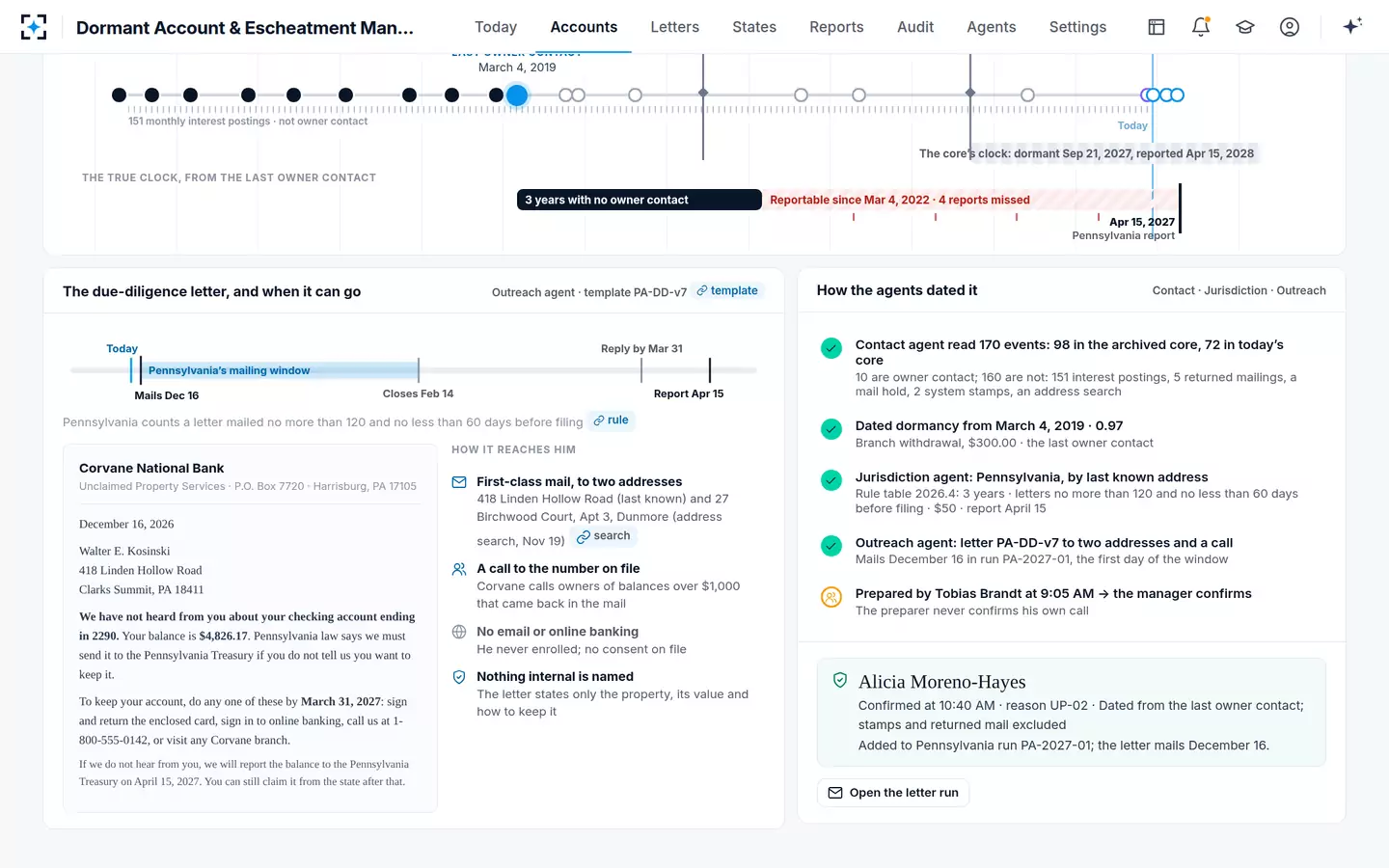
In Dormant Account & Escheatment Management, the Jurisdiction agent applies only a rule-table version that deposit counsel and the manager have approved, and cites the row it used for every account. A pending change, such as a state deciding to count online banking logins as owner contact, is shown with the accounts it would move before anyone approves it.
In Dormant Account & Escheatment Management, every date cites the rule it applied
The solution's full description is on the Dormant Account & Escheatment Management page.
Questions people ask
How long before a bank account is considered abandoned?
Three or five years without owner interest, depending on the owner's state, and a state can set different periods for different accounts. Texas, for example, uses three years for checking, savings and matured certificates of deposit but five for its other accounts, and only where the bank does not know where the depositor is.
What is a dormancy period for unclaimed property?
The time a holder must wait, with no indication of interest from the owner, before property is presumed abandoned and must be reported. It differs by property type as well as by state: on NAUPA's listing, Delaware gives deposits, wages and utility deposits five years but dividends and securities three.
Do dormancy periods differ for savings and checking accounts?
Not in any state on NAUPA's listing: each sets the same period for both, and Pennsylvania's statute treats them in one clause. Where states differ is the starting point for time deposits. Delaware and Indiana count from the earlier of maturity or the owner's last indication of interest; Washington and the uniform act count from the later.
Does a bank's dormancy fee affect escheatment?
Only where the state allows the charge. Pennsylvania lets a bank keep back lawful charges from a dormant deposit, but not an inactivity charge imposed after 1981 unless a valid written contract with the owner allows it. A fee is never owner activity and does not reset the clock.
Do dormancy periods change?
Yes. Washington replaced its unclaimed property act from January 2023 and amended it again in 2025 at its revenue department's request, with parts in force from January 2026; Florida's deposit section was amended in 2026. A bank should re-read each state's law at least once a year and record the version used for each report.