Escheatment software for banks should be judged on four numbers: how many dormant accounts it dates from a system stamp instead of the owner's last real contact, how many due-diligence letters it mails outside a state's window, how many state files reach approval without tying to the general ledger to the cent, and how many owners it reaches before their money is reported. Hours saved matter, but a tool that saves hours while getting the first number wrong only produces wrong reports faster. Botminds' Dormant Account & Escheatment Management was designed around those four measures: six agents date every account from source events, schedule letters inside each state's window, tie each file to the escheat suspense account, and stop the report the moment an owner answers, with an Unclaimed Property Manager approving every step.
The four numbers also give a buyer a fair way to compare products that look alike in a demonstration. Each can be measured on a bank's own closed year, before a contract is signed.
The four measures of escheatment software, and what good looks like
0
accounts dated by a conversion or system stamp
Design target
100%
of due-diligence letters mailed inside each state’s window
What the statutes require
1day
to tie a state file to the general ledger, not weeks
Design target
$9.3m
stayed with 4,412 owners who answered in a year
Sample data, fictional bank
What does escheatment software do, and what does it usually leave out?
Most escheatment software does three things well: it finds accounts in an extract whose last-activity date passed a state's dormancy period, it produces letters, and it writes the state file in the NAUPA standard electronic format, which every state has accepted since 2004 according to the association of state administrators (NAUPA). The format itself is old and exact: records "based upon a 625-byte record layout", with a type code in the first byte (NAUPA standard electronic file format).
What it usually leaves out is the question of whether the last-activity date is true. Software working from an extract inherits whatever the core says. North Carolina's Treasurer puts the gap bluntly in its guide for financial institutions: "Unclaimed property compliance software does not monitor beyond the current report year", so accounts whose dates fell before the year being run "will not appear on the report" (N.C. Department of State Treasurer). A tool can run perfectly and still miss the account that matters.
What is unclaimed property compliance?
It is a holder's whole set of duties toward property it can no longer return: identify it as of each state's cut-off, notify the owner inside the window, report and remit to the right state on time, and keep the records. The duty starts earlier than many banks assume. Delaware makes a holder of presumed abandoned property hold it "in trust for the benefit of the State Escheator on behalf of the owner from and after the date such property is presumed abandoned" and says a holder "shall establish trust accounts or otherwise segregate property held for the benefit of the State Escheator" (Del. Code tit. 12 § 1152A).
An unclaimed property compliance system, then, is not a reporting tool alone. It is whatever lets a bank show, for any account, that it met each of those duties: the date, the letter, the report, the money and the evidence. The four measures below each test one link in that chain.
How to measure each of the four on your own data
| Measure | How to compute it | What it needs | Ask the vendor to show |
|---|---|---|---|
| Accounts dated by a system stamp | Re-date a closed year from source events; count accounts whose reported date was a conversion, release, interest or mail event | Today’s core, the archived core, imaging | The source event behind any date, in one click |
| Letters inside the window | Letters mailed between the state’s earliest and latest dates, over letters owed | Proof of mailing, the rule table | Which letters were held because the window had closed |
| Files tied to the general ledger | Files whose total equals the escheat suspense balance to the cent before approval | File totals, ledger balances | A break traced to the account that caused it |
| Owners reached before reporting | Owners who answered and were reactivated before the report, and their balances | Answers, reactivations | How an answer stops a report already in a draft file |
Measure one: accounts dated by a system stamp, not the owner
The target is zero, and it is the measure most tools cannot report, because they do not know which dates are stamps. A core conversion writes its load date into last-activity fields; a release that adds a field can touch the contact date; interest postings and statements look like activity. North Carolina lists conversions, mergers and system modifications among the common errors it sees, and rejects statements that were mailed and not returned as proof that the owner is there (N.C. guide).
Take a sample bank, Corvane National Bank, which is fictional. Comparing all 2,914,600 accounts converted in June 2021 with the archived core found 6,214 whose core date was not owner contact, about one in 470. Small as a share, they were 2,370 accounts already reportable and late, worth $7.3 million. A buyer should ask any vendor how many such accounts its tool would have found in the same comparison, and how.
Measure two: letters mailed inside each state's window
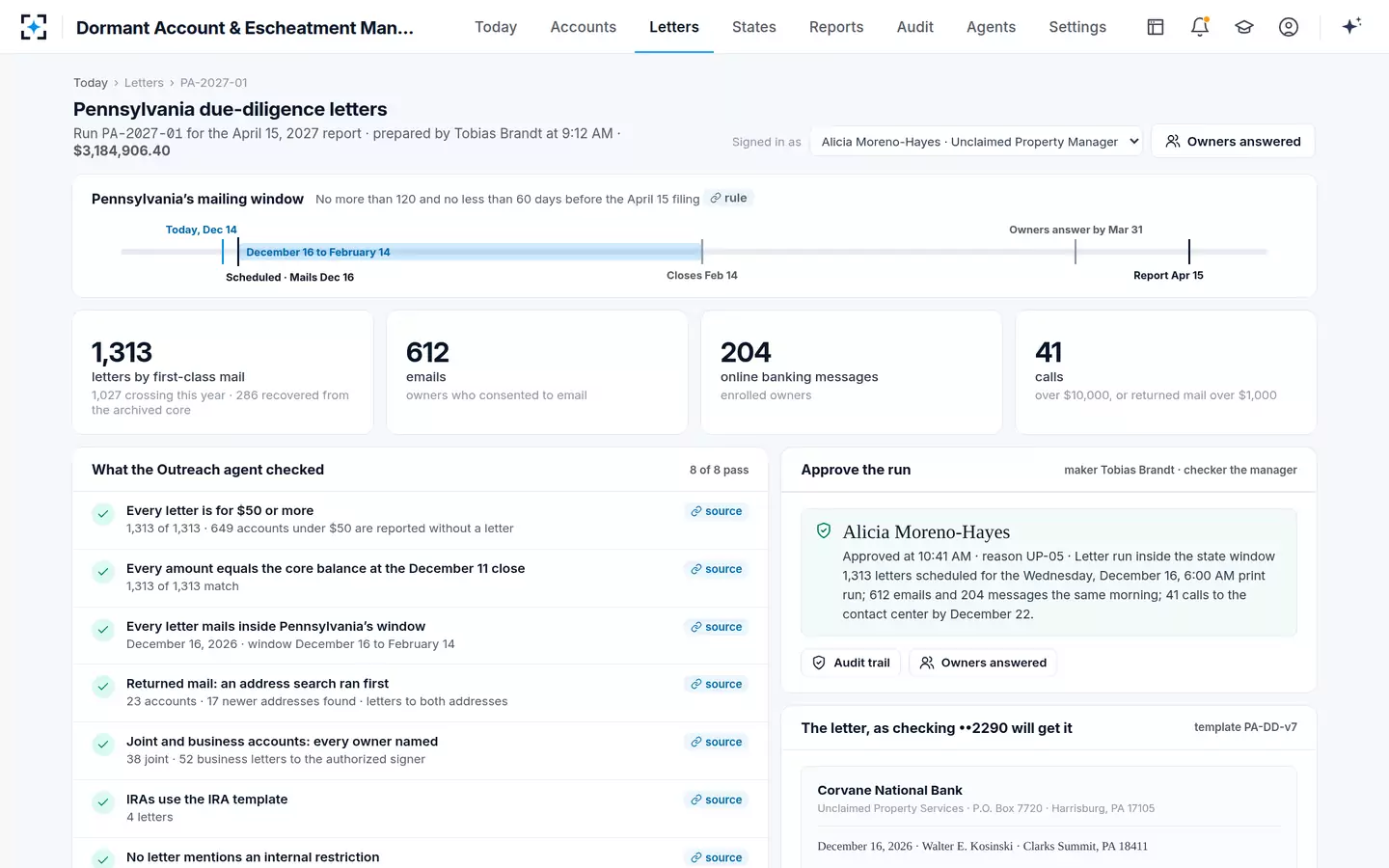
The law sets this one at 100%, so the measure is really the count of misses. Windows differ: Delaware allows a letter between 120 and 60 days before filing (§ 1148); Florida wants the first letter 90 to 180 days before and, over $1,000, a certified letter at least 60 days before (Fla. Stat. § 717.117); New York sets only latest dates, ninety and sixty days before the report (APL § 1422). Software that holds one window for every state, or that schedules from the date the letter run was built rather than from the report date, misses quietly.
The misses are of two kinds. Letters mailed too early fail the statute even if the owner answers; letters never mailed because the account was dated after the window closed leave the bank choosing between reporting without the required notice and reporting late. Ask for both counts.
Dormant Account & Escheatment Management checks a letter run against its window
Measure three: state files tied to the general ledger before money moves
Every file should equal the escheat suspense account to the cent before the manager approves it, and every difference should be traced to an account. The common failure is timing: a file built on Monday, an owner who walks into a branch on Tuesday, a reactivation that moves money back, and a file that is now wrong by exactly that balance.
In Corvane's New Jersey supplemental file, the difference was $1,212.40, traced to one checking account whose two owners had visited a branch the day after the file was built. With that account removed, the file of 148 owner records tied at $401,701.22, and only then did the manager approve it and the controller sign the remittance. The solution's design target is one day to tie a state file to the general ledger, where a manual tie-out can take weeks.
Measure four: owners who answer before the report
This is the measure that shows whether the letters are working, and the one that customers notice. Pennsylvania's Treasury describes the point of its notice rule plainly: "Complying with these new notification requirements may result in an owner recovering property or indicating an interest prior to the unclaimed property being remitted. If this is the case the property does not become reportable to Treasury." (Pa. Treasury holder reporting book)
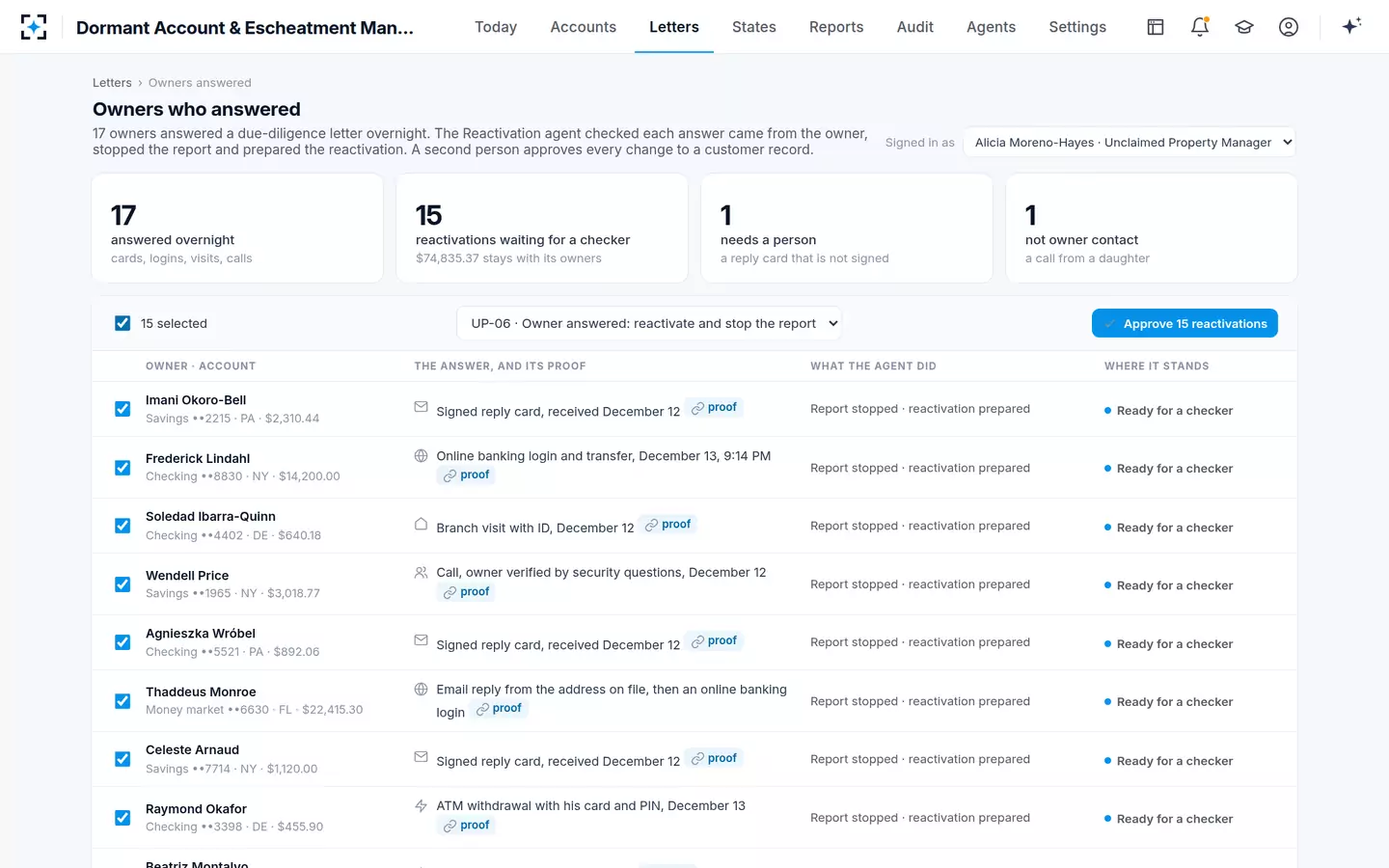
Count owners who answered and were reactivated before the report, and the balances that stayed with them. At Corvane, $9.3 million stayed with 4,412 owners who answered in 2026. The number depends on the letters, but also on the channels: email, online banking messages and calls where the owner consented, and an address search before any letter goes to an address the mail already came back from.
Each answer stops the report and waits for a second person
What does late or wrong reporting cost? The economics behind the four measures
Interest on property reported late, penalties for failures, the cost of the cycle itself, and the deposits that leave when owners are not asked in time. The first two come from statute. Pennsylvania's statute charges 12% a year from the date the report should have been filed (72 P.S. § 1301.24); Delaware's is 0.5% a month, capped at half the amount due.
One account shows the scale. Corvane's checking account ending 2290 holds $4,826.17. Dated from a system stamp, it looked active; dated from its owner's last branch withdrawal on March 4, 2019, it should have been in Pennsylvania's April 15, 2023 report. Reported in 2027, four years late, it carries interest exposure of up to about $2,317 at the statutory rate before any waiver, nearly half its balance. Multiply by the 2,370 late accounts a single conversion hid and the first measure becomes the expensive one.
The return on escheatment software, written as a sum
Interest avoided
Late balances × state rate × years late
Pennsylvania 12% a year; Delaware 0.5% a month, capped at 50%
Unclaimed Property Manager
Penalties avoided
Per-day and percentage penalties not incurred
Statutory maximums, before waivers
Deposit counsel
Deposits kept
Balances of owners reactivated before reporting
Funds that stay on the balance sheet
Head of deposit operations
Cost of the system
Licence + review time + compliance testing
Including the people who approve and sign
Finance
Outcome measures or activity measures: what most dashboards count
Most escheatment dashboards count activity: letters sent, accounts processed, reports filed on time. Those numbers rise whether the dates are right or not. The four outcome measures move only when the work is right, which is why they are the ones to put in a contract.
Activity counts against outcome measures
What dashboards often count: Accounts processed this cycle
What shows the software works: Accounts whose date was a stamp, found and corrected
What dashboards often count: Letters sent
What shows the software works: Letters owed but not mailed inside the window
What dashboards often count: Reports filed by the due date
What shows the software works: Files that tied to the general ledger before approval
What dashboards often count: Response rate to letters
What shows the software works: Balances that stayed with owners who answered
What dashboards often count: Users with access
What shows the software works: Calls the agents were unsure of, decided by a named person
What is the best escheatment software for a bank?
The one that scores best on the four measures on your own closed year, which is a test any vendor can be asked to run. Choose a year with a conversion or merger in it if you have one; that is where the differences show. The guide to unclaimed property audit procedures describes the replay, and the guide to escheatment services, software or agents runs one hard account through all three.
Before you sign: six requests to any escheatment software vendor
- Replay one closed year of ours
Report the four measures on it, account by account.
- Show the source behind ten dates we pick
Including at least one account touched by a conversion.
- Show a state rule change
Who approves it, and which reports it applies to.
- Show a window that has closed
What happens to an account dated a day too late.
- Show a file that does not tie
How the break is traced and who approves the corrected file.
- Show what the software can do alone
It should not send, file, reactivate or remit without a person.
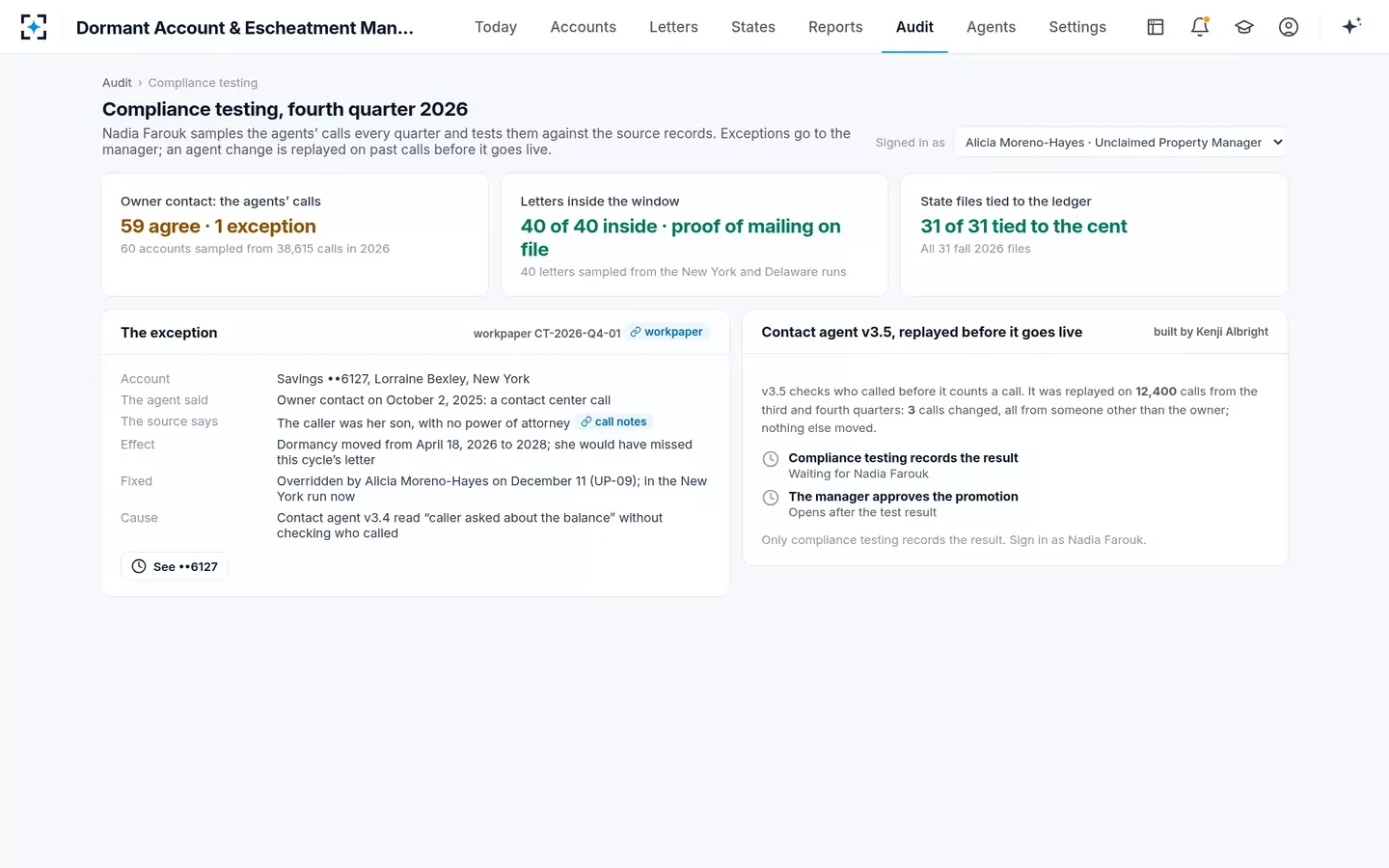
The four measures, tested every quarter
Which banks Dormant Account & Escheatment Management suits, and its limits
It fits a bank or credit union with dormant deposits owed to many states, at least one conversion or merger in its history, and the archived records to prove owner contact. Its agents read and check; the manager approves dates, letter runs, reactivations and files; the controller signs every remittance. The targets above are design targets, measured in each live deployment, not results promised in advance.
It is not a replacement for a state's portal or a bank's filing role, and it does not make the legal calls that belong to deposit counsel, such as whether to enter a voluntary disclosure. Details are on the Dormant Account & Escheatment Management page.
Questions people ask
What is escheatment reporting software?
Software that identifies property due to a state, prepares owner notices and writes the annual report in the format states accept, usually the NAUPA standard electronic file. Some of it also tracks dormancy across accounts; less of it proves the last owner contact behind each date.
Is there free unclaimed property reporting software?
Yes. NAUPA notes that state unclaimed property programs accept a free basic reporting program that produces the standard format. It formats and files reports; it does not date accounts from source records or run letter windows.
What is an escheatment system in a bank?
The combination of people, rules and tools a bank uses to meet its unclaimed property duties: a dormancy date for each account, letters inside each state's window, reports and remittances, and the records an examiner will ask for. Delaware requires those records for 10 years after each report.
How do you measure unclaimed property compliance?
With outcome measures on a closed year: accounts dated by a stamp rather than the owner, letters outside the window, files that did not tie to the general ledger, and owners reached before reporting. Each can be computed by replaying the year from source records.
Does escheatment software reduce audit risk?
Only if it improves the dates. A state examiner tests whether accounts that were not reported should have been; a tool that formats reports faster but trusts the core's last-activity field leaves that risk exactly where it was.