Escheatment services are outside firms that run a holder's unclaimed property work for it: they search the holder's data for property past its state's dormancy period, send the owner letters the states require, prepare and file the annual reports and arrange the remittance, while the holder keeps the legal duty and signs. They are one of three ways a bank can buy help. Reporting software formats the state file and the letters from a core extract that the bank's own staff run; an escheatment service does the same cycle with its people, usually from the same extract; and an agent-based system reads each account's source records and leaves every approval to the bank's people. On a clean account all three produce the same report. On a hard one, an account the core shows as active because a conversion and a system release stamped it, they produce three different answers, and only one is right. Botminds' Dormant Account & Escheatment Management is the third kind: six agents read today's core and the archived one, date the account from the owner's last real contact, and hand every letter run, reactivation and state file to an Unclaimed Property Manager to approve.
The comparison below names no firm or product. It describes what each kind of help sees, does and leaves to the bank, and the questions that separate them.
Three approaches, one account: what each sees and decides
| Reporting software | Escheatment service | Agents with people approving | |
|---|---|---|---|
| What it reads | A core extract for one report year | The extract, plus what the bank sends on request | Every event in today’s core and the archived core, imaging, logs |
| Date it uses | September 21, 2024, the core’s field | Usually the core’s field, unless a review is bought | March 4, 2019, the last owner contact, cited |
| When it reports the account | April 15, 2028 | April 15, 2028, unless research finds otherwise | April 15, 2027, as late property |
| The letter | Not this cycle | Not this cycle | December 16, inside the window, to two addresses, plus a call |
| Who approves | Whoever runs the tool | The service, then the bank signs | The bank’s manager; the controller signs the money |
| Evidence left behind | The file and the letter list | The service’s work papers | The source of every date and every approval |
What are escheatment services, and what do the other two sell?
An escheatment service sells people and their process. The statute is the clearest map of what it can take on: Delaware says a holder "may contract with a third party to make the report required", and still requires every report to carry the holder's signature, or one made for it, and a verification that it is complete and accurate (Del. Code tit. 12 §§ 1142(b), 1143(a)(1)). So a service can review the dormant property, mail the letters, build the file in each state's format and send it, and help answer a state's examination questions. What it works from is the deciding detail: most services start from an extract the bank produces, so the dormancy dates in that extract are the bank's, not the service's.
Reporting software is the oldest category: it produces the annual report in the standard format the states accept, and NAUPA's advice to holders is short: "It is important to select software which will produce a report in the NAUPA standard electronic format" (NAUPA). States also accept a free basic program that does exactly that, so formatting alone is not worth paying much for. Agent-based systems sell the work in between: reading each account's events and deciding which are the owner's, applying the state's rules, drafting, reconciling, with the bank's own people approving each step. Many providers blend the categories, so the useful question is not what a provider calls itself but where its dormancy date comes from.
One change is coming to every category. NAUPA is re-engineering the file format, and says "The NAUPA III release is expected in the coming year and will co-exist with NAUPA II during transition to the new format" (NAUPA). A buyer signing a multi-year contract should ask how and when each provider will support the new format, and whether the bank will have to file in both during the changeover. It is a fair question for a reporting tool or a service, whose main output is the file; it matters less for a system whose main job is deciding what goes in it.
One hard account, three ways
The test account is the kind a bank that has converted its core system is likely to hold. It comes from a sample bank, Corvane National Bank, which is fictional. Walter E. Kosinski opened checking ending 2290 at a Pennsylvania branch in 2014; the balance is $4,826.17. His last act was a $300.00 cash withdrawal at the branch on March 4, 2019, recorded in the core that was retired in June 2021, with a signed slip in document imaging. After that came 151 monthly interest postings, statements returned as undeliverable from October 2019, the conversion's load date, and a 2024 release that touched the contact date. The core now says last activity September 21, 2024.
The same account on two clocks
- Stamps and interest look like activity
- Dormant 3 years from the stamp
- Wait
- Dormant 3 years
- To report
- Late: four reports missed
Approach one: reporting software working from a core extract
Reporting software sees an active account and leaves it alone. Its extract asks the core for accounts whose last-activity date passed each state's dormancy period by the cut-off, and this account's date is 2024. The tool is working correctly; the input is wrong. If nothing changes, the account becomes reportable in the cycle after September 2027 and goes to Pennsylvania in the April 15, 2028 report, five years after it was due.
North Carolina's Treasurer describes both halves of the problem in its guide for financial institutions: conversions and system changes that move contact dates when no owner acted, and compliance software that looks only at the current report year, so older accounts never surface (N.C. Department of State Treasurer). Reporting software is good at what it does. What it does starts after the date has been decided.
Approach two: an escheatment service working from what it is sent
An escheatment service sees what it is sent. If the bank sends the same extract, the service reaches the same answer as the software, with more people involved. A service can do better if its contract includes research into the archived core, and that research is exactly the work a buyer should price separately: how many accounts, from which systems, with what evidence kept.
What a service cannot take is the liability. Once a holder has contracted the report out, Delaware's statute says "the holder is responsible to the State Escheator for all of the following", beginning with complete, accurate and timely reporting (Del. Code tit. 12 § 1142(c)). The same statute follows the duty through a merger: "the holder's successor by merger or consolidation, or any person or entity that acquires all or substantially all of the holder's capital stock or assets, shall be responsible for fulfilling the holder's obligation" (§ 1147(b)). A bank that bought another inherits its dormant accounts, its dates and its errors.
Approach three, Dormant Account & Escheatment Management: each event marked by who caused it
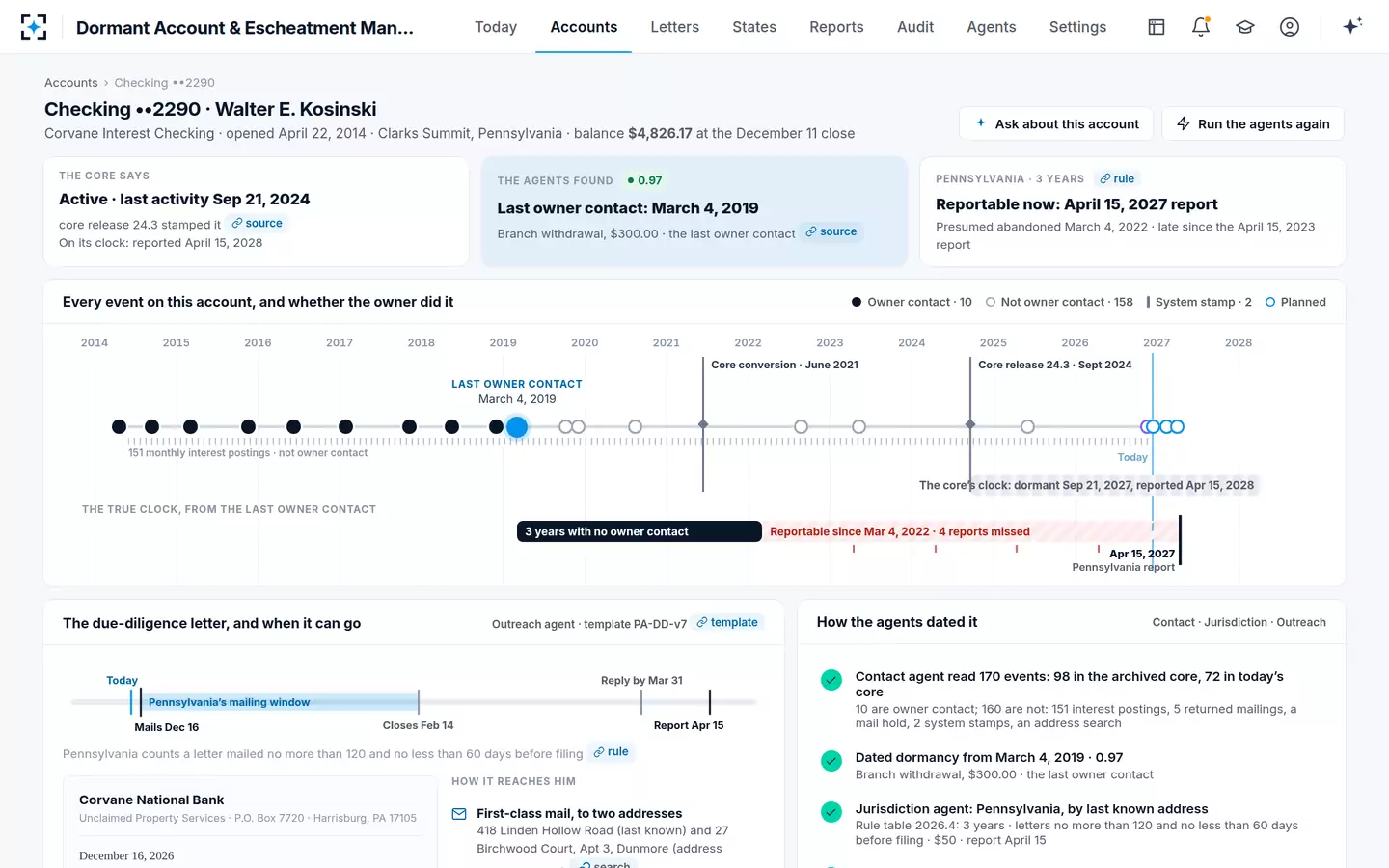
The dated line is what an examiner would reconstruct by hand
Approach three: agents reading source records, people signing
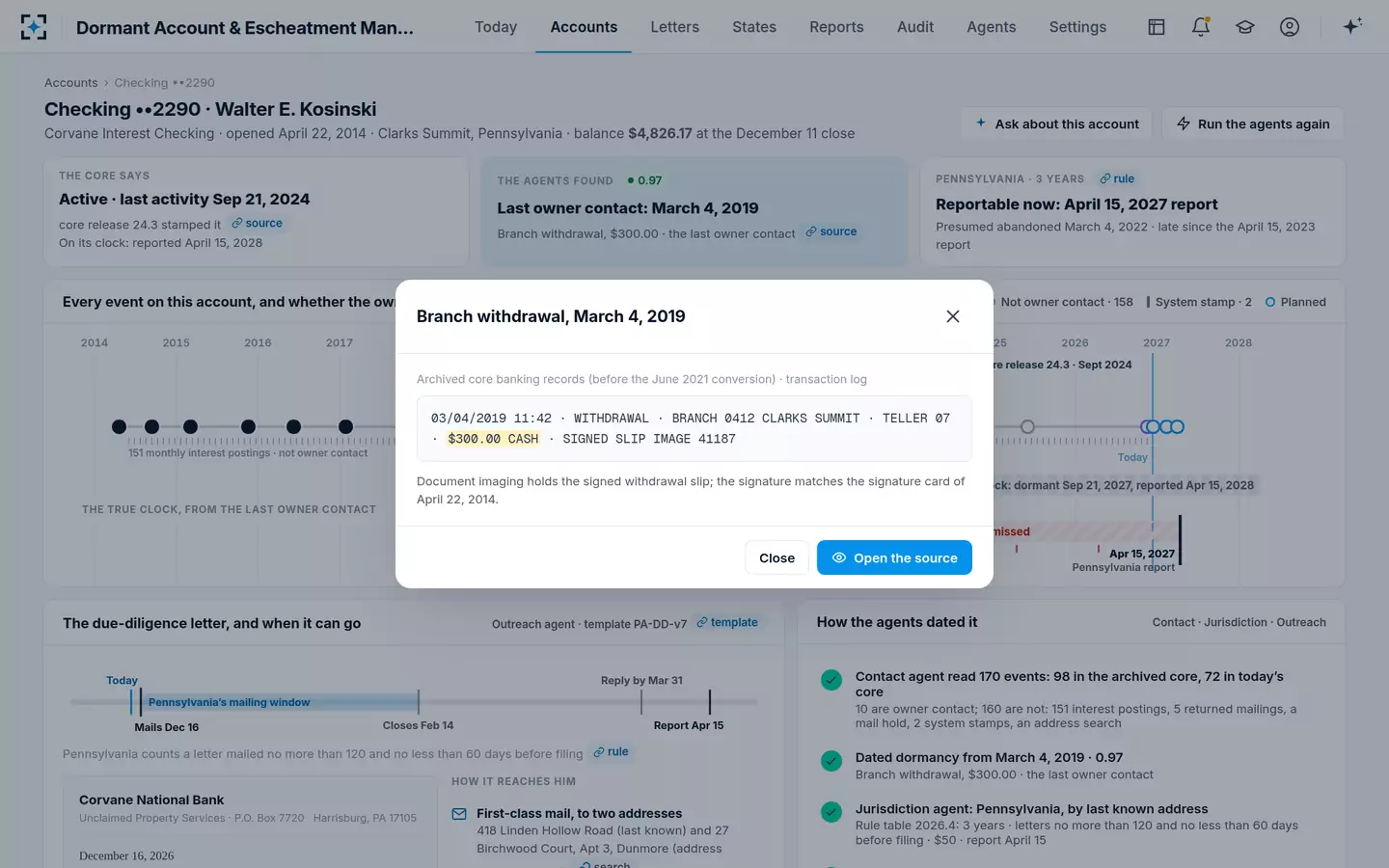
The Contact agent reads every event on the account in today's core and the archived core and marks each as owner contact or not under Pennsylvania's rule, citing its source. The last owner contact is the March 4, 2019 withdrawal; the interest postings, the returned statements and both system stamps are cited as not owner contact. Pennsylvania's three years ran out on March 4, 2022, so the account goes into the April 15, 2027 report as late property, with a note to the state drafted for deposit counsel.
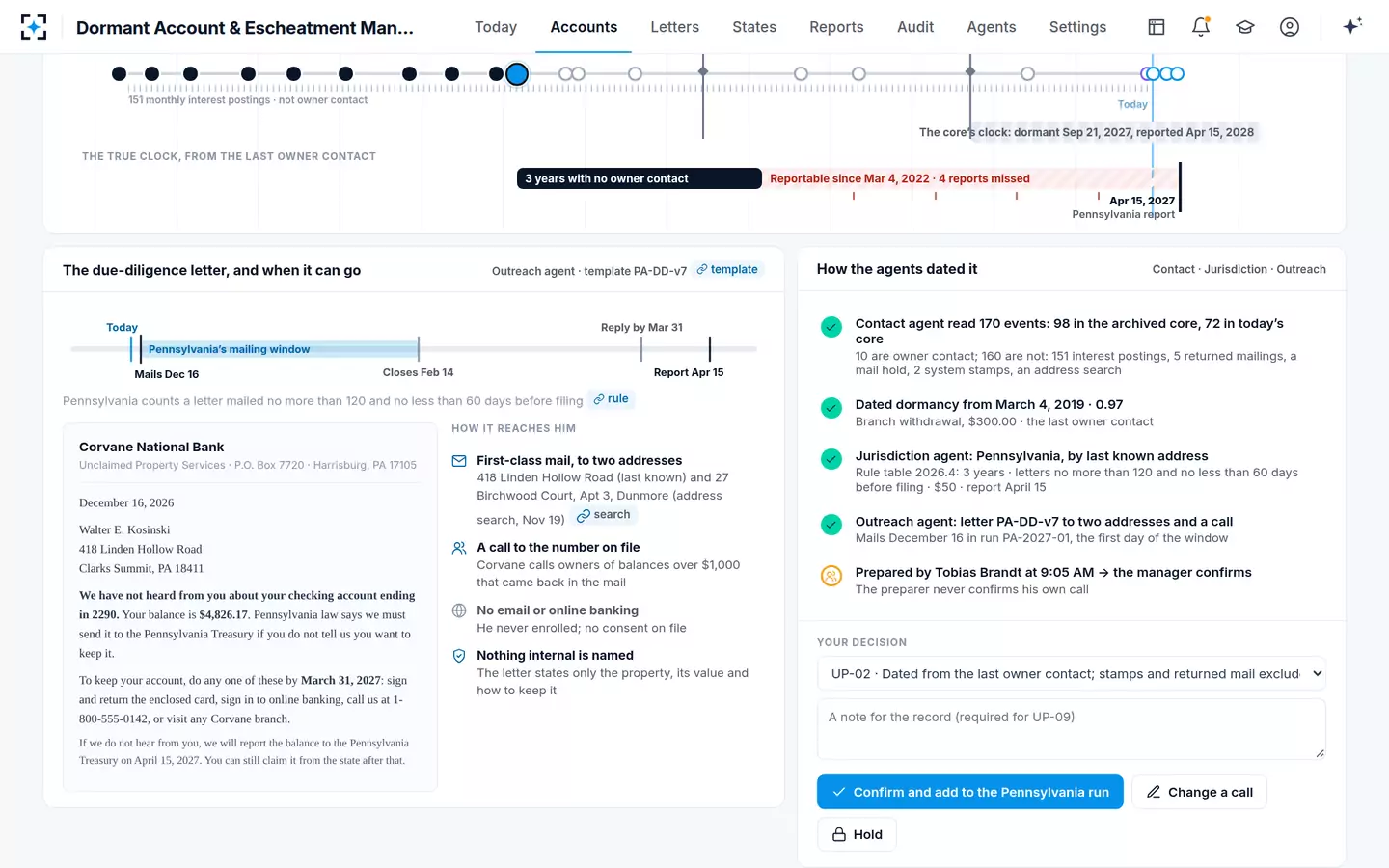
The Outreach agent drafts the due-diligence letter for December 16, the first day of Pennsylvania's window, to the last known address and to a newer one an address search found, and adds a call because the balance is over $1,000 and the mail came back. Then the people take over. The analyst prepared the date, so the manager confirms it; the manager approves the letter run; if the owner answers, a second person approves the reactivation.
The evidence behind the date in Dormant Account & Escheatment Management
What the one account shows
5years
late, if the core’s date is trusted: due 2023, reported 2028
1
letter that would never have been sent, inside a 60-day window
151
interest postings that looked like activity and were not
What stays the bank's responsibility whichever provider you choose?
All of it, in law. The report is the holder's statement: Florida requires it to "state that it has complied with the due diligence requirements of this section" (Fla. Stat. § 717.117), and Pennsylvania wants the holder's own affirmation that its owner notices went out (72 P.S. § 1301.10a). The choice of provider changes who does the work and how good the evidence is, not who signs.
That has a practical consequence for buying. A tool or service whose work the bank cannot see account by account asks the bank to sign on trust. A bank should be able to open any account in a report, or any account left out of one, and see why.
Buying a service against keeping the work with agents
Escheatment service: The service’s staff, from data the bank sends
Agents in the bank, people approving: Agents, from the bank’s own systems, every night
Escheatment service: Only if the contract buys the research
Agents in the bank, people approving: Read for every converted account
Escheatment service: Routed back to the bank to act on
Agents in the bank, people approving: Stop the report in the draft file the same day
Escheatment service: The service’s own tables
Agents in the bank, people approving: A rule table the bank’s counsel approves
Escheatment service: The service’s work papers, on request
Agents in the bank, people approving: Kept by the bank behind every date
Escheatment service: The bank
Agents in the bank, people approving: The bank
Should a bank outsource escheatment?
Outsource when the problem is capacity and the dates are already right; keep the work in the bank when the dates are the problem. A small institution with one core system, no conversion and owners in a handful of states may need little more than a service, or software that produces the standard file, and a sound process around it. A bank that has converted or merged, reports to dozens of states and holds tens of thousands of dormant accounts needs something that tests the dates, because that is where its exposure is, and a service working from the bank's extract has no reason to reopen a date the extract supplied.
Price the two the same way. A service's fee for the annual cycle is the visible cost; the research into converted accounts, the second look at returned mail and the evidence kept for an examiner are the costs that decide whether the report is right, and each should be a named line in the contract or a named step in the bank's own process.
The fair test is the same for every provider: give each a closed report year and ask which accounts it would have reported, which it would have written to, and on what evidence. The guide to escheatment software sets out four measures for scoring the answers, and the guide to what counts as activity on a bank account lists the events a dating rule must handle.
Questions to ask escheatment service providers and unclaimed property software vendors
Ask questions that only have good answers if the product does the hard part. A provider that can show the evidence behind ten dates you choose, including accounts touched by a conversion, is a different proposition from one that can only show a finished report.
Seven questions that separate the three kinds of provider
- Where does your dormancy date come from?
The core’s field, the bank’s extract, or the account’s own events?
- Can you read our archived core?
And how is each pre-conversion event cited?
- How do you treat linked accounts?
New York allows activity on one account to count for a customer’s linked accounts, within limits.
- Which rules are yours and which are ours?
Who approves a change, and how is the version recorded?
- What happens when an owner answers after the file is built?
The file and the general ledger must still agree.
- What can your product do without a person?
It should not send, file, reactivate or remit.
- What will an examiner get?
The evidence behind each date and approval, for ten years after each report in Delaware.
The letter the core's date would never have produced
When reporting software alone is enough
When the dates are already right. A bank that has never converted its core, keeps contact fields that only owner actions can change, and can show that unreturned mail is never treated as contact may be well served by reporting software and a careful analyst. The test is simple: replay one closed year from source events and count the accounts whose dates change. If the count is close to zero, the extract is trustworthy.
If the count is not close to zero, the comparison above applies, and the decision is between paying a service to do the research once and keeping it running in the bank every night. Botminds' solution is described on the Dormant Account & Escheatment Management page.
Questions people ask
What do unclaimed property reporting services do?
They do the holder's statutory tasks on its behalf: find the property, notify the owners, report and remit. In Delaware every report has had to be filed as a web-based record since March 1, 2018, so the service files online for the holder, and the report must still be signed by or for the holder and verified as complete and accurate.
Is there free unclaimed property reporting software?
Yes. NAUPA, the association of state unclaimed property administrators, says the state programs accept a free basic reporting program that produces the standard format, which all 50 states have used since 2004. It formats and files a report; it does not date accounts, run letter windows or keep the evidence behind either.
How long must a bank keep escheatment records when a service did the work?
As long as the state requires, whoever kept them. Delaware's rule is ten years after the report was filed, unless the State Escheator sets a shorter period by rule, and a holder that has received an examination notice must keep records until the examination and any appeal end. A contract should say who holds the work papers and how the bank gets them back.
Who pays if an escheatment service files late?
The bank. Delaware holds the holder responsible for complete, accurate and timely reporting even when a third party files, and charges interest of 0.5% a month on amounts paid late, capped at half the amount due, before any penalty for the late report itself. Whether the bank can recover that from the service is a contract question, not a statutory one.
Can unclaimed property software find accounts a core conversion reset?
Only if it reads something other than the converted core's last-activity field. North Carolina names conversions as a common cause of dates that reset incorrectly; finding those accounts means comparing each one with the archived records from before the conversion.