What counts as activity on a bank account, for dormancy and escheat, is what the owner does: a deposit or withdrawal the owner makes, a check the owner writes, a visit to a branch, a signed letter, a call the bank records, and in many states signing in to online banking to look at the account. What does not count is everything the bank or its systems do on their own: interest credited, statements mailed, service charges, letters sent, returned mail, and the dates a conversion or software release writes into the core. The distinction is the whole of escheat compliance, because every dormancy clock runs from the last time the owner acted. Botminds' Dormant Account & Escheatment Management applies it event by event: its Contact agent marks each event on an account as owner contact or not, under the rule of the owner's state, and cites the record it relied on.
States agree on the core of the rule and disagree at the edges, on automatic payments, logins and calls from people other than the owner. Those edges are where a bank's core system, which records any posting as activity, gets the answer wrong.
Owner activity against everything else on the account
Resets the dormancy clock: A deposit or withdrawal the owner makes; a check the owner writes
Does not reset it: Interest the bank credits; service and dormancy charges
Resets the dormancy clock: A letter or signed form from the owner about the account
Does not reset it: Statements and notices the bank mails, returned or not, outside Pennsylvania’s certified-receipt rule
Resets the dormancy clock: A call from the owner that the bank records at the time
Does not reset it: A call from a relative or stranger without authority
Resets the dormancy clock: Signing in to view or use the account, in Delaware, New York and the uniform act
Does not reset it: An automated alert, or a login nobody can tie to the owner
Resets the dormancy clock: —
Does not reset it: Conversion load dates, release stamps, field updates
What is considered an active bank account in escheat law?
An account whose owner has shown an interest in it within the state's dormancy period. Delaware's list is typical of the modern statutes. It counts "A record communicated by the owner to the holder" about the account; an oral communication if the holder "contemporaneously makes and preserves a record of the fact of the owner's communication"; and "Activity directed by an owner in the account in which the property is held, including accessing the account or information concerning the account, or a direction by the owner to increase, decrease, or otherwise change the amount or type of property held in the account" (Del. Code tit. 12 § 1136(b)).
The uniform act adds a catch-all: "any other action by the apparent owner which reasonably demonstrates to the holder that the apparent owner knows that the property exists" (RUUPA § 210(b)(7)). Older statutes use plainer words. Texas counts from "the date of the depositor's last transaction or correspondence concerning the account" (Tex. Prop. Code § 73.101). Pennsylvania lists what keeps a deposit alive: the owner changing its amount, having "corresponded in writing with the holder concerning the deposit", changing or agreeing to new terms in writing or electronically, or a writing on file showing interest (72 P.S. § 1301.3).
Does interest count as activity on a bank account?
No. Interest is credited by the bank, not directed by the owner, and the statutes that mention it say so. Pennsylvania counts an owner who "increased the amount of the deposit, shares or claim, otherwise than by the crediting of accrued interest, or decreased it" (72 P.S. § 1301.3). The uniform act counts deposits and withdrawals "other than an automatic reinvestment of dividends or interest" (RUUPA § 210(b)(5)). North Carolina's guide lists automatic interest postings among the things that are not positive owner contact (N.C. Department of State Treasurer).
There is one old exception that proves the rule. Florida counts an owner who "presented the passbook or other similar evidence of the deposit for the crediting of interest" (Fla. Stat. § 717.106(1)(a)): the act that counts is the owner bringing in the passbook, not the interest. New York's banking guidance says the same about passbook updates and asks banks to get the depositor's signature when they happen.
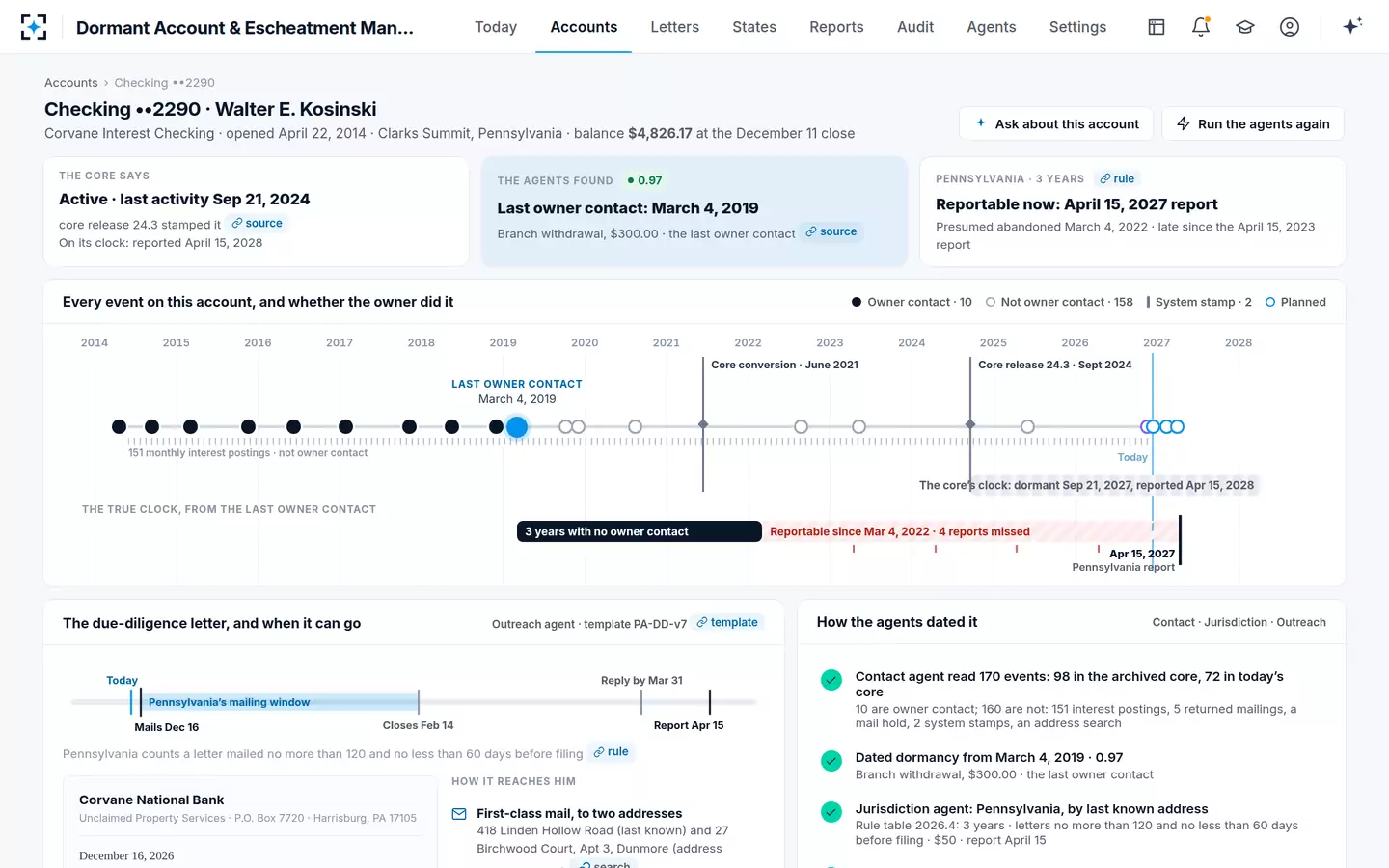
On one account, the owner made 10 of the events
Does logging in count as activity on a bank account?
In many states, yes, if the login can be tied to the owner. Delaware's words, "accessing the account or information concerning the account", cover an owner who signs in only to look. New York's Comptroller counts "a verifiable login by the owner using a website or mobile application made available by the holder", citing its regulations at 2 NYCRR Part 125 (N.Y. OSC banking reference sheet). North Carolina's definition of positive owner contact includes "certain online banking transactions" (N.C. guide), which is narrower: a transaction, not a glance.
The hard part is the word "verifiable". A login from the owner's usual device, followed by a transfer, is strong evidence. A login from a new device, with nothing else, may be the owner, a relative with the password, or a fraudster testing credentials. That is the kind of event an agent should hand to a person rather than decide, and in Dormant Account & Escheatment Management it does: below the agent's confidence threshold, the analyst makes the call.
Automatic deposits and drafts: where states disagree
A payroll deposit or a monthly bill payment the owner set up years ago is the clearest disagreement between states. The uniform act counts "a deposit into or withdrawal from an account at a financial organization, including an automatic deposit or withdrawal previously authorized by the apparent owner", excepting only reinvested dividends and interest (RUUPA § 210(b)(5)). North Carolina's guide, by contrast, leaves automatic drafts out of positive owner contact altogether.
So the same recurring payment keeps an account alive for an owner in a state that follows the uniform act and lets it go dormant for an owner in North Carolina. A bank that applies one house rule to every state will be wrong in one direction or the other: reporting accounts too early, which forces owners to claim back money they were using, or too late, which carries interest. The rule has to follow the owner's state.
Contested events, state by state
| Event | Delaware | Uniform act | North Carolina | Pennsylvania |
|---|---|---|---|---|
| Interest credited | Not owner-directed | Excluded | Excluded | Excluded |
| Owner signs in to view | Counts | Counts | Only certain transactions | Not stated |
| Pre-authorized automatic payment | Not stated | Counts | Excluded | Not stated |
| Call from the owner | Counts if recorded at the time | Counts if recorded at the time | Counts, documented | Not stated |
| Contact by someone else | Only if it shows the owner knows | An agent’s act is presumed the owner’s | Not stated | Not stated |
| Activity on another account | Counts for all the owner’s accounts | Not stated | Not stated | Counts if owner acted on other property |
| Statement received, with proof | Not stated | Not stated | Unreturned mail excluded | Counts, by certified mail or similar record |
Calls, letters and people other than the owner
An owner's call counts in most statutes if the bank wrote it down at the time; a call from anyone else is harder. Florida counts communication "in writing or by documented telephone contact" (Fla. Stat. § 717.106), and Delaware an oral communication the holder records as it happens. Delaware then shuts out third parties: a communication from someone other than the bank counts only if a record of it shows the owner knows of the property. The uniform act takes the opposite starting point and presumes that an agent's or representative's act is on the owner's behalf.
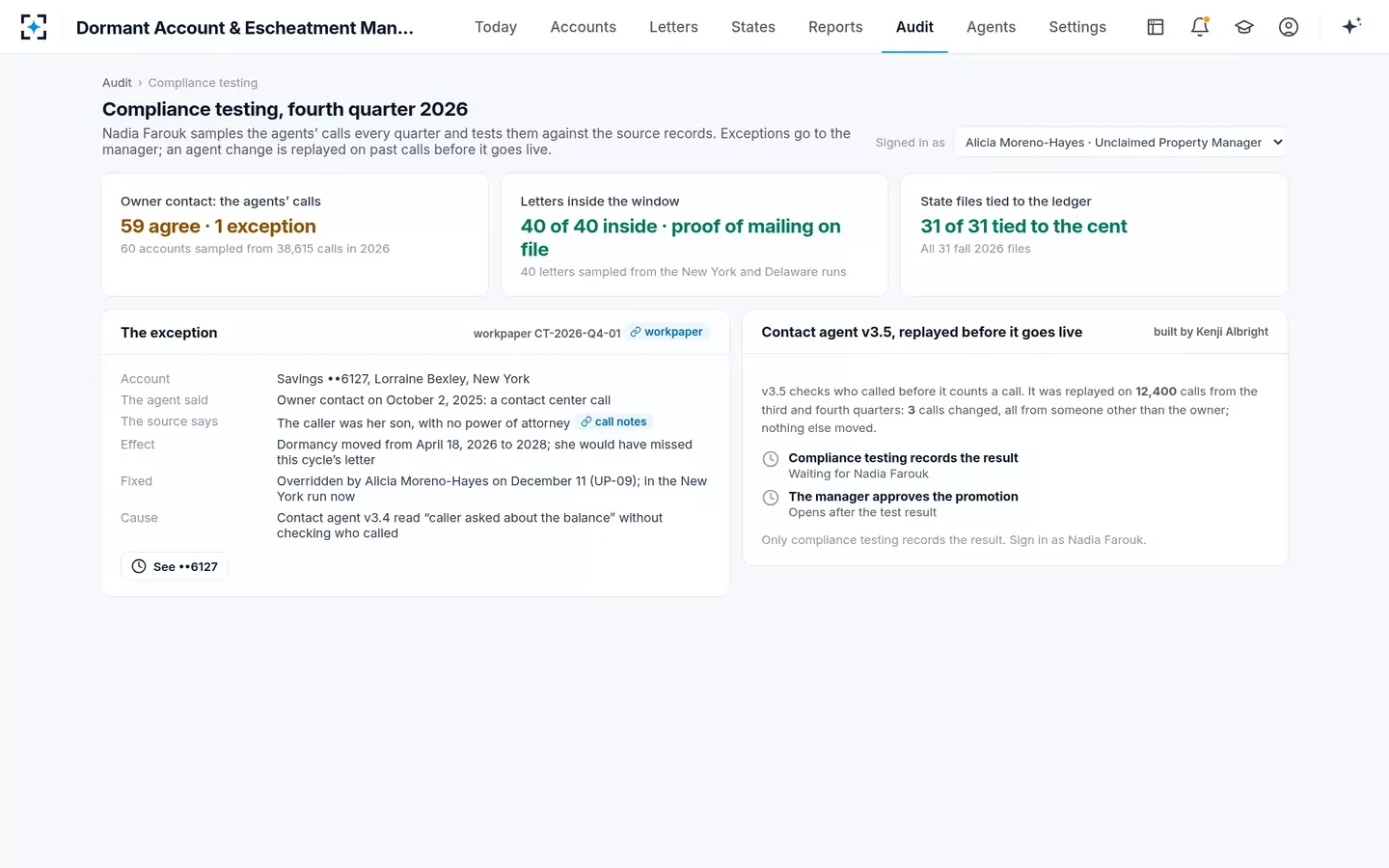
In practice a bank needs to know who was on the phone and with what authority. A daughter calling about her father's balance without a power of attorney is not the owner; an agent acting under a valid power of attorney may be, in a state that presumes it. The answer has to be in the call notes, and when it is not, a person should decide.
A communication with an owner by a person other than the holder or the holder's representative is not an indication of the owner's interest in the property unless a record of the communication evidences the owner's knowledge of a right to the property.
Delaware Code, title 12, § 1136(c)
Pennsylvania adds an unusual form of contact that runs the other way: an owner who "received tax reports or regular statements of the deposits, shares or claim by certified mail or other method of communication that will provide the financial institution with a record that such report or statement was transmitted and received" (72 P.S. § 1301.3). An ordinary statement that simply was not returned is not that; a signed receipt is.
The call that was not the owner's
Does activity on another account count?
Often, yes: in several states an owner's activity on one account keeps the owner's other accounts with the same bank alive. Delaware says it directly: "If an owner has more than 1 investment or account with a holder, an indication of owner interest with respect to 1 investment or account with that holder is an indication of the owner's interest in all accounts of the owner with respect to that holder" (§ 1136(g)). Pennsylvania keeps a deposit alive if the owner "owned other property held by the financial institution" on which the owner acted.
New York allows linkage with conditions. The owners must be authorized signers on every linked account, with their tax identification number on each and the same address, and "It's unacceptable to link personal accounts to corporate accounts, estate trusts or trust accounts as these are separate legal entities" (N.Y. OSC). Its own example: a savings account untouched for three years, a checking account with checks debited last month; "the recent activity in the checking account precludes the reporting of the savings account."
Linkage cuts both ways for a bank. Ignoring it reports accounts whose owners are plainly present. Applying it loosely, across a business account and a personal one, keeps accounts off a report they belong on.
Why the core's last activity date is often wrong
Because the core records events, not intentions, and many of its events are the bank's own. North Carolina's Treasurer lists the failures it sees at financial institutions: conversions that reset aging dates, mergers that lose them, system changes that rewrite contact fields when no owner did anything, and unreturned statements treated as proof the owner is there (N.C. guide).
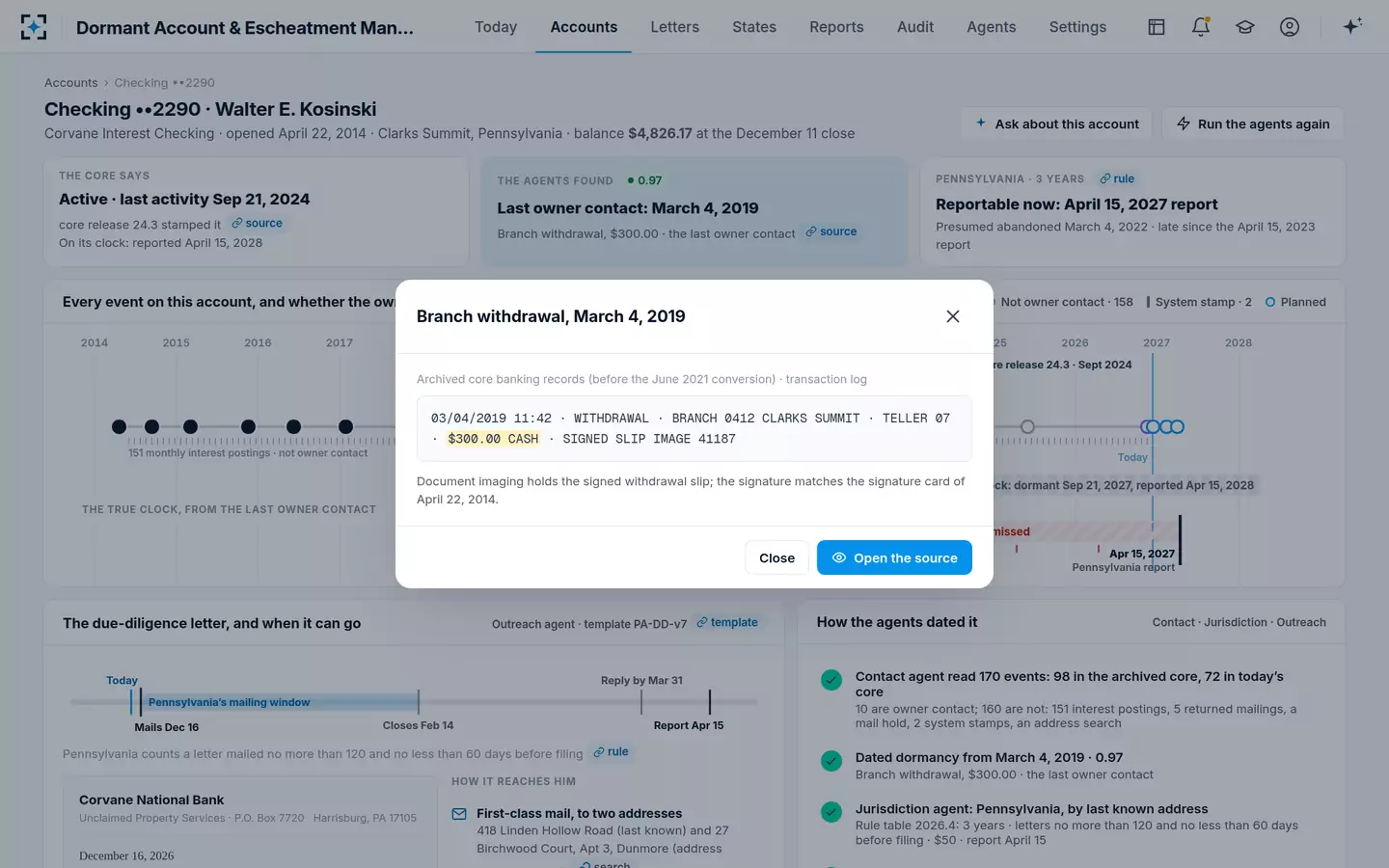
Take a sample bank, Corvane National Bank, which is fictional. Its core says checking ending 2290 had activity on September 21, 2024. That date is a stamp from a core release. Before it came a 2021 conversion that wrote its load date into the account, 151 monthly interest postings, and statements returned from the address on file. The owner's last act was a $300.00 cash withdrawal at a branch on March 4, 2019, recorded in the archived core and backed by a signed slip.
The last owner contact, with its source, in Dormant Account & Escheatment Management
Dormant Account & Escheatment Management: owner contact and everything else on one line
The guide to escheatment dormancy periods by state shows how long each state's clock runs once the last owner act is known, and the solution itself is on the Dormant Account & Escheatment Management page.
Dormant account vs inactive account: is there a difference?
Inside a bank, sometimes; in escheat law, no. North Carolina's Treasurer notes that the two words are usually used interchangeably and that some institutions call an account inactive after one year without owner contact and dormant after two. Those labels drive a bank's own handling: restrictions, statement cycles, fees where allowed. The legal question is separate: whether the owner has shown interest within the state's three or five years.
Five checks before treating an event as owner activity
- Who started it?
The owner, someone with authority, or the bank and its systems.
- Is there a record made at the time?
A transaction log, a signed slip, call notes, a login record.
- Which state’s rule applies?
The state of the owner’s last known address decides logins and automatic payments.
- Does it touch this account or another?
Linkage counts in some states, with conditions.
- Would it survive an examiner’s question?
If the answer depends on a field the core rewrote, it would not.
Questions people ask
What is dormant account activity?
Any action by the owner on an account the bank has marked dormant: a deposit, a withdrawal, a signed letter, a call the bank records, often a login. In escheat terms it is an indication of interest, and it restarts the state's dormancy period from that day.
Does a direct deposit keep a bank account active?
It depends on the owner's state. The uniform act counts an automatic deposit or withdrawal the owner authorized, while North Carolina's guidance excludes automatic drafts. A bank should apply the rule of the owner's state rather than one house rule.
Does checking my balance count as activity?
In Delaware, yes: accessing the account or information about it counts. New York counts a verifiable login. Other states may require a transaction, so the safest course for an owner is to make a deposit or withdrawal, or write to the bank.
Does a bank statement count as activity?
No. A statement is the bank's act. Pennsylvania is an exception only where the owner received statements by certified mail or a similar method that gives the bank a record of receipt; an ordinary statement that was not returned is not evidence the owner is there.
How long before a bank account goes dormant?
Some banks mark an account inactive after a year and dormant after two, by their own rules. For escheat, the state's period applies: three years in 27 jurisdictions and five in 24, counted from the owner's last act.
What is considered an inactive bank account?
One whose owner has not acted on it for the period the bank chooses, commonly a year. It is a bank label, with no legal consequence by itself; the legal clock is the state's dormancy period, which only owner activity resets.