CD escheatment is the point at which a certificate of deposit becomes unclaimed property, and for an automatically renewing CD it usually comes earlier than a bank's systems suggest. In Delaware, Florida, Washington and the Revised Uniform Unclaimed Property Act, a renewable deposit is treated as matured on its first maturity date unless the owner consented to the renewal in a record at or about the time it happened; the dormancy period then runs from that first maturity, not from the latest rollover. A CD that has renewed itself quietly for years can be dormant, or overdue for reporting, while the core shows a live account with fresh maturity dates. Botminds' Dormant Account & Escheatment Management applies each state's CD rule when it dates an account, from the original issue and maturity dates and the owner's own contacts, and leaves the decision to report with the Unclaimed Property Manager.
Renewals are the bank's act, not the owner's, which is why they do not reset the clock. What does reset it is the owner's own contact with the CD, or with another account in states that let activity on one account count for all.
Two auto-renewing CDs, bought the same day, reported four years apart
- To first maturity
- Dormancy: 3 years
- Term ends
- Report
- To first maturity
- Dormancy: 3 years
- Term ends
- Report
When does a CD escheat?
When the state's dormancy period has run from the later of the CD's maturity or the owner's last indication of interest, and the next report date arrives. For a CD that matures and simply sits, maturity starts the clock. For a CD that renews automatically, most modern statutes fix maturity at the first one. In New York, "In the absence of depositor contact, the three-year dormancy period on time deposits begins at the first maturity" (N.Y. OSC banking reference sheet).
The periods themselves vary as they do for other deposits: three years in New York, Texas, Pennsylvania and Washington, five in Delaware and Florida, and ten in North Carolina, which presumes matured CDs abandoned "ten years from the date of initial maturity" or from the last indication of owner interest (N.C. guide).
CD escheatment rules in seven states and the uniform act
| State | Period | Clock starts | First-maturity rule |
|---|---|---|---|
| Delaware | 5 years | Earlier of maturity or last owner interest | Yes, unless consent on record at renewal |
| Florida | 5 years | Matured deposit; owner activity within 5 years | Yes, unless the owner consented at renewal |
| North Carolina | 10 years | Initial maturity, or last owner interest | Auto-renewing CDs age from the first maturity |
| New York | 3 years | First maturity | Yes; the term in progress runs to its end |
| Pennsylvania | 3 years | Matured time deposit; owner activity | Not stated in the section read |
| Texas | 3 years | Matured CD; depositor’s last transaction | Not stated in the section read |
| Washington | 3 years | Later of maturity or last owner interest | Yes, unless consent on record at renewal |
| RUUPA model | 3 years | Later of maturity or last owner interest | Yes, unless consent on record at renewal |
Do CDs escheat if they keep renewing? The first-maturity rule
Yes. A renewal the bank processes automatically does not show the owner knows the CD exists, so most statutes look through it. Delaware's text is typical: a time deposit "including a deposit that is automatically renewable" is presumed abandoned five years after maturity or the owner's last interest, "except a deposit that is automatically renewable is deemed matured on its initial date of maturity unless the owner consented in a record on file with the holder to a renewal at or about the time of the renewal" (Del. Code tit. 12 § 1133(5)). Washington's statute and the uniform act use the same words with a three-year period.
Florida reaches the same place with a slightly wider door for consent. A renewable deposit matures "upon the expiration of its initial time period", except for a renewal to which the owner consents "by communicating in writing with the banking or financial organization or otherwise indicating consent as evidenced by a memorandum or other record on file prepared by an employee of the organization" (Fla. Stat. § 717.106(4)). A branch employee's note of a call in which the owner asked to roll the CD over is enough in Florida.
North Carolina's Treasurer puts it in operational terms: "CDs that automatically renew begin to age for abandonment on the first maturity date following instrument purchase", and advises banks to contact the owner before that first maturity (N.C. guide).
How long before a CD is considered abandoned?
The state's dormancy period after the first maturity, plus, in practice, the time to the end of the term in progress and the next report date. New York's own examples show how far that can stretch. A two-year CD bought on February 14, 2019 first matures in 2021, goes dormant in February 2024 in the middle of its third term, runs to the end of that term in February 2025, and is reported on November 10, 2025. A five-year CD bought the same day first matures in 2024, goes dormant in 2027, completes its term in 2029 and is reported on November 10, 2029.
The rule New York applies to the term in progress is short: "If the rollover is prior to the dormancy date, then it continues to maturity." But the bank need not wait: it "may break the term to escheat at the dormant date at no cost to the account owner", and must break a CD that has rolled over after it went dormant, also at no cost (N.Y. OSC).
The numbers that set a CD's escheat date
1st
maturity: where the dormancy clock starts for an auto-renewing CD
DE, FL, NY, WA, uniform act
10years
North Carolina’s period for matured CDs, against 5 for its checking
3years
New York’s period, run to the end of the term in progress
Does a CD renewal count as activity?
Not by itself. An automatic renewal is a posting the bank makes, like an interest credit; New York says plainly that "Only a customer-generated activity may change the dormancy date" for time deposits. What turns a renewal into owner activity is the owner's consent to it, on record, at or about the time of the renewal: a signed instruction, a call the bank noted, a choice made in online banking.
That makes the evidence different from a checking account's. For a CD the analyst looks for the original issue date, each maturity date, and any record of the owner choosing a renewal. New York tells banks to "maintain records of the original issue or maturity date" for exactly this reason. A core that overwrites the maturity date at each rollover, and keeps no history, has thrown away the date the law counts from.
An auto-renewing CD in the core against the CD in law
What the core shows: Active, renewed last month
What the statute counts: Matured at its first maturity, unless the owner consented to renewal
What the core shows: The latest maturity date
What the statute counts: The first maturity date, or the last owner contact if later
What the core shows: Recorded as account activity
What the statute counts: The bank’s act; not owner interest
What the core shows: Recorded as account activity
What the statute counts: Not owner interest
What the core shows: Often not recorded against the CD
What the statute counts: Consent on record: the clock restarts
Early withdrawal penalties when a CD is escheated
The statutes try to keep the owner from paying a penalty for the state's custody. Delaware moves the payment date instead: if paying the deposit to the state at the time of the report would cause "a penalty or forfeiture in the payment of interest", the date for payment "is extended until a penalty or forfeiture no longer would result from payment, if the holder informs the State Escheator of the extended date" (§ 1152(b)). New York lets the bank break the term at the dormancy date at no cost to the owner.
North Carolina allows reporting to wait for the next maturity, and notes what that does to a bank's year: "several reports might need to be filed throughout the course of the year as abandoned CDs mature". Its guide adds that "Many financial institutions waive forfeitures and penalties when escheating CD property in order to avoid this problem" (N.C. guide). Whichever route the bank chooses, the policy should be written, applied the same way to every CD, and visible in the report.
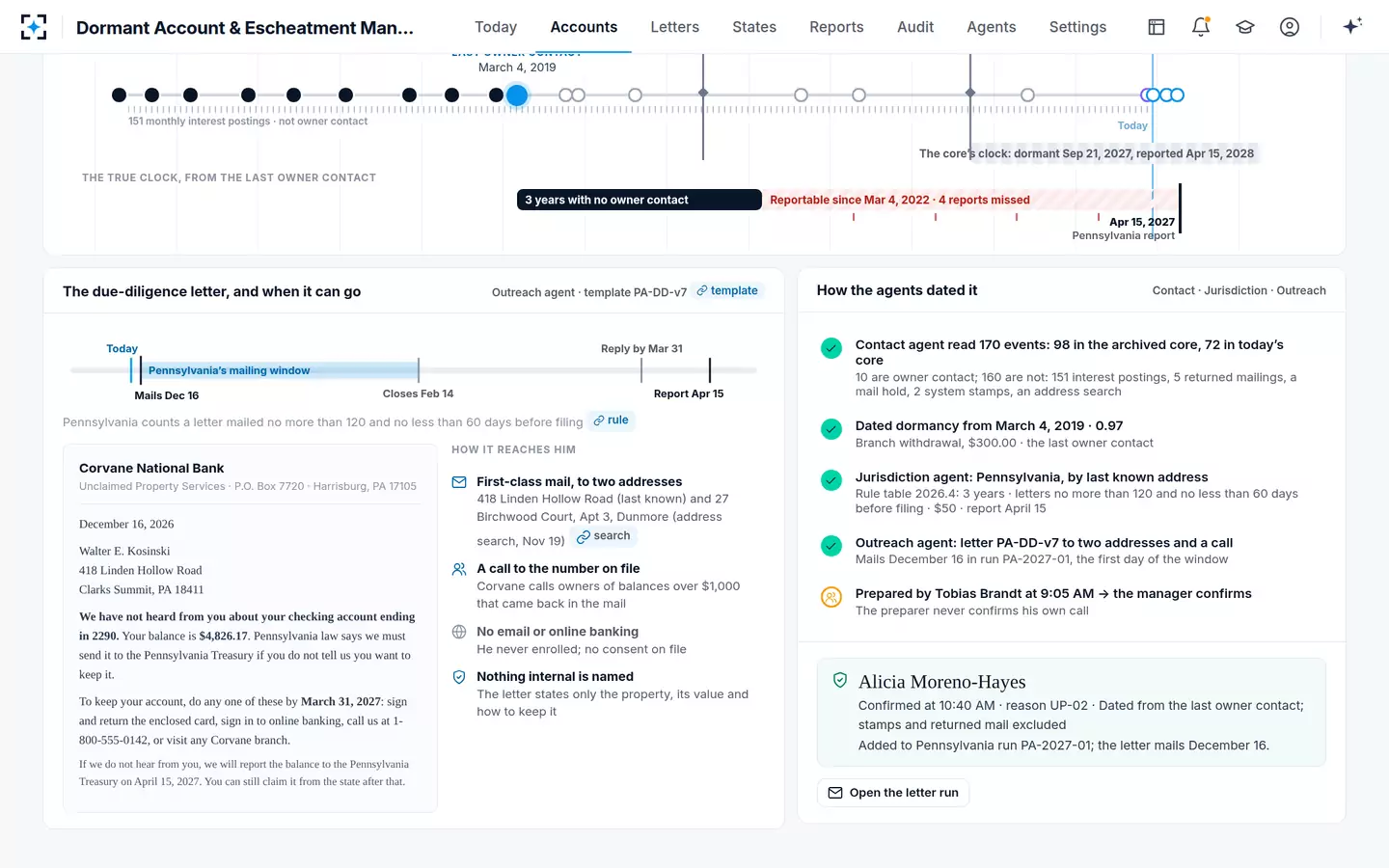
In Dormant Account & Escheatment Management, a person confirms every dormancy date
Linked accounts can keep a CD alive, or not
In states that allow linkage, an owner's activity on another account can stop a dormant CD from being reported. New York's example: "The CD has had automatic renewals for the past three years with no other activity; however, the customer is making monthly payments on their mortgage. The recent payment on the mortgage precludes the reporting of the time deposit." Delaware makes interest shown in one account an indication of interest in all of the owner's accounts with the bank.
Linkage does not run backwards from a CD, though. New York's counter-example is a checking account and a two-year renewing CD with no customer activity on either for three years: "The checking account is deemed reportable, even though, based on the criteria for reporting CDs, the CD account is not reportable for another two years" (N.Y. OSC). The CD's later date does not shelter the checking account.
Why a core system gets CDs wrong
Because it is built to service the CD, not to date the owner's interest in it. Each rollover writes a new maturity date and posts interest; each looks like activity. After a conversion, the original issue date may survive only in the archived core. The guide to what counts as activity on a bank account covers the general rule; CDs add the first-maturity date and the consent record to what must be found.
Dormant Account & Escheatment Management reads today's core and the archived core for every account, so a CD's original issue and first maturity can be recovered after a conversion, and its Jurisdiction agent applies the CD rule of the owner's state from a rule table counsel approves. The dormancy date, with its source, goes to a person to confirm. The periods for other deposit types are in the guide to escheatment dormancy periods by state.
Before a CD goes into, or stays out of, a report
- Original issue date and first maturity date
From the archived core if the CD predates a conversion.
- Every renewal, and whether the owner consented to it on record
A signed instruction, a noted call, an online choice.
- The owner’s state and its CD rule
Period, first-maturity rule, and any longer period for matured CDs.
- Linked accounts that may keep it alive
Only in states that allow linkage, and only on their conditions.
- The term in progress at the dormancy date
Wait for it, break it at no cost, or defer payment, by a written policy.
- The letter to the owner before the report
A CD owner is owed the same due-diligence letter as any other.
Safe deposit box escheatment
Safe deposit boxes run on their own clock, which starts when rent goes unpaid or the lease ends, not when the owner last visited. Delaware presumes the proceeds of sale of a box's contents abandoned when unclaimed five years after the earlier of the lease's expiry or the date the bank may lawfully open the box (§ 1134); Pennsylvania three years from the date the rental period expired; North Carolina two years after the box is drilled for non-payment; Texas five years from the date rent was due and not paid.
New York's banking guide is the most practical on what to do with the contents: report cash, auction proceeds and securities "three years from the date of the box's opening"; "Do not report checks found in a safe deposit box as abandoned property"; keep Series E, EE and I savings bonds or send them to the Treasury, not to the state; and keep "papers and property of no apparent value for at least ten years" (N.Y. OSC). Coins worth more than face value are kept and auctioned rather than reported.
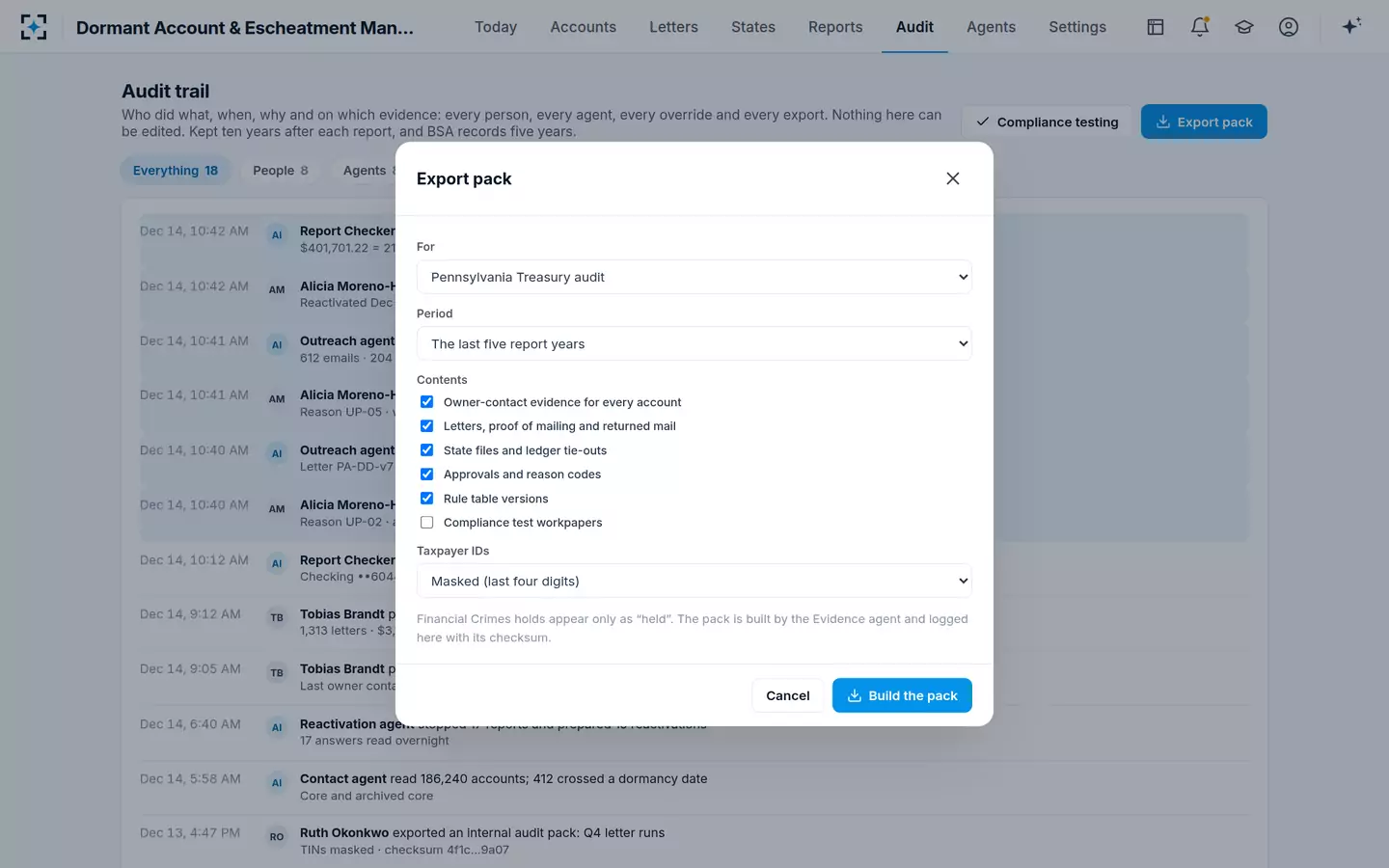
Dormant Account & Escheatment Management's export pack: the evidence behind each decision
The full solution is described on the Dormant Account & Escheatment Management page.
Questions people ask
Do CDs escheat?
Yes. A certificate of deposit is a time deposit, and once the state's dormancy period has run from its maturity, or from the owner's last indication of interest if later, it must be reported like any other deposit, after the due-diligence letter.
Does an auto-renewing CD ever become unclaimed property?
Yes. In Delaware, Florida, Washington and under the uniform act, it is treated as matured at its first maturity unless the owner consented to renewal on record at about the time it happened, so the dormancy clock starts then, however many times it has rolled over since.
How long before a CD is considered abandoned?
Three years after the first maturity in New York, Texas, Pennsylvania, Washington and the uniform act; five years in Delaware and Florida; ten years from initial maturity in North Carolina, absent owner contact.
Does the owner lose interest or pay a penalty when a CD is escheated?
The statutes try to prevent it. Delaware defers payment until no penalty would apply, New York lets the bank break the term at no cost to the owner, and North Carolina notes that many institutions waive forfeitures and penalties.
What do banks do with unclaimed safe deposit boxes?
Once the rent goes unpaid and the bank opens the box under the state's procedure, it reports cash and securities to the state after the dormancy period, and in New York may auction tangible property and report the net proceeds, keeping papers of no apparent value for ten years.