Unclaimed property reporting deadlines by state are not one date but a calendar. For a bank's deposit accounts, 45 of the 51 jurisdictions (the 50 states and the District of Columbia) want the annual report between October 31 and November 10; six want it in spring or summer, among them Pennsylvania on April 15, Florida before May 1 and Texas on July 1. Every one of those dates has a due-diligence letter window counted back from it, and a cut-off date that decides which accounts belong in the report at all. Getting the calendar wrong is the commonest way to send a letter too early, file late or miss a cohort of accounts entirely. Botminds' Dormant Account & Escheatment Management exists to run that calendar: agents date each dormant account from the owner's last real contact, apply each state's report date and window, and an Unclaimed Property Manager approves every letter run and file.
The counts above come from the state-by-state listing kept by the National Association of Unclaimed Property Administrators (NAUPA), read on 26 October 2026, and from each state's own law or unclaimed property office for every state this guide names. States amend these rules often, so a bank's own table should cite the statute or office page it was built from and the date it was read.
Every report date drags a letter window behind it
- Letters May 4–Sep 1
- Answers
- Letters Jul 4–Sep 2
- Answers
- Letters Jul 13–Sep 11
- Answers
- First-class by Aug 10
- Publish, certified, answers
- Letters Nov 2–Jan 31
- Certified, answers
- Letters Dec 16–Feb 14
- Answers
- Notices by May 2
- Answers
What are the unclaimed property reporting deadlines by state?
For deposits held by a bank, the deadline is October 31, November 1 or November 10 in all but six jurisdictions. On NAUPA's listing, 38 jurisdictions set November 1 or "before November 1" for banks, four set October 31 (Maryland, Minnesota, Nevada and Washington), California takes a notice report before November 1 and the money in June, and Delaware and New York give banks until November 10. The other six sit in the first half of the year: Connecticut, Pennsylvania, Florida, Vermont, Michigan and Texas.
The November cluster is no accident. The Revised Uniform Unclaimed Property Act, which the Uniform Law Commission approved in 2016 and states have been adopting since, says the report "must be filed before November 1 of each year and cover the 12 months preceding July 1 of that year" (RUUPA § 403). Washington adopted it from January 2023 with an October 31 date: its holders report "on or before October 31st of each year and cover the 12 months preceding July 1st of that year" (RCW 63.30). A state on an older act often kept the same rhythm.
Where a bank's 51 report dates fall
45
jurisdictions want a bank’s report between October 31 and November 10
50 states and DC
6
file in spring or summer: CT, PA, FL, VT, MI and TX
16
require a negative report even when there is nothing to report
three more in some cases
Report dates, cut-offs and letter windows a bank works to
| State | Cut-off | Letters | Report due |
|---|---|---|---|
| Delaware (banks) | June 30 | 120 to 60 days before filing | November 10 |
| New York (banks) | June 30 | First-class by Aug 10; publish by Sep 1; certified by Sep 10 over $1,000 | November 10 |
| North Carolina | June 30 | 120 to 60 days before the due date | November 1 |
| Washington | June 30 | 180 to 60 days before filing | October 31 |
| RUUPA model | June 30 | 180 to 60 days before filing | Before November 1 |
| California | Cycle charts | 6 to 12 months before property becomes reportable | Notice before Nov 1; money June 1–15 |
| Pennsylvania | December 31 | 120 to 60 days before filing | April 15 |
| Florida | December 31 | 180 to 90 days before filing; certified 60 days before over $1,000 | Before May 1 |
| Texas | March 1 | No later than 60 days before the due date | July 1 |
Banks file on different dates from other holders
A bank should never read a state's general deadline and assume it applies. Delaware is the clearest case: most holders file "on or before March 1", but the report "must be filed by banking organizations on or before November 10 of each year to cover the 12 months preceding July 1 of that year" (Del. Code tit. 12 § 1144). Insurance companies file on December 20. A bank that diarises Delaware's March date files nearly four months late, or files the wrong twelve months.
New York is the second. Banks report under Article III of the Abandoned Property Law, and the Comptroller's reference sheet for banking institutions sets the whole sequence: a June 30 cut-off, the first-class mailing completed by August 10, a published notice by September 1, proof of publication and the certified mailing by September 10, and the final report, remittance and verification "received in our office" by November 10 (N.Y. Office of the State Comptroller). The bank date pulls other property along with it: a bank acting as paying agent "must file the report of abandoned property on the banking report due date of November 10", the sheet says, not on the date its corporate clients would use.
Illinois makes the split by industry: banking, financial institutions and non-life insurers report before November 1, while most other holders report before May 1, according to the state's entry on NAUPA's listing. The lesson is the same in each state: the rule table a bank works from must be keyed to the holder type, not only to the state.
The cut-off date decides which accounts go in which report
Every report covers property that became reportable during a defined period, and the cut-off closes that period. Under the November model the period is the twelve months ending June 30; Pennsylvania counts the calendar year, with reports due the following April 15; Texas uses March 1 as its "annual cutoff date for required abandonment periods" (Texas Comptroller). New York's banking sheet puts it plainly: "if funds have become dormant in the year prior to this date, include them in this report cycle".
Pennsylvania's holder book shows what the cut-off means in practice. For the report due April 15, 2026, property with a three-year dormancy period belongs in the report if its last transaction fell between January 1 and December 31, 2022 (Pa. Treasury holder reporting book). An account whose owner last acted on January 2, 2023 waits for the next report. A dormancy date set one day wrong can move an account a whole year, which is why the date has to be the owner's last real contact, not the core system's last-activity stamp. The companion guide to escheatment dormancy periods by state covers how that date is set.
When do you send unclaimed property letters before each deadline?
Inside a window counted back from the report date, and the windows differ more than the report dates do. Delaware wants the letter "by first-class United States mail, not more than 120 days nor less than 60 days before filing the report" (§ 1148); North Carolina's statute sets the same 120 to 60 days from the due date (N.C. Department of State Treasurer); Pennsylvania the same again before April 15 (72 P.S. § 1301.10a). Washington and the uniform act allow 180 to 60 days. Florida wants the first letter "at least 90 days, but not more than 180 days" before filing, and a second, certified letter at least 60 days before when the property is over $1,000 (Fla. Stat. § 717.117).
New York counts the other way: no earliest date, only latest ones. The holder sends a first-class notice "not less than ninety days prior to the applicable reporting date" and, for property over $1,000, a certified notice not less than sixty days before (APL § 1422). Texas wants notices out "no later than 60 days before the due date". California is the outlier: owners must be told when property "will become reportable within 6-12 months" (State Controller's Office), so its letters go out before the property is even dormant. The full requirements, element by element, are in the guide to unclaimed property due diligence letter requirements.
Letter windows run from 60 to 120 days
The short windows are the hard ones. A sixty-day window has to hold the address search, the letter run and the print vendor's lead time, and an account that is dated late cannot join the run once the window closes. A bank that finds a batch of accounts a week after the window shut has two choices, both bad: report them without the letter the state requires, or hold them past the report date and report them late.
A Pennsylvania letter run, approved for the first day of the window
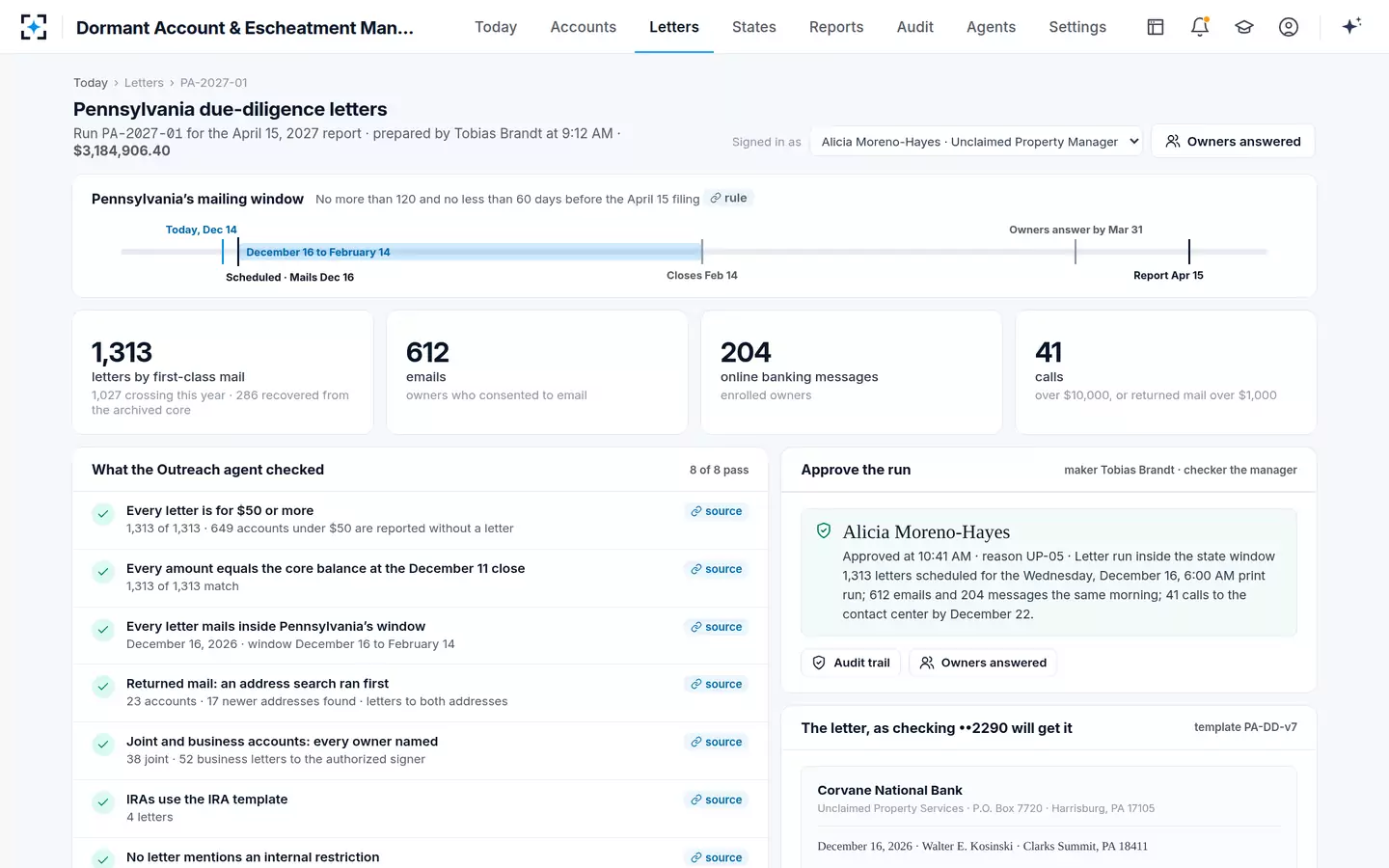
The window bar is computed from the report date, not typed in
California reports twice: notice in the fall, money in June
California splits the deadline in two, and a bank that treats it like a November state will remit too early. The holder sends the State Controller a Notice Report before November 1 listing owners, and is told plainly: "Do not remit property at this time." The Controller then writes to the owners itself, telling them to contact the holder, and the Remit Report with the money is "Due June 1-15" (State Controller's Office, How to Report).
Between the two reports the bank is still paying owners who come forward because of the state's letter, which means the reactivation desk works California's calls through the spring. The June remittance has to drop every account an owner reclaimed, so the file and the general ledger must be tied again in May, not only in October.
Is a negative report required, and does it matter?
In 16 jurisdictions on NAUPA's listing, yes: a holder with nothing to report still files a report saying so. Three more require it in some cases (Illinois for larger business holders, Maine for Maine holders, Idaho for holders domiciled there), and New Jersey and Indiana recommend it. Texas is among the sixteen; its Comptroller tells holders, "Don't have anything to report this year? File a negative report."
Where it is optional, the filing still buys something. North Carolina does not require one, but warns that a year with no report on file leaves a hole in the holder's filing history, and that if property is later found to have been reportable, "the five-year statute of limitations provisions would not apply to that period" (N.C. holder FAQ). Pennsylvania offers a negative or compliance report too (holder book). For a bank, which almost always has something dormant somewhere, the practical point is the reverse: a state with no report on file for a year invites the question of why.
What a missed unclaimed property deadline costs
Interest from the day the report was due, a daily penalty, and in some states a share of the property. Pennsylvania's statute makes a holder that fails to report "liable to pay to the State Treasurer interest at the rate of twelve per centum per annum from the time such report should have been filed", plus "a penalty not to exceed one thousand dollars ($1,000) per day" until a proper report is filed (72 P.S. § 1301.24), which the Treasurer may waive for good cause. North Carolina lists "a daily interest penalty, a $1,000 civil penalty each day the report is held, plus 25 percent of the value of any property that should be reported" (N.C. holder FAQ). Florida's is lighter: $10 a day up to $500 for a late report.
The larger cost is usually not the report filed a week late but the account that should have been in a report years ago and never was. Interest runs from the year it should have been reported. That is the account a core conversion hides, and it is the one a state examiner looks for first; the guide to unclaimed property audit procedures shows how to find those accounts before an examiner does.
Staffing the season around the deadlines
Plan the year as two seasons and give each a named owner. Letter season for the November states runs from May (Washington's window opens 180 days out) to mid-September; filing season runs through October and into November 10; the spring states start in November with Florida's window and end with Texas on July 1. There is no quiet quarter: the work only changes shape.
The roles do not change with the season, and the separation between them matters more than the headcount. The analyst prepares; the Unclaimed Property Manager approves dates, letter runs, reactivations and files; the controller signs the remittance; internal audit reads everything after. Delaware requires the report to be "signed by or on behalf of the holder and verified as to its completeness and accuracy" (§ 1143), and Pennsylvania wants "an affirmation of compliance" with its notice rule attached to the report (§ 1301.10a(d)): someone signs, and the signature should rest on evidence.
Who carries the calendar, before and after Dormant Account & Escheatment Management
Today
Pulls one report year from the core for each state and rebuilds the letter list every window.
With agents
Starts from accounts already dated from owner contact, each marked with its state’s next window.
Still theirs: Prepares dates and runs; never approves them
Today
Signs letter runs and files assembled from extracts and spreadsheets.
With agents
Approves each run with the checks shown: threshold, amounts, window, addresses, templates.
Still theirs: Every approval, with a reason code
Today
Ties each state file to the escheat suspense account by hand before the wire.
With agents
Sees the file tied to the general ledger to the cent, every break explained.
Still theirs: The remittance signature
Today
Gathers years of letters, proofs of mailing and filings when a state asks.
With agents
Exports one pack per state audit with every approval and source attached.
Still theirs: Independent read-only review
Where Dormant Account & Escheatment Management fits the calendar
The solution keeps each jurisdiction's report date, cut-off, window and threshold in a rule table that deposit counsel approves, and schedules work from it. When an account crosses a dormancy date, the Jurisdiction agent assigns its state by last known address and the Outreach agent places its letter inside that state's window; when the window is already closed, the account is flagged before the report, not after. Owners who answer are taken out of draft files the same day, so the file that reaches the manager in late October is the file that will be filed.
Take a sample bank, Corvane National Bank, which is fictional, as its Pennsylvania cycle runs through the solution. For the April 15, 2027 report, the window runs from December 16 to February 14. The run of 1,313 letters is approved for December 16, the first possible day, which leaves eight weeks for any account found late to join a second run before the window closes.
One letter, placed inside its state's window
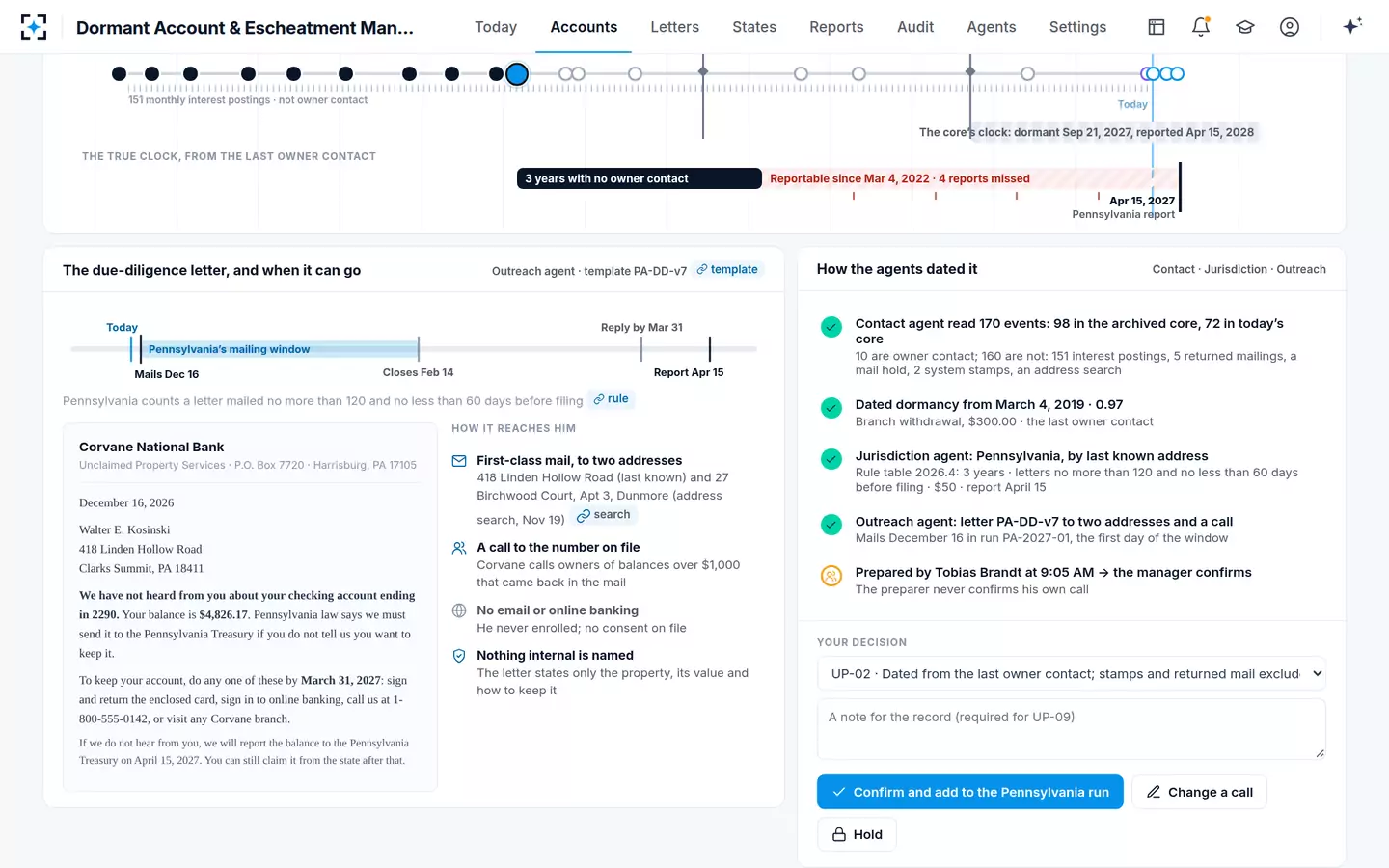
What the solution does not do is file or pay. Every state portal upload, every certification and every remittance stays with the bank's own people: the manager approves the file, and the controller signs the money out. Agents read, date, draft and check. That division is set out in the guide to escheatment automation, and the solution itself is described on the Dormant Account & Escheatment Management page.
Questions people ask
When is unclaimed property reported?
Once a year, on a date set by each state's law. For banks, 38 of the 51 jurisdictions want the report on or before November 1 for property that became reportable in the twelve months to June 30; Delaware and New York give banks until November 10, and Pennsylvania (April 15), Florida (before May 1) and Texas (July 1) report in spring and summer.
What is the unclaimed property reporting period?
It is the window of time a report covers, closed by a cut-off date. Under the uniform act it is the twelve months preceding July 1; Pennsylvania uses the calendar year; Texas uses a March 1 cut-off. An account belongs in the report for the period in which its dormancy period ended.
Is the Delaware unclaimed property reporting due date different for banks?
Yes. Delaware's general date is March 1, but banking organizations file on or before November 10 for the twelve months preceding July 1, and insurance companies on December 20. A bank using the March date would be months late on property that had already passed its fall due date.
What is the New York unclaimed property reporting due date for banks?
November 10, with a June 30 cut-off, according to the State Comptroller's reference sheet for banking institutions. Before it come the first-class mailing by August 10, a newspaper notice of owners with $50 or more by September 1, and the certified mailing for property over $1,000 by September 10.
Can a bank get an extension on an unclaimed property report?
Usually, if it asks before the due date. Delaware lets the State Escheator grant an extension "for good cause" and lets the holder pay an estimate meanwhile, which stops interest on the amount paid; North Carolina approves extension requests "only for good cause". An extension moves the report date, so the letter window moves with it.
Do all states require a negative unclaimed property report?
No. Sixteen jurisdictions on NAUPA's listing require one outright and three in some cases; most others do not. Filing one where it is optional still documents the year, which North Carolina notes matters when its five-year limitation period is later counted.