Unclaimed property audit procedures follow a common pattern: the state, or a contract auditor working for it, asks a holder for its records over a long look-back period, tests whether accounts that were not reported should have been, estimates what the records cannot show, and issues findings with interest. For a bank the test that matters is whether each dormancy date rests on owner contact the bank can prove. The way to prepare is to replay last year's filed report as an examiner would: re-date every account from its source events and see which reported, unreported and wrongly reset accounts change. Botminds' Dormant Account & Escheatment Management runs that replay as a matter of course, because its agents date every account from source records and its compliance tester samples their calls each quarter.
This guide takes Delaware's statute as the worked example, because it writes each stage of an examination out in full: the invitation to disclose, the look-back, estimation, the findings and the appeal. Other states differ in the numbers more than in the shape.
What one replay of converted accounts found
What is an unclaimed property audit?
It is a state's examination of a holder's books to find property that should have been reported and was not. States use two depths. A compliance review in Delaware "must be limited to the contents of the report filed" and its supporting documents; an examination goes further, and the State Escheator may "Examine the records of a person or the records in the possession of an agent, representative, subsidiary, or affiliate of the person under examination in order to determine whether the person complied with this chapter", take testimony and issue an administrative subpoena (Del. Code tit. 12 §§ 1170–1171).
Many examinations are run by firms under contract to the state. Delaware caps any one contractor at half its reviews: "no such person shall be assigned more than 50% of the number of all such compliance reviews and examinations undertaken subsequent to January 1, 2015" (§ 1178). In Washington, a 2025 law requested by the Department of Revenue removed the rule that the department "must notify a holder 60 days before assigning a third-party auditor to conduct an examination" (House Bill Report HB 1127). Several states can also examine a holder together, so one auditor's request can cover many states' property at once.
Delaware adds a step before an examination starts: since July 1, 2015 the State Escheator may not open one "unless the person has first been notified in writing by the Secretary of State that the person may enter into an unclaimed property voluntary disclosure agreement" (§ 1172(a)), with exceptions such as a joint examination begun by another state. The letter inviting a voluntary disclosure is often the first sign of an audit.
How far back can an unclaimed property audit go?
In Delaware, ten years from the date the duty to report arose, which for a five-year deposit means fifteen years of account history. The statute says the State Escheator "may not commence an action or proceeding to enforce this chapter with respect to the reporting, payment, or delivery of property more than 10 years after the duty arose" (§ 1156(b)). A holder under examination must keep records "to the present day for 10 years plus the applicable dormancy period" (§ 1145(b)).
Other states are shorter, with a catch. North Carolina has a five-year limitation period, but a year with no report on file is not protected by it: property later found to have been reportable in such a year falls outside the five years (N.C. holder FAQ). The same Washington bill sought to settle when "a 6-year or 10-year statute of limitations applies". Texas tells holders to keep records of each report "for at least 10 years" (Texas Comptroller).
How much account history a Delaware examination can reach
- Dormancy: 5 years
- Enforcement reach: 10 years after the duty arose
- Dormancy: 5 years
- Limitation: 5 years
What happens when the records are missing? Estimation
The state estimates, and the estimate is rarely kind. If a holder under examination has not kept the records the statute requires, Delaware's State Escheator "may determine the amount of property due using a reasonable method of estimation based on all information available to the State Escheator, including extrapolation and the use of statistical sampling when appropriate" (§ 1176(a)). The examiner may also use "any and all reliable external data, including electronic databases deemed relevant" (§ 1172(g)).
Records are the defence. Where a holder has filed every report and kept every record, the examination "may not be based upon an estimate unless the holder expressly consents in a record to the use of an estimate" (§ 1172(f)). For a bank this turns on one detail of the retention rule: the records must include "Sufficient records of items that were not reported as unclaimed, to allow review to determine whether the holder has complied" (§ 1145(d)). An examiner's first question about a dormant account that was not reported is why not, and the answer has to be an owner-contact event the bank can show.
An examiner's estimate against a bank that can show its dates
Records missing or thin: Extrapolation from a sample and outside data
Every date backed by a source: The holder’s own records, reviewed item by item
Records missing or thin: Presumed reportable unless contact can be shown
Every date backed by a source: The owner-contact event, with its source, explains why
Records missing or thin: Looks like activity; the examiner treats the date as unproven
Every date backed by a source: Marked as not owner contact; the real last contact cited
Records missing or thin: Yes, when required records were not kept
Every date backed by a source: Only with the holder’s written consent, in Delaware
Records missing or thin: From the year the estimate says property was due
Every date backed by a source: Limited to accounts actually found late
Unclaimed property audit procedures, step by step
The sequence below follows Delaware's statute, which writes each step down; other states' examinations follow similar steps with different deadlines.
- An invitation, then a notice. An offer to enter voluntary disclosure, and if the holder declines, a notice of examination naming the years and property types.
- A records request. Reports filed, and the records behind them, including the items not reported and the commencement date the holder used for each property under § 1143(a)(5).
- Testing. A sample of dormant and closed accounts traced to owner-contact evidence; linked accounts, returned mail and system stamps examined.
- Estimation where records fail. Error rates from the tested years projected onto the years without records.
- A statement of findings. Delaware must give the holder "a complete and unredacted statement of findings", including the methodology of any estimation (§ 1177).
- Final determination. Ninety days after the statement of findings and request for payment is mailed, it becomes the final determination of liability unless the holder goes to the Court of Chancery (§ 1179).
Interest and penalties follow the findings. Delaware charges "Interest at 0.5% per month on outstanding unpaid amounts", capped at half the amount due (§ 1183(a)), and where a holder wilfully fails to perform a duty, a civil penalty "of $1,000 for each day" up to $25,000, "plus 25% of the amount or value of any property that should have been but was not reported" (§ 1184).
How do you run an unclaimed property self audit? Replay last year's report
Take the report you filed and the dormant population you did not report, and re-date every account from its source events as an examiner would. The replay answers four questions at once: which reported accounts were reported correctly, which were reported although the owner had in fact acted, which should have been reported and were not, and which accounts are crossing a dormancy date next.
The method has three rules. First, start from events, not fields: every deposit, withdrawal, login, signed card, recorded call and letter, in today's core and in the archived core from before any conversion. Second, classify each event under the rule of the owner's state, because states differ on automatic drafts and logins. Third, keep the source of every classification, so that the replay itself can be checked; a self-audit nobody can verify is only a second opinion.
Take a sample bank, Corvane National Bank, which is fictional. Its June 2021 conversion stamped the load date on every one of 2,914,600 accounts, and a 2024 core release touched the contact date on 1,118,420 of them. Replaying the converted accounts against the archived core found 6,214 whose core date was not owner contact: 2,370 already reportable and late, worth $7,284,517.06; 1,980 crossing a dormancy date in 2027; and 1,864 whose owners had acted since. The first group is what an examiner would have found. The bank found it first.
The evidence an examiner asks for, one click from the date
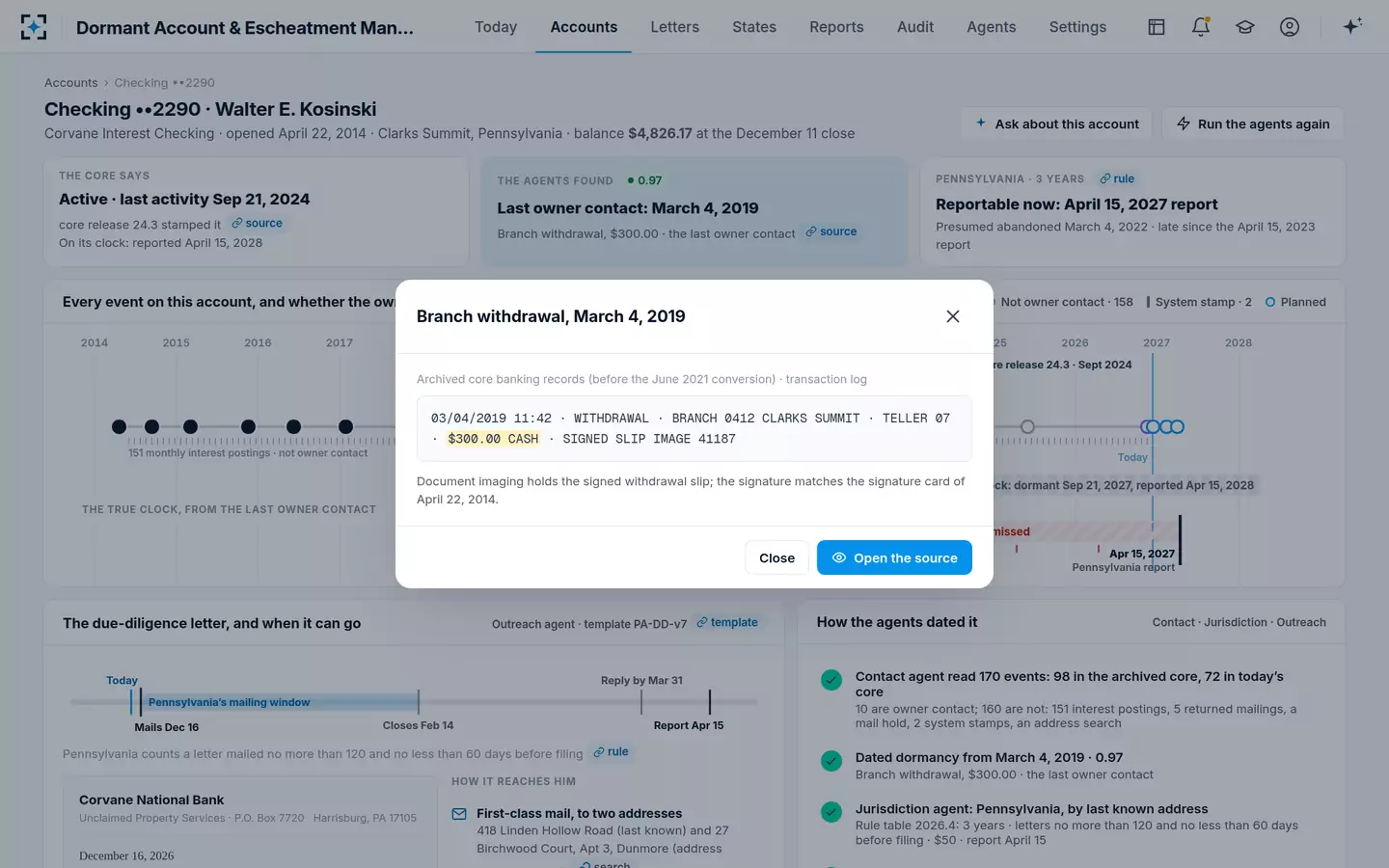
What a replay usually finds
The same failures state compliance staff list. North Carolina's guide for financial institutions names four that bear on deposits: conversions that reset aging dates, aging data lost in mergers, system changes that update contact fields with no owner involved, and unreturned mail taken as proof the owner is there (N.C. Department of State Treasurer). It also warns that compliance software does not look past the current report year, so an account whose date fell before the year being run never reaches a report at all.
A replay also finds the opposite error: accounts reported although an owner acted. Linked accounts are the usual cause. New York lets a bank that can link a customer's accounts "treat an action on one of the customer's accounts as an exclusionary activity for all of the customer's accounts", but not across separate legal entities (N.Y. OSC banking reference sheet). A savings account reported while the same owner used checking every month is money the owner has to claim back from the state. The guide to what counts as activity on a bank account sets out which events reset the clock in which states.
Delaware's numbers an audit turns on
10years
after the duty arose: the state’s enforcement reach
0.5%a month
interest on late property, capped at 50% of the amount
90days
from the statement of findings to a final determination
What to do with late property the replay finds
Report it, and where the state offers one, through a voluntary disclosure, which usually trades a full look-back for relief from interest and penalties. In Delaware the Secretary of State "shall waive interest and penalty under §§ 1183 and 1184 of this title for holders that complete the voluntary disclosure in good faith" (§ 1173). North Carolina's program lets holders report past-due property "without paying interest and penalties" (N.C. holder FAQ).
The trade has terms. Pennsylvania's agreement requires the holder to report all past-due property "identified through a complete examination of its books and records for the last ten years", and is open only to a holder that is "currently not under audit or self-audit by Pennsylvania Treasury" (Pa. Treasury voluntary disclosure agreement). Timing is everything: a bank that runs its replay before an invitation letter arrives keeps the choice; one that waits may lose it.
Which route to take, state by state, is a decision for deposit counsel. In Dormant Account & Escheatment Management the Evidence agent drafts a note to each state explaining what the conversion did, how the accounts were found and that the late property is in the report, and counsel decides whether and how it goes.
What evidence should a bank keep for an unclaimed property audit?
Enough to answer, for any account in the look-back period, when the owner last acted, which state's rule applied, whether a letter went out inside the window, and who approved the report. Delaware's floor is ten years after each report, and longer once an examination or disclosure begins.
The file an unclaimed property examiner can test
- The last owner-contact event for every dormant account
With its source: transaction log, imaged slip, recorded call, login record.
- The commencement date used, and why
Delaware’s report must contain it for each property.
- Accounts not reported, with the reason
The records of items not reported are part of the retention rule.
- Events excluded as not owner contact
Conversion and release stamps, interest postings, returned mail, each cited.
- The rule-table version applied to each report
With who approved it and when.
- Letters, proof of mailing and returned mail
Matched to the window the state sets.
- Owners’ answers and the reactivations they caused
With who approved each one.
- The report as filed, tied to the general ledger
Signed and verified, with the remittance record.
Testing the agents the way an examiner tests a bank
If agents date the accounts, the agents' calls are what an examiner will test, so the bank should test them first. Dormant Account & Escheatment Management gives that job to a compliance tester who samples the agents' owner-contact calls every quarter against the source records, records each exception with its cause and fix, and replays any new agent version on past calls before it goes live.
A quarter's compliance test in Dormant Account & Escheatment Management
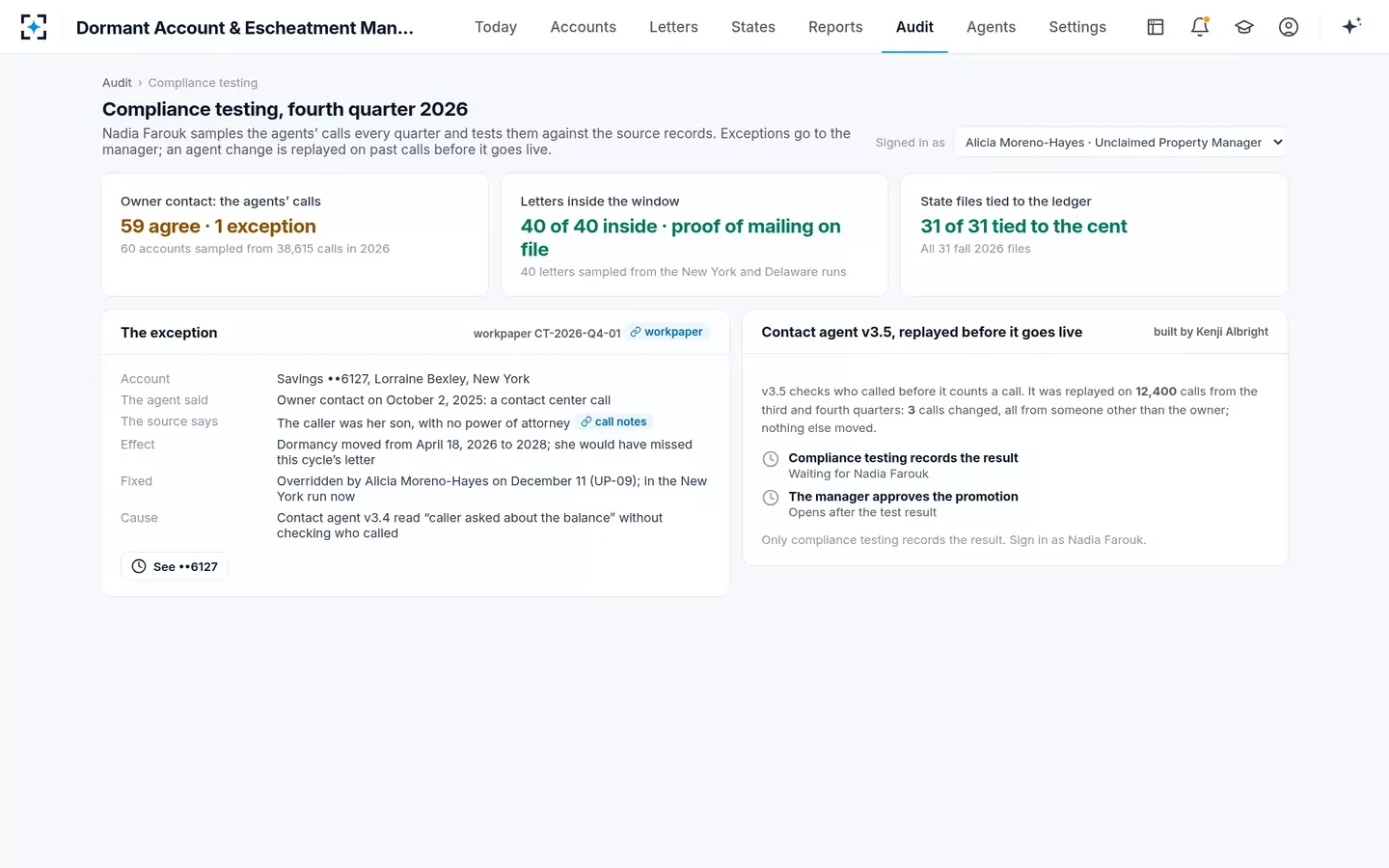
The one exception in the sample quarter is instructive. A call about the balance was counted as owner contact; the call notes showed the caller was the owner's son without authority, a contact that a rule like Delaware's on third-party communications does not count. Corrected, the account's dormancy date went back to April 2026 and it joined the current letter run; the agent's rule was tightened and the new version replayed on 12,400 earlier calls. That is the record an examiner wants to see: errors found by the bank, explained, and fixed at the cause.
One export pack per state audit, from Dormant Account & Escheatment Management
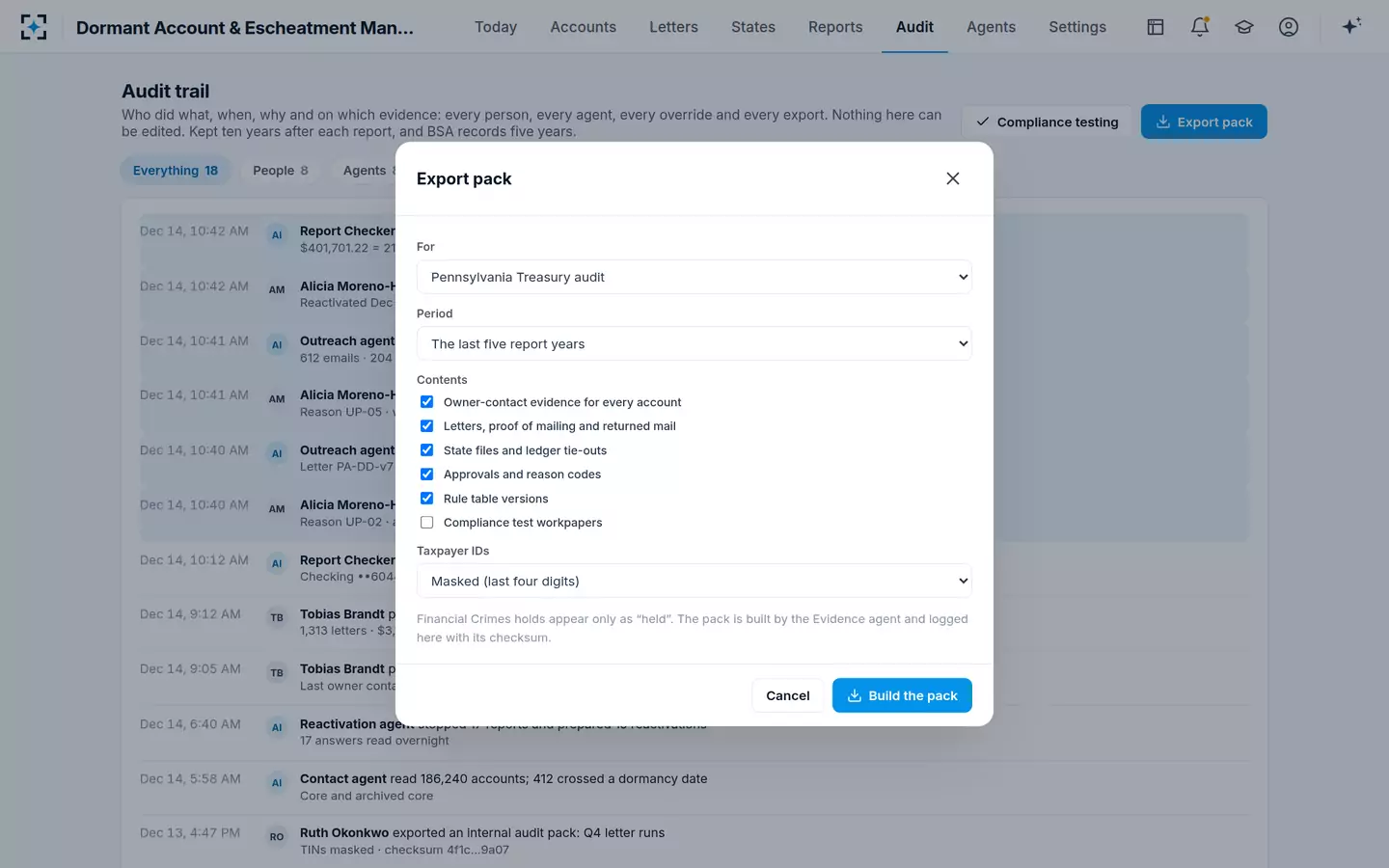
For a bank choosing tools, the replay is also the fairest test of any vendor: give each the same closed year and see which accounts each would have reported. The guide to escheatment software sets out the four measures that comparison should use, and the full solution is on the Dormant Account & Escheatment Management page.
Questions people ask
What triggers an unclaimed property audit?
The statutes cited here do not list triggers, but they name some routes in. Delaware's lets an examination begin as a joint examination started by another state, or from a whistleblower, who can be awarded the interest and penalties the state collects. North Carolina points to the year with no report on file as the gap it will look at. A merger or core conversion, which resets dormancy dates, is the internal event most worth a self-audit.
Is there a statute of limitations on unclaimed property?
For the state's claims against a holder, yes, but it is long and can be lost. Delaware's is 10 years after the duty arose; North Carolina's is five years, but it does not protect a year for which no report was filed. The owner's claim against the state is another matter: Washington, for one, holds the money "in perpetuity until claimed by the rightful owner or heir".
What is an unclaimed property voluntary compliance program?
A state program that lets a holder report past-due property on its own initiative in exchange for waived or reduced interest and penalties. Delaware, North Carolina and Pennsylvania all run one, with different look-backs and eligibility rules; Pennsylvania's requires a review of the last ten years.
How long does an unclaimed property audit take?
The statutes set no overall limit, and with a records request that can span a decade or more, the length is driven by how quickly the holder can produce its evidence. The stages with fixed clocks come at the end: in Delaware, a statement of findings becomes final 90 days after it is mailed unless the holder goes to court.
What is unclaimed property audit defense?
Mostly evidence. A holder that can show, account by account, the owner contact behind each date and the reason each account was or was not reported limits the examiner to its own records; in Delaware a holder that filed every report and kept every record cannot be estimated against without its written consent.
Can a bank appeal unclaimed property audit findings?
In Delaware, yes: within 90 days of the statement of findings the holder can sue in the Court of Chancery, either before paying or after paying and seeking a refund. The court reviews whether the findings were rationally supported by substantial evidence.