Escheatment automation means handing the reading, dating, checking and drafting of an escheat cycle to software agents while the bank's people keep the decisions the law puts on a holder. Of the dozen tasks in a bank's cycle, agents can take eight outright: pulling the dormant population, dating each account from the owner's last real contact, assigning the state and its rules, searching addresses, drafting letters inside each window, reading owners' answers, building the state file and tying it to the general ledger. People keep the contested calls, the approvals, the signed report and the remittance. Botminds' Dormant Account & Escheatment Management is built on that division: six agents do the first kind of work, an Unclaimed Property Manager approves, and a controller signs the money out.
The order matters. Most automation in this field started at the end of the cycle, formatting the file and printing the letters, because those steps are mechanical. The expensive errors happen earlier, when an account is dated from a system stamp instead of the owner, and that is where an agent reading source records changes the outcome rather than the speed.
Twelve escheat tasks: what agents take, what people keep
| Task | Today | Agents take | People keep |
|---|---|---|---|
| Find the dormant accounts | One report year pulled from the core | Every quiet account read nightly, in today’s core and the archived one | — |
| Date the last owner contact | The core’s last-activity field | Each event marked owner contact or not, with its source | Calls the agent is unsure of |
| Assign the state | Address field in the extract | Last known address, with the fallback to the bank’s state | Rule-table changes, with counsel |
| Apply period, cut-off, window | A spreadsheet per state | The approved rule-table row, cited | Approving each table version |
| Search addresses on returned mail | A batch to a vendor, when time allows | Searched before the letter run | — |
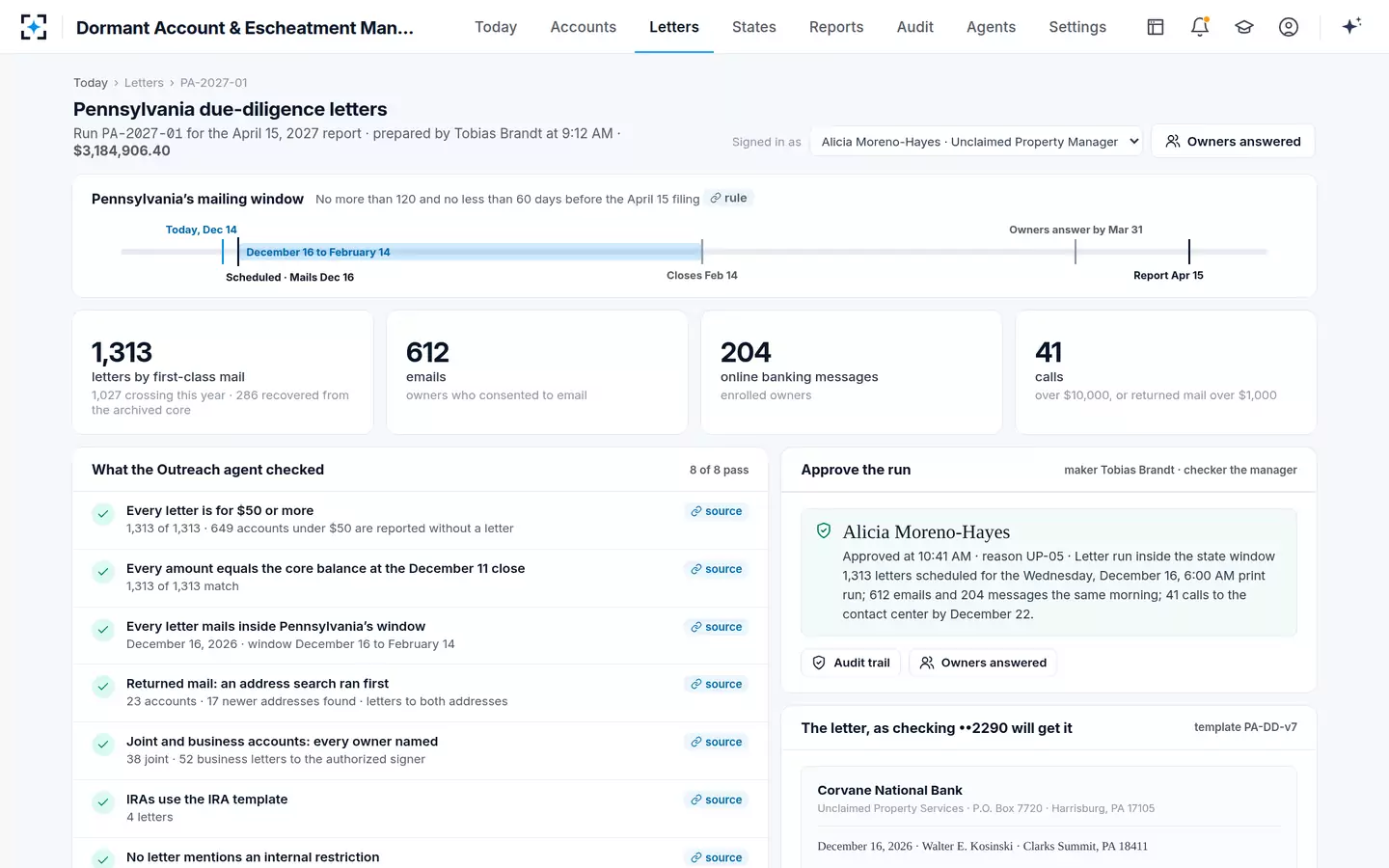
| Draft letters and other contact | Mail merge, a print vendor | Drafted from approved templates inside the window | Approving each run |
| Read owners’ answers | Mailroom and branches, by hand | Checked as from the owner; report stopped | Every reactivation |
| Build the state file | Reporting tool fed by the extract | Standard electronic format, validated | Approving the file |
| Tie the file to the general ledger | The controller, by hand, at the end | Tied to the cent, each break explained | Signing the remittance |
| File and certify | A person | Never | The report’s signature and verification |
| Notes to states on late property | Rarely written | Drafted for deposit counsel | Counsel decides and sends |
| Evidence for an examiner | Gathered by hand when asked | Kept behind every date; packs built | Internal audit reviews |
What is escheatment in banking, and what does the process involve?
Escheatment in banking is the transfer of a dormant account's balance to a state's custody once the owner has shown no interest for the period that state sets. The state holds it for the owner, who can claim it later; Delaware's required notice tells owners that "after the property is turned over to the State Escheator an owner that seeks return of the property may file a claim" (Del. Code tit. 12 § 1149). The state is chosen by the owner's last known address, and each state sets its own dormancy period, letter window and report date.
For the bank, the process is a cycle of duties: identify accounts that crossed a dormancy date, write to their owners inside the state's window, stop the report for anyone who answers, report and remit the rest, and keep the evidence for years. Delaware keeps the bank on the hook even when someone else does the work: a holder may contract out the reporting, but "shall remain responsible to the State Escheator for the complete, accurate, and timely reporting of the property" (§ 1147(c)). Automation changes who does the steps, never who answers for them.
Which escheatment tasks can be automated first?
Start with dating owner contact, because every other step inherits its answer. The dormancy clock, the letter, the report year and any interest for lateness are all counted from the date of the owner's last indication of interest, and the core banking system does not hold that date. It holds a last-activity date, which systems update for their own reasons.
North Carolina's Treasurer, in a guide for financial institutions updated in September 2026, lists the failures it sees. A system conversion resets aging dates. Aging data "is lost during mergers and acquisitions". A bank modifies its systems in ways "that cause customer contact fields to update when indeed no positive contact has occurred". And unreturned statements are treated as contact, though "Indirect evidence of owner contact, such as statements mailed but not returned by USPS, is not adequate evidence of positive owner contact" (N.C. Department of State Treasurer). Each is a field-level error a person would have to find account by account, across systems; an agent can read every event and classify it.
A computer system conversion causes the dates used to age dormant accounts to reset incorrectly.
North Carolina Department of State Treasurer, Guide to Unclaimed Property for Financial Institutions
Take a sample bank, Corvane National Bank, which is fictional, and one of its accounts. The core says checking ending 2290 is active, with a last-activity date of September 21, 2024: a stamp from a core release. The Contact agent reads the account in today's core and the archived pre-conversion core, finds 151 interest postings and returned statements, and one last thing the owner did: a $300.00 cash withdrawal at a branch on March 4, 2019, with a signed slip in document imaging. Pennsylvania's three years ran out on March 4, 2022. The account is late, and no amount of faster letter-printing would have found it.
The agents date the account; the manager confirms it
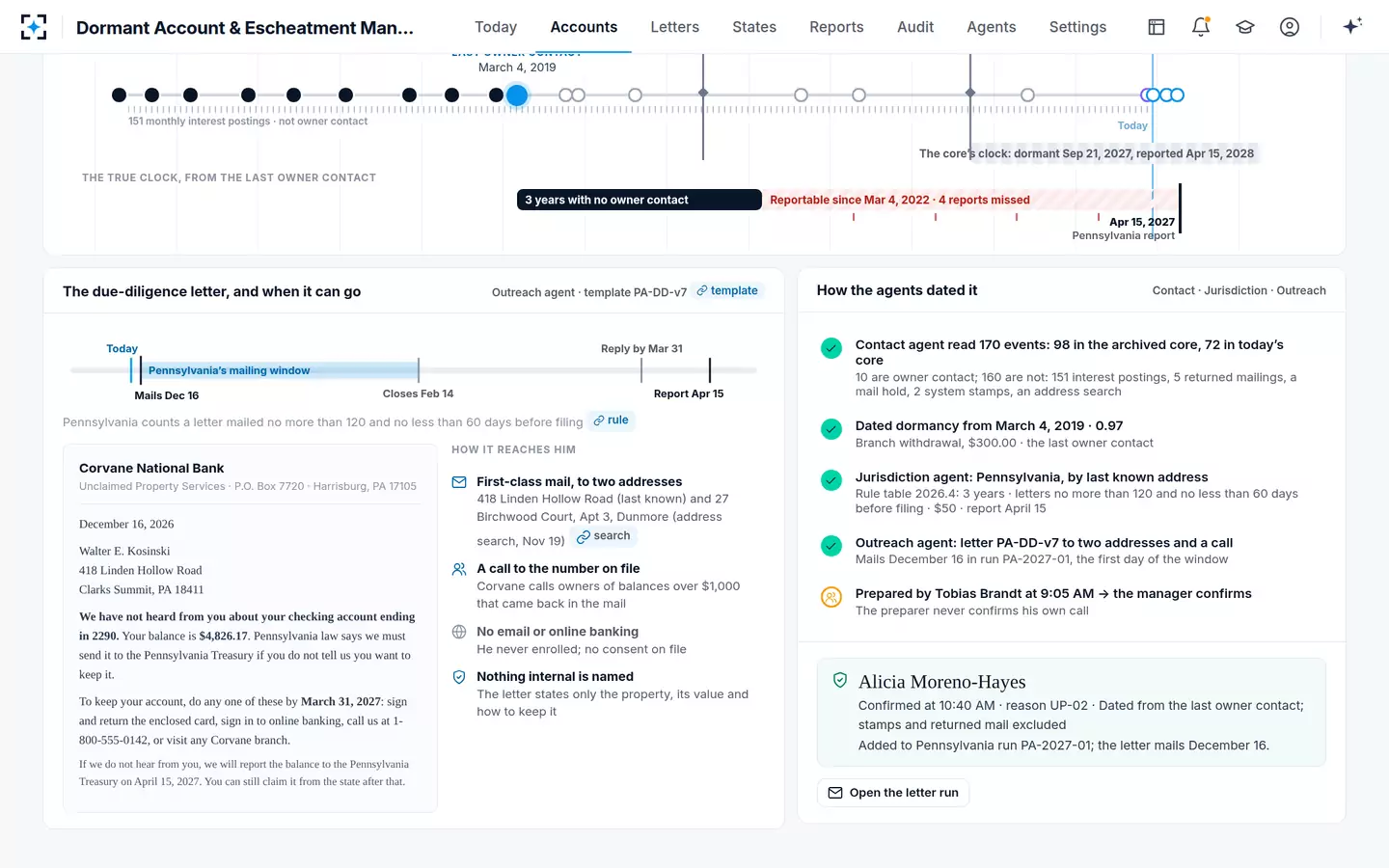
Every step on the right cites the record it rests on
Which escheatment decisions should stay with people?
Four kinds: the calls the rules leave open, the approvals that release work to customers, the signed report, and the money. Automation that takes any of those away from a named person moves liability without moving judgment.
The open calls are mostly about who acted. Delaware counts a communication from someone other than the bank only when a record of it shows the owner knows of the property (§ 1136(c)), while the uniform act presumes that "an action by an agent or other representative of an apparent owner" is on the owner's behalf (RUUPA § 210(c)). A call from a daughter who holds no power of attorney, or a login from an unrecognised device, is exactly where an agent should stop and hand the account to a person.
The approvals release letters, reactivate accounts and send files; each touches a customer or a state, so each needs a second person. The report is a sworn statement in all but name: Delaware's must be signed for the holder and verified as complete and accurate (§ 1143), and Pennsylvania's must carry the holder's own affirmation that the owner notices went out (72 P.S. § 1301.10a). No agent can make that statement for a bank. And the remittance, which moves real money out of the general ledger, belongs with the controller.
One account through Dormant Account & Escheatment Management
Agent
Contact agentReads every event in both cores, marks each as owner contact or not under the owner’s state’s rule, dates dormancy from the last real contact
Never: Counts a conversion stamp, interest posting, returned mail or a bank letter as contact
Agent
Jurisdiction agentAssigns the state by last known address and applies its period, cut-off, window, threshold and report date
Never: Uses a rule-table version counsel has not approved
A person decides
Unclaimed Property ManagerConfirms dormancy dates the analyst prepared; decides the calls the agents were unsure of
Agent
Outreach agentDrafts letters from approved templates inside each window, searches addresses on returned mail, adds consented channels
Never: Sends anything, or mails outside a window
A person decides
Unclaimed Property ManagerApproves the letter run after the agent’s checks are shown
Agent
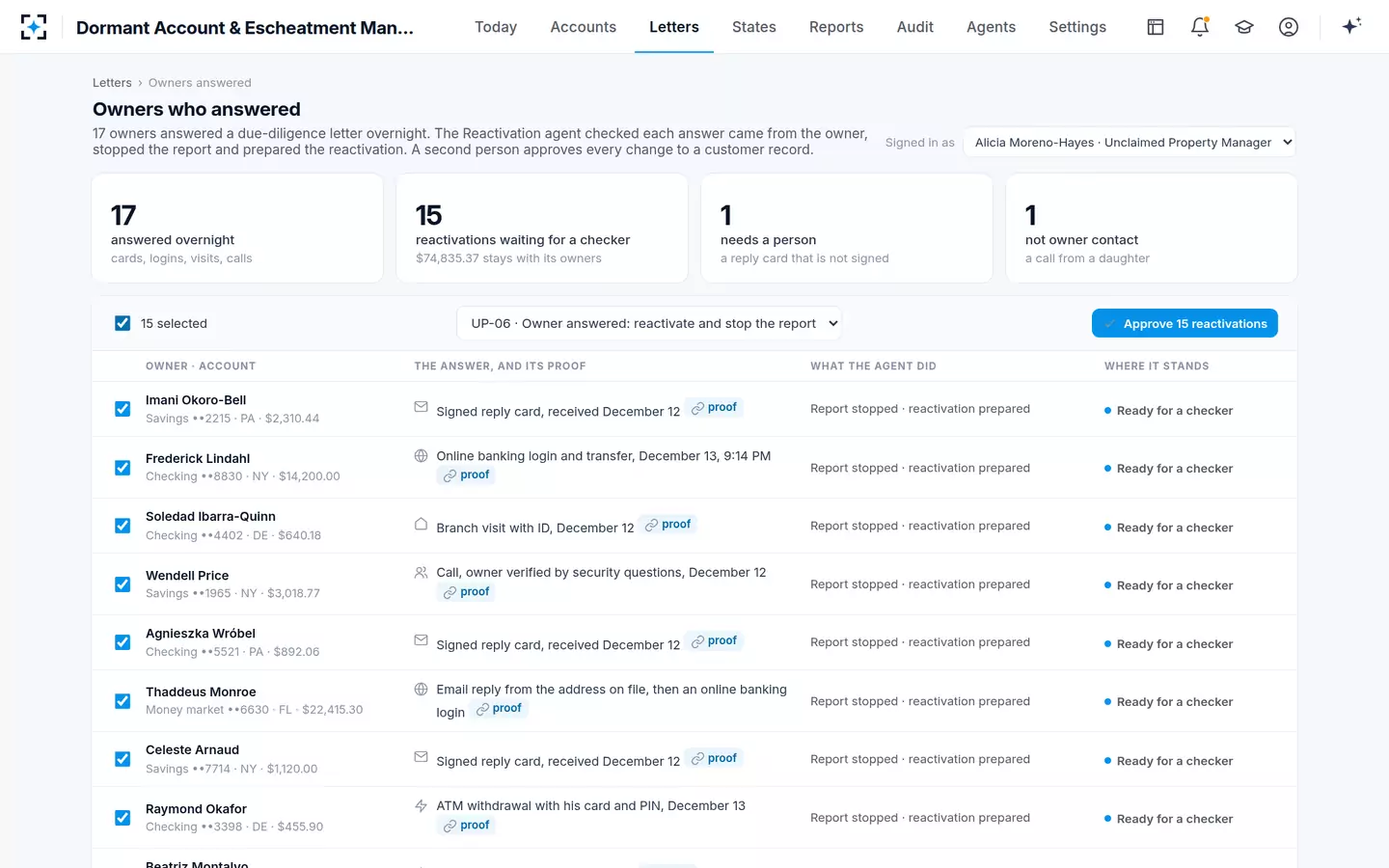
Reactivation agentReads answers, confirms each came from the owner, stops the report, prepares the reactivation
Never: Reactivates an account itself
Agent
Report CheckerBuilds the state file in the standard format, validates it, ties it to the escheat suspense account to the cent
Never: Files or remits
A person decides
Deposit Operations ControllerSigns the remittance once the manager has approved the file
Agent
Evidence agentKeeps the proof behind every date, drafts notes to states about late property for deposit counsel, builds export packs
Never: Changes an account, a letter or a file
Owners who answered, each with the proof it came from them
What regulators expect when AI touches escheat work
No escheat statute cited in this guide mentions artificial intelligence, and none needs to: the holder's duties are the same whoever, or whatever, performs them. Federal oversight takes the same line. GAO found in May 2025 that the federal financial regulators mostly supervise AI through the laws, rules, guidance and risk-based examinations they already have (GAO-25-107197), the same point the guide to AI audit software for branch reviews works through for examiners.
The risks are known, too. Treasury's 2024 report on AI in financial services summarises what firms told it: generative AI can take on back-office work such as keeping records, transcribing audio and searching documents, the kind of work the guide to account management automation splits into what to automate and what stays manual, but it can also produce "AI hallucinations", confidently stated output that is wrong (U.S. Treasury, December 2024). In escheat work the defence is structural. Every agent statement cites the source event it rests on, every date below a confidence threshold goes to a person, and the compliance team samples the agents' calls each quarter against the source, the way it would sample an analyst's.
How does escheatment automation keep up with each state's rules?
By keeping the rules as versioned data that counsel approves, not as code or habit. The differences are not cosmetic. Delaware, North Carolina and Pennsylvania give a 60-day letter window; Washington and the uniform act give 120. The uniform act counts an automatic deposit or withdrawal the owner authorized in advance as an indication of interest (RUUPA § 210(b)(5)), while North Carolina's definition of positive owner contact "does not include unreturned mail, automatic interest postings, automatic drafts, or service charges" (N.C. guide). The same recurring payment keeps one account alive and lets another go dormant, depending on where the owner lives.
And the rules move. In 2025 Washington, at its Department of Revenue's request, set the due-diligence notice threshold at $50 and the aggregate reporting amount at $5 (House Bill Report on HB 1127; RCW 63.30), and a bill can change a threshold between one report and the next. A rule table that says which version applied to which report, and who approved it, is what lets a bank answer an examiner who asks why an account was treated as it was three years ago. The guide to dormancy periods by state shows how such a table is built.
Where the time goes in an escheat cycle, by hand and with agents
By Botminds' estimate for one state's report cycle at a regional bank, about 35 business days of work by hand fall to about four and a quarter with agents. The largest shares by hand are tying the file to the general ledger (10 days) and proving owner contact across today's core and the archived one (8 days). The estimate is ours, kept modest, and it is a design figure, not a measured result.
Where one state report cycle's days go
By hand · 35 days
- Extract, dating, state rules · 23%
- Proving owner contact · 23%
- Letter run · 11%
- Answers · 14%
- File and tie-out · 29%
With agents · 4.25 days
- Extract, dating, state rules · 18%
- Proving owner contact · 23%
- Letter run · 12%
- Answers · 23%
- File and tie-out · 24%
The shares that grow with agents are telling. Working owners' answers rises from 14% to 23% of the remaining time, because reactivation is a human approval and stays one. Proving owner contact keeps its share because the hard accounts, the ones below the confidence threshold, still go to the analyst; what disappears is the routine account that a person used to check only because nobody could tell which ones were routine.
A letter run the manager can approve in one decision
What to ask before buying escheatment automation
Ask what the product does with the hard account, not the easy one. A demonstration on clean data shows formatting; the questions below show whether the tool finds the account a conversion hid, and whether a person stays in charge of what leaves the bank.
Eight questions for any escheatment automation
- Where does the dormancy date come from?
From source events the owner made, with each one cited, or from the core’s last-activity field?
- Can it read the archived core after a conversion?
North Carolina names conversions and mergers as the first errors it sees.
- What happens below its confidence threshold?
A named person should decide, and the decision should be recorded with a reason.
- Are state rules data that counsel approves, with versions?
An examiner may ask which rule applied three reports ago.
- Can it send, file or remit on its own?
The right answer is no: approvals and the remittance stay with people.
- Does it tie each file to the general ledger before money moves?
To the cent, with every difference traced to an account.
- How are its calls tested?
A quarterly sample against source records, and replay of any new version before it goes live.
- What evidence does it leave?
Delaware requires records for 10 years after a report; ask what an export for an examiner contains.
Where Dormant Account & Escheatment Management fits, and where it does not
The solution fits a bank or credit union that reports to many states, has been through at least one core conversion or merger, and wants dates it can defend. It reads the core, the archived core, document imaging, online banking and contact-center logs, and the general ledger, and it changes no customer's account without a person's approval. It produces the state file in the standard electronic format that, according to NAUPA, "All 50 states have used" since 2004 (NAUPA), so it does not replace each state's portal or the bank's filing role.
It does not suit a holder whose problem is volume of uncashed checks rather than dormant deposits, and it cannot date an account from evidence the bank no longer has: if pre-conversion records were destroyed, the agents can only flag the gap. For banks that do have the records, the comparison of approaches on a single hard account is in the guide to escheatment services, software or agents, and the solution is described in full on the Dormant Account & Escheatment Management page.
Questions people ask
How does escheatment work for a bank account?
When an account has had no owner-generated activity for the state's dormancy period, usually three or five years, the bank must try to reach the owner by letter inside the state's window. If the owner does not answer, the bank reports the balance to the state of the owner's last known address and remits it; the owner can then claim it from the state.
What are the steps in the bank escheatment process?
Identify accounts that crossed a dormancy date as of the state's cut-off; confirm the last owner contact; send the due-diligence letter inside the window; stop the report for owners who answer; build, verify and file the report; remit; and keep the records, which Delaware requires for 10 years after the report.
Can escheatment be fully automated?
Not responsibly. The reading, dating, drafting and reconciling can be, but the report must be signed and verified by or for the holder, reactivations change customer accounts, and remittances move money. A design that lets software do those alone removes the control the statutes assume.
How do you automate unclaimed property reporting?
Automate from the front of the cycle, not the back. Formatting the file is the easy part; dating each account from the owner's real last contact is the part that decides whether the report is right. Then keep state rules as versioned data, generate letters inside each window, and tie every file to the general ledger before approval.
What are escheatment solutions?
The market sells three kinds: reporting software that formats files from an extract, outsourced services that run the cycle for the bank, and agent-based systems that read source records with people approving. They differ most in where the dormancy date comes from, which is the question to ask first.
Does automating escheatment change who is liable?
No. Delaware's statute keeps the holder responsible for complete, accurate and timely reporting even when a third party prepares the report, and Pennsylvania requires the holder's own affirmation that it sent the required notices.