Account management automation, in a bank's deposit operations, is software that reads account maintenance requests, checks them against the bank's own documents and history, and prepares the change for a person to approve: new signers, owners, addresses, phones, beneficiaries and names. It does not mean letting software change accounts on its own. The maintenance teams that adopt it come to trust it for two reasons: every proposed change opens the line of the document it came from, and clean work is sampled in full before a checker approves it in bulk. Botminds' Account Maintenance Requests is account maintenance request software built that way, with agents that propose and cite and two specialists who sign; this guide covers what to automate, what to keep manual, and how to go live without losing the desk's confidence.
Examples and settings come from a fictional sample bank, Corvane National Bank, as it runs the solution; the rollout plan is our recommendation. Regulators' positions are linked where they appear.
Who has to trust the automation, and what earns it
Today
Distrusts anything that types for them: a wrong keystroke is their name on a loss.
With agents
Trusts a proposed change once every value opens its line on the form and every warning shows its evidence.
Still theirs: Approve, hold or override, with a reason
Today
Worries that a bulk approve button means signing what they did not see.
With agents
Opens one in 20 clean requests in full before approving a group, and can pull any one out.
Still theirs: The second signature
Today
Needs the same-day target met without lowering the bar on risky changes.
With agents
Sees clean and flagged work in separate lanes, with callbacks on a clock.
Still theirs: Thresholds, staffing, sample rates
Today
Asks what happens when a model changes.
With agents
Signs a comparison of each new agent version run on last month’s requests before it goes live.
Still theirs: Locked settings and version approval
Today
Cannot test what it cannot see.
With agents
Filters every action by person and agent and builds an examiner pack with masking applied.
Still theirs: Testing and findings
What account management automation means in deposit operations
In a bank, account management automation for deposit operations means automating the reading, checking and preparing of maintenance changes, while the decision and the signatures stay with people. That is different from what the phrase means in sales software, where account management is about client relationships; here the account is a deposit account and the work is keeping its owners, signers, contacts and beneficiaries right.
In Account Maintenance Requests the work is split across six agents. An Intake agent reads forms, branch uploads, secure messages and call notes into only the fields that change. An Authority agent checks the signature card, the corporate resolution or the power of attorney. A Signature agent scores the signature against the card. A Takeover agent reads 90 days of calls, devices, card requests and earlier changes. A Callback agent chooses a safe number and drafts a script. An Update and notice agent posts the approved change, reads the core back and drafts the confirmations. None of them approves anything.
Can account changes be automated? Which ones, and how far
Most of the work on most account changes can be automated up to the point of decision, and for clean, low-risk changes the decision can be made in groups with a sample. What should never be automated is the decision on a request with takeover signals, the callback, and the reading of a disputed legal document. The table sorts the common change types.
How far each kind of account change can be automated
| Change type | What agents do | What a person does | Lane at Corvane |
|---|---|---|---|
| Address change matching a permanent USPS change of address, no signal in 90 days | Read, match, check history, draft update and two letters | Checker opens one in 20, approves the group | Low-risk |
| Phone or email change made in a verified digital banking session | Read, confirm the session’s step-up, check history | Checker approves the group after the sample | Low-risk |
| Name change with a marriage certificate, divorce decree or court order | Read the document, match it to the customer | Checker approves the group after the sample | Low-risk |
| Signer, owner or beneficiary change | Read, check authority and signature, draft the update | Maker approves; a second specialist checks | Specialist |
| Any request with takeover signals | Assemble history, choose the callback number, draft the script | Specialist holds, calls, records the outcome | Flagged |
| Power of attorney without the power asked for; one signature of two | Find the gap and say what is missing | Decline, ask, or send to Legal or the protection team | Exception |
Do regulators allow AI in account servicing?
Yes, within the rules that already apply to the work. The Government Accountability Office's 2025 review found that federal financial regulators supervise AI mainly through the laws, guidance and risk-based examinations they already had, not through rules written for AI (GAO-25-107197, May 2025); AI audit software for branch reviews applies the same finding to another desk. For account maintenance those existing rules are concrete: the Red Flags Rule's identity theft program, the FFIEC's 2021 authentication guidance, the BSA's recordkeeping and SAR confidentiality rules, and deposit insurance rules on how accounts are titled.
Two existing obligations bear directly on a bank that brings in agents from a vendor. The Red Flags Rule makes oversight of service providers part of administering the program (12 CFR 41.90(e)(4); red flags rule vendor management covers the contract terms), and its guidelines suggest requiring a service provider by contract to detect relevant red flags and report them or act on them (Appendix J, section VI(c)). The interagency guidance on third-party relationships also applies; in September 2026 the agencies proposed to rescind and replace the 2023 version, with comments due by November 16, 2026 (91 FR 58536), so a bank should plan its vendor oversight to whichever version is in force when it signs.
The U.S. Treasury's 2024 summary of industry responses describes the use case plainly: "Generative AI can automate back-office functions like recordkeeping, predictive texting, transcribing audio, and advanced document searches" (U.S. Treasury, Artificial Intelligence in Financial Services, December 2024). It reports what firms said, not a supervisory view, but it is a fair description of what the agents on a maintenance desk do.
How do you get staff to trust automation? Show the line, not a score
Staff trust automation when they can check it in seconds, not when they are told it is accurate. A specialist will not approve a new beneficiary because a model says 0.97. They will approve when the value on screen opens the scanned line of the form it came from, the signature comparison shows the strokes that differ, and the warning about a phone change opens the call that made it. That is the design principle the solution is built on: agents propose, cite and recommend, and every value and every signal carries its evidence.
A score with its reasons, and a rule that a score is never a decision
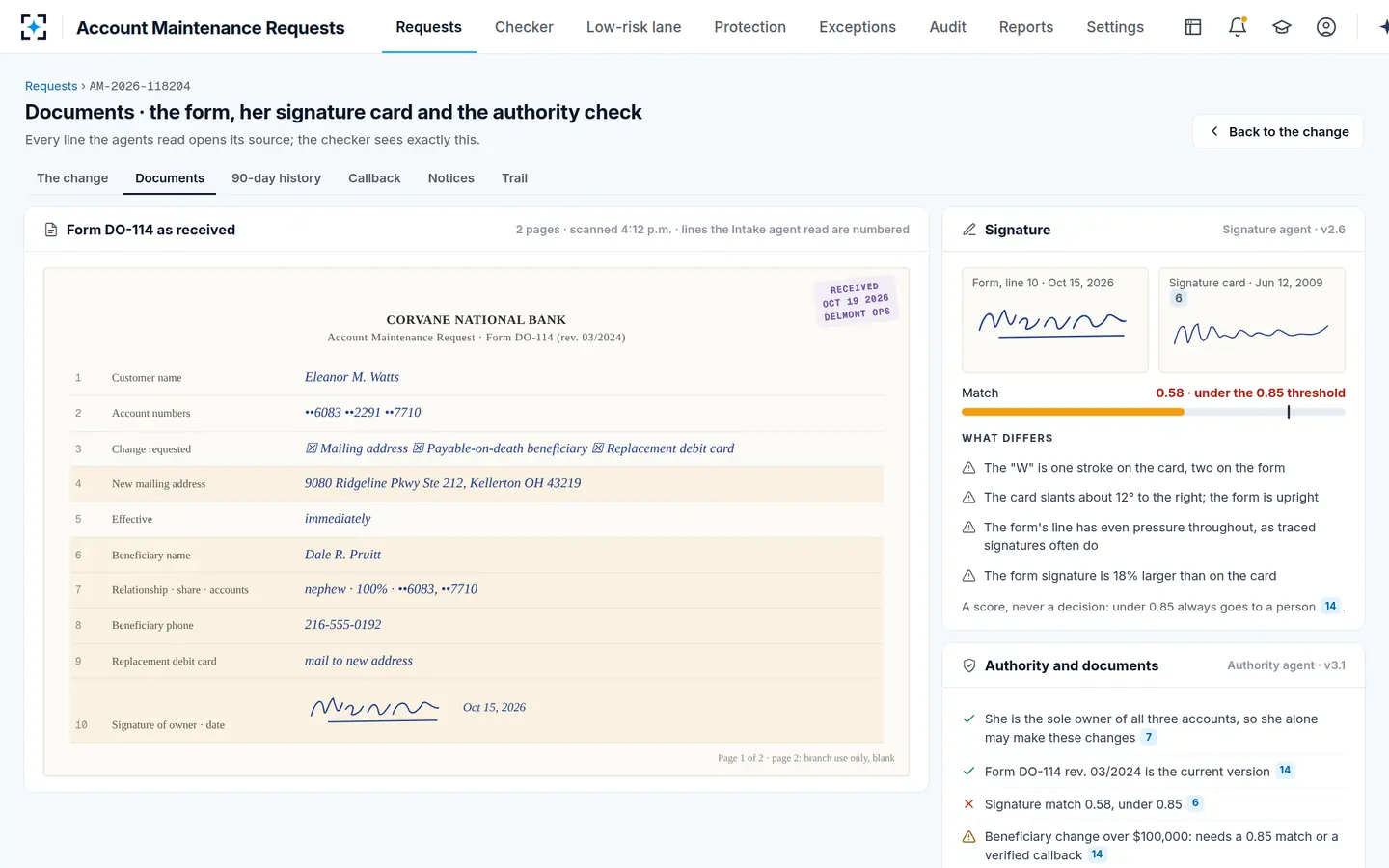
The second trust builder is a plain-words consequence. Above each risky request the Takeover agent writes what approving would let someone do: in the sample case, that $279,210.55 would pass to a stranger at the customer's death, that her statements and a new debit card would go to a private mailbox, and that the bank's fraud alerts would reach a number added six days earlier. A specialist does not need to trust a score when the stakes are written out.
The third is that the agents' limits are visible and absolute. The Signature agent never decides; the Takeover agent never contacts a customer; the Callback agent never calls a number in the request or one changed in the last 90 days, and never records an outcome; nothing posts on one signature. People trust a colleague whose boundaries they know.
What should stay manual in account maintenance?
The steps that carry legal responsibility or need a human conversation should stay manual: the decision on any flagged request, the callback and its outcome, the hold and the referral, the reading of a contested power of attorney or resolution, any protective action, and the checker's signature. Each is a place where a confident wrong answer is expensive and where the bank will later have to say who decided and why.
Seven things that stay with people, whatever the agents can do
- Approving, holding or overriding a flagged request
Overrides carry a reason code and a note.
- Placing the callback and recording what the customer said
The agent picks the number and drafts the script; it never records an outcome.
- Deciding a hold, a referral or an elder protection case
Agents can suggest the protection team; they cannot open the case.
- Reading a disputed power of attorney or resolution
The agents flag the gap; Legal or a senior specialist decides.
- Every protective action on a customer’s account
Each is made by one person and checked by another.
- Anything that would reveal a suspicious activity report
Letters and screens never mention a referral or a report.
- The second signature on every change
A maker never checks their own request.
How to roll out automation in deposit operations: a twelve-week plan
Roll it out in the order that builds evidence: read last month's requests first, compare with what the desk actually did, then let the agents propose live while people work as before, and switch on group approval of clean work last, starting with a heavier sample. Each stage gives the team something to check before it is asked to rely on anything.
Twelve weeks from first connection to group approval of clean work
- Connect, readWeeks 1–2
- Replay last monthWeeks 3–4
- Shadow liveWeeks 5–7
- Makers use proposalsWeeks 8–9
- Clean lane, 1 in 10Weeks 10–11
- ReviewWeek 12
The replay in weeks three and four is the step that changes minds. At Corvane, a new version of any agent runs on the previous month's requests, 45,870 of them, and Compliance signs the comparison before it goes live. Doing the same at the start gives the desk a list of cases where the agents and the specialists disagreed, which is the most persuasive document in the project: some disagreements are agent errors to fix, and some are requests the desk let through that it would not let through again.
The low-risk lane: approve in groups, open one in twenty
The low-risk lane is where automation saves the most time, and where trust is most fragile, so its rules should be narrow and its sample real. At Corvane a request qualifies only if it fits one of four groups, such as an address change matching a permanent USPS change of address by the same customer with no takeover signal in 90 days, and a checker opens one in 20 in full before approving the group. On the sample Monday, that was 72 requests opened out of 1,412, and the sample pulled one out: a postal change that was a temporary forward, not a move.
That single pull-out is what makes the lane credible. A sample that never finds anything gets skipped; one that occasionally catches a real exception keeps checkers looking. The rate is a setting, at one in 10, 20 or 50, and the plan above starts at one in 10 for that reason.
Will automation replace account maintenance clerks?
It changes what they spend time on more than how many are needed, and the occupation was projected to shrink before any of this. O*NET's profile of New Accounts Clerks, the closest federal occupation to maintenance work, shows 37,900 people employed in 2025 and employment projected to decline by 1% or more from 2025 to 2035 (O*NET 43-4141.00). If the projection holds, the same maintenance work will fall on fewer people.
A smaller occupation with a harder job
37,900
New Accounts Clerks employed in 2025
Decline
projected employment, 2025 to 2035: -1% or lower
On a desk that adopts agents, the work that shrinks is finding, reading and keying; the work that grows in value is the callback, the authority judgment and the protection case. Segregation of duties on the maintenance desk makes the same point from the staffing side.
What to watch in the first ninety days
Watch the numbers that show whether people are relying on the agents for the right things: overrides and their reasons, returns from checkers and their reasons, what the low-risk sample pulls out, how many callbacks end in a customer denial, and whether callbacks meet their deadline. Corvane codes overrides OV-1 to OV-5 and returns RC-1 to RC-5, so each can be counted.
Two patterns are warning signs. Overrides that cluster on one reason usually mean a rule is set wrong, not that specialists are careless. And a low-risk sample that has found nothing for months is either a very clean lane or a checker who has stopped reading; opening the examiner pack on a few approved groups tells the manager which. The buyer's questions include how a vendor makes these numbers visible.
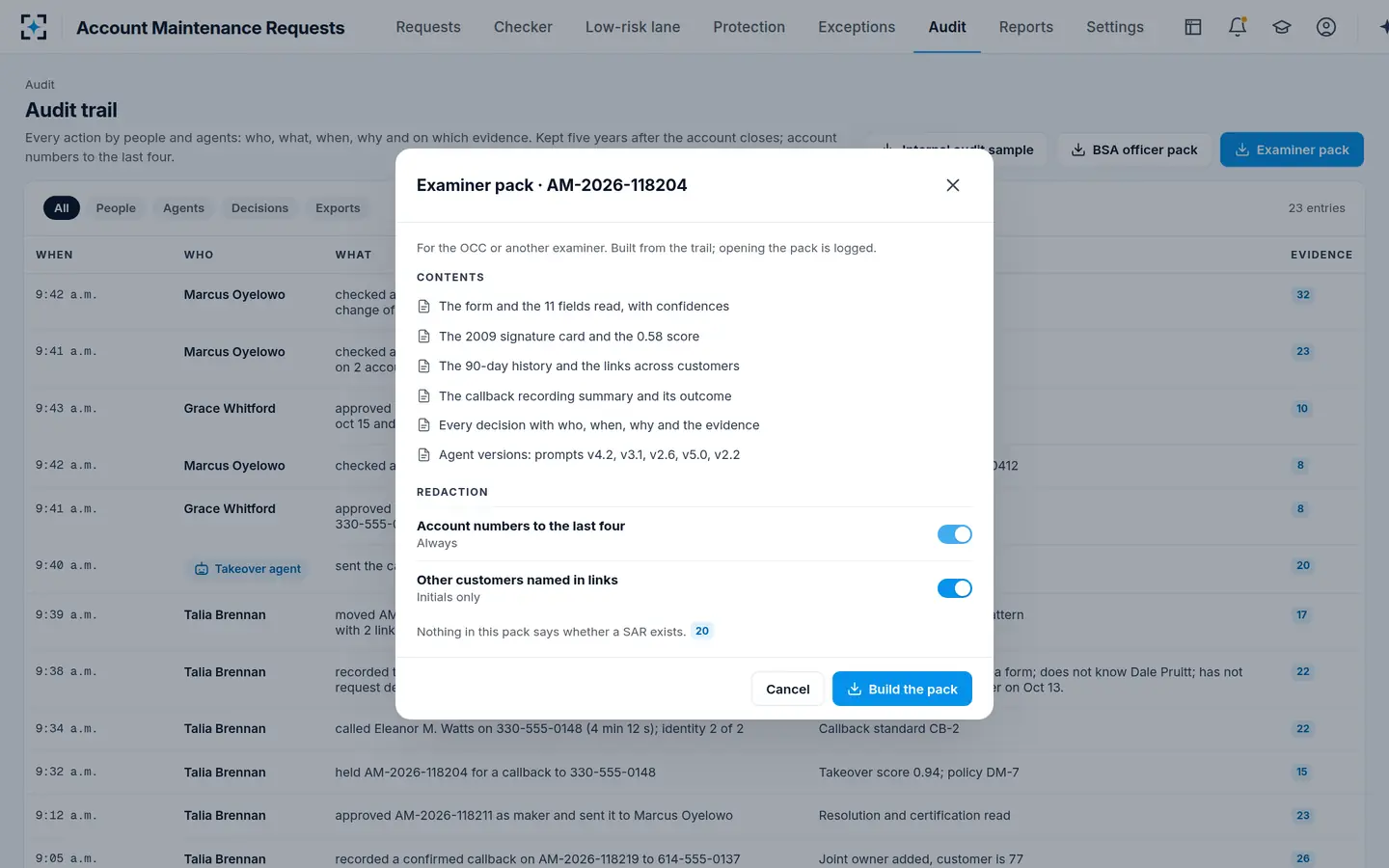
Every action by people and agents, and an examiner pack built from it
Where Account Maintenance Requests fits in a rollout, and where it stops
The solution fits a deposit operations desk that receives maintenance requests through several channels, keeps forms and signature cards in document imaging, and wants clean changes cleared quickly without loosening checks on risky ones. It works with the systems already there: the core banking system for customer search, posting and read-back; document imaging for forms, cards, resolutions and powers of attorney; contact history; the digital banking platform and card processor; an address validation service; and case management and correspondence.
It is not a replacement for the core's own maintenance screens, which remain the system of record, and it is not a digital fraud platform that watches every online session; account takeover detection in digital channels is a different job with its own tools. Nor does it settle legal questions: when a power of attorney or resolution is disputed, the agents say what is missing and a person decides. A bank without a written change-type policy and callback standard should write those first, because the solution turns them into settings; it does not invent them.
Questions people ask
What is account maintenance automation?
It is software that reads maintenance requests and prepares account changes for people to approve: owners, signers, addresses, phones, beneficiaries and names. Done well, it ties every proposed value to its source and leaves the decision, the callback and the second signature with specialists.
Can an AI agent post a change to the core banking system?
In Account Maintenance Requests, only after a maker approves and a different specialist checks; the Update and notice agent then posts the change and reads the core back. It never posts on one signature, which is the control an examiner will look for after any loss.
How long does it take to automate account maintenance?
Our recommended plan runs twelve weeks from first connection to group approval of clean work, with live shadowing in the middle. The integration with the core banking system and document imaging is likely to set the pace more than the agents do.
What happens when an agent is wrong?
The specialist overrides it with a reason code and a note, or the checker returns the request with a reason. Those codes are counted, so a pattern of errors shows up as a number the manager can act on rather than as anecdotes.
Can the low-risk lane run without a checker?
Not in this design. Every low-risk group is approved by a checker after the sample is opened, and any request the sample finds odd is pulled out for a specialist. The lane removes keying and one-by-one review, not the second signature.
Does automation weaken the Red Flags program?
It should strengthen detection, because the agents read the cross-channel history a busy specialist often cannot. But the program stays the bank's: its board-approved red flags, its responses and its oversight of any service provider that performs the work, which the rule requires.