Bank signature card requirements do not come from any single federal rule, and no rule says every account needs a card, but in practice a bank cannot do without the document the card represents. The Bank Secrecy Act requires banks to keep every document that grants someone signature authority over a deposit account; the FDIC insures a joint account as a joint account only if each co-owner has signed a signature card or the bank's records otherwise establish co-ownership; and the Red Flags guidelines treat a mismatch with the signature card as a warning sign. After opening, the card becomes the yardstick for every maintenance request: a new address, a new beneficiary or a new signer is judged partly by whether the signature on the request matches it. Botminds' Account Maintenance Requests is account maintenance request software in which agents compare the signature with the card on file and show the differences, and a person decides.
Rule text below is from the eCFR, current to October 22, 2026, and the FDIC's deposit insurance brochure. Worked examples use a fictional sample bank, Corvane National Bank, and its sample customers.
Bank signature card requirements, rule by rule
- Keep the document that grants signature authority
BSA recordkeeping, 31 CFR 1020.410(c)(1), including any notes of the identification used to verify the signer.
- Keep it for at least five years
The general BSA retention period, 31 CFR 1010.430(d).
- For joint accounts, have each co-owner sign, or hold other proof of co-ownership
FDIC, 12 CFR 330.9(c): electronic signatures count, and issuing each co-owner a way to access the account can substitute.
- Never treat the card as identification
Where the BSA funds transfer rule requires identity verification in person, it requires a document other than a bank signature card.
- Use it as the comparison point for later requests
Red Flags guidelines, Supplement A, example 8: information inconsistent with what is on file, such as a signature card.
- Replace it when the signers change
Good practice: the card should match the latest resolution or ownership exactly.
Are signature cards required for bank accounts? The short answer
Not as a stand-alone requirement, but the document a signature card is, the record of who may sign and how, is required to be kept, and for joint accounts it decides the insurance category. A bank that opens accounts without one has to prove signature authority and co-ownership some other way, and has nothing to compare future signatures against.
The BSA recordkeeping rule is the nearest thing to a general requirement. It requires each bank to keep the original or a copy of a list of records, and the first item is every document granting signature authority over a deposit or share account, together with any note the bank normally makes of how it verified the signer, such as a driver's license number (31 CFR 1020.410(c)(1)). The same recordkeeping rule at the teller line shows how far that list reaches. The rule does not dictate the form. A card, an electronic signature record or a signed account agreement can each be the document, so long as it grants the authority and can be retrieved.
What a signature card holds, and why deposit operations relies on it
A signature card is the bank's record of who owns an account, who may sign on it, how many signatures a transaction needs, and what each authorised person's signature looks like. On a consumer account it usually carries the owners' names, the ownership type, any payable-on-death beneficiaries and each owner's signature. On a business account it lists the authorised signers named in the company's resolution and the signing rule, such as two signatures on items over a set amount.
Today the "card" is often an image in document imaging or an electronic signature record, and the FDIC's own rule now speaks of a co-owner having "personally signed, which may include signing electronically, a deposit account signature card" (12 CFR 330.9(c)(1)(ii)). The name has outlived the cardboard; the function has not changed.
What is the purpose of a signature card? Four jobs one document does
A signature card does four jobs: it evidences who may sign, it records the ownership the bank and the FDIC rely on, it keeps a specimen to compare later signatures against, and it fixes the signing rule a business set. Each job is tied to a different rule or risk, which is why one document carries so much weight.
One document, four jobs, four different rules
| Job | What depends on it | Where the rule is |
|---|---|---|
| Evidence of signature authority | Whether a withdrawal, check or wire was authorised | BSA recordkeeping, 31 CFR 1020.410(c)(1) |
| Record of ownership | The deposit insurance category, and who inherits | FDIC joint accounts, 12 CFR 330.9(c); trust accounts, 12 CFR 330.10(d) |
| Specimen signature | Whether a maintenance form or check is genuine | Red Flags guidelines, Supplement A, example 8 |
| Signing rule for a business | Whether one signature is enough | The company’s own resolution, reflected on the card |
The specimen job is the one maintenance relies on most. The Red Flags guidelines list, among suspicious documents, "Other information on the identification is not consistent with readily accessible information that is on file with the financial institution or creditor, such as a signature card or a recent check" (12 CFR 41, Appendix J, Supplement A, example 8). A maintenance form signed by someone other than the customer fails exactly that comparison, if anyone makes it.
Does a joint account need both owners to sign the signature card?
For full joint-account insurance coverage, each co-owner must have signed the signature card, or the bank's records must otherwise establish co-ownership. The FDIC's rule makes a qualifying joint account depend on three things: each co-owner is a natural person, each "has personally signed, which may include signing electronically, a deposit account signature card, or the alternative method provided in paragraph (c)(4) of this section is satisfied", and each "possesses withdrawal rights on the same basis" (12 CFR 330.9(c)(1)).
Two ways to prove a joint account is joint
A signed signature card: Each co-owner signs the card, on paper or electronically
The alternative the rule allows: The bank’s records show co-ownership another way
A signed signature card: Two signatures on the card
The alternative the rule allows: A mechanism for accessing the account issued to each co-owner, or evidence of each co-owner using the account
A signed signature card: Signatures of two or more persons are “conclusive evidence” of a joint account, though not necessarily a qualifying one, unless the records as a whole are ambiguous
The alternative the rule allows: Depends on what the records show
A signed signature card: Not needed for certificates of deposit, negotiable instruments, or accounts held by an agent, nominee, guardian, custodian or conservator
The alternative the rule allows: Same exceptions apply
Two consequences matter for maintenance. When a bank adds a joint owner, the new owner's signature, or the alternative evidence, is what makes the account qualify for the joint category, and the FDIC's brochure gives the test in plain words: "All co-owners must have equal rights to withdraw deposits from the account" (FDIC, Your Insured Deposits). And a card that shows different signing rules for different owners can take the account out of the joint category altogether. CIP requirements at an ownership change covers what else an added owner changes.
Beneficiaries on the card: why a payable-on-death name is a maintenance event
On many consumer accounts the signature card, or the record that replaces it, is also where payable-on-death beneficiaries are named, and the FDIC's rule makes that naming count. For deposit insurance, the beneficiaries of a payable-on-death account count only if the bank's deposit account records name them (12 CFR 330.10(d)(1)), and coverage is the standard maximum multiplied by the number of beneficiaries, up to five; FDIC insurance on payable-on-death accounts works through the arithmetic.
That turns every beneficiary change into a change of who inherits and of how much is insured, made by editing one field. It is why Corvane treats a beneficiary change over $100,000 as needing either a strong signature match or a verified callback, and why a beneficiary change requested by an agent under a power of attorney gets a guide of its own.
How long must a bank keep signature cards?
At least five years under the BSA's general retention rule, which sets five years for records the BSA regulations require (31 CFR 1010.430(d); BSA record retention explains where the seven- and ten-year figures come from). Because a card is the comparison point for as long as the account is open, a bank keeps it at least that long in practice; the five years is the federal floor, not the whole policy.
The same section requires that the records can be retrieved within a reasonable time. For maintenance that is an operational requirement, not only a legal one: a specialist who cannot pull the card up in seconds will compare the signature against memory or skip the comparison. The identification rule sets a different clock for its own records, five years after the account is closed (31 CFR 1020.220(a)(3)(ii)), which is a reason to keep the two kinds of record in the same place.
Can a bank verify identity with a signature card?
No. A signature card shows what a signature looks like; it does not prove who someone is. The BSA's funds transfer rule says so directly: where it requires a bank to verify the identity of someone placing or receiving a transfer in person, the bank must examine "a document (other than a bank signature card), preferably one that contains the person's name, address, and photograph" (31 CFR 1020.410(a)(5)). The identification rule's documentary standard for an individual is current government-issued identification that shows nationality or residence and carries a photograph or a similar safeguard, a driver's license or a passport for example (31 CFR 1020.220(a)(2)(ii)(A)); customer identification program requirements sets out the rest of that rule.
The distinction drives how a maintenance desk should use the card. A signature that matches the card supports a request; it does not authenticate the person who sent it. That is why the FFIEC's 2021 guidance calls for enhanced authentication on account maintenance activities such as address and contact changes (FFIEC, 2021), and why a high-value change with a weak match should go to a callback rather than to a closer look at the ink.
When does a bank need a new signature card?
A bank should take a new card whenever the people or the rules on it change: a signer added or removed, an owner added or removed, a name change, or a business changing how many signatures it needs. The card should always match the latest authority document exactly, because it is what the next request will be compared against.
Where the signature card is used across a maintenance request
Agent
Authority checkThe card shows who owns and who may sign; the Authority agent checks the requester against it.
Never: Never accepts authority the documents do not show
Agent
Signature comparisonThe Signature agent compares the request’s signature with the card and lists what differs.
Never: A score, never a decision
A person decides
DecisionA specialist weighs the comparison with everything else; below the bank’s threshold it goes to a person, and a high-value change can need a callback.
A person decides
New card if the people changeFor a signer or owner change, a new card signed by everyone who will be on the account.
Agent
Post, read back, storeThe approved change and the new card are stored with the request, and the core is read back.
Corvane's business example shows the rule in action. When Kessling Millwork LLC added a new signer and removed another, the checker's list included "A new signature card is signed by all three signers", next to the resolution and the beneficial ownership certification. The card on file then matched the resolution on the day the change posted.
A business signer change, with a new card signed by every signer

Comparing a signature with the card: what a score can and cannot say
A signature comparison score says how alike two signatures are; it cannot say who wrote either one. That is why it should be shown with its reasons and treated as one input. In Corvane's hardest case, a mailed form for Eleanor M. Watts, 81, scored 0.58 against her signature card from June 12, 2009, below the bank's 0.85 threshold. The Signature agent listed what differed: the "W" was one stroke on the card and two on the form, the card slanted about 12 degrees and the form was upright, the form's line had even pressure throughout, as traced signatures often do, and the form's signature was 18% larger.
The form's signature against the 2009 card, with the differences listed
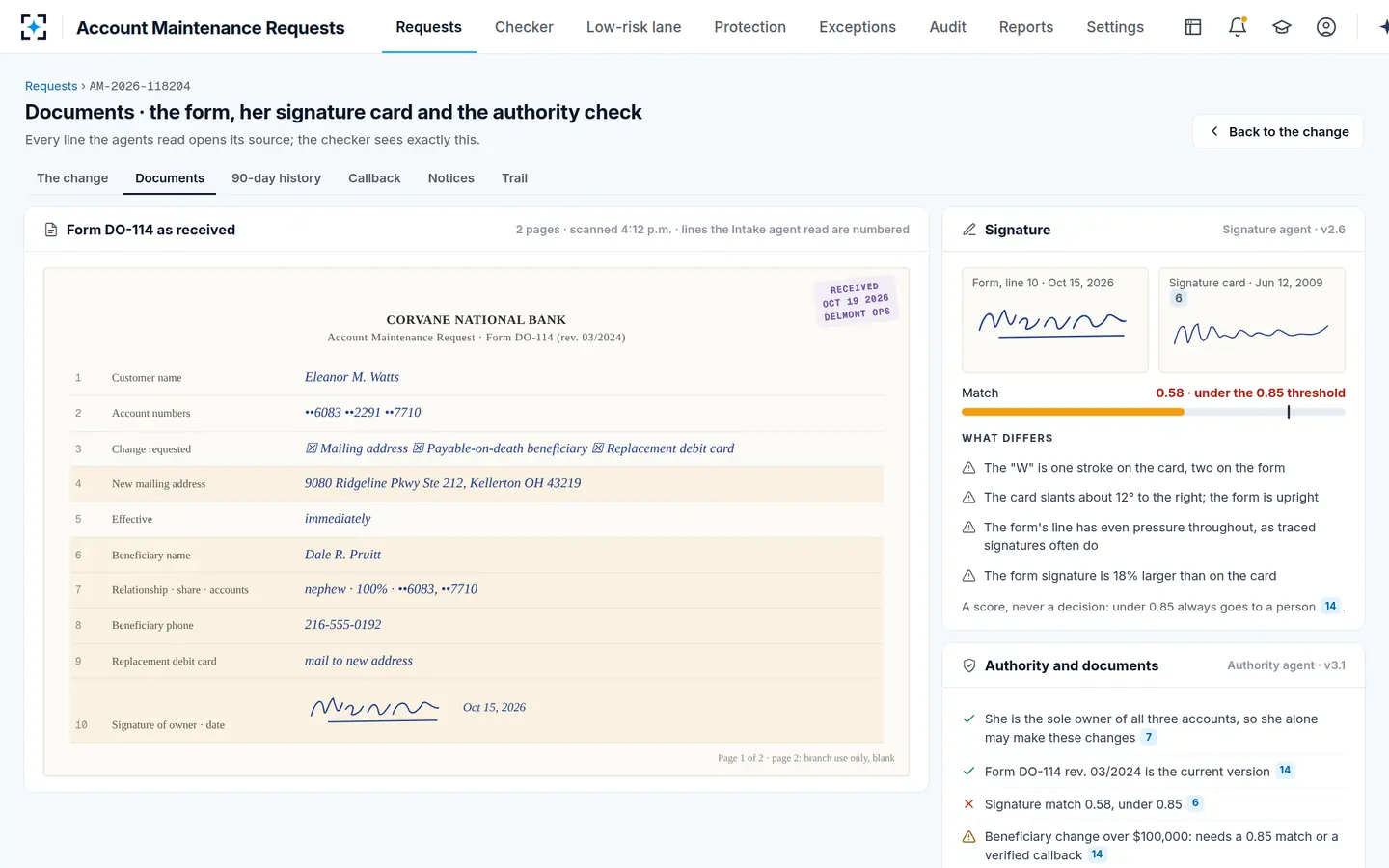
A low score is a reason to verify, not proof of forgery: people's signatures change with age, illness and haste, and a 17-year-old card is a weak specimen. A high score is not proof of authenticity either, because a careful forger can match a specimen they have seen. Corvane's policy reflects both points: a beneficiary change over $100,000 needs a 0.85 match or a verified callback to a number on file, and below 0.85 the request always goes to a person. In the Watts case the callback settled it; Mrs. Watts had never sent the form.
The other lesson is to keep the card current. A customer who signs a fresh card when their signature has changed gives the bank a better specimen and fewer false alarms. Changing the signers on a business account shows how a new card fits with the resolution, and the buyer's questions include how a tool shows its signature comparisons.
Questions people ask
Can a bank account be opened without a signature card?
Yes, in the sense that no single federal rule demands a physical card; many accounts are opened online with an electronic signature. But the bank still has to keep the document that grants signature authority under the BSA, and for joint accounts it needs each co-owner's signature or the FDIC's alternative evidence for joint coverage.
Is an electronic signature valid on a signature card?
The FDIC's joint-account rule expressly allows it: a co-owner may have "personally signed, which may include signing electronically" a signature card. Whether an electronic record is a good specimen for later comparison is a separate, practical question.
Does a payable-on-death beneficiary sign the signature card?
No. Under state multiple-party account laws such as Virginia's, the account belongs to the owner during the owner's lifetime, and the owner, not the beneficiary, signs and names the beneficiary. For FDIC trust coverage, each beneficiary has to appear by name in the bank's own account records, which is why a beneficiary change is a maintenance request of its own.
What happens if a signer leaves a company and the card is not updated?
The bank may keep honouring that person's signature, because the card and the last resolution still authorise it. Businesses should send a new resolution and card as soon as a signer leaves, and banks should remove the person's online access and templates at the same time.
Does a bank need a new signature card after a name change?
It should take one. A married or court-ordered name that differs from the card makes every later comparison harder, and the Red Flags guidelines treat identifying information that is inconsistent with what is on file as a warning sign. A new card signed in the new name, with the marriage certificate or court order on file, resolves both.
Is a signature card the same as a deposit agreement?
No. The deposit agreement sets the terms of the account for every customer; the signature card records who owns and may sign on a particular account. Some banks combine them in one signed document, which works so long as it grants signature authority and can be retrieved.