An account maintenance software comparison should start with the questions an examiner or a fraud investigator will ask after a loss, not with the demo screens. Does the tool prove the requester's authority from the bank's own documents? Whom does it call back, and on which number? Does it read the account's recent changes across channels, or only the form in front of it? Can anything post on one person's signature? And what record does each changed field leave? Twelve questions below turn those into a comparison a buying team can score, and a replay test turns the answers into evidence. Botminds' Account Maintenance Requests is account maintenance request software for deposit operations built around those questions; the last section says honestly where it fits and where it does not.
Product examples are sample data from a fictional bank, Corvane National Bank, as it runs the solution; rules and guidance are linked where they appear. The scorecard weights are our suggestion.
Twelve questions for any account maintenance software
- Does it show only the fields that change, each tied to the line it came from?
A specialist, a checker and an examiner should all be able to open the source of every new value in one click.
- How does it prove authority for each change type?
Owner or signer on the card, the officer a resolution names, an express grant in a power of attorney; and what it does when a document is missing.
- Does it ask instead of guessing?
When a resolution has one signature of two, or a POA lacks the power asked for, it should say what is missing, not fill the gap.
- Does the signature comparison give reasons, and is it barred from deciding?
A score with the strokes that differ, routed to a person below your threshold.
- Does it read the account’s recent history across channels?
Contact center calls, password resets, devices, payees, card requests and earlier changes, read with the request.
- Does it link the same phone, email or mailbox across customers?
Takeover crews reuse drops; one mailbox on three older customers’ requests is the pattern.
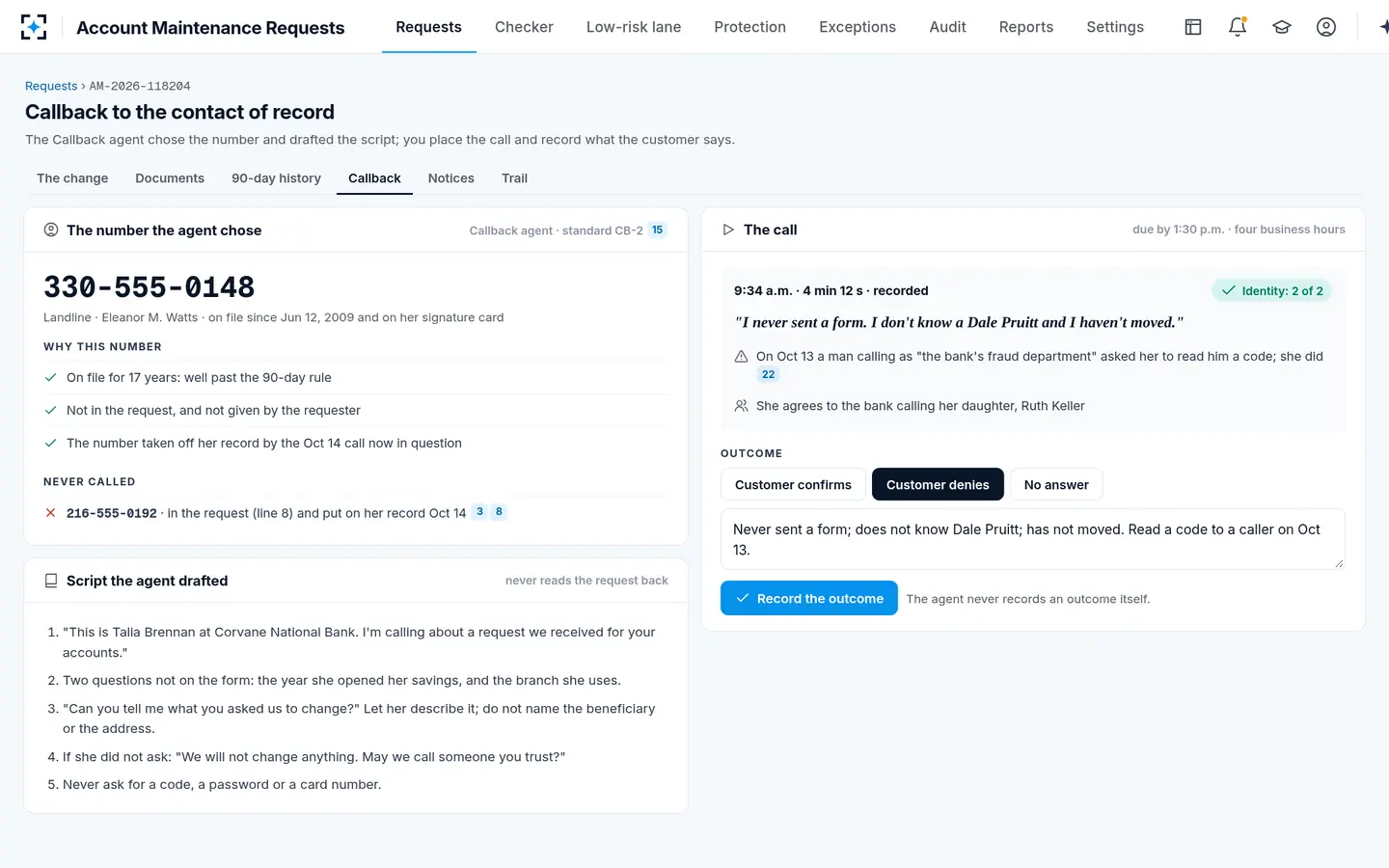
- How does it choose the callback number, and who records the outcome?
On file for a set period, never from the request; a person places the call and records what was said.
- Does it validate address changes before cards, and confirm both ways?
The card issuer rule’s 30-day window; separate notices to the old and the new address.
- Is there a maker and a different checker on every change, and a read-back?
Nothing should post on one signature, and the core should be read back after posting.
- How does it clear clean requests safely?
Group approval by a checker, a sample rate you set, and the power to pull items out.
- Can any letter or screen reveal a suspicious activity report?
Notices and customer views checked before sending; referrals invisible outside the teams that need them.
- What does the trail record, and how are new versions tested?
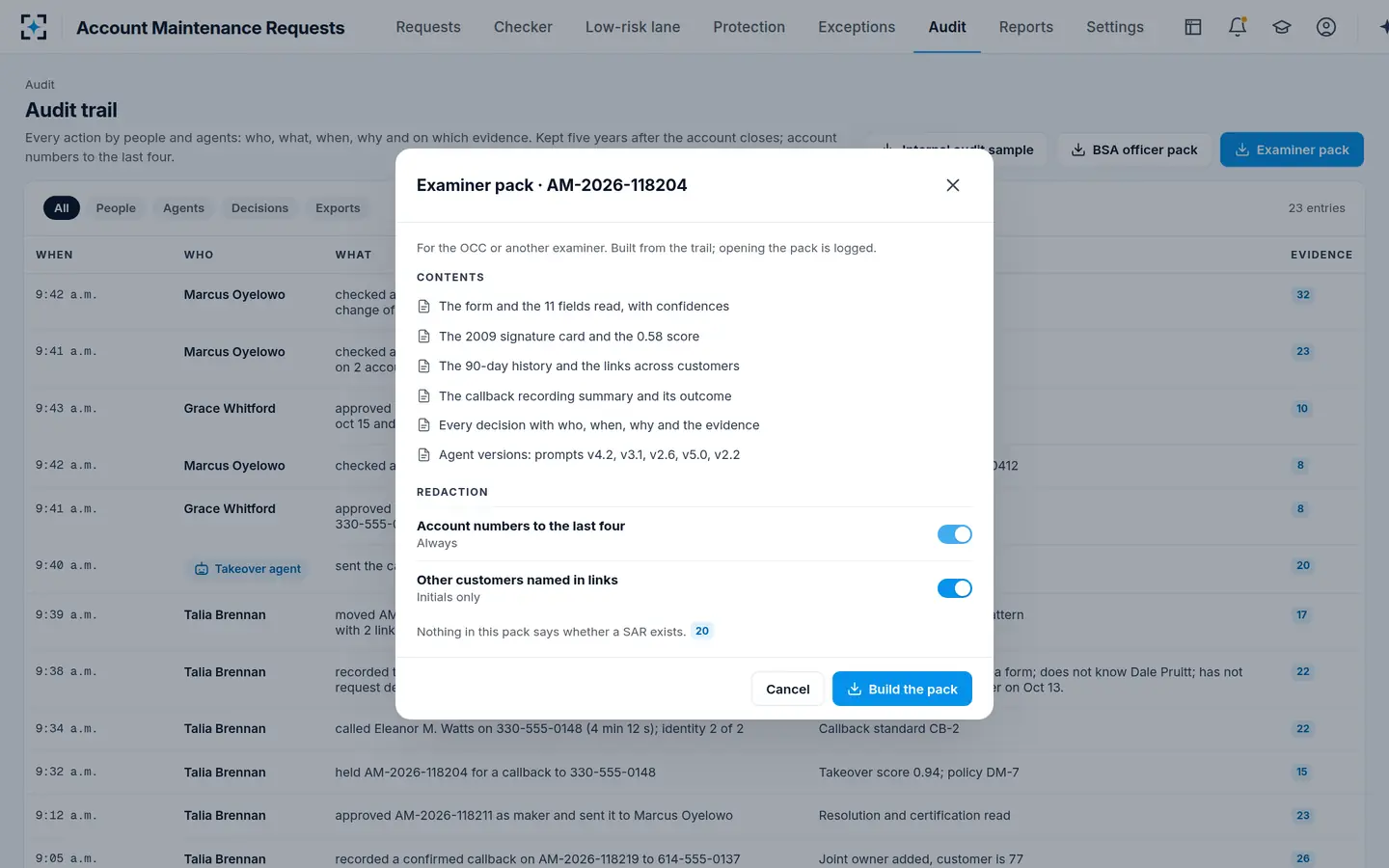
Who, what, when, why and the evidence for every action; new prompt or model versions replayed on past requests and signed off before going live.
Account maintenance software comparison: what to compare first
Compare first on the controls a regulator already expects for maintenance, because those decide whether the tool reduces risk or just moves it faster. The FFIEC put account maintenance squarely among authentication risks in 2021.
Enhanced authentication controls are applied for account maintenance activities (e.g., changes to physical or email address, password, contact information, or enrolled devices) performed or requested by customers or users.
FFIEC, Authentication and Access to Financial Institution Services and Systems, 2021
The Red Flags Rule adds the program side. A bank's written identity theft program covers "any existing covered account", not only openings (12 CFR 41.90(d)(1)), and its guidelines ask banks to verify the validity of change of address requests on existing accounts. Software that speeds up keying but cannot show how it verified a change, or that the bank responded to the red flags it saw, makes the program harder to evidence, not easier.
Speed matters, but it is the easy part to buy. Every serious tool will read a form faster than a person; the differences that decide losses are in authority, callbacks, cross-channel reading and the trail.
What to look for in account maintenance software
Look for evidence on every value, an explicit authority check per change type, a takeover view that reads beyond the form, a callback that the tool cannot point at the fraudster's phone, and a maker-checker rule the tool enforces rather than suggests. Corvane's hardest case is a useful yardstick: a forged form naming a stranger payable-on-death beneficiary on $279,210.55 for an 81-year-old customer, with a phone change six days earlier to the number the form gave for the beneficiary.
A tool that reads the form alone would see a tidy request and a signature that, at a glance, resembles the card. A tool that answers the twelve questions sees five signals, including that the beneficiary's phone is the number added by a contact center call that skipped the code, and routes the request to a hold and a callback on the customer's landline of 17 years. The difference is not the user interface; it is what the tool reads.
A scorecard for the comparison, weighted toward the controls that stop losses
| Area (questions) | Weight | A strong answer shows | A weak answer sounds like |
|---|---|---|---|
| Evidence and authority (1–3) | 20 | Every value opens its source line; missing documents produce a request, not a guess | “Our model is 98% accurate on forms” |
| Signature comparison (4) | 5 | A score with the features that differ; below threshold always to a person | “Signatures are auto-verified” |
| Takeover reading (5–6) | 20 | Ninety days across channels read with the request; links across customers | “We integrate with your fraud vendor” |
| Callback (7) | 15 | Number chosen by rule, never from the request; a person records the outcome | “The system can call the customer” |
| Address and card rules (8) | 5 | Validation before cards; notices to old and new address, separate from statements | “Customers get a confirmation email” |
| Maker, checker, read-back (9) | 15 | Two different people on every change; posting only after both; core read back | “Supervisors can approve in bulk” |
| Clean lane (10) | 10 | Group approval after a sample you set; items can be pulled out | “Low-risk changes post automatically” |
| Notices, trail, versions (11–12) | 10 | SAR-safe templates; full trail and masked exports; versions replayed and signed off | “Logs are available on request” |
The weights put more than half the score, 55 points, on three areas, evidence and authority, takeover reading and the callback, because those decide whether a forged request posts. Throughput is deliberately not a line: every credible tool is fast, and a tool that is fast and weak on those three moves risk through the desk faster.
A callback number chosen by rule, with the number never to call
Account maintenance software features that examiners test
Examiners test controls against rules, so the features worth paying for are the ones that map to a rule and leave evidence. The table maps the common feature claims to the rule each serves and to the evidence a bank should be able to produce from the tool.
Feature claims, the rule behind each, and the evidence to ask for
| Feature claim | Rule or guidance it serves | Evidence the tool should produce |
|---|---|---|
| Reads forms automatically | BSA recordkeeping of signature-authority documents (31 CFR 1020.410(c)) | Each new value linked to its source line; the document retained and retrievable |
| Verifies identity for contact changes | FFIEC 2021 enhanced authentication for account maintenance | Which method was used on each change, and when |
| Flags suspicious address changes | Red Flags guidelines, App. J III(b) and Supplement A | The red flags seen, the response chosen, who chose it |
| Holds card requests after a move | Card issuer address rule, 12 CFR 41.91 | Validation date and method before any card was issued |
| Maker-checker workflow | Internal control; no rule prescribes it for maintenance, but a loss review will ask who checked | Two different people on every change; no self-checks |
| Customer notices | SAR confidentiality, 31 CFR 1020.320(e) | Templates checked for any mention of a referral or report |
| Audit trail | Exam testing and BSA retention (five years under 31 CFR 1010.430) | Every action with who, what, when, why and the evidence; masked exports |
One rule deserves a direct test, because tools fail it quietly. A bank may not reveal a suspicious activity report, or anything that would show one exists, outside the narrow channels the rule lists (31 CFR 1020.320(e)). A tool that drafts a customer letter saying the change has gone to fraud investigators, or puts a referral flag on a screen a branch employee turns toward the customer, creates that disclosure on the bank's behalf. Callback verification at a bank shows the same trap on a callback.
How do you test account maintenance software before buying?
Replay your own past requests through it, including cases whose outcome you know, and score what it catches, what it holds wrongly and what it cannot read. A vendor's demo data shows what the tool does with tidy inputs; last month's requests show what it does with yours.
A replay test built from your own files
| Seeded case from your history | What a good tool does | What to measure |
|---|---|---|
| A confirmed takeover: phone change, then address or beneficiary change | Links the changes, scores the request, recommends a hold and a safe callback number | Caught or missed; number chosen |
| A beneficiary change by an agent under a power of attorney without an express grant | Flags the missing grant and stops | Stopped or posted; reason given |
| A business resolution signed by one of two required signers | Asks for the second signature | Asked or guessed |
| An address change matching a temporary postal forward | Keeps it out of the low-risk lane, or the sample pulls it | Pulled or approved in bulk |
| Fifty clean changes of each common type | Groups them for a checker with a sample | False holds; minutes per request |
| An unreadable fax and a stale form version | Stops for a person and says why | Stopped with a reason, or read with false confidence |
Run the replay in shadow, with the vendor's tool proposing and your specialists working as usual, and compare the two on every disagreement. The useful output is not an accuracy percentage; it is a list of named requests where the tool and the desk differed, and why. That list is what a risk committee can actually evaluate.
Account maintenance software reviews: what a reference call should ask
Independent reviews are hard to find for this category, so reference calls do the work. Ask references for numbers the tool itself should produce: how often specialists override its recommendations and for which reasons, how often checkers return changes, what the low-risk sample has pulled out, how many held requests ended in a customer denial on callback, and how long callbacks take against the deadline. A reference that cannot answer has not been using the tool for the controls that matter.
Ask too about the examiner experience: whether an examiner has tested maintenance files produced by the tool, what they asked for, and how long it took to produce it. And ask about the bad week: what happened when the core banking system did not answer, or an agent version had to be rolled back.
Bank account management software vs an account maintenance tool
Bank account management software usually means the core banking system's own screens, or customer relationship software; an account maintenance tool is the layer that reads requests, checks them and prepares changes for the core. Digital fraud platforms are a third category, watching online sessions and payments. A comparison that mixes the three will compare the wrong things.
Three kinds of software that touch account maintenance
Core banking maintenance screens: Holds the account data and lets staff key changes
An account maintenance layer such as Account Maintenance Requests: Reads requests and documents, checks authority, signature and history, prepares the change for maker and checker
Core banking maintenance screens: Its own fields
An account maintenance layer such as Account Maintenance Requests: Forms, cards, resolutions, POAs, contact history, devices, card requests, earlier changes
Core banking maintenance screens: Usually none at the point of change
An account maintenance layer such as Account Maintenance Requests: Takeover signals across channels and across customers
Core banking maintenance screens: Entitlements on who may key
An account maintenance layer such as Account Maintenance Requests: Maker and checker on every change; posting only after both; read-back
Core banking maintenance screens: Separate
An account maintenance layer such as Account Maintenance Requests: Complements them: a session-monitoring tool watches logins and payments; the maintenance layer reads the change request
If the problem you are buying for is suspicious logins and payments in digital banking, account takeover fraud detection is the closer category. If it is the queue of forms, messages and calls that change who owns, signs, is contacted and inherits, the maintenance layer is.
Integration questions: what the tool must read, and what it must not touch
A maintenance tool is only as good as what it can see, so ask which systems it reads and how it writes. Reading needs the core banking system for customer search and balances, document imaging for forms, cards, resolutions and powers of attorney, contact center history, the digital banking platform and card processor for devices, payees and card requests, and an address validation service for postal matches and private mailbox flags. Writing should be narrow: posting an approved change to the core through the bank's existing interfaces, reading it back, and sending templated notices.
Then ask what happens when a connection fails. Corvane's exceptions list includes a case where the core banking system did not answer; the right behaviour is a stop with a reason, not a retry that posts twice or a change that silently waits. A vendor that has a clear answer to that has run in production.
Vendor due diligence in 2026: what has changed
The supervisory framework for vendor oversight is being rewritten while banks buy. In September 2026 the OCC, the Federal Reserve, the FDIC and the NCUA proposed new third-party risk management guidance and said "The agencies plan to rescind and replace existing guidance on third-party risk management"; comments are due by November 16, 2026 (Proposed Third-Party Risk Management Guidance, 91 FR 58536). Until a final version replaces it, the 2023 interagency guidance remains the reference, and a contract signed now should satisfy both.
Two other points belong in the due diligence file. The Red Flags Rule requires oversight of service providers that perform activities on covered accounts, and its guidelines suggest requiring them by contract to detect and report or act on red flags (Appendix J, VI(c)). And for tools that use generative models, ask how errors are caught: the U.S. Treasury's 2024 summary of industry responses warned that such models can state wrong answers with full confidence (U.S. Treasury, December 2024), the failure AI hallucination in credit policy citations takes apart in detail. The answer you want is structural: every value cites its source, nothing posts without two people, and versions are tested before release.
The trail and an examiner pack, built in one step
Where Account Maintenance Requests fits, and where it does not
Account Maintenance Requests fits a bank or credit union whose deposit operations team handles signer, owner, address, phone and beneficiary changes from several channels and wants each one read field by field, checked for authority and takeover, and signed by two specialists before the core changes. Its six agents read, check authority, compare signatures, sweep 90 days of history, choose the callback number and post after the checker signs; people decide every hold, callback outcome, referral and protective action. Thresholds, the callback rule, sample rates and retention are the bank's settings.
It does not replace the core banking system, watch digital banking sessions in real time, or decide legal questions about a disputed power of attorney or resolution; it states what is missing and routes the request to a person. It needs connections to the core, document imaging, contact history, the digital banking platform and card processor, and an address validation service, and it needs the bank's written change-type policy and callback standard to configure. A buyer who wants a tool that approves maintenance on its own should look elsewhere; this one is built so that it cannot.
The cost side of the decision is worked through in what one account maintenance request really costs, and the rollout in account management automation the team will trust.
Questions people ask
What features should account maintenance software have?
At minimum: field-level evidence for every change, authority checks by change type, signature comparison with reasons, a cross-channel history view, safe callback number selection, enforced maker-checker with a read-back, validated address changes before cards, notices that cannot reveal a SAR, and a complete trail. Speed and screens matter after those.
Is account maintenance software the same as core banking software?
No. The core holds the accounts and is the system of record; maintenance software sits in front of it, reads requests and documents, checks them and prepares changes that people approve before they post to the core.
How long does a proper evaluation take?
A replay on one month of requests plus a few weeks of live shadowing is enough to see the disagreements that matter. Our rollout plan for the solution allows four weeks for connection and replay and three for shadowing before anyone relies on it.
Can account maintenance software be used by credit unions?
Yes. The work and the risks are the same, and the twelve questions apply unchanged; a credit union should map each control to NCUA's own rules and examination guidance rather than to the bank citations used here.
What should a bank ask about AI in maintenance software?
What the AI may decide, and what it may not. A good answer is short: it reads, cites and recommends; it never posts on one signature, never calls a customer, never records a callback outcome and never decides a hold or a referral. Ask to see those limits enforced, not described.
How should the scorecard be weighted?
Toward the controls that prevent losses: in our suggested scorecard, evidence and authority, takeover reading and the callback carry 55 of 100 points. Set your own weights before the first demo, so the demo cannot set them for you.