AI hallucination in finance is rarely an invented number from nowhere; in a bank's credit policy it is usually a real citation attached to a wrong conclusion. A cited answer can still be wrong because a citation proves only that a source exists, not that it says what the answer claims, applies to the question, or is still in force. Generative AI tools that answer from documents, a design called retrieval-augmented generation, make up fewer things than a general chatbot. They still cite the wrong passage, a superseded version or an inapplicable case. For a credit analyst asking about the bank's credit policy, accuracy therefore means three things beyond "it has citations". The answer quotes the right version. It uses the right precedent, with how that loan turned out. And it says plainly when the policy is silent. Botminds' Credit Policy & Precedent Search is built around those three. This page explains why each matters and how to test any tool for them.
What researchers found when they tested cited AI answers
17–33%
of answers hallucinated by each of three commercial AI legal research tools built on retrieval
Fewer
hallucinations than a general-purpose chatbot, but not few
2
ways to be wrong: an incorrect statement, or a source that does not support it
What is an AI hallucination in finance?
It is confidently stated output that is false, or that the cited source does not support, produced by a generative AI system in a financial task. NIST's Generative AI Profile calls it confabulation: "The production of confidently stated but erroneous or false content (known colloquially as 'hallucinations' or 'fabrications') by which users may be misled or deceived" (NIST AI 600-1). The Treasury's 2024 report on AI in financial services uses the plain term: generative AI "can be susceptible to 'AI hallucinations,' producing confidently stated but incorrect output" (Treasury, 2024).
The cause is structural, not a bug that the next release removes. NIST explains that confabulations "are a natural result of the way generative models are designed": a language model predicts the next word, and that prediction "can also produce outputs that are factually inaccurate or internally inconsistent." The risk is highest "in domains which require highly contextual and/or domain expertise", and NIST singles out "applications involving consequential decision making". A credit policy answer is both: it depends on the deal's property type, grade and purpose, and it ends up in a memo that decides whether a bank lends.
In a credit department the hallucination that matters is seldom the fabricated rule number that makes headlines. It is the quiet one: last year's limit quoted as this year's, a single approved exception presented as the bank's practice, or a confident answer where the policy says nothing. Those are the five failures this page takes apart below.
Can a cited AI answer still be wrong?
Yes, and the best research on cited AI answers shows how. A citation shifts the burden of checking to the reader; it does not remove it.
The Stanford study defines a hallucination as an answer that is "either incorrect or misgrounded". It defines misgrounded as an answer whose "key factual propositions are cited but misinterpret the source or reference an inapplicable source" (Magesh et al.). Its authors note that an answer can be perfectly faithful to the documents retrieved and still misgrounded, if the documents are the wrong ones. Their test questions were built around the hard cases of live legal research, including "overruled precedents". Credit has an exact equivalent: superseded policy versions and exceptions the bank has since regretted.
The U.S. government's own risk framework for generative AI says the same thing in general terms. NIST calls the failure confabulation, "the production of confidently stated but erroneous or false content", and warns about what citations do to the reader's judgement.
GAI outputs may also include confabulated logic or citations that purport to justify or explain the system's answer, which may further mislead humans into inappropriately trusting the system's output.
NIST AI 600-1, Generative Artificial Intelligence Profile (July 2024)
That is the trap in credit. A paragraph with six bracketed citations looks more reviewed than one with none. A busy senior credit officer reading the memo is less likely to open each source, not more. The citation has to be right because its presence lowers the reader's guard.
Valid and accurate are different tests
Cited and correct
“Owner-occupied industrial stops at 75% of the lower of price or appraised value” — §6.4.2, Credit Policy v14, page 104, current.
The goal: right passage, right version, applied to the right question.
Cited but wrong
“The bank lends 80% on owner-occupied industrial” — citing Brightwater Machining, approved at 80% by exception.
The source exists and says something close. It does not support the claim. Researchers call this misgrounded.
Correct but uncited
“Walt always wants leverage at zero synergies” — from memory, in the corridor.
Probably right, impossible to check, and gone when the person who remembers it leaves.
Uncited and wrong
“Earn-outs are excluded from funded debt” — no passage says so.
A plausible rule the policy does not contain. The most dangerous answer, because it sounds like policy.
How often do AI research tools hallucinate?
Between 17% and 33% of the time for each of the three commercial legal research tools in the Stanford evaluation, and far more often for a general chatbot without retrieval. The authors note earlier work finding that general-purpose models hallucinate on legal queries "between 58% and 82% of the time" (Magesh et al.). Retrieval cuts the rate sharply; it does not bring it near zero.
The hallucination rate is also only half the picture. The study sorted every response into three outcomes: accurate (correct and grounded), incomplete (a refusal, or an answer without the authority behind it) and hallucinated. The best tool answered 65% of more than 200 queries accurately; the other two managed 41% and 19%. One gave incomplete answers to more than 60% of queries. A tool can keep its hallucination rate low by declining to answer, which is safer but leaves the analyst where they started.
Accurate answers from three retrieval-based research tools
For a bank, two lessons follow. First, ask any vendor for all three numbers on a test set you wrote, not a single "accuracy" figure. Second, decide in advance which failure you prefer. In credit the right preference is clear: an honest "the policy does not say" is a far smaller risk than a confident answer the analyst pastes into a memo. The study also found the tools "quite capable at navigating our false premise queries", so the failures were less about being led astray by the question than about citing the wrong thing.
Five ways a cited credit policy answer goes wrong
Each failure below produces an answer with a real citation and a wrong conclusion. Each has a specific defence, and none of the defences is "add more citations". The examples are from the solution's fictional sample bank, whose Credit Policy v14 took effect on 1 July 2026.
1. The superseded version. The sample bank's v14 requires every acquisition memo to show leverage with no synergies, and treats anything over the limit on that basis as an exception. In v13 the figure was optional. An answer that quotes v13 accurately is wrong today. The defence is version control at the source: only the current policy is cited as current. Older versions stay searchable but always appear with their version and dates.
2. Someone else's exception, read as the rule. Brightwater Machining was lent 80% on an owner-occupied plant. The policy limit is 75%; Brightwater was an exception, approved on 1.48x coverage and two guarantees. An answer that says "the bank lends 80% on owner-occupied industrial", citing Brightwater, is misgrounded. The defence is to keep rule and precedent apart in every answer, and to label each precedent with what kind of decision it was.
3. The precedent that went bad. Bramwell Paperboard was approved on planned synergies with no quality-of-earnings report. It was later downgraded to grade 7, and the bank capped synergies because of it. Cited as support, it points the analyst the wrong way. The defence is to show how each precedent has performed since, from annual reviews and grade changes, beside the decision.
4. The right policy, the wrong section. The sample bank's v14 raised the debt-service coverage minimum for office property from 1.25x to 1.30x. Owner-occupied industrial still needs 1.25x. An answer for an office deal that quotes the industrial section is cited, current and wrong. The defence is to read the deal before searching, so the section is chosen for this property type, purpose and grade.
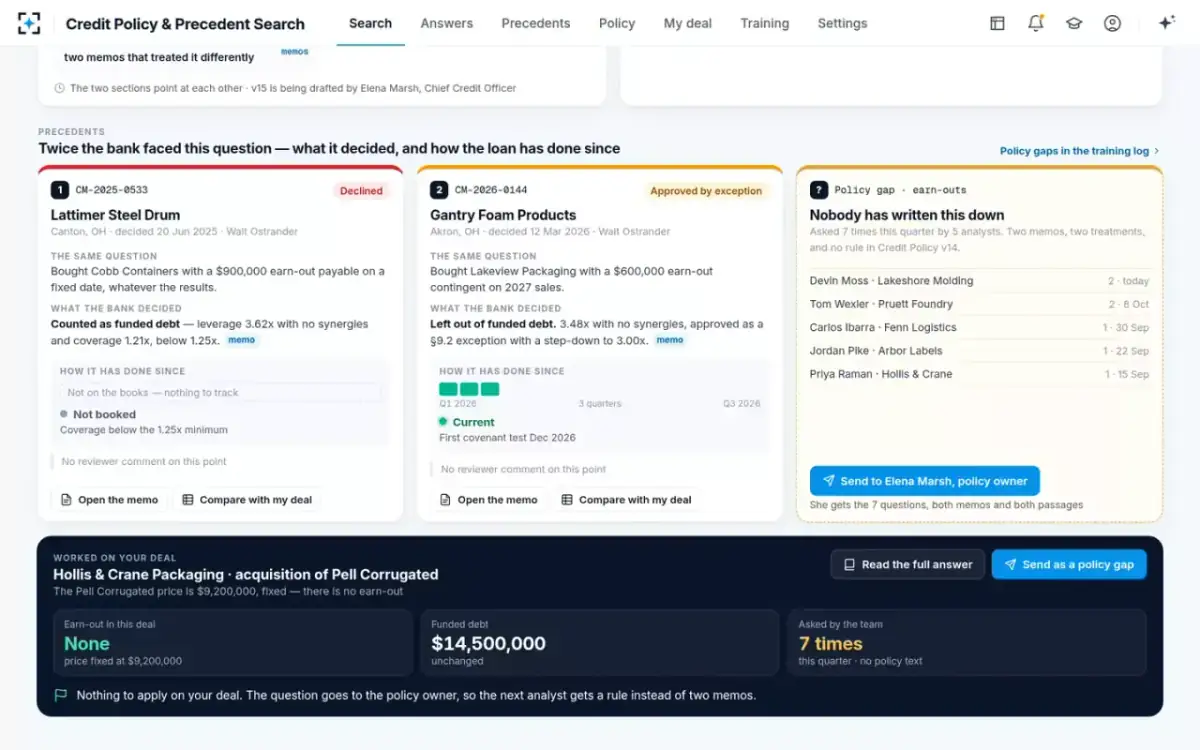
5. Silence, filled. The sample bank's policy says nothing about earn-outs. Two past memos treated them in opposite ways. A system that answers anyway will produce a confident rule with a citation to whichever memo it found first. The defence is the rule the solution is built on: no passage, no answer.
Failure 5, prevented: no passage, so no rule
Silence is an answer
When the policy does not answer a question, the accurate response says so, shows what the bank has done, and routes the question to the person who can decide. A system that always answers is optimising for the wrong thing. In the solution, when nothing in the policy or the memos answers, no answer is written. The analyst can send the question to the named senior for that topic, with everything that was searched. Replies are tracked, with a reminder after two business days. After three unanswered questions on one point, a policy gap is logged and sent to the chief credit officer.
Silence handled this way is useful information. Earn-outs had been asked about seven times in a quarter by five analysts at the sample bank. That is a gap the policy owner should close, and an answer engine that invented a rule would have hidden it. The FAQ on the solution's own page puts it plainly: it says there is no rule to quote, and writes no rule of its own.
How do you detect AI hallucinations in finance?
By checking each sentence against the passage it cites, automatically and before anyone reads the answer, and then sampling what the automatic check cannot see. NIST's suggested action is direct: "Review and verify sources and citations in GAI system outputs during predeployment risk measurement and ongoing monitoring activities" (NIST AI 600-1, MS-2.5-003). It adds a warning that applies to every pilot: "Avoid extrapolating GAI system performance or capabilities from narrow, nonsystematic, and anecdotal assessments."
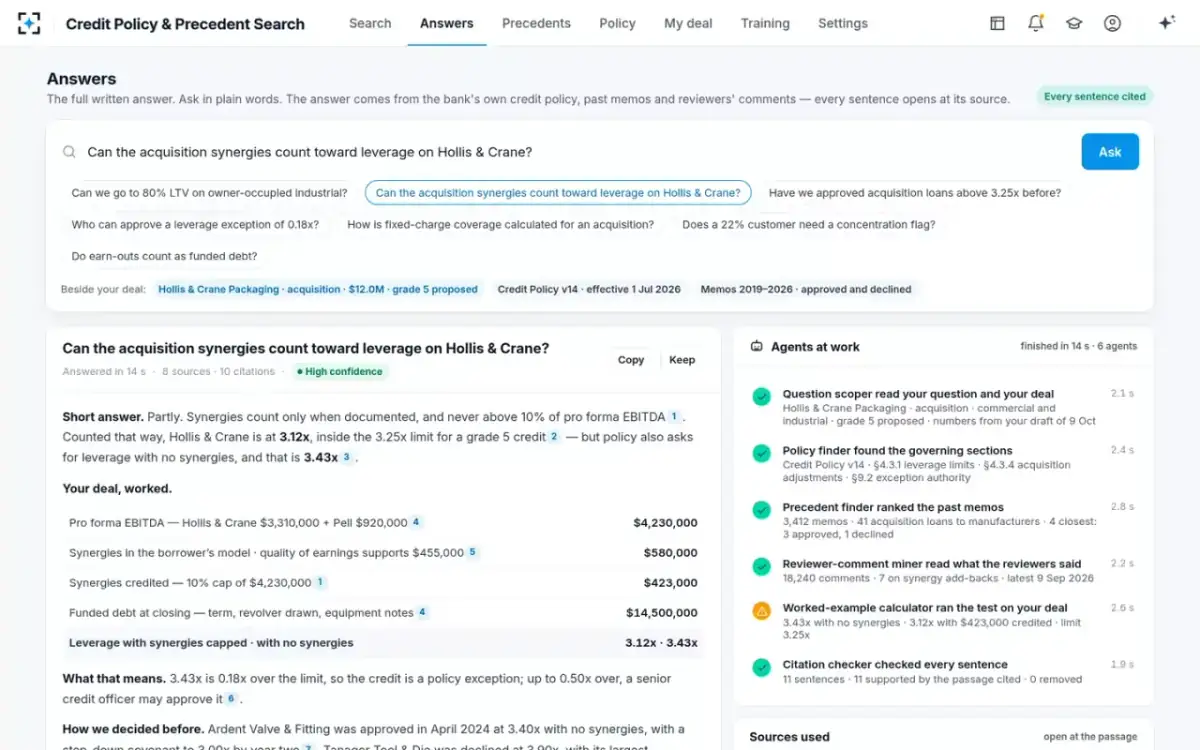
In practice, detection has three layers. A sentence-level support check removes any sentence its cited passage does not support; in the solution, a citation checker does this as the last step of every answer. A version check confirms that anything quoted as current comes from the version in force, which is a property of the document store, not of the model. And a human sample catches what neither can: an answer whose every sentence is supported by a passage that should never have been chosen. That third kind, the misgrounded answer, is invisible to any automatic check that only compares sentence to source.
left="A sentence-by-sentence citation check confirms" right="It does not confirm, so the system must handle separately" rows=[object Object][object Object][object Object][object Object][object Object]caption="In the solution, the citation checker removes any sentence its passage does not support; on the sample synergy question it checked 11 sentences and removed none. The right-hand column is handled by version rules, precedent performance and the deal read before the search." />The answer and its trace, side by side
What do bank regulators say about generative AI hallucination?
They name the risk, keep the responsibility with the bank, and have not yet written a standard for testing it. The OCC's Spring 2026 risk report lists the challenges banks face with generative and agentic AI as "lack of explainability, data privacy and data poisoning issues, cybersecurity threats, and validation challenges", and describes current use as limited "with guardrails and human-in-the-loop accountability" (OCC, Spring 2026).
No federal model-risk guidance covers these tools yet. The revised interagency guidance of April 2026, which replaced SR 11-7, says that "Generative AI and agentic AI models are novel and rapidly evolving. As such, they are not within the scope of this guidance" (OCC Bulletin 2026-13). The agencies promised a request for information on AI; it had not appeared by late October 2026. Buying the tool does not move the responsibility either. Third-party guidance in force since 2023 says that using a third party "does not diminish or remove banking organizations' responsibilities" (88 FR 37920). Until a standard exists, the bank's own test set is the evidence an examiner will ask for.
How to test an AI on your own credit policy before trusting it
Test it the way an examiner would test a file: against questions whose right answer you already know, including the hard ones. Write the answers and the governing sections down before the tool sees the questions, so the score cannot drift towards whatever the tool said.
A test set for any credit policy answer engine
- Questions your seniors answer from memory
Twenty or thirty, with the answer and the section written down first. Score the answer and the citation separately.
- Questions on sections that changed in the last version
The right answer is the new one; an answer quoting the old version fails even if the quote is exact.
- Questions whose only “support” is an exception
The answer must state the rule and present the exception as an exception.
- Questions with a precedent that went bad
The answer must show how the loan performed, not only that it was approved.
- Questions that look alike but fall under different sections
Office against industrial, construction against term, grade 4 against grade 5.
- Questions the policy does not answer
The only passing answer says there is no rule and shows what was searched.
- Questions about memos the user may not see
A relationship manager should not see declined memos; the answer must not leak them.
- Re-run after every policy release
A new version is a new test: the answers that were right last month may not be.
Scoring should separate the two ways to fail. A wrong statement and a right statement on the wrong source are different defects with different fixes. The trace that shows which step produced each part of an answer is set out in one question, traced second by second. How a credit team moves from testing to relying on the answers is covered in when analysts should still open the policy. To try the hard questions on the sample bank's policy, start from Credit Policy & Precedent Search.
Questions people ask
Is it safe to use generative AI on an internal credit policy?
It can be, if the answers are restricted to the bank's own documents, cite the current version, keep precedent apart from rule, refuse when nothing answers, and respect who may see which memos. Regulators currently describe bank use as limited "with guardrails and human-in-the-loop accountability", and the decision stays with the people the policy names.
Does retrieval-augmented generation stop hallucinations?
It reduces them; it does not stop them. In the Stanford evaluation, retrieval-based tools hallucinated less than a general chatbot but still between 17% and 33% of the time, often by citing a source that did not support the claim.
Who is responsible if an AI answer about policy is wrong?
The bank. Third-party guidance says using a vendor does not remove the bank's responsibilities, and in credit the analyst who writes the memo and the officer who approves the exception remain accountable for what it says.
What is the difference between a hallucinated answer and an incomplete one?
A hallucinated answer states something false or cites a source that does not support it; an incomplete answer refuses or gives no supporting authority. The Stanford study scored them separately, and one tool kept hallucinations down mainly by giving incomplete answers to more than 60% of queries. Both cost the analyst time; only the first can end up in a memo unnoticed.
Why do AI models hallucinate at all?
Because they generate text by predicting likely next words, not by looking facts up. NIST calls confabulation "a natural result of the way generative models are designed". Retrieval narrows what the model draws on, and a sentence-level citation check removes unsupported claims, but neither changes how the model writes.
Is there a published hallucination rate for AI on bank credit policies?
We know of none. The closest preregistered test is the Stanford study of legal research tools, which is why it is used here. A bank's own test set, written before the tool sees it and re-run after each policy release, is the only rate that describes its own policy.