A bank loan policy should include the bank's lending fields and trade area, lending authority by officer and committee, measurable underwriting limits, internal loan-to-value limits for real estate, financial-statement requirements by borrowing level, concentration limits, an exception process with a named approver, loan review and grading, and reporting to the board. No federal regulator supplies a template. The FDIC, the Federal Reserve, the OCC and the NCUA each publish lists of what a policy must address, and for real estate the board must re-approve it every year. Most of what banks believe about loan policies comes from habit rather than from those texts. This page checks seven common beliefs against the rules.
The policy is also what every analyst's question is ultimately answered from. Botminds' Credit Policy & Precedent Search answers analysts' questions from the bank's own credit policy, underwriting guides, past memos and reviewers' comments, with every sentence opening at its source. A policy that is precise, current and clear about its exceptions makes those answers precise. A vague one makes them vague, and a well-built answer engine says so rather than filling the gap.
Seven beliefs about loan policies, and what the text says
Belief 1
The regulators publish a standard loan policy, and ours should follow it.
What the text says
They publish lists of what to cover, not a policy. The FDIC’s examination manual says it is “not the FDIC’s intent to suggest universal or standard loan policies” and that its guidance “will not include or allude to acceptable ratios, levels, comparisons or terms.” The numbers are the board’s to set.
FDIC, RMS Manual of Examination Policies §3.2 Loans (3-2026)
Belief 2
The board approves the policy when it changes.
What the text says
For real estate lending, the board must review and approve the policies “at least annually”, whether or not anything changed. The credit risk review policy is “typically approved at least annually” too.
12 CFR 365 and Appendix A, Interagency Guidelines for Real Estate Lending Policies (eCFR); Interagency Guidance on Credit Risk Review Systems, 85 FR 32991, 2020
Belief 3
Our loan-to-value limits can simply be the supervisory limits.
What the text says
The supervisory limits are a ceiling for the bank’s own internal limits, which it is expected to set. For riskier subcategories a lower internal limit should be considered, and the guidelines warn that loans at the supervisory levels are not “automatically … considered sound.”
12 CFR 365 and Appendix A, Interagency Guidelines for Real Estate Lending Policies (eCFR)
Belief 4
A good policy produces no exceptions.
What the text says
The Federal Reserve wants loan officers to bring sound credits that do not conform. The OCC warns that “the absence of policy exceptions could indicate the policy is overly broad” and that justified exceptions “often present acceptable credit risk.”
Federal Reserve, Commercial Bank Examination Manual §2010.1; OCC, Lending and Loan Portfolio Risk Management, v1.0, June 2026
Belief 5
Once an exception is approved, it is closed.
What the text says
Exceptions are monitored for life. The reason is “detailed in writing”, the directors’ loan committee reviews all exceptions “at reasonable intervals”, and real estate loans above the supervisory limits are reported to the board at least quarterly and capped in aggregate at 100% of capital.
Federal Reserve, Commercial Bank Examination Manual §2010.1; 12 CFR 365 and Appendix A, Interagency Guidelines for Real Estate Lending Policies (eCFR)
Belief 6
Regulators define what a leveraged loan is.
What the text says
Not at the OCC or FDIC any more. When they rescinded the 2013 leveraged lending guidance in December 2025, they said “each bank should determine its own definition of a ‘leveraged loan.’” The Federal Reserve had announced no rescission of its own as of October 2026.
Belief 7
Everything about how we lend belongs in the policy.
What the text says
Policies set standards and outer limits; procedures describe how they are put into practice. Putting operating detail in the policy makes every change a board item; leaving limits out of it makes them unenforceable.
OCC, Lending and Loan Portfolio Risk Management, v1.0, June 2026
What is a loan policy in a bank, and what must it contain?
A loan policy is the board-approved document that sets the bank's lending standards, limits and authorities, against which every loan is underwritten and every exception is measured. The rules require a written policy, approved by the board, that states limits a lender can measure a deal against and says what happens when a deal does not fit. Beyond that the content is the bank's choice, and examiners judge whether it is realistic and followed. Four texts carry most of the weight for a commercial lender, and they differ by charter.
For an FDIC-supervised bank, real estate lending policies are a regulation, not guidance. Under 12 CFR 365.2 they must establish "Prudent underwriting standards, including loan-to-value limits, that are clear and measurable", diversification standards, loan administration procedures, and "Documentation, approval, and reporting requirements". They must also be "reviewed and approved by the … board of directors at least annually" (eCFR). National banks and state member banks follow parallel rules in 12 CFR 34 and 12 CFR 208. For a federally insured credit union, 12 CFR 723.4 says that before any commercial lending it "must adopt and implement a comprehensive written commercial loan policy". The NCUA then sets a minimum list that runs from the types of loans permitted to "the level and depth of financial analysis necessary" (eCFR).
Who requires what in a commercial loan policy
| Requirement | Where it comes from | What the text asks for |
|---|---|---|
| Written policy, board-approved | FDIC 12 CFR 365.2; NCUA 12 CFR 723.4; FDIC RMS Manual §3.2 | The board “is responsible for formulating lending policies”; real estate policies re-approved at least annually; a credit union adopts one before its first commercial loan. |
| Measurable underwriting limits | 12 CFR 365.2(b); Interagency Real Estate Guidelines | Standards “clear and measurable”; maximum loan amount, maturity, amortization, pricing and loan-to-value by property type. |
| Internal loan-to-value limits | Interagency Real Estate Guidelines | Set by the bank, no higher than the supervisory limits: 65% raw land, 75% land development, 80% commercial construction, 85% improved property. |
| Lending authority | FDIC RMS Manual §3.2; Fed CBEM §2010.1 | The lending authority of each loan officer and of any loan or executive committee, and the board’s role in approving loans. |
| Financial-statement requirements | Fed CBEM §2010.1; NCUA 723.4(f) | Audited, unaudited, annual or interim statements by borrowing level; the degree of verification needed for an accurate analysis. |
| Exception process | Interagency Real Estate Guidelines; Fed CBEM §2010.1 | A written justification setting out “all of the relevant credit factors”, a designated approver, and periodic review of exceptions by the board or its committee. |
| Concentrations and portfolio mix | FDIC RMS Manual §3.2; OCC Concentrations of Credit v3.0 | Goals for portfolio mix and diversification, and the action to take on concentrations that develop. |
| Annual review and grading | Fed CBEM §2010.1; Credit Risk Review guidance (2020) | “an annual review of borrowers, including a reassessment of the appropriateness of credit lines”; a loan grading system and its review. |
The FDIC's examination manual gives the broadest single list, about eighteen areas in all. It runs from "General fields of lending in which the institution will engage" and the "Lending authority of each loan officer" to limits on the amount advanced against collateral, credit files, collections, trade area, portfolio mix, loan review and the allowance for credit losses (RMS Manual §3.2). It then declines to fill in a single number.
It is not the FDIC's intent to suggest universal or standard loan policies for specific types of credit. The establishment of these policies is the responsibility of each institution's Board and management.
FDIC, RMS Manual of Examination Policies, Section 3.2 Loans
Who approves a bank's loan policy, and how often?
The board, and for real estate lending at least once a year. The FDIC's examination manual is direct: "The board of directors of every institution is responsible for formulating lending policies and to supervise their implementation" (RMS Manual §3.2). Real estate lending policies must be "reviewed and approved by the … board of directors at least annually" under 12 CFR 365.2, and the interagency credit risk review guidance expects the loan review policy to be "reviewed and typically approved at least annually by the institution's board of directors or appropriate board committee" (2020 guidance).
In practice the chief credit officer drafts and owns the text, and a board credit committee reviews it. The OCC describes that committee's job as including to "review and approve lending policies and underwriting standards that reflect the bank's risk appetite" and to "monitor the loan portfolio's performance, exceptions, and the [ACL]" (OCC, 2026). The annual approval is a floor, not a schedule. A change in the rules behind a section, a run of exceptions on one limit or a question analysts keep asking with no passage to answer it are each a reason to amend between reviews. The sample bank's v14 was approved on 24 June 2026 and took effect on 1 July; v15 is already being drafted.
Seven beliefs about loan policies, against the text
Most of the beliefs above are not wrong so much as incomplete, and each incompleteness produces a recognisable weakness in an examination. The policy copies the supervisory limits instead of setting its own. It treats exceptions as embarrassing rather than as information. It closes an exception once it is approved. Or it defines a leveraged loan by reference to guidance two agencies have withdrawn.
Belief 4 deserves the most attention because it shapes behaviour. The Federal Reserve's manual asks that a lending policy "require loan officers to present credits they believe are fundamentally sound and worthy of consideration, even though they may not conform", with the reason "detailed in writing and submitted for approval to a designated authority" (CBEM §2010.1). The same paragraph warns that the frequency of exceptions "may indicate a lessening of underwriting standards on the one hand, or a need to adjust the policy" on the other. An exception rate is a measurement of the policy as much as of the lenders. A bank that tracks exceptions only as violations loses the second reading. How an analyst should write one up is the subject of how to document a loan policy exception.
Belief 6 is the newest. When the OCC and FDIC rescinded the 2013 Interagency Guidance on Leveraged Lending and its 2014 FAQs on 5 December 2025, they did not replace the definition. Their release says "Each bank should determine its own definition of a 'leveraged loan,'" and asks for analysis of a leveraged borrower's "past and current performance compared with projections" (NR-IA-2025-119). A policy that still points to the 2013 guidance for its definition is pointing at nothing. It is one of five sections that 2026's changes touch, set out in the loan policy update for 2026.
What is the difference between a loan policy and loan procedures?
A rule belongs in the policy if breaking it should need an exception approved by a named authority; otherwise it belongs in a procedure or an underwriting guide. The OCC's 2026 lending booklet draws the line in nearly those words. Policies "primarily impose standards" and are "a statement of the bank's credit culture and risk appetite". Procedures "describe how policies are put into practice" and typically cover "job responsibilities, approval authorities, necessary steps for approvals" and documentation. "Policies often include outer limits, with procedures or guidelines including more granular instructions or inner targets" (OCC, Lending and Loan Portfolio Risk Management).
Policy and procedure do different jobs
Loan policy: A statement of credit culture and risk appetite that imposes standards.
Procedures and underwriting guides: How the standards are put into practice, step by step.
Loan policy: The board or its credit committee, at least annually for real estate.
Procedures and underwriting guides: Usually senior management or the chief credit officer.
Loan policy: An exception, written up and approved by the authority the policy names.
Procedures and underwriting guides: A departure to explain in the memo; not necessarily an exception.
Loan policy: Outer limits: maximum leverage by grade, loan-to-value by property type, minimum coverage.
Procedures and underwriting guides: Inner targets and methods: how to compute EBITDA adjustments, which statements to collect.
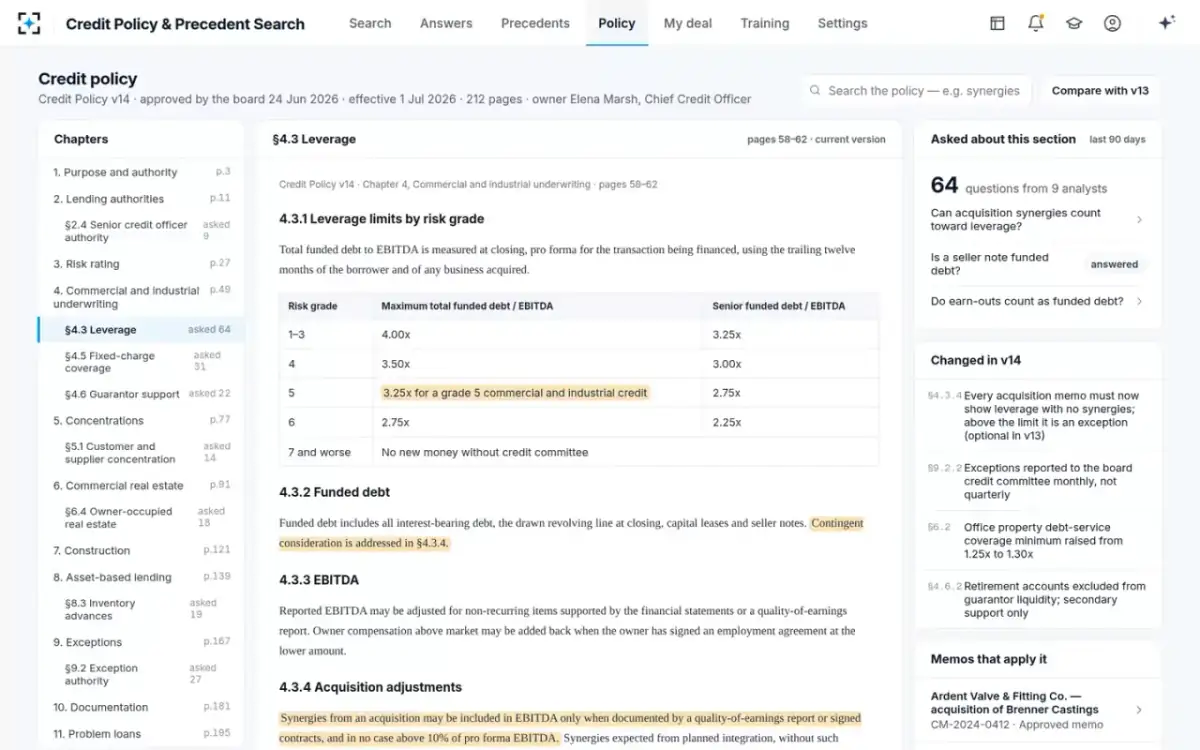
Loan policy: Credit Policy v14, 212 pages, §4.3.1: leverage at most 3.25x for a grade 5 credit.
Procedures and underwriting guides: Nine underwriting guides, 386 pages, e.g. cash equity of at least 10% in a purchase.
The distinction matters most to a new analyst. A number in the policy needs an exception; a number in a guide needs an explanation. Mistaking one for the other either sends an unnecessary exception to a senior or, worse, sends a real one to committee unlabelled. In the solution, answers say which document a limit comes from, quote it, and name who may approve a departure under the exception section.
The policy as an analyst reads it: section, version and the rules highlighted
What are the supervisory loan-to-value limits?
They are the ceilings the interagency real estate guidelines set for each bank's own internal loan-to-value limits: 65% for raw land, 75% for land development, 80% for commercial, multifamily and other nonresidential construction, 85% for 1-to-4 family residential construction and 85% for improved property (12 CFR 365, Appendix A). Owner-occupied 1-to-4 family and home equity loans carry no supervisory limit in the table. Improved property includes "Completed commercial property" and other completed income-producing property, which is where an owner-occupied plant or office sits.
The supervisory loan-to-value ceilings for a bank's own limits
Three points follow for the policy. The guidelines expect the bank's own limits to sit below the ceilings where risk is higher: "For any subcategory of loans that exhibits greater credit risk than the overall category, a lender should consider the establishment of an internal loan-to-value limit for that subcategory that is lower." The ceilings are not a safe harbour: they "should not be interpreted to mean that loans at these levels will automatically be considered sound." And the policy needs two tiers of exception, because a loan above the bank's own limit and a loan above the supervisory limit are reported and capped differently. The sample bank shows the pattern: owner-occupied industrial is limited to 75%, five points can be approved by exception, and nothing goes above the 85% ceiling.
What does the NCUA require in a commercial loan policy?
More than the bank regulators spell out, and before the first loan is made. Under 12 CFR 723.4 a federally insured credit union "must adopt and implement a comprehensive written commercial loan policy and establish procedures for commercial lending" before it engages in commercial lending, and the policy is board-approved (12 CFR 723.4). The rule then sets a minimum list that reads like a table of contents.
The NCUA's minimum contents for a commercial loan policy
- Types of loans, trade area and concentration limits
Including a limit to one borrower of the greater of 15% of net worth or $100,000, plus 10% more if fully secured by readily marketable collateral.
- Qualifications and experience of lending staff
For everyone involved in underwriting, processing, approving, administering and collecting commercial loans.
- Approval authority matched to proficiency
Levels “commensurate with the individual’s or committee’s proficiency in evaluating and understanding commercial loan risk”.
- Underwriting standards
The depth of financial analysis, due diligence on principals, borrower projections when history does not support the debt, statement quality and verification, collateral methods and loan-to-value limits.
- Risk management
Covenants and reporting frequency, periodic loan review, a credit risk rating system assigned at inception.
- Exceptions
“A process to identify, report, and monitor loans approved as exceptions to the credit union’s loan policy.”
For a bank, the NCUA list is a useful second checklist even though it does not bind. It is the only federal text that asks the policy to address staff qualifications and the "Requirements of a borrower-prepared projection when historic performance does not support projected debt payments", two places where commercial policies are often thin.
Which numbers a loan policy must state, and which it can leave to the guides
A policy has to state any number the bank intends to enforce: limits whose breach is an exception, approval thresholds, concentration caps and the exception approver's authority. What it leaves out cannot be enforced. The clearest illustration is a failure. In its review of First NBC Bank, whose 2017 failure cost the Deposit Insurance Fund an estimated $996.9 million, the FDIC's Inspector General wrote that "First NBC's loan policy did not include maximum maturity dates, capital limits, or other common controls for these relationships. These extensions masked potential delinquencies" (FDIC OIG, AUD-18-002).
The supervisory texts point to the numbers that are most often expected. They are maximum loan amount, maturity and amortization by type, loan-to-value by property type, minimum debt service coverage, equity, guarantor support, and "Minimum covenants for loan agreements" for commercial real estate. Add the lending authority of each officer and committee, and the aggregate limits on exception loans: 100% of total capital for all real estate loans above the supervisory limits, and 30% for commercial and other non-1-to-4 family property (Interagency Guidelines). Methods, such as how to compute pro forma EBITDA or which add-backs a quality-of-earnings report supports, can live in a guide. In that case the policy should name the guide, so that the method carries the policy's authority.
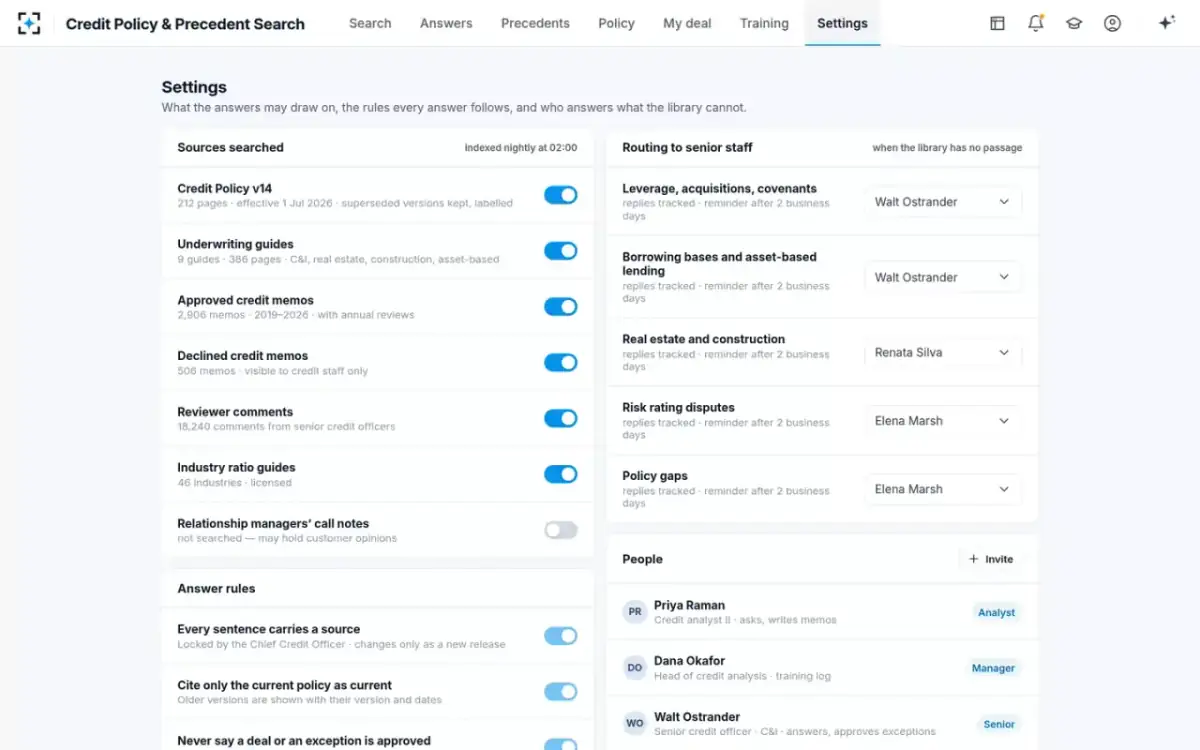
What the answers may draw on, and the rules they follow
Questions to put to your own loan policy
Checking a policy against the rules is a desk exercise. It is easier when the policy can be searched by section and version and the bank's exceptions can be read against it. These are the checks that follow from the texts above. The cost of keeping a policy searchable in that way, against the alternatives, is set out in what an AI knowledge base for credit policy costs.
Eight checks on a commercial loan policy
- Every enforced limit is in the policy, with a number
Leverage, coverage, loan-to-value, maturity, amortization, equity and concentration. A limit that appears only in a guide is a target, not a rule.
- Internal loan-to-value limits sit below the supervisory ones where risk is higher
The supervisory table is a ceiling for the bank’s own limits, not a substitute for them.
- The exception section names the approver and the authority
Who may approve how far over each limit, and when it goes to committee.
- Exceptions are reported and reviewed, not just approved
Real estate exceptions above supervisory limits reported to the board at least quarterly, and all exceptions reviewed at reasonable intervals.
- Statement requirements scale with the borrowing
Audited, reviewed, compiled or tax-return based, by size of relationship.
- Definitions no longer lean on rescinded guidance
Leveraged loan, model and similar terms defined by the bank itself.
- The board approval date is less than a year old
Required for real estate lending policies, and the natural point to re-check every section.
- Repeated questions with no passage are logged as gaps
Where analysts keep asking and the policy is silent, the policy owner should decide.
In the solution, the last check runs on its own. When three analysts' questions on one point find no policy text, a policy gap is logged and sent to the policy owner. In the sample bank, earn-outs had been asked about seven times in a quarter, and two past memos had treated them differently. To see how the sample policy is searched and cited, start from Credit Policy & Precedent Search.
Questions people ask
What happens if a bank does not follow its own loan policy?
Examiners treat it as a management weakness, and the FDIC tells them to work out "whether troublesome loans result from inadequate lending and collection policies and practices or merely reflect exceptions to basically sound credit policies and practices". Departures that were never approved as exceptions are the ones that turn into findings.
Should a loan policy include pricing guidelines?
The FDIC's list of areas includes "Guidelines for rates of interest and the terms of repayment for secured and unsecured loans", and the interagency real estate guidelines name pricing among underwriting standards. Most banks state the principles in the policy and keep rate sheets in procedures.
How long should a bank loan policy be?
No rule sets a length. What matters is that every limit the bank enforces is stated with a number and that operating detail sits in procedures, so the policy can be re-approved each year without a page-by-page rewrite. The solution's sample bank runs a 212-page policy with nine underwriting guides of 386 pages beside it.
What do examiners look for in a loan policy?
Whether it covers the required areas, whether its limits are realistic for the bank, and whether lending follows it. The FDIC manual says examiners should review "loan policy exception reports to determine whether exceptions are adequately documented and appropriate", and the OCC looks at the level and pattern of exceptions as a sign of the bank's real appetite.
Is there a commercial loan policy template for community banks?
Not from the federal regulators, by design. The FDIC's list of areas and the NCUA's minimum list in 12 CFR 723.4 work as an outline; the limits within each section are the board's to set and defend.