The cost of AI knowledge base software for a credit team is mostly not the software. Over three years, what a bank spends on answering its analysts' policy questions is driven by analyst hours spent searching and writing, senior credit officers' time spent answering and reviewing, memos sent back for policy reasons, and the work of keeping the library current and access-controlled. A licence or build cost sits on top. Three options are realistic for a commercial credit team. It can keep the policy as a PDF and route questions to seniors. It can put a general-purpose chatbot over the policy text. Or it can use agents that answer from the bank's own policy, past memos and reviewers' comments, which is how Botminds' Credit Policy & Precedent Search works. This page gives a method for costing all three, worked through with stated estimates, so a buyer can replace each input with the bank's own and add vendor quotes.
No regulator or independent study measures how long a credit analyst spends on a policy question or what a bank spends on policy tools, so every per-question figure here is an estimate and is labelled as one. The wage inputs are federal data.
Where an analyst's hands-on hours go on one policy question, by hand
About 3.5 hours of the analyst’s own work, before any wait for a senior
- Finding the section in force · 14%
- Searching past memos · 29%
- Working the test on the deal · 29%
- Writing the cited paragraph · 28%
How much does AI knowledge base software cost? Three options, one method
Vendors rarely publish comparable prices, and the licence is the smallest line; what decides the choice is people's time per question. Price every option on the same five lines, and the differences show where the money actually goes. The lines are analyst time per question, senior time per question, rework when a reviewer sends a memo back, upkeep of the library, and the price of the tool. A policy PDF looks free because its costs sit in the first three lines and in nobody's budget. A general chatbot moves the first line a little. Agents over the bank's own memos move all three, and add upkeep and a price.
The comparison has to be like for like on what is answered. A chatbot over the policy text can find a section quickly. It cannot say how the bank has used the rule, because that is in the memos, not the policy. As the solution's own FAQ puts it, a policy search tells you what the rule says. Precedent, performance and the test on the deal still fall to the analyst and the senior.
The three-year return of answering from the bank's own record, as a sum
Analyst hours released
(hours per question by hand − with the tool) × questions × loaded hourly cost
Search, test and writing time per question, from a timed sample of your own memos.
Head of credit analysis
Senior time released
(share routed to a senior today − with the tool) × questions × senior hours × senior cost
Includes the time seniors spend reviewing citations, which rises at first.
Chief credit officer
Rework avoided
(memos sent back before − after) × hours to fix and re-review
Count only memos returned for policy, precedent or calculation reasons.
Credit review
Price, set-up and upkeep
licence or build + implementation + seniors’ testing time + re-testing after each policy release
Vendor quotes, the shadow-testing weeks, and access control and indexing kept current.
Procurement and credit administration
What does a senior credit officer's time cost, and an analyst's?
About $69 an hour for a credit analyst on federal data, and whatever the bank pays its seniors, for whom no federal series exists; those two numbers drive the whole comparison. Federal data give a floor for pricing the first. Credit analysts earned a mean annual wage of $100,850 in May 2025 (BLS OEWS). Wages and salaries were 70.0% of private employers' total compensation costs in June 2026 (BLS ECEC). Grossing the wage up gives a loaded cost of about $144,000 a year, or roughly $69 an hour over 2,080 hours (our arithmetic). Senior credit officers have no separate federal wage series. This page assumes $150 an hour loaded, and a reader should replace it with the bank's own figure.
The senior's hour matters more than its price suggests, because the same people are the review bottleneck on every deal. An hour a senior credit officer spends answering a question the policy already answers is an hour not spent reviewing a memo. Every deal in the queue behind it waits. That delay does not appear in any of the five lines. It shows up as relationship managers finding out late whether a structure is an exception, and as memos that reach committee unlabelled.
What is the difference between a chatbot and AI agents, in cost?
A chatbot over the policy text runs one search and writes one answer from one set of documents; agents split the question into steps over several sources, each with its own job and limits. The difference decides which costs move. A chatbot can only answer what the policy text says, so the questions that cost the most, how the bank has applied the rule and what a senior would say about this deal, still go to people. Agents that read the deal, the memos and the reviewers' comments can answer those, and they can refuse in a controlled way when nothing answers.
A chatbot over the policy and agents over the bank's own memos
General chatbot over the policy text: The policy and perhaps the underwriting guides.
Agents over policy, memos and reviewer comments: Policy, guides, approved and declined memos, reviewer comments, and the analyst’s open deal.
General chatbot over the policy text: What the rule says.
Agents over policy, memos and reviewer comments: What the rule says, how the bank has applied it, how those loans performed and what the reviewer is likely to ask.
General chatbot over the policy text: Depends on what was uploaded; old and new versions can mix.
Agents over policy, memos and reviewer comments: Only the current version cited as current; older ones labelled with their dates.
General chatbot over the policy text: Often a plausible answer anyway.
Agents over policy, memos and reviewer comments: “No passage”, with the question routed to a named senior.
General chatbot over the policy text: The reader checks, if they open the source.
Agents over policy, memos and reviewer comments: Each sentence checked against its passage before it is shown; unsupported sentences removed.
General chatbot over the policy text: Precedent search, the test on the deal, and most senior time.
Agents over policy, memos and reviewer comments: Reviewing and editing the draft, and the questions the library cannot answer.
Running the numbers for a nine-analyst team
Take the solution's fictional sample bank: nine analysts asking about 540 policy and precedent questions a month, and two senior credit officers. The worked estimate below costs 1,000 questions under each option, on the assumptions in the caption. It is arithmetic on estimates, not a measured result, and it excludes the tool's price. That is the line a buyer fills in from quotes.
Analyst and senior time per 1,000 policy questions, by option (our estimate)
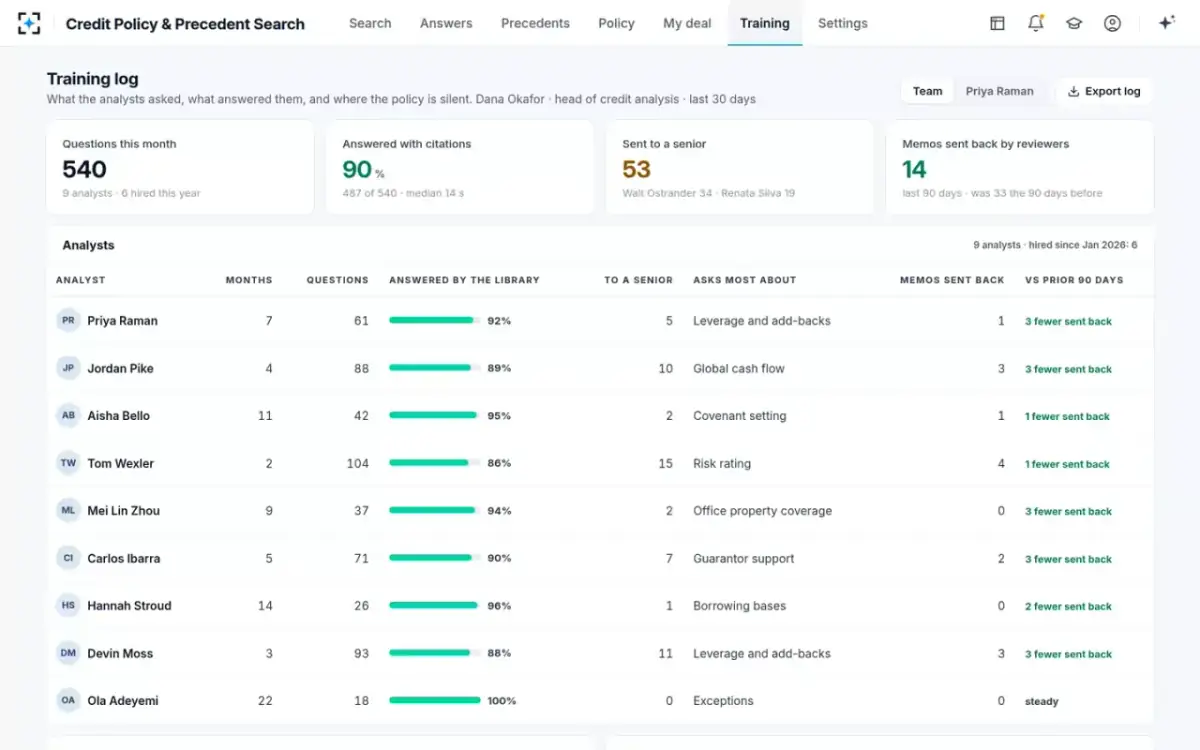
Three things stand out, and none depends much on the exact inputs. The chatbot barely moves the total, because finding the section was never the expensive part. The expensive parts are searching precedent, working the test and getting a senior's view, and those need the memos and the deal. The agents' total is dominated by the analyst's remaining hour, which is the reviewing and writing a person should do. And the senior line falls furthest. In the sample bank's training log, 53 of 540 questions went to a senior; the rest were answered with citations.
At the sample bank's volume of roughly 6,500 questions a year, the difference between the first and third rows would be about $1.3 million a year of people's time on these estimates, before any price. Treat that as an upper bound: teams ask fewer questions when each one costs a senior's afternoon, so the by-hand volume is likely lower. A buyer should rerun it with their own question count, their own timed sample and their own senior cost. They should then set the result against quotes. A bank that asks far fewer questions, or whose seniors answer in minutes, will see a smaller gap.
Where each option's cost sits
| Cost line | Policy PDF and seniors | General chatbot over the policy | Agents over the bank’s own memos |
|---|---|---|---|
| Analyst time | All of it: find, search memos, test, write. | Finding is faster; precedent, test and writing are not. | Mostly reviewing and editing a cited draft. |
| Senior time | Every question that is not a lookup. | Most questions about practice, precedent or the deal. | Questions the library cannot answer, routed with the search attached; plus citation sampling. |
| Rework | Memos returned for missed rules or unlabelled exceptions. | Adds a risk: confident answers from the wrong version or section. | Exceptions labelled and reviewers’ likely questions answered before the memo goes up. |
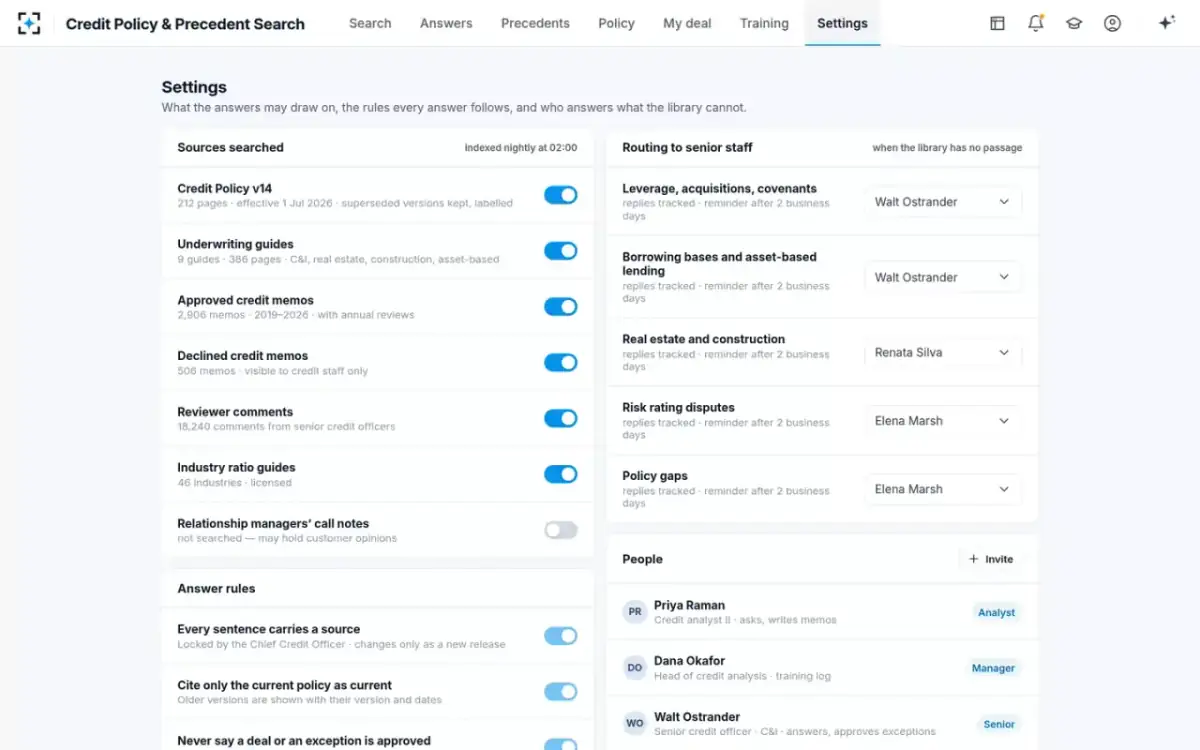
| Upkeep | Distributing each policy release. | Re-indexing and re-testing after each release. | Nightly indexing of policy, guides and memos; access rules; re-testing changed sections. |
| Access control | The file room’s rules. | Usually all-or-nothing on the policy text. | Follows the credit file: declined memos to credit staff only. |
| Price | None. | Licence or build. | Licence and implementation. |
What hidden costs does AI software have? Version control, access and testing
The costs that decide whether a policy tool is safe to rely on are rarely on a price list. Version control means the tool quotes only the current policy as current and labels superseded versions. Access control means a relationship manager never sees a declined memo. Testing means the bank's seniors re-check the changed sections after every release. Each costs time to set up and keep running, and leaving any of them out turns a cheap tool into an expensive mistake.
Regulators will not carry those costs for the bank. Interagency guidance in force since 2023 says that using a third party "does not diminish or remove banking organizations' responsibilities to ensure that activities are performed in a safe and sound manner" (88 FR 37920). A replacement was proposed on 15 September 2026, with comments due 16 November 2026, and the 2023 guidance stays in force until a final version replaces it (proposal). The April 2026 model-risk guidance places generative and agentic AI outside its scope (OCC Bulletin 2026-13). How a bank tests an answer engine is therefore its own design, and a cost line in its own right.
Hidden costs to price before choosing
- Senior time in the first weeks
Shadow testing on known questions, and citation sampling in review, cost senior hours before they save any.
- Re-testing after every policy release
The changed sections need checking before analysts rely on answers about them again.
- Access rules that follow the credit file
Declined memos, relationship managers’ call notes and restricted borrowers, configured and audited.
- Memo archive preparation
Memos linked to their later annual reviews and grade changes, so precedents carry outcomes.
- Closing the policy gaps the tool exposes
Questions with no passage become policy work for the chief credit officer.
- Third-party oversight
Due diligence and monitoring of the provider, which remain the bank’s responsibility.
- Exit
Whether the bank’s indexes, settings and training log can be taken elsewhere.
The settings behind the upkeep lines
Should a bank build or buy an AI knowledge base?
Either can work; the honest comparison is of the parts that take longest, not of the licence against an engineer's salary. A team that builds a credit policy assistant needs, at a minimum: ingestion that keeps every policy version with its effective dates; access rules that mirror the credit file, including who may see declined memos; a link from each past memo to its later annual reviews and grade changes, so precedent carries outcomes; a sentence-level citation check; routing of unanswered questions to named seniors; and a test set the seniors maintain and re-run after every release.
Building does not escape third-party risk. A bank that assembles its own assistant usually still relies on an outside language model and hosting, and the 2023 interagency guidance applies to those relationships as it would to a vendor. Nor does it escape governance: with generative and agentic AI outside the 2026 model-risk guidance, the bank designs its own controls either way. What a build buys is control of the roadmap. What it costs is the upkeep line for as long as the tool is used, carried by a team whose main job is not credit.
What should you look for in AI knowledge base software for credit?
Look for the properties that keep the expensive lines down, not the ones that make a demonstration impressive. Ask to see, on your own documents: the version of the policy each quote came from; a past exception presented as an exception, with the loan's later performance; a question answered differently for a relationship manager and a credit analyst because of access rules; a sentence removed by the citation check; a "no passage" answer routed to a named senior; and the log a head of credit analysis would read each month. Then ask what happens to your indexes, settings and log if you leave.
Botminds' Credit Policy & Precedent Search is built for that narrow job: answering credit policy and precedent questions beside the analyst's deal, from the bank's own policy, underwriting guides, memos and reviewer comments. It is not a general knowledge base for the whole bank, and a buyer who needs one for HR or operations policies should cost that separately. How a team tests any of these tools before relying on them is in why a cited answer can still be wrong.
How do you calculate the ROI of an AI knowledge base after year one?
The return should be measured from the bank's own log, not from the estimate that justified the purchase. The training log gives most of the inputs directly: questions asked, the share answered with citations, the share routed to seniors, and memos sent back by reviewers. In the sample bank, reviewers sent back 14 memos in the latest 90 days against 33 in the 90 days before. That is a result of the solution running on invented data, but it is the kind of number a bank can count for itself.
The inputs to the return, counted rather than estimated
Adoption decides how quickly the estimate turns into a measured return, and the pace is set by the seniors' testing rather than the contract. That ladder is described in how a credit team learns to trust an AI for policies and procedures. The upkeep line peaks around policy releases; this year's regulatory changes, and the sections they touch, are in the 2026 loan policy update. To see the sample bank's log and settings, start from Credit Policy & Precedent Search.
Questions people ask
How much does AI knowledge base software cost?
Vendors do not publish comparable prices, and the licence is usually the smallest part of the total. Cost the time it changes first: analyst hours per question, senior hours per question and memos returned. Then compare the saving with quotes.
Is a general AI chatbot over our credit policy enough?
It speeds up finding a section, which is the cheapest step. It cannot show how the bank has applied the rule or how those loans performed, because that is in the memos, and it adds the risk of confident answers from the wrong version or section.
What is the total cost of ownership of AI software over three years?
Price plus implementation, plus the seniors' testing time in the first weeks, re-testing after every policy release, indexing and access rules kept current, third-party oversight and the cost of leaving. For a credit team those are usually smaller than the change in analyst and senior hours, which is why the method prices time first.
What does a credit analyst's hour cost a bank?
About $69 on federal data: the BLS mean wage for credit analysts of $100,850, grossed up because wages are 70.0% of private employers' compensation costs, over 2,080 hours. A bank's own payroll figure, including benefits, should replace it.
How quickly does an AI knowledge base pay back?
Not in the first weeks, when seniors spend extra time testing it. The return starts when analysts reach the point of asking the library first, which we estimate at around twelve weeks for a team of ten, and it should then be counted from the log: questions answered, questions routed to seniors and memos sent back.