A credit policy exception is a loan approved outside a limit in the bank's own written credit policy, by someone the policy authorises to depart from it. To document a loan policy exception, write down five things: the policy limit and the section it sits in, the size of the departure in the policy's own units, the person or committee the policy names as approver, the mitigants that answer the risk the limit controls, and the bank's earlier decisions on the same question. Then label the exception where the approver will see it first, normally on page one of the credit memo. The Federal Reserve asks that "the reason for the exception should be detailed in writing and submitted for approval to a designated authority". For real estate, the interagency guidelines ask for "a written justification that clearly sets forth all of the relevant credit factors that support the underwriting decision", kept in the permanent loan file.
This page works one exception through from question to paragraph, in Botminds' Credit Policy & Precedent Search: the bank's credit policy, past memos and reviewers' comments searched beside the deal, with the policy test worked on the deal's numbers and every sentence cited. The bank, borrower and people are fictional sample data. Kestrel Precision Machining wants to buy the industrial plant it has leased for years, and its relationship manager has asked for 80% of the price.
From the question to an exception the right person can approve
Agent
Question scoperReads the question and the open deal: owner-occupied industrial, purchase, the price, the appraisal and the request.
Never: guesses a deal figure
Agent
Policy finderQuotes §6.4.2 (75% of the lower of price or appraisal) and §9.2.3 (75% to 80% is an exception), with page and version.
Never: cites a superseded version as current
Agent
Precedent finderRanks the bank’s 27 decisions on the same question and adds how each loan has performed since.
Never: shows a memo the user may not open
Agent
Worked-example calculatorMeasures the gap on Kestrel’s numbers: a $2,550,000 policy maximum against $2,720,000 requested.
Never: alters a deal figure
A person decides
Credit analystEdits the drafted paragraph, adds it to section 3 of the memo and labels the exception on page one.
A person decides
Senior credit officerApproves or declines the exception, within the authority §2.4 gives her.
What should a policy exception memo include?
An approvable request lets the approver decide from the page without reopening the policy or the file. It does that by answering, in order, the questions the approver will ask anyway. Which rule? By how much? Am I allowed to approve it? Why is the risk acceptable? Have we done this before, and how did it go? Regulators ask for the substance of the same list, in different words. The Fed's manual wants the reason in writing and a designated authority. The interagency real estate guidelines want "all of the relevant credit factors" and the approval kept "as a part of the permanent loan file" (12 CFR 365, App. A). The OCC's examiners check that "the approver had sufficient authority based on the bank's established limits" (OCC, 2026).
Examiners read exceptions twice, once on the loan and once in aggregate. The FDIC tells its examiners to "review loan policy exception reports to determine whether exceptions are adequately documented and appropriate in light of all the relevant credit considerations" (RMS Manual §3.2). Loans approved as exceptions to policy are named in the interagency guidance as part of the scope of credit risk review (2020 guidance). A paragraph that is clear on the day of approval is the one that survives both readings.
Kestrel Precision Machining: the exception, measured
$2.55M
policy maximum: 75% of the $3,400,000 price, the lower of price and appraisal
$2.72M
requested: $2,720,000, 80% of the price, over 20 years
$170K
the exception, five points, within §9.2.3
1.45x
global debt-service coverage, against a 1.25x minimum
The rule and the gap, measured in the policy's own units
State the limit exactly as the policy states it, apply it to the measure the policy names, and give the departure in both the policy's units and dollars. Kestrel's rule is §6.4.2 of the sample bank's Credit Policy v14: the loan "may not exceed 75% of the lower of the purchase price or the appraised value." The price is $3,400,000 and the appraisal $3,450,000, so the base is the price and the maximum is $2,550,000. The request of $2,720,000 is five points, or $170,000, over. Get the base wrong and the gap is wrong. Using the appraisal would understate the exception, and that is the kind of slip the OCC has in mind when it writes that "unidentified exceptions are often the result of errors, miscalculations, breakdowns in the pre- or post-closing review process" (OCC, 2026).
What is the difference between a financial and an administrative exception?
Timing and substance: a financial exception is a credit weakness that appears during the life of the loan, such as a covenant breach or coverage below policy at annual review, while an administrative exception is a documentation or process failure, such as a stale financial statement or a missing lien recording. Both differ from the exception an analyst writes up at approval, which is an underwriting exception. The OCC notes that "Many banks differentiate between administrative and financial exceptions" (OCC, 2026), and a good exception report keeps them apart, because they call for different owners: credit for the first, credit administration for the second.
Say which kind of exception it is. An 80% loan on completed industrial property is above this bank's internal limit but below the interagency supervisory limit of 85% for improved property. It is a policy exception, not a supervisory one. The difference matters. Loans above the supervisory limits must be "identified in the institution's records", reported to the board at least quarterly, and kept within aggregate caps of 100% of total capital, and 30% for commercial and other non-1-to-4 family property (Interagency Guidelines). A request that says which it is saves the approver from checking.
Kinds of exception an analyst should be able to name
| Kind | When it arises | Examples in the OCC’s text | What the write-up needs |
|---|---|---|---|
| Underwriting exception | At approval: the loan departs from a policy standard. | A loan-to-value, leverage or coverage limit exceeded at origination. | Rule, gap, approver, mitigants, precedent; labelled in the memo. |
| Supervisory LTV exception | At approval, on real estate above the interagency limits. | 80% on raw land against a 65% supervisory limit. | All of the above, plus inclusion in the quarterly board report and the 100% / 30% capital caps. |
| Financial exception | During the life of the loan. | “Covenant breaches (even if waived)”, “DSCR below policy at the time of annual review”, “LTV above policy at the time of annual review”. | Identified at review and tracked until cured. |
| Administrative exception | During the life of the loan. | “Stale financial statements, tax returns, or borrowing base certificates”, “Missing lien recordation”. | Tracked and cleared; a pattern is a credit administration finding. |
| Unidentified exception | Found later by review or examiners. | “errors, miscalculations, breakdowns in the pre- or post-closing review process, or system failures”. | What a clear measurement at approval prevents. |
Who approves an exception to loan policy? Name the person and the section
Whoever the bank's own exception section names, within the authority it delegates; regulators require a "designated authority", not a particular title. Name the approver the policy names, and cite the section that gives them the authority. In the sample bank, §9.2.3 makes a loan-to-value from 75% to 80% a policy exception, and §2.4 gives the senior credit officer for real estate the authority to approve it. Above 85%, the supervisory limit, the bank does not lend. Renata Silva holds that role. Writing her name and the section into the paragraph does two things. It routes the memo to the right desk, and it shows the reviewer, and later the examiner, that the approval sat within delegated authority.
For leverage the same bank's §9.2 is graded: a senior credit officer may approve up to 0.50x over a leverage limit, and credit committee decides beyond that. An analyst who gets this wrong either sends a small exception to committee and loses a week, or sends a large one to an individual who cannot approve it. In the solution, answers name who may approve under the exception section. The agents never approve an exception, assign a risk grade or speak for a reviewer.
What are compensating factors for a policy exception?
Compensating factors, or mitigants, are the strengths that offset the specific risk the breached limit was written to control, and a mitigant earns its place only if it answers that risk. A loan-to-value limit protects the bank's collateral margin, so the mitigants that count are stronger repayment from cash flow, more recourse, or more collateral. Kestrel's paragraph offers global debt-service coverage of 1.45x and the owners' personal guarantees. The reviewer's own words set the bar. On a 2024 memo for a similar plant purchase, Renata Silva wrote: "Five points on owner-occupied is fine when the operating company carries the debt at 1.4x or better. Below that, no."
Three earlier decisions on the same question, with the reviewer's words
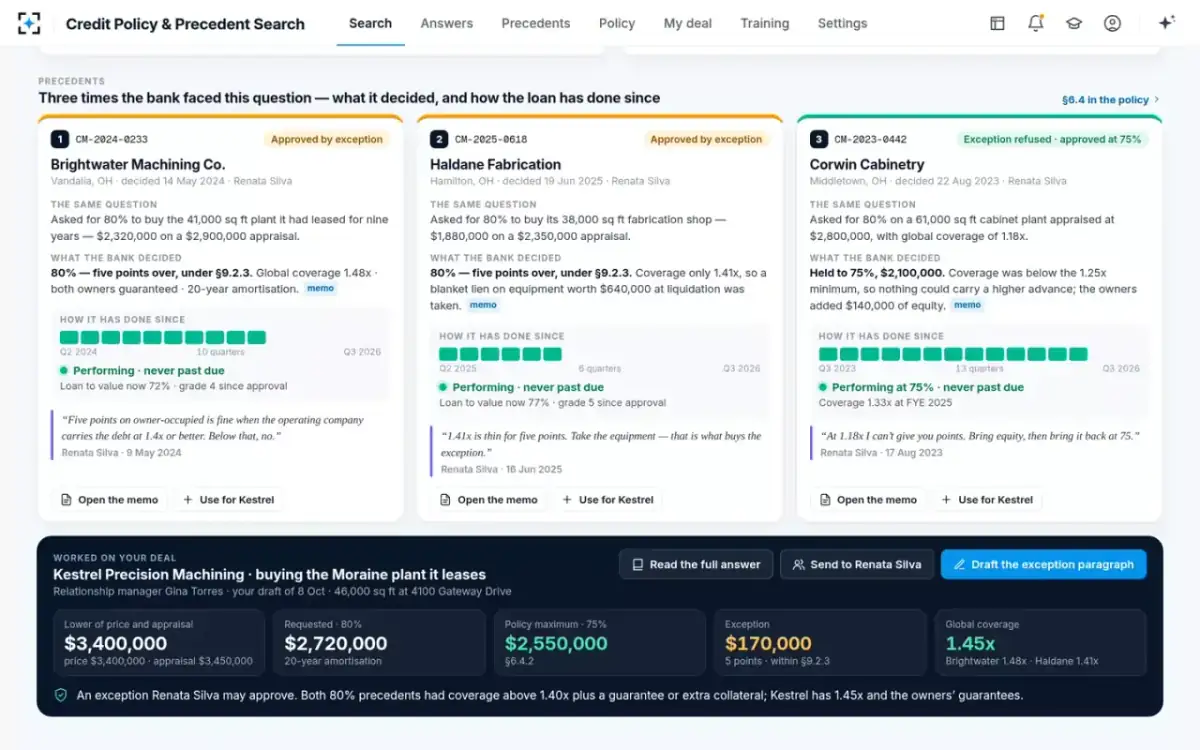
The three cards show the bank's practice. Brightwater had 1.48x and guarantees and got 80%. Haldane had only 1.41x, and the bank took a blanket lien on $640,000 of equipment to make up the difference. Corwin had 1.18x and was held to 75% until the owners added $140,000 of equity. Kestrel's 1.45x with guarantees sits with Brightwater, which is why that is the precedent the paragraph cites.
Precedent: the decisions granted, and the one refused
Cite the closest approved precedent and say how it performed. Where the bank has refused the same request, say why yours differs. Across the sample bank's 27 decisions on owner-occupied industrial since 2019, 19 were within 75%, six were exceptions and two were declined above 80%. Every exception was at 78% to 80% with coverage above 1.40x and a guarantee or extra collateral, and none has been past due. A precedent is evidence of the bank's appetite, not permission. A loan approved by exception under v11 of the policy says nothing about whether v14 would allow it, and a run of similar exceptions is something the OCC reads as drift. How to cite precedent without creating drift is the subject of how to read a past approved exception.
One paragraph, four jobs, six citations
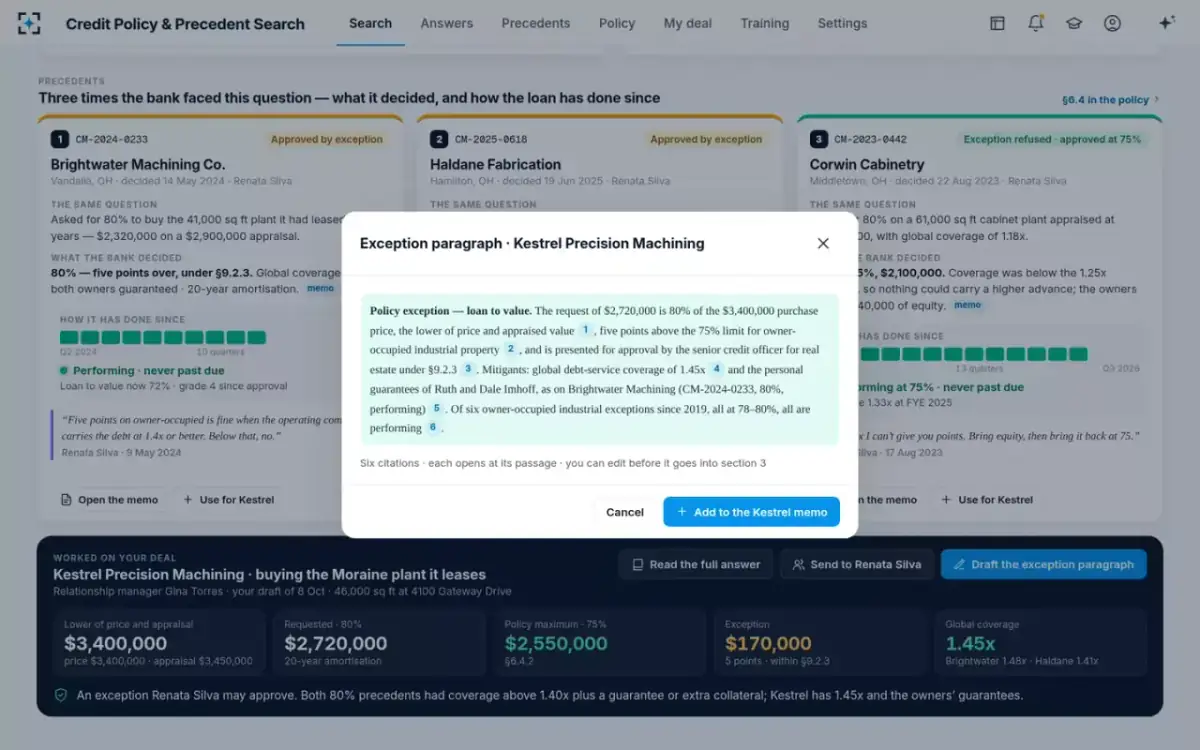
The finished paragraph is short because each clause does one job and points to its source. The analyst can edit every word before it goes into section 3 of the memo. The label on page one tells the reader, before anything else, that the memo asks for an exception and who decides it.
The Kestrel exception paragraph, clause by clause
The rule and the gap
The request of $2,720,000 is 80% of the $3,400,000 purchase price, the lower of price and appraised value [1], five points above the 75% limit for owner-occupied industrial property [2],
Names the limit, the measure it is applied to and the size of the departure in the policy’s own units.
The approver
and is presented for approval by the senior credit officer for real estate under §9.2.3 [3].
Says who may approve it and under which section, so nobody has to look it up and nobody approves beyond their authority.
The mitigants
Mitigants: global debt-service coverage of 1.45x [4] and the personal guarantees of Ruth and Dale Imhoff,
Answers the risk the limit exists to control: thinner collateral margin, offset by cash flow and recourse.
The precedent
as on Brightwater Machining (CM-2024-0233, 80%, performing) [5]. Of six owner-occupied industrial exceptions since 2019, all at 78–80%, all are performing [6].
Shows the bank has granted the same departure on the same mitigants, and how those loans have done.
The drafted paragraph, editable before it goes into the memo
The same exception, written two ways
Hard to approve: “Slightly above our usual LTV.”
Approvable: §6.4.2: 75% of the lower of price or appraisal; v14, current.
Hard to approve: “About 80%.”
Approvable: $2,720,000 against a $2,550,000 maximum: five points, $170,000.
Hard to approve: Left to the reader, or “for committee”.
Approvable: Senior credit officer for real estate, under §9.2.3.
Hard to approve: “Strong relationship, good management.”
Approvable: Global coverage 1.45x against a 1.25x minimum; both owners guarantee.
Hard to approve: None, or “we have done this before”.
Approvable: Brightwater, 80% at 1.48x with guarantees, performing; six such exceptions since 2019, all performing.
Hard to approve: Page 9, in the collateral section.
Approvable: Labelled on page one; paragraph in section 3.
The same pattern carries to other limits. On the sample bank's Hollis & Crane acquisition, the paragraph states leverage at 3.43x with no synergies against a 3.25x limit, 0.18x over and within the senior credit officer's 0.50x. It names Walt Ostrander under §9.2 and gives a step-down covenant to 3.00x as the mitigant. It cites Ardent Valve & Fitting as the precedent and Bramwell Paperboard as the difference. The policy texts that require this kind of written justification are summarised in what a bank loan policy should include.
How should loan policy exceptions be reported to the board?
In aggregate and on a schedule the board sets, with the large ones named and the trend visible. The Federal Reserve's manual says "The directors' loan committee or a similar body should review and approve all exceptions at reasonable intervals" (CBEM §2010.1). For real estate above the supervisory loan-to-value limits, the interagency guidelines ask for the aggregate to be "reported at least quarterly to the institution's board of directors", and for the bank to "individually report exception loans of a significant size" (12 CFR 365, App. A). The OCC's description of the credit committee includes monitoring "the loan portfolio's performance, exceptions, and the [ACL]" (OCC, 2026).
Many banks report more often than the minimum. The sample bank's Credit Policy v14 moved its exception report to the board credit committee from quarterly to monthly, one of four changes in that release. Frequency matters less than content, though. A report that lists exceptions one by one, with no counts by type, officer or approver and no performance of the loans already excepted, cannot show the board whether its policy still describes the bank's practice.
What a board exception report should let directors see
| View | What it shows | Why the board needs it |
|---|---|---|
| New underwriting exceptions | Count and dollars by policy section, with the approver and authority used | Whether delegated authority is being used as designed |
| Supervisory loan-to-value exceptions | Aggregate against total capital; the 100% and 30% caps | The caps the interagency guidelines set |
| By officer and by approver | Exceptions requested and granted per person | Clusters that point to one desk or one approver |
| Financial and administrative exceptions | Open items, age and owner; cured since last report | Credit weakness and process failure, kept apart |
| Performance of excepted loans | Grade changes, past dues and payoffs since approval | Whether the exceptions the bank grants are working |
| Trend and gaps | Change against prior periods; recurring exceptions on one section | When to change the policy instead of excepting it |
A checklist before the memo goes up
Seven checks on a policy exception write-up
- The limit is quoted from the current version
Section, page and version date. A limit quoted from a superseded policy is an error the approver may not catch.
- The base is the one the policy names
Lower of price or appraisal, pro forma or trailing EBITDA, global or business coverage, as the section says.
- The gap is in policy units and dollars
Five points and $170,000; 0.18x and the funded debt it implies.
- Policy or supervisory exception, stated
Real estate loans above the supervisory limits carry board reporting and capital caps.
- The approver is named with the section
Within the authority the exception section grants, or routed to committee.
- Each mitigant answers the limit’s risk
Collateral margin for loan-to-value, cash flow and deleveraging for leverage.
- The precedent includes how it performed
And why your deal differs from any refusal or downgrade on the same question.
To see the Kestrel exception drafted and sent, screen by screen, start from Credit Policy & Precedent Search. For how the answer behind the paragraph is assembled, see one question, traced second by second.
Questions people ask
Is a policy exception the same as a policy violation?
No. An exception is a departure approved through the policy's own process by the authority it names; the Federal Reserve expects a policy to invite sound credits that do not conform, with the reason in writing. A departure that nobody approved, or that went beyond the approver's authority, is the problem examiners look for.
Where should the exception appear in the credit memo?
On page one, as a label that says which limit is exceeded and who decides, with the full paragraph in the section that covers that risk. An approver who finds the exception on page nine may approve the loan without noticing it, which turns an approved exception into an unidentified one.
Does every exception need a precedent?
No. When the bank has never granted the departure, say so plainly; the absence is itself information for the approver. The write-up then has to carry more weight on compensating factors, and the approver may ask for a senior's view even within delegated authority.
What happens if an exception is not documented?
It becomes an unidentified exception when a reviewer or examiner finds it. The OCC treats a large volume of those as a sign of weak exception processes that "generally merits examiner scrutiny and determination of the root cause", and for real estate above the supervisory limits the written justification is expected in the permanent loan file.
Is a waived covenant an exception?
The OCC lists "covenant breaches (even if waived)" among financial exceptions, identified during the life of the loan. It is tracked differently from an exception granted at approval, but it is still one.