AI is unlikely to replace commercial credit analysts, but it is already changing what their hours are spent on. The tasks that move are the ones that consist of finding and computing: locating the policy section in force, searching past memos, reading reviewers' comments, applying ratio tests to stated figures. The tasks that stay are the ones the bank's own policy and its regulators assign to named people: judging the borrower, choosing the structure, recommending, grading and approving. Federal labour data show a slow-growing occupation rather than a vanishing one. The research on AI assistants suggests the biggest change is to how fast a new analyst becomes useful. Botminds' Credit Policy & Precedent Search is one example of where the line falls. Its agents find, read and compute with every sentence cited; the analyst writes and a senior approves exceptions.
An analyst's tasks, and who does them with agents
Agents do it
Finding, reading, computing. Every output cited.
- Find the policy section in force
- Search past memos for the same question
- Read what reviewers wrote on similar deals
- Compute the policy tests on the deal’s figures
Agents draft, the analyst decides
The draft is a start, not a conclusion.
- Draft a cited paragraph
- Check that the figures in the draft are right
- Decide which precedent really resembles this deal
Stays with people
By policy and by regulation.
- Judge management, the market and the borrower’s character
- Choose the structure and the mitigants
- Recommend and sign the memo
- Assign the risk grade
- Approve an exception
Will AI replace credit analysts? The short answer
The job changes shape; it does not disappear. A credit memo is a recommendation that a named person makes and a named authority approves, and nothing in current supervisory practice hands either role to software. The OCC's Spring 2026 Semiannual Risk Perspective found that banks are taking "a measured approach" to generative and agentic AI. Usage is "generally limited to specific use cases with guardrails and human-in-the-loop accountability to manage risk" (OCC, Spring 2026). The Federal Reserve's Vice Chair for Supervision said in July 2026 that AI used "in a way that has more direct impact on credit decisions" presents "more substantial legal compliance challenges than other AI use cases" (Bowman, 2026).
What moves to software is the part of the job that was never the point. Finding the rule, finding the precedent and redoing arithmetic is how analysts spend much of their first years. It is also what a well-built system does in seconds, with citations.
What is the job outlook for loan officers and credit analysts?
The Bureau of Labor Statistics projects slow growth, not decline, and names technology as one reason. Employment of loan officers, the occupation that includes commercial loan officers who "analyze the finances of businesses applying for credit", is "projected to grow 1 percent from 2025 to 2035, slower than the average for all occupations" (BLS). The handbook names the cause: "the increased use of productivity-enhancing technology in loan processing are expected to slow employment growth." It still projects about 17,100 openings a year, mostly to replace people who leave.
Two credit occupations, by employment and pay
Credit analysts are a smaller and better-paid group: 64,390 people in May 2025 with a mean annual wage of $100,850 (BLS OEWS). That pay reflects judgement, not lookup speed. An occupation priced for judgement is better placed than one priced for throughput when the lookups get faster.
The banks that employ them are shrinking their headcount slowly, not abruptly. FDIC-insured institutions reported 2,034,151 full-time-equivalent employees in the second quarter of 2026, 1.3% fewer than a year earlier (FDIC Quarterly Banking Profile). That is the pace of attrition, not of a function being switched off, and it fits the BLS picture of openings that mostly replace people who leave.
How are banks using AI in lending today?
Mostly around the credit decision, not inside it. A Census Bureau working paper built on confidential survey microdata found that on average 11% of US banks used AI between 2017 and 2022 (Census Bureau, 2025). Banks with greater AI use lent "significantly more to distant borrowers, about whom they have less soft information", and saw lower default rates from them. The authors read that as AI reducing a bank's reliance on soft information. It is a finding about reach and pricing, not about replacing the people who underwrite.
Automated approval is still rare in business lending. The FDIC's Small Business Lending Survey found that one in ten banks have a credit-scoring system that can partially or fully automate the underwriting of some non-credit-card lending. But "less than one in thirty banks use a credit-scoring system to auto-approve loans, and less than one in one hundred banks will auto-approve a loan of $250,000" (FDIC SBLS). In the survey's words, automated lending "is used almost exclusively for smaller loans." Commercial credit of the size a credit analyst writes up is still underwritten by people.
AI in bank lending: present, but rarely the one who approves
11%
of US banks used AI on average, 2017–2022 (Census Bureau survey microdata)
1 in 10
banks have a scoring system that can automate some non-card underwriting
<1 in 100
banks will auto-approve a $250,000 business loan
Where generative AI has arrived, supervisors describe it as a productivity tool. The OCC observed that use cases "are primarily productivity and customer experience enhancement tools" (OCC, Spring 2026). Finding the policy section, the precedent and the reviewer's last comment is exactly that kind of productivity work.
Which credit analyst tasks can AI do, and which stay with people?
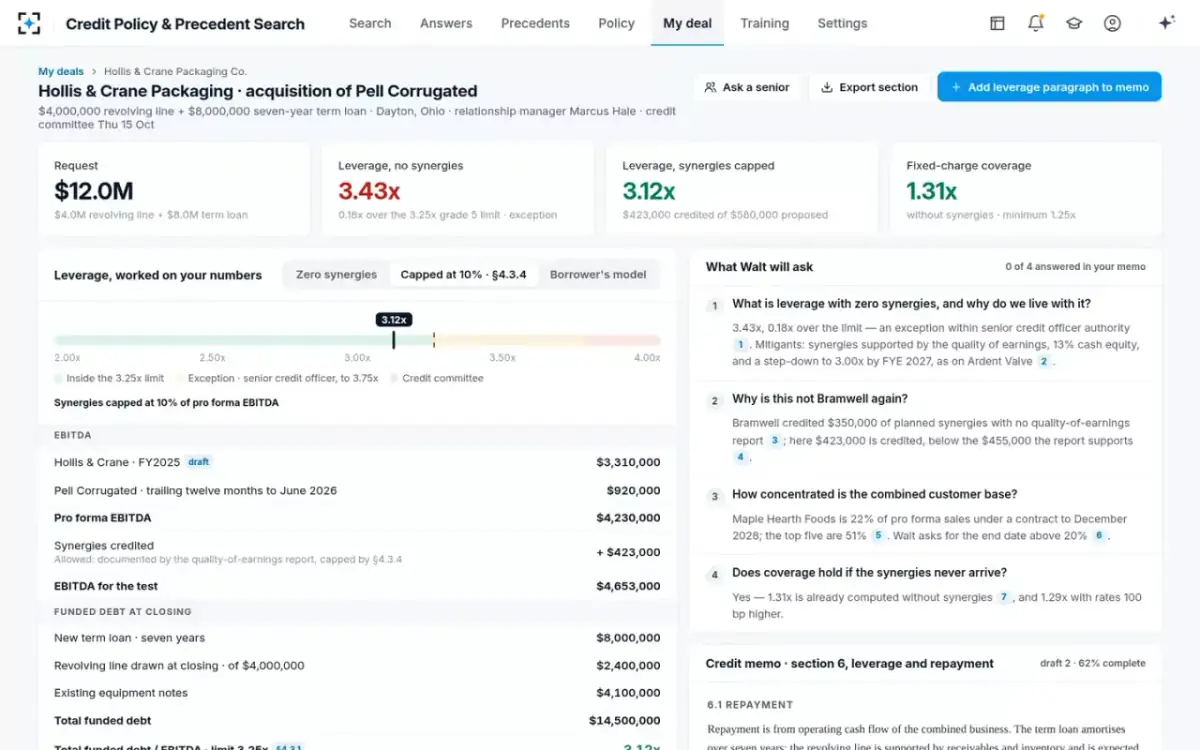
A task moves when its output can be checked against a source; it stays when its output is a decision someone must answer for. Finding §4.3.4 of the credit policy can be checked against the policy. Computing leverage at 3.43x with no synergies can be checked against the memo's figures. Deciding that a borrower's management can deliver an integration plan cannot be checked against anything. It is a judgement, and the person who makes it signs.
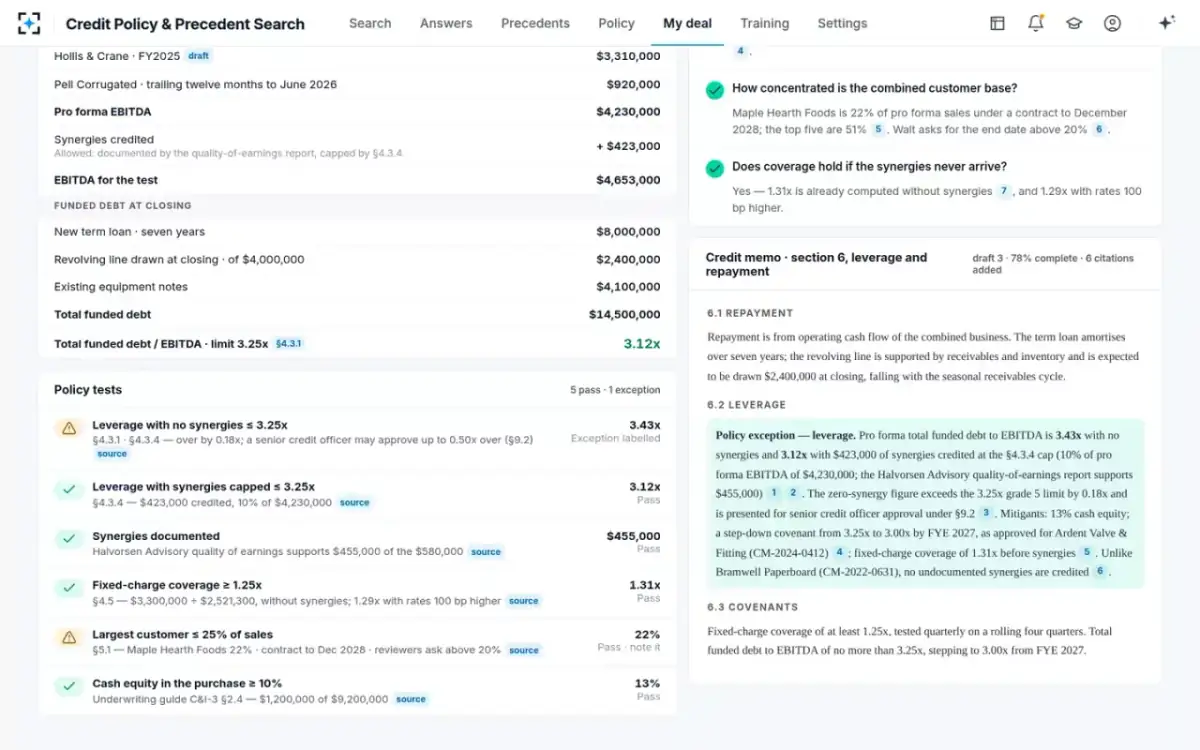
The middle of the grid is where the job is changing most. An agent can draft the leverage paragraph for a memo, with six citations. Whether that paragraph says the right thing is still the analyst's call: whether Ardent Valve is the right precedent, whether Bramwell is the right warning, whether the step-down covenant answers the reviewer's real concern. The work moves from assembling the paragraph to deciding whether it is true.
The analyst's deal, worked: the arithmetic done, the judgement left
The learning curve is what changes most
The best evidence on AI assistants at work says they help the least experienced people most. That points to a change in how analysts are trained, not to fewer of them. In a study of 5,179 customer support agents, access to a generative AI assistant raised productivity 14% on average. It raised it 34% "for novice and low-skilled workers but with minimal impact on experienced and highly skilled workers" (NBER w31161). The authors' explanation is that the tool "disseminates the best practices of more able workers and helps newer workers move down the experience curve."
Generative AI at work: who gained most
+14%
productivity on average, measured as issues resolved per hour
+34%
for novice and low-skilled workers
Minimal
impact on experienced, highly skilled workers
Credit analysis is a different job, and no study of it exists. The mechanism, though, is the one that matters in a credit department. Much of a bank's lending knowledge is what economists call soft information. Allen Berger and Gregory Udell wrote that "the loan officer is the repository of this soft information" (Federal Reserve, 2001). In a credit department that knowledge sits in reviewers' comments and in the memory of the senior people who wrote them. A system that surfaces a senior's past comments beside a new analyst's deal hands on that practice the way the customer-support tool did. The month this shortens is described in a new credit analyst's first month.
The first two years, then and now
Learning by asking: Search the binder; ask a senior to confirm the version.
Learning from cited answers: The rule in force, quoted with section, page and version, beside the deal.
Learning by asking: Absorbed slowly from the memos a senior happens to mention.
Learning from cited answers: Every decision on the same question, with how each loan performed.
Learning by asking: Discovered when memos come back.
Learning from cited answers: The reviewer’s past comments on similar deals, quoted, before the memo goes up.
Learning by asking: Rebuilding leverage and coverage by hand for each structure.
Learning from cited answers: Checking a worked test against its sources.
Learning by asking: Knowing where things are and who to ask.
Learning from cited answers: Judging which precedent fits, structuring the deal and writing a recommendation that holds.
Why the rules keep a named person on every credit decision
Because the supervisory texts on commercial credit are written around a human approver with delegated authority, and none yet covers an AI one. The Federal Reserve's examination manual requires that the reason for a policy exception "be detailed in writing and submitted for approval to a designated authority" (Fed CBEM §2010.1). The OCC's 2026 lending booklet tells examiners to determine "that the approver had sufficient authority based on the bank's established limits" (OCC, 2026). And the FDIC's examination manual lists "Lending authority of each loan officer" among the areas a loan policy should address (FDIC RMS Manual §3.2).
The 2026 model risk guidance, which replaced SR 11-7, leaves AI agents outside its scope altogether: "Generative AI and agentic AI models are novel and rapidly evolving. As such, they are not within the scope of this guidance" (OCC Bulletin 2026-13). A promised request for information on AI had not been published by late October 2026. And buying the tool from a vendor moves none of the accountability: third-party use "does not diminish or remove banking organizations' responsibilities" (interagency guidance, 2023).
So the analyst's signature, the senior credit officer's approval and the committee's vote stay where they are. What a bank can defend to an examiner is software that finds, quotes and computes, with every step visible, and a person who reads it and decides. That division is also what the bank's own policy will usually say once its owner rewrites the sections on authority. An analyst who can show which source supports each sentence is the person the rules are written around.
What does the credit analyst career path look like now?
The rungs are the same: analyst, senior analyst, then an underwriter, portfolio manager or relationship role, and for some a senior credit officer with lending authority of their own. What changes is how the first rungs are climbed. The years once spent learning where the rules are and what was done last time can be shortened; the years spent learning to judge cannot.
That raises a real risk for banks. If juniors no longer assemble memos from scratch, they also stop absorbing the bank's practice by osmosis, and the senior people who carry that practice still retire. Research on loan officers who go on leave suggests how much that knowledge is worth: their borrowers fared measurably worse while they were away, and less so when officers had reasons to hand information on (Drexler & Schoar, 2014).
The practical answer is to make the transfer deliberate. A senior's reviewer comments, attached to the deals they were written on and shown to the next analyst who faces the same question, are knowledge transfer that does not depend on who sits next to whom. The analyst who climbs fastest will be the one who reads those comments as reasoning to learn from, not answers to paste, and who can explain on a live deal why one precedent fits and another does not.
What skills does a credit analyst need now?
The skills that grow are the ones an answer engine makes more necessary: reading a precedent critically, structuring around a weakness, and writing a recommendation a committee can decide on. Economists who study lending organisations make the same point about committees. José María Liberti and Mitchell Petersen write that decision makers "need the information to be boiled down to what is important" (NBER w25075). When the finding is done in seconds, the analyst's value is in choosing what to put in front of the committee and why.
- Reading precedent critically. Knowing that a past approval is evidence, not permission, and asking under which policy version, by whose authority and how the loan performed. Set out in how to read a past approved exception.
- Checking a cited answer. Opening the source, confirming the version, noticing when a citation points to an exception rather than a rule.
- Structuring. Turning a policy exception into an approvable deal: the step-down covenant, the extra equity, the guarantee, the equipment lien.
- Judgement about people and markets. The soft information no file holds: management's depth, a customer's real dependence, an industry turning.
- Writing for the approver. A memo that states the exception on page one and answers the reviewer's questions before they are asked.
The paragraph the agents draft and the analyst owns
A team that adopts tools like this has to decide when analysts may rely on them and when they must still open the policy. That question is taken up in why analysts stop checking the policy PDF. To see how the work is divided on the sample bank's deals, start from Credit Policy & Precedent Search.
Questions people ask
Is credit analyst a good career with AI coming?
The federal outlook is steady rather than growing fast, and pay for credit analysts sits above that for loan officers. The work most exposed to automation is the lookup and arithmetic of the early years; the work that defines a senior analyst, judging and structuring credit, is the part regulators and bank policies keep with people.
Will AI make credit decisions instead of analysts and officers?
Not in commercial lending as supervisors describe it today. The OCC reports generative AI use limited to specific cases with human-in-the-loop accountability, and credit decisions are where the Federal Reserve sees the most substantial legal compliance challenges.
What should a new credit analyst learn first?
Where the bank's limits are and who may approve departures from them, then how to read past decisions with their outcomes. Financial statement analysis remains the base the BLS describes for commercial loan officers: "they need to understand general business accounting, including how to read financial statements."
How much do credit analysts earn?
The BLS put the median annual wage for credit analysts at $83,510 and the mean at $100,850 in May 2025, across 64,390 jobs. Loan officers earned a median of $76,690. The credit analyst figures include consumer credit roles, so commercial analysts at larger banks typically sit above the median.
Will banks hire fewer junior credit analysts?
Federal data point to slow change rather than a cut. The BLS still projects about 17,100 loan officer openings a year to 2035, mostly replacements, and bank headcount fell 1.3% in the year to June 2026. The bigger risk for a junior is a thinner apprenticeship, which is why banks that adopt assistants need a deliberate way to pass on seniors' reasoning.
Do credit analysts need to learn to code or write prompts?
No federal source lists either as a requirement, and the BLS description of the work still centres on reading financial statements and judging businesses. What does grow in value is the habit of checking a machine's answer against its source, and of knowing when a cited answer has quoted the wrong version or the wrong deal.